/pre-wedding-photoshoot
O Quy Ho Pass Photography: Rules, Permits & Shoot Planning
O Quy Ho Pass (Hang Quy Ho) sits at roughly 1,620 metres in Ha Giang province, far north Vietnam. It is not a tourist attraction with a photo permit system; it is a strategic military road with security checkpoints and civilian access limits. Individuals can visit during daylight (typically 6 a.m. to 5 p.m., verified locally), but drones are prohibited without explicit military approval—rarely granted to travellers. Professional photoshoots require a local guide, a long drive from Hanoi (8+ hours), and coordination with checkpoint officials. Weather is unpredictable above 1,500 m: fog, sudden rain and cold are common Sep–Nov and Dec–Feb. Cáo Studio does not operate in Ha Giang; for a shoot here, you must hire a local Hanoi-based photographer who has existing checkpoint relationships and can secure access letters. Pre-wedding couples often choose O Quy Ho for its dramatic limestone karst and isolation, but the logistical and legal complexity makes it a multi-day expedition, not a same-day session.
Why is O Quy Ho pass so restricted compared to other northern routes?
O Quy Ho is a military strategic corridor, not a national park. It crosses sensitive border regions and is monitored by local security forces. Unlike Fansipan or Ha Giang Loop roads, O Quy Ho has no tourism infrastructure, no official photography zone and no issuing office for permits. Access is tolerated but not encouraged for commercial activity. Before 2020, the pass was closed to civilians entirely; current policy allows daytime passage with a local guide. Checkpoint officials have discretion to refuse entry if your group looks unprepared or commercial intent is obvious. Bring a Vietnamese speaker, a guide with a known face at checkpoints, and patience—turnarounds happen.
---
Can you legally fly a drone at O Quy Ho pass?
Drones are effectively banned. Vietnam's civil aviation authority (CAAV) restricts all UAS flight within 5 km of military installations, airports and sensitive infrastructure. O Quy Ho qualifies on all counts. Travellers who land drones at checkpoints face confiscation, fines and possible detention. No exceptions are made for wedding photography. If drone footage is a must, hire a licensed local pilot with prior permission (which is exceptionally rare and requires 4–8 weeks advance application through official channels, unlikely to be granted for a one-off shoot). For pre-wedding couples, accept that O Quy Ho means ground-level cinematography only.
---
What's the best light window to shoot at O Quy Ho?
Golden hour is tight: sunrise is 5:30–6:00 a.m. (Sep–Nov), sunset 5:00–5:15 p.m. (Dec–Feb). Fog clears by 8:00–9:00 a.m. on clear days; afternoon cloud rolls in by 2:00 p.m. Plan a 4:00 a.m. departure from Hanoi to arrive by 6:00 a.m., shoot in clear light, then depart before fog thickens. Overcast days are useless—light is flat and visibility is lost. Weather is unpredictable; book a 2–3 day window and be ready to pivot to a backup location (Tram Ton, Lung Cu or a lower-elevation spot). Winter (Dec–Feb) has more stable mornings but colder wind; summer (Jun–Aug) is wet and often socked in. Best weather windows: mid-Sep to end-Oct (cool, dry mornings) and Mar–early May (warm, less rain). A local guide will read the forecast 24 hours before and advise a move.
---
What outfits and gear work best at high altitude and how do you prepare?
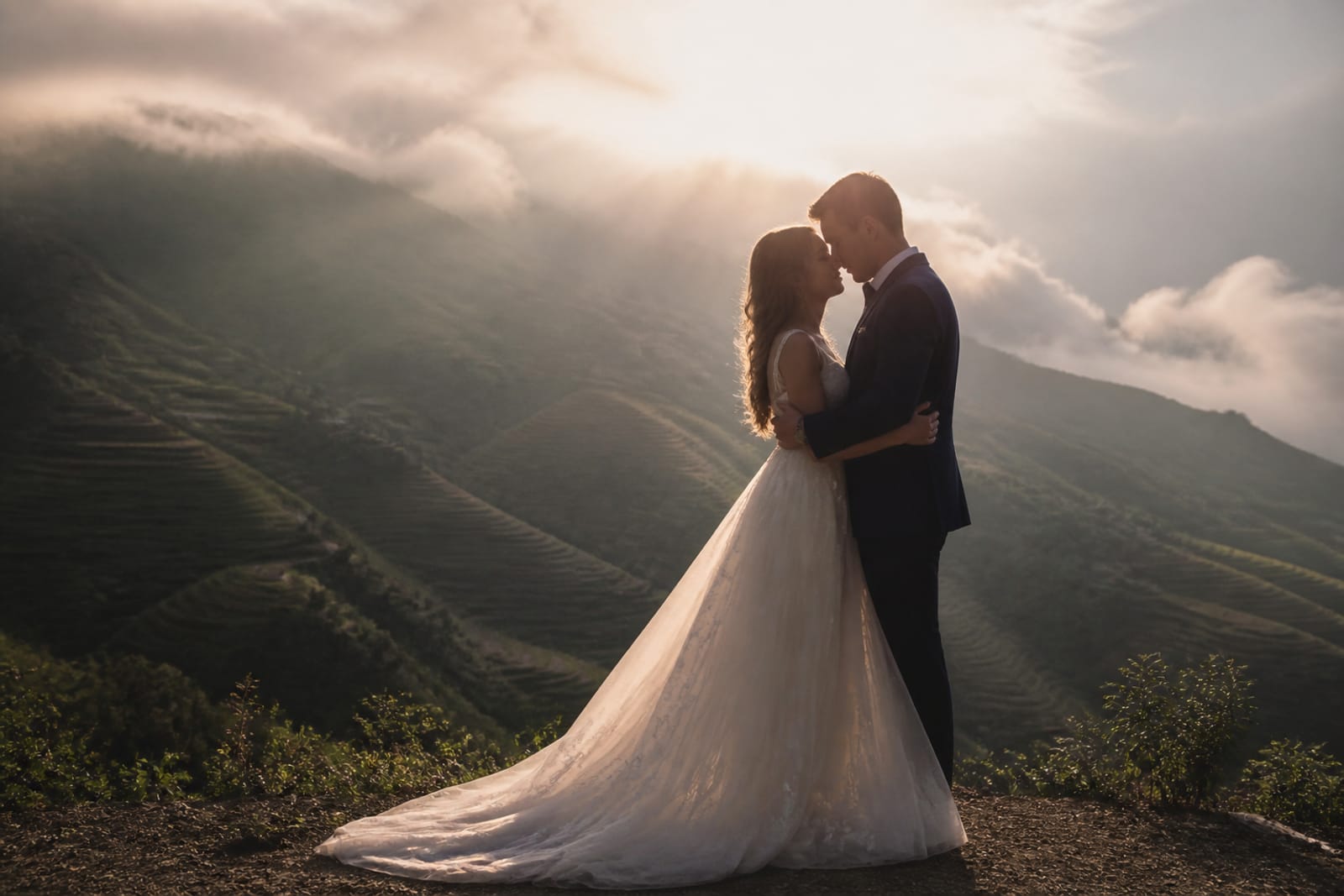
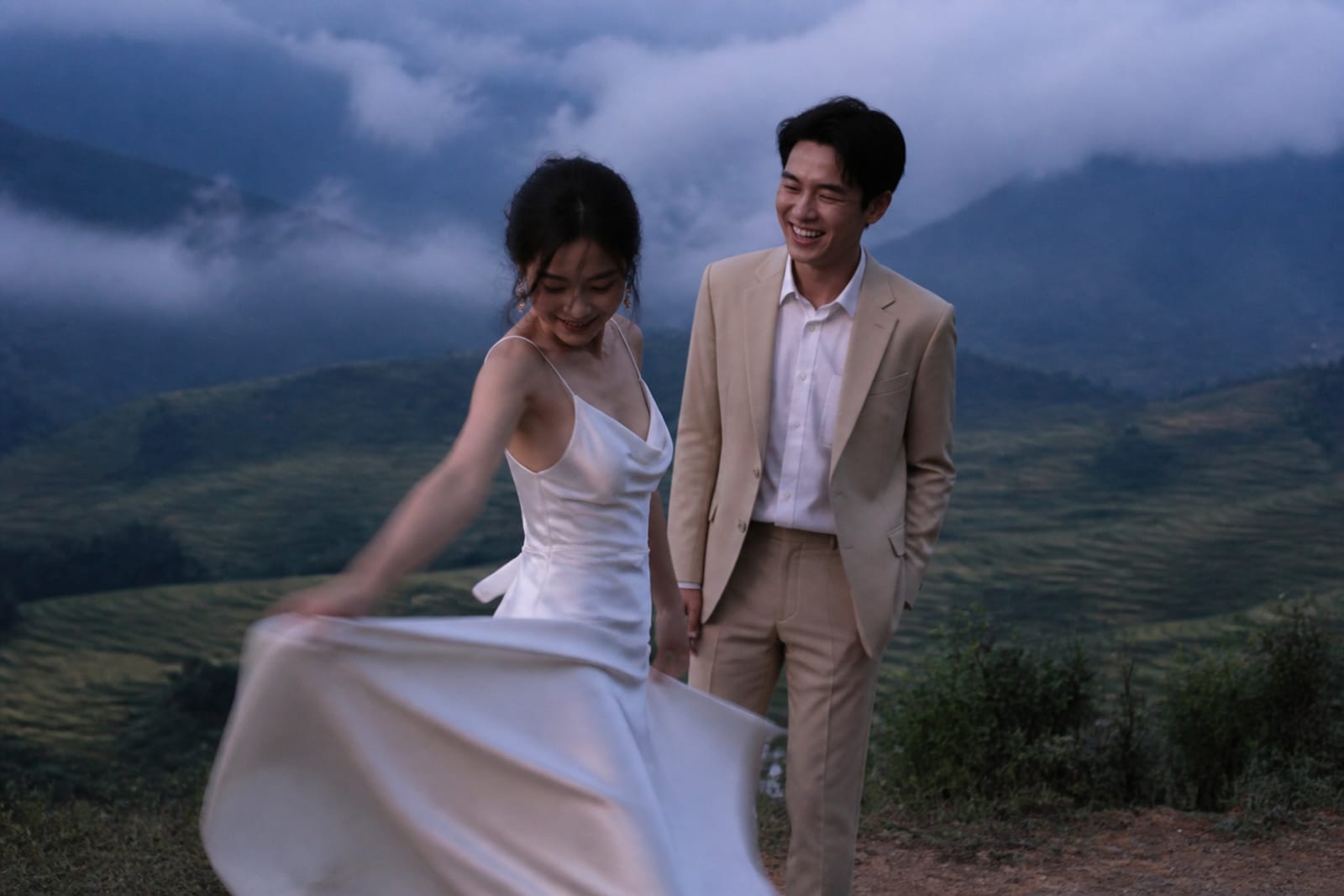
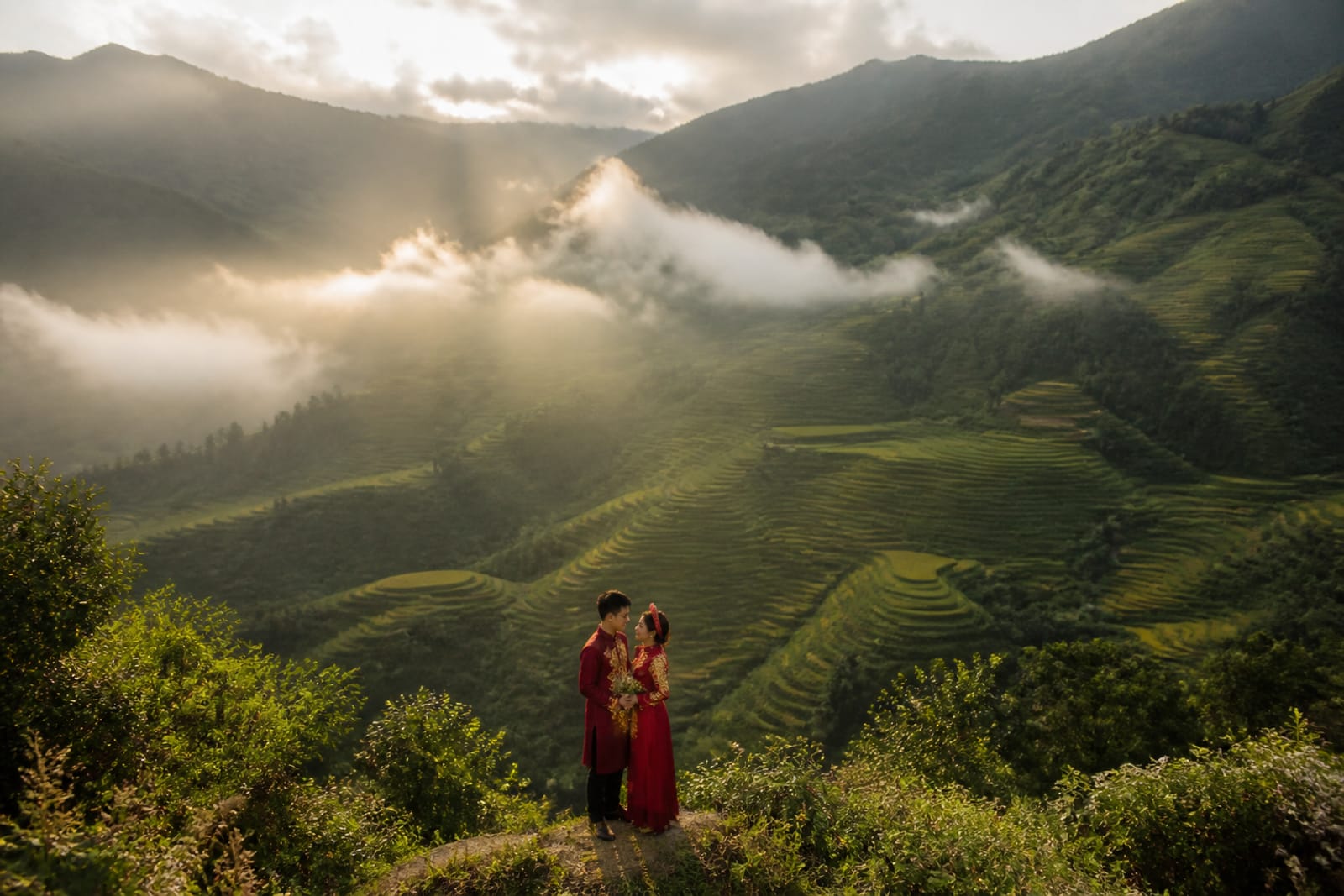
O Quy Ho sits above 1,500 m with temperatures 5–15°C below Hanoi. Lightweight layers are essential: a breathable inner layer, a insulated mid-layer (fleece or down vest), a windproof jacket, and a warm beanie or hood. Silk or satin wedding dresses catch wind and pick up dust on rough roads; ao dai (traditional tunic) works better if tailored fitted and worn over warm leggings. Bring 2–3 outfit changes and a protective bag to store them during checkpoint waits. Shoes must have grip (no heels; trails are rocky). Altitude affects stamina; arrive a day early to acclimatize if anyone in the party is sensitive to height. A makeup artist trained to work in wind (waterproof products, mist-proof primers) is critical; standard studio makeup fails. The drive is 8+ hours with no food or water stops past Hanoi—pack snacks and electrolyte drink. Hair and makeup touch-ups happen in a van or a basic guesthouse; plan time accordingly.
| Outfit Option | Best For | Weather Fit | Practical Notes |
|---|---|---|---|
| Ao dai + warm leggings | Traditional, intimate feel | Cool/windy, 5–15°C | Tailor fitted; carry spare if muddy |
| Lightweight wedding dress + jacket | Western couple | Calm mornings, Sep–Oct | Satin picks dust; needs protective bag |
| Casual street wear + sweater | Elopement, adventure vibe | All seasons | Easier to move, climb, sit for portraits |
| Formal suit + wool coat | Groom/partner | Dec–Feb stable cold | Layers under coat; face can look stiff in wind gusts |
---
How do you book a photographer for O Quy Ho and what questions should you ask?
Cáo Studio operates in Hanoi, Ho Chi Minh City and Hoi An; O Quy Ho shoots are outside our service area. For a shoot here, find a Hanoi-based photographer with documented experience at O Quy Ho checkpoints and relationships with local guides. Ask them:
- Do you have a guide with a known face at O Quy Ho checkpoints? (Non-negotiable; a stranger guide will face delays or turnarounds.)
- What is your backup plan if fog doesn't clear by 9:00 a.m.? (Rain or whiteout should trigger a pivot to Tram Ton or Lung Cu, not a refund-or-cancel binary.)
- Do you provide a makeup artist who has worked above 1,500 m? (Studio makeup doesn't survive wind; ask for proof of high-altitude shoots.)
- What is included in the cost and what are add-ons? (Travel time, guide fee, vehicle fuel, checkpoint permits, editing, album, video—clarify boundaries.)
- Can you provide a reference from a couple who shot there in the past 18 months? (The landscape and access rules change; recent experience matters.)
- What is the cancellation/postponement policy? (Weather delays are common; your contract should allow free rescheduling within 6 months if fog blocks the shoot day.)
Vet photographers through their lookbook (not just testimonials; ask to see unedited frames from O Quy Ho), their website's clarity about logistics, and their willingness to name a specific guide. If a photographer glosses over permits or promises "no issues," they lack realistic on-ground experience.
---
What's the honest cost and time breakdown for an O Quy Ho shoot?
O Quy Ho shoots cost more than Hanoi city sessions because of travel time, guide fees, checkpoint coordination and vehicle rental. You pay for:
- Vehicle & fuel: A private van or jeep for 16+ hours of driving (8 hours out, 8 hours back). Cost varies by season and fuel price.
- Local guide fee: Usually a fixed rate for the day; guides at O Quy Ho are scarce and charge accordingly.
- Photographer & crew: Time cost is higher because half the day is driving; some photographers quote travel-inclusive rates, others add a travel surcharge.
- Makeup artist: On-site is complex; cost reflects early wake-up and high-altitude work.
- Checkpoint clearance: Technically free, but a guide's connections matter; some guides charge a "connection fee" to ensure smooth passage.
- Contingency: If weather forces a postponement, you pay for fuel and guide time again.
Never use Hanoi taxi or ride-share apps here; hire a known driver. Ask your photographer for a line-item breakdown before committing. Many couples discover the total cost (all-in travel, crew, guide, film or album) exceeds a pre-wedding package in a more accessible location. If budget is tight, consider Tram Ton Pass (easier access, similar drama) or Sapa (better infrastructure, cheaper guide).
---
What to check before you book an O Quy Ho photoshoot
- Photographer's checkpoint relationship. Ask for the name of their regular guide and proof of prior shoots (photos dated within 18 months, location-tagged).
- Weather cancellation policy. Fog or rain should allow full postponement credit within 6 months, not a partial refund.
- Makeup & hair plan. Confirm the artist has high-altitude, wind-resistant experience; ask for photos from another 1,500+ m shoot.
- Vehicle & driver. Confirm the vehicle is a private hire (not taxi), has working heat, and the driver knows the route. Long drives tire crews; confirm driver + photographer are separate people.
- Checkpoint alert letter. Ask if the photographer or guide will provide a written explanation (in Vietnamese) to carry at the checkpoint—this smooths access.
- Backup location. Confirm which site (Tram Ton, Lung Cu, lower ridge) you'll use if O Quy Ho is socked in; this should be in the contract.
- Editing & delivery timeline. High-altitude shoots are harder to edit (uneven light, weather artifacts); ask for a realistic turnaround (often 2–4 weeks, not 48 hours).
- Insurance & liability. Confirm the photographer is insured for work at remote sites; O Quy Ho has no rescue infrastructure—know what happens if an accident occurs.
---
Why pre-wedding couples should consider easier northern alternatives
O Quy Ho is dramatic but logistically punishing. A pre-wedding photoshoot in Ha Long Bay, Tram Ton or Hanoi's Temple of Literature requires less travel, shorter turnarounds and more flexibility for weather. If you want mountain drama without the military-road bureaucracy, Sapa (rice terraces, cable car, local guides, basic tourism services) or Ba Be Lake (limestone, quieter than Ha Long, day-trip from Hanoi) deliver strong frames with a fraction of the friction. O Quy Ho is a commitment; book it only if the pass itself is non-negotiable to your vision, not because "it looks amazing on Instagram."
---
How far is O Quy Ho from Hanoi and what's the realistic timeline?
O Quy Ho is roughly 350 km north-east of Hanoi. A private vehicle takes 8–9 hours one way, depending on road condition and checkpoint waits. A typical shoot itinerary is:
- Day 1: Leave Hanoi 3:00–4:00 a.m., arrive checkpoint 10:00–11:00 a.m., shoot 11:00 a.m.–1:00 p.m. (if fog clears), overnight in Hanoi or a nearby guesthouse.
- Day 2: Optional second location or return to Hanoi by evening.
Most couples do not day-trip O Quy Ho; the drive + fatigue + unpredictable weather make a 2–3 day shoot window standard. Budget accordingly: vehicle rental, overnight lodging, meals and crew overtime add significantly to the final cost. This is why many couples pair O Quy Ho with a second shoot in Hanoi or Hoi An to maximize their investment.
📸 Book on WhatsApp — pre-wedding & elopement | 💄 Makeup & hair at your hotel | 🌸 See the lookbook
FAQ
Is a drone allowed at O Quy Ho pass?
No. Drones are prohibited within 5 km of military installations; O Quy Ho qualifies. Confiscation and fines are common. No civilian exceptions are granted. Accept ground-level cinematography only or choose a lower-altitude location.
Do I need a permit to shoot a wedding photoshoot at O Quy Ho?
There is no photography permit system. You need checkpoint access (via a local guide), not a photo licence. A guide with checkpoint relationships ensures passage; confirm this before booking.
What is the best month to shoot at O Quy Ho?
Mid-September to end-October (cool, dry, stable mornings) and March to early-May (warm, less rain). December to February is cold and often foggy at sunrise. June to August is wet and visibility is poor.
Why does weather delay so many O Quy Ho shoots?
The pass sits above 1,500 m. Fog rolls in by 9:00 a.m., afternoon cloud is common, and rain can arrive unpredictably. A 2–3 day booking window with a backup location is standard to guarantee usable light.
Can Cáo Studio shoot at O Quy Ho?
No. Cáo Studio operates in Hanoi, Ho Chi Minh City and Hoi An. For O Quy Ho, hire a local Hanoi photographer with checkpoint relationships. Ask for recent references and a clear backup plan if weather blocks the main day.
What should I wear to stay warm and look good at O Quy Ho?
Layer lightweight garments (breathable inner, fleece mid-layer, windproof jacket, beanie). Ao dai works well over warm leggings. Avoid satin dresses (they pick up dust). Bring 2–3 outfit changes and protective bags. Boots with grip are essential; no heels.
How much does an O Quy Ho photoshoot cost?
Costs vary by photographer, season, vehicle, guide and crew. Budget includes travel time, vehicle rental, guide fee, checkpoint coordination and crew overtime. Ask your photographer for a line-item breakdown; total cost often exceeds city-based sessions due to logistics.
FAQ
Is a drone allowed at O Quy Ho pass?
No. Drones are prohibited within 5 km of military installations; O Quy Ho qualifies. Confiscation and fines are common. No civilian exceptions are granted. Accept ground-level cinematography only or choose a lower-altitude location.
Do I need a permit to shoot a wedding photoshoot at O Quy Ho?
There is no photography permit system. You need checkpoint access (via a local guide), not a photo licence. A guide with checkpoint relationships ensures passage; confirm this before booking.
What is the best month to shoot at O Quy Ho?
Mid-September to end-October (cool, dry, stable mornings) and March to early-May (warm, less rain). December to February is cold and often foggy at sunrise. June to August is wet and visibility is poor.
Why does weather delay so many O Quy Ho shoots?
The pass sits above 1,500 m. Fog rolls in by 9:00 a.m., afternoon cloud is common, and rain can arrive unpredictably. A 2–3 day booking window with a backup location is standard to guarantee usable light.
Can Cáo Studio shoot at O Quy Ho?
No. Cáo Studio operates in Hanoi, Ho Chi Minh City and Hoi An. For O Quy Ho, hire a local Hanoi photographer with checkpoint relationships. Ask for recent references and a clear backup plan if weather blocks the main day.
What should I wear to stay warm and look good at O Quy Ho?
Layer lightweight garments (breathable inner, fleece mid-layer, windproof jacket, beanie). Ao dai works well over warm leggings. Avoid satin dresses (they pick up dust). Bring 2–3 outfit changes and protective bags. Boots with grip are essential; no heels.
How much does an O Quy Ho photoshoot cost?
Costs vary by photographer, season, vehicle, guide and crew. Budget includes travel time, vehicle rental, guide fee, checkpoint coordination and crew overtime. Ask your photographer for a line-item breakdown; total cost often exceeds city-based sessions due to logistics.
Ao dai, makeup, hair and a local photographer in Hanoi or Saigon — one WhatsApp message.