/pre-wedding-photoshoot
O Quy Ho pass wedding photos: best time and light
O Quy Ho Pass (Heaven's Gate, Sapa) sits 2,050m above sea level on the road to Fansipan, delivering wide-angle mountain light best captured before 8:30 a.m. when mist clears and side light is soft. Shoot here 2–4 hours before your timeline flexes — early starts mean calm wind, sharp focus and fewer motorbikes. Season matters: May–June and September–early October have the clearest air and stable morning weather; December–February brings cold (near 0°C), fog and frost that can ruin a shoot or create moody frames if that's your intent. Altitude fatigue, thin air and cold wind are real — bring layers, schedule a 20-minute acclimatization walk before posing, and hire a local guide familiar with the pass. Cáo Studio works with Sapa-based partners for pre-wedding shoots in this region; contact WhatsApp for Sapa coordination.
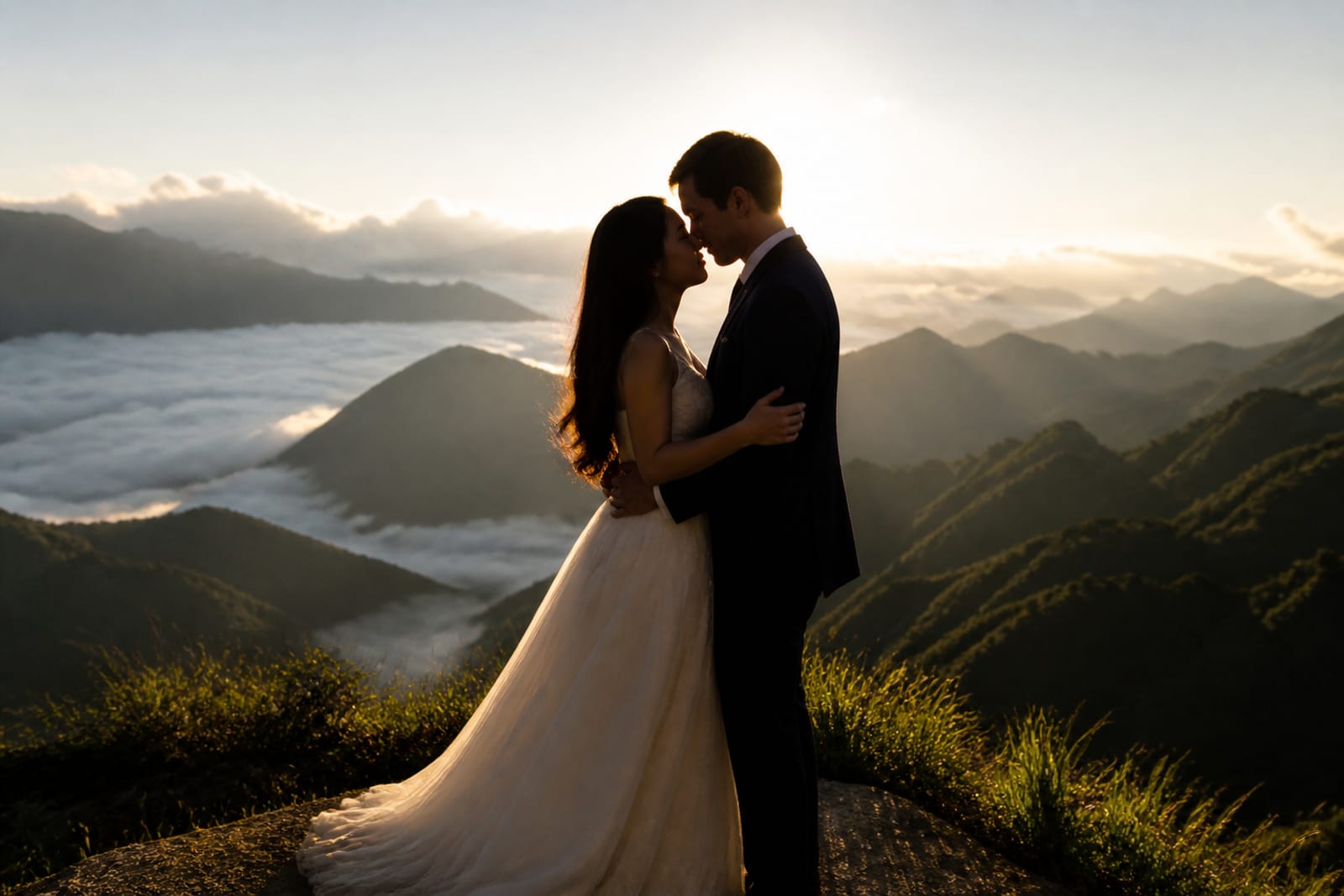
O Quy Ho Pass delivers scale: mountains rolling into cloud, a paved road crossing the ridge, valley light that shifts every ten minutes. Early morning — 6:00–8:30 a.m. — is non-negotiable. Wind is gentler then, mist is lifting, and the sun hits the western face at an angle that reads as cinematic, not flat.
The pass itself has no monuments or crowds by that hour. You walk the road, frame the sky, pause at the edge. Outfit choice — ao dai, suit, or travel dress — matters more here than at lower elevations because wind can flatten fabric and cold makes movement stiff. Couples who've shot here often regret choosing thin fabrics; layers under an ao dai work better than you'd expect.
Why does light quality change so fast on the pass?
Sapa sits at 1,600m; O Quy Ho climbs another 450m. Mountain air is thinner, so sunlight scatters less. At dawn, the sun rises over the eastern valley and the pass sits in cool side light for roughly 90 minutes — no harsh shadows, colors saturated, contrast controlled. By 9:00 a.m., the light has moved directly overhead or west-facing, and mist often rolls back in. Wind direction also shifts: calm in early morning, strengthening by mid-morning. If you're not on the pass by 6:30 a.m., you're chasing light you've already lost.
What's the best season: weather, visibility and outfit fit?
Season determines whether you'll shoot at all and what you'll wear.
| Season | Light & Visibility | Weather & Outfit Fit | Best Weeks | Why it works |
|---|---|---|---|---|
| May–Jun | Clear at dawn, mist by 10 a.m. | Mild, layers possible, occasional drizzle | Mid-May to mid-Jun | Green terraces below, stable mornings, suit/dress breathe |
| Jul–Aug | Humid, frequent cloud cover | Hot, muggy; ao dai sticks to skin; afternoon rain | None — skip this | Mist hides the pass most mornings |
| Sep–Oct | Sharp clarity, crisp air, golden tones | Cool (12–18°C), wind steady, suits and ao dai ideal | Early Sep to mid-Oct | Best risk/reward: clear skies, landscape golden, outfit comfortable |
| Nov–Dec | Clear but cold, occasional frost | Chilly (5–12°C), layer heavily, morning frost on grass | Late Nov to mid-Dec | Moody, sharp detail, but requires thermal layers and early arrival |
| Jan–Feb | Foggy, low visibility | Cold (0–8°C), sometimes freezing, fog obscures pass | None — skip this | Fog dominates; frames are muted and risky |
| Mar–Apr | Warming, seasonal mist | Transitional (8–15°C), unpredictable wind | Mid-Mar to early Apr | Spring green, fewer tourists, light softens nicely |
Early September and October are the default choice: the air is clearest, the temperature allows real movement in formal wear, and the wider landscape reads. May and June work if your couple likes green terraces and don't mind occasional drizzle. Avoid July–August (clouds and humidity) and January–February (fog).
Do you need a local guide, or can you shoot solo?
Hiring a local Sapa guide is not optional — it's insurance. The pass is on a two-lane road with regular traffic (trucks, tour vans, occasional landslides after rain). A guide knows safe pullouts, hidden vistas 50 meters off the main path, and real-time weather shifts. Photographers shooting without a guide often lose light waiting for a safe spot or miss the clear window because they're unfamiliar with the terrain. A guide costs money — ask about rates on WhatsApp when you book — but prevents wasted takes and keeps the couple safe. The guide walks ahead, signals wind direction and vehicle approach, and understands how long you have before mist rolls back in.
What outfit choice works best at altitude and cold?
High altitude is brutal on fabric. Wind flattens an ao dai's pleats and skirt, cold makes hands stiff for poses, and thin layers are useless.
Ao dai option: Layer a lightweight long-sleeved shirt or silk underslip beneath the ao dai (warm, holds shape, invisible on camera). Bring a heavy cardigan or shawl for between-shoot moments. White or cream ao dai reads beautifully against grey sky; darker tones risk blending. Test movement in advance — walking downhill in an ao dai requires a hand on the fabric to avoid tripping.
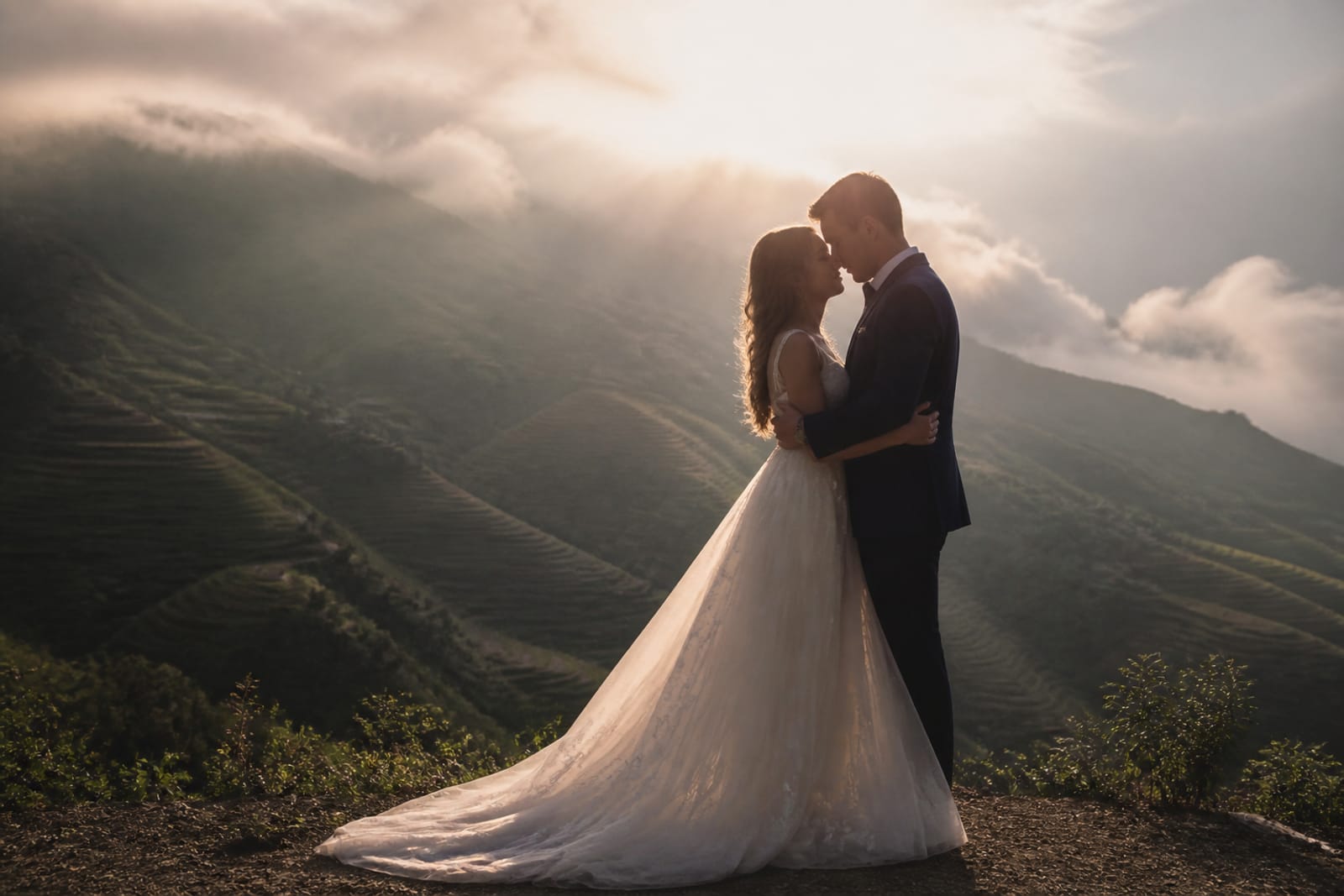
Western dress or suit: A tailored suit works here because structure holds in wind. A wedding dress needs a full skirt (ball gown) to move; slim silhouettes look stiff. For travel dresses, choose linen or cotton blend, not silk (wind clings to silk). Layers — a close-fit sweater under a dress, or a blazer over a suit — keep you warm and look intentional on camera.
What fails: Thin fabrics, sleeveless tops, loose hair without ties, open-toed shoes (grip matters on morning dew). Bring a backup tie or clip for hair; wind is relentless.
How do you plan a full pre-wedding day around O Quy Ho?
A pre-wedding session at O Quy Ho is one location on a larger narrative. Schedule it first — the 6:00–8:30 a.m. window — because light is fixed. Then build around it.
Example timeline (September, clear weather):
- 5:00 a.m.: Arrive at the pass from Sapa town.
- 5:30–6:00 a.m.: Outfit and hair final checks, acclimatization walk.
- 6:00–8:15 a.m.: Shoot at O Quy Ho (wide vistas, detail frames, motion).
- 8:30–10:00 a.m.: Drive to lower elevation, second location (Old Quarter or Fansipan base for different light).
- Afternoon: Rest, lunch, evening shot in Sapa town or old French villas (soft side light, 4:00–5:30 p.m.).
This approach uses the pass's unique light without wasting the couple's energy on a single location. Cáo Studio's pre-wedding shoots typically span multiple locations and light windows; a Sapa session with the pass would be coordinated via WhatsApp to confirm local guide availability and real-time weather.
What realistic issues crop up, and how do you avoid them?
Altitude sickness: 450m above Sapa isn't Fansipan (3,143m), but thin air affects people differently. A 20-minute slow walk before posing prevents dizziness and stiff movement. Bring water.
Mist: Mountain mist isn't romantic; it's flat light and zero depth. A 6:00 a.m. start usually beats it, but September is more reliable than June. Check dawn weather forecasts the night before.
Traffic: The pass is a through-road. Time poses between vehicles. A guide watches for trucks and signals when the road is clear.
Cold hands: Gloves until the last moment, then hands in pockets between frames. Wind-chapped lips read on camera — bring balm.
Outfit wind-wreck: A fitted top under an ao dai prevents the skirt lifting. For Western dresses, safety pins on the hem hold fabric down. Carry a light shawl not just for warmth but to anchor loose fabric during motion shots.
Weather cancellation: If fog doesn't clear by 7:30 a.m., the pass is a write-off — visibility is under 20 meters. Have a backup location (Fansipan base, Old Quarter) scheduled for the same morning light window.
Plan for flexibility: if O Quy Ho is fogged out, a skilled photographer pivots to lower elevations where light is still soft. This is why working with a director-led team matters — they adjust in real time rather than shooting the fog and pretending it's artistic.
---
📸 Book on WhatsApp — pre-wedding photoshoot
How does Cáo Studio coordinate Sapa shoots?
Cáo Studio is based in Hanoi and Ho Chi Minh City; Sapa is outside our primary service area. However, we work with vetted local photographers and guides in Sapa for pre-wedding and elopement couples who want the O Quy Ho Pass as part of a larger narrative. Contact WhatsApp to discuss timing, outfits (we can coordinate ao dai rental or suit rental delivery), and hair and makeup logistics.
The alternative: book a Sapa-based photographer directly. When vetting them, ask to see morning-light work from the pass (not sunset shots), confirm they use a local guide, and check their rain/fog cancellation policy. Ask how many hours they schedule for the pass — two hours is realistic; four hours wastes light.
---
💄 Makeup & hair at your hotel | 🌸 See the lookbook
What to check before you book a Sapa shoot
- Light window: Confirm your photographer arrives by 5:30 a.m. and schedules the pass for 6:00–8:30 a.m.
- Local guide included: Ask if a guide is part of the package. If not, hire one separately (ask your hotel or the photographer for a reference).
- Weather cancellation: What happens if mist doesn't clear? Is there a backup location and time?
- Altitude & acclimatization: Does the photographer understand altitude sickness? Will they schedule a walk before posing?
- Outfit logistics: If wearing an ao dai, confirm layers are handled and wind-proofing is discussed.
- Number of locations: O Quy Ho works best as one location in a longer narrative. A full day should include 2–3 locations and different light windows.
- Turnaround time: How long until edited photos? Cáo Studio's standard is 48 hours; ask any photographer the same.
- Travel & guide cost factors: These are separate from the photographer's fee. Confirm who pays for the guide and transport.
---
🌸 Browse the lookbook | 📸 Browse family & couple sessions
FAQ
What time should we arrive at O Quy Ho Pass for a wedding photoshoot?
Arrive by 5:30 a.m. to settle, check conditions and acclimatize. Shooting should begin by 6:00 a.m., when side light is softest and wind is calmest. By 8:30 a.m., light has moved and mist often returns.
Is an ao dai practical to wear and move in at 2,050m altitude?
Yes, with layers underneath. Add a lightweight long-sleeved shirt or silk slip under the ao dai for warmth and shape retention in wind. A cardigan between shots keeps you warm. Test movement beforehand — the altitude affects breathing slightly, but ao dai movement is possible with preparation.
What should we do if mist covers the pass on shoot day?
Mist typically clears by 7:30 a.m. in September–October. If it persists, the pass is unsafe and frames will be flat and grey. Have a backup location at lower elevation (Old Quarter, Fansipan base) in the same early-morning light window. Your photographer should pivot within the hour.
Do we need a local guide, or can the photographer handle it?
A local guide is essential. The pass is on a two-lane mountain road with traffic and weather shifts. A guide knows safe pullouts, watches for vehicles, understands real-time conditions, and prevents wasted time. This is a separate cost — confirm with your photographer or ask WhatsApp for a Sapa coordination quote.
How long can we realistically shoot at O Quy Ho before light and weather deteriorate?
Two to two-and-a-half hours (6:00–8:30 a.m.) is realistic. After 8:30 a.m., light moves west, shadows harden, and mist often rolls back in. A full pre-wedding day includes this location plus 1–2 others at different times to tell a complete visual story.
What season has the clearest light and most stable weather?
September–early October is optimal: crisp air, clear dawn visibility, cool temperatures (12–18°C) that work with formal wear, and fewer crowds. May–June is a secondary choice (green terraces, occasional drizzle). Avoid July–August (cloud cover) and January–February (fog dominates).
FAQ
What time should we arrive at O Quy Ho Pass for a wedding photoshoot?
Arrive by 5:30 a.m. to settle, check conditions and acclimatize. Shooting should begin by 6:00 a.m., when side light is softest and wind is calmest. By 8:30 a.m., light has moved and mist often returns.
Is an ao dai practical to wear and move in at 2,050m altitude?
Yes, with layers underneath. Add a lightweight long-sleeved shirt or silk slip under the ao dai for warmth and shape retention in wind. A cardigan between shots keeps you warm. Test movement beforehand — the altitude affects breathing slightly, but ao dai movement is possible with preparation.
What should we do if mist covers the pass on shoot day?
Mist typically clears by 7:30 a.m. in September–October. If it persists, the pass is unsafe and frames will be flat and grey. Have a backup location at lower elevation (Old Quarter, Fansipan base) in the same early-morning light window. Your photographer should pivot within the hour.
Do we need a local guide, or can the photographer handle it?
A local guide is essential. The pass is on a two-lane mountain road with traffic and weather shifts. A guide knows safe pullouts, watches for vehicles, understands real-time conditions, and prevents wasted time. This is a separate cost — confirm with your photographer or ask WhatsApp for a Sapa coordination quote.
How long can we realistically shoot at O Quy Ho before light and weather deteriorate?
Two to two-and-a-half hours (6:00–8:30 a.m.) is realistic. After 8:30 a.m., light moves west, shadows harden, and mist often rolls back in. A full pre-wedding day includes this location plus 1–2 others at different times to tell a complete visual story.
What season has the clearest light and most stable weather?
September–early October is optimal: crisp air, clear dawn visibility, cool temperatures (12–18°C) that work with formal wear, and fewer crowds. May–June is a secondary choice (green terraces, occasional drizzle). Avoid July–August (cloud cover) and January–February (fog dominates).
Ao dai, makeup, hair and a local photographer in Hanoi or Saigon — one WhatsApp message.