/pre-wedding-photoshoot
One-Day Pre-Wedding Photoshoot Itinerary in Ha Giang: Light, Routes &
A one-day Ha Giang pre-wedding shoot sits between a city-based couple photoshoot and a full elopement trip. You're not staying overnight; you're extracting one full creative day from a larger Vietnam holiday. The payoff is dramatic: terraced valleys, ethnic-minority homestays, and light that moves differently than it does in Hanoi's urban core. The cost factor lies in transport (long drives, fuel, road wear), timing (must start before sunrise), outfit care (dust, mud, weather), and which photographer you hire.
Why does Ha Giang demand different timing than a city photoshoot?
Light in the mountains follows the sun's path through valleys, not around buildings. A 6 am start in Hanoi might be too late in Ha Giang—you need to shoot before the valley fills with midday haze. The drive from Hanoi takes 1.5–2 hours depending on traffic and road condition; add another 30–45 minutes to reach prime locations like Hoang Su Phi terraces or Yen Minh limestone. You lose 3–4 hours to logistics alone, so a "one day" shoot is really 4–5 hours of actual shooting across perhaps two or three locations. Winter mornings (Dec–Feb) are cold—shoot starts around 6–7 am and peaks by 9 am before harsh shadows. Autumn (Sep–Oct) allows a longer window but brings unpredictable afternoon cloud or rain. Start with the question: does our photographer know the drive, the light windows, and the safe stopping points?
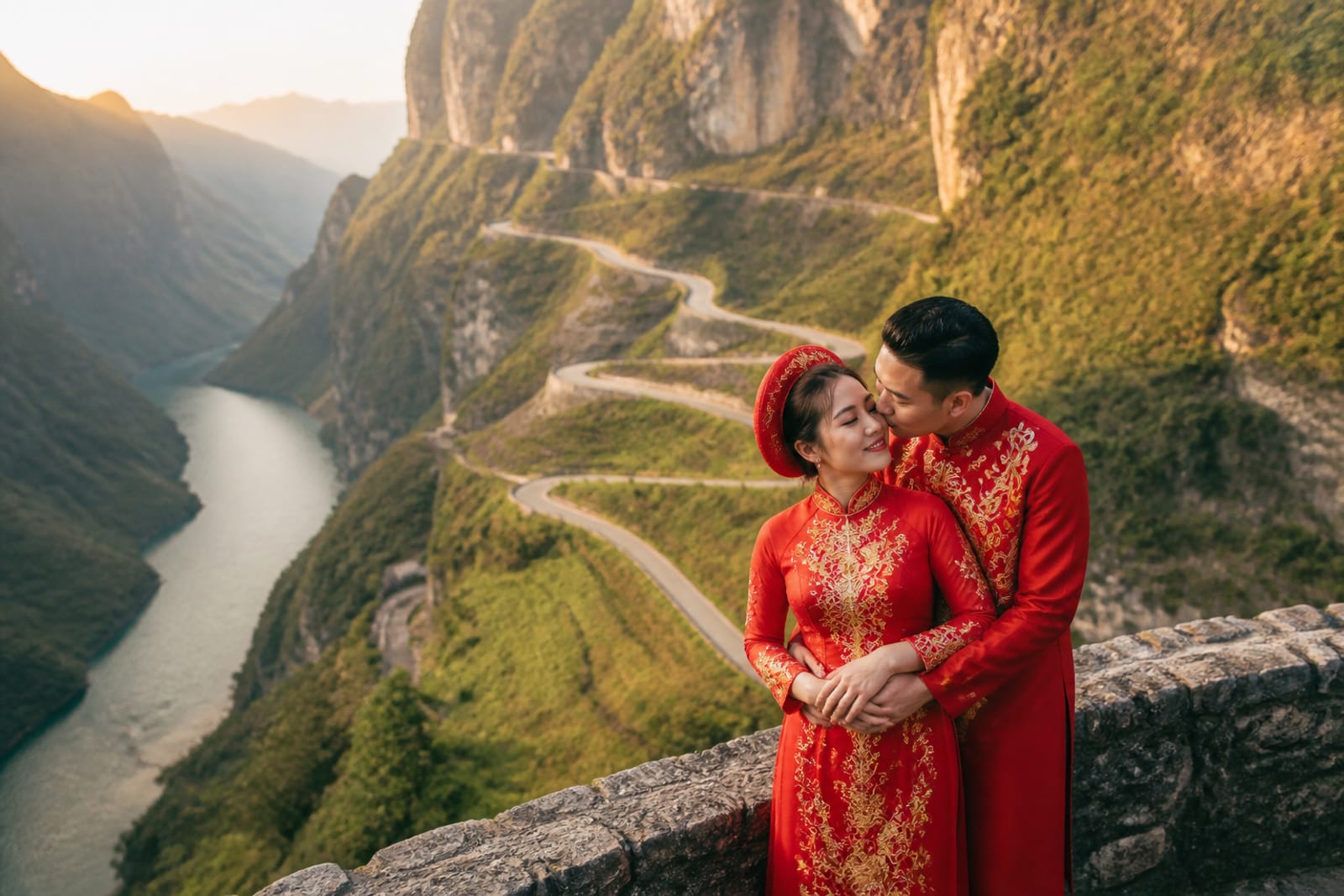
Which season and light hour gives the best pre-wedding frames?
| Season | Light Window | Why It Works | What to Watch |
|---|---|---|---|
| Dec–Feb (winter) | 6:30–9:30 am | Clear skies, gold side light on rice stubble, cold = crisp contrast | Early mornings are freezing; dress layers under the ao dai |
| Sep–Oct (autumn) | 6:00–8:30 am | Buckwheat flowers (pink/white), soft cloud, terraces still green | Rain risk Sep; Oct is safer but haze can blur distant valleys |
| Mar–May (spring) | 6:00–8:00 am | Fresh green terraces, but light heats fast; 9 am onwards is harsh | Afternoon clouds common; second shoot window (5–6:30 pm) is narrow |
| May–Sep (summer) | 5:30–7:30 am only | Rains most afternoons; early light is soft but humidity is extreme | Visibility low; afternoon shoots risk downpour; outfit suffers |
Winter (Dec–Feb) is the benchmark for Ha Giang pre-wedding shoots because you get 2–3 unbroken hours of directional light. Autumn (Sep–Oct) is second choice—buckwheat flowers draw the eye, but rain can cancel a shoot with little notice. Spring and summer require flexibility: one early window, then either a risky afternoon return or a second day. Book your shoot in Dec–Feb if possible; accept autumn as a compromise; avoid summer and spring unless you're staying multiple days and willing to wait for clear afternoon light.
What do you actually wear under an ao dai on a mountain shoot, and how do it protect it?
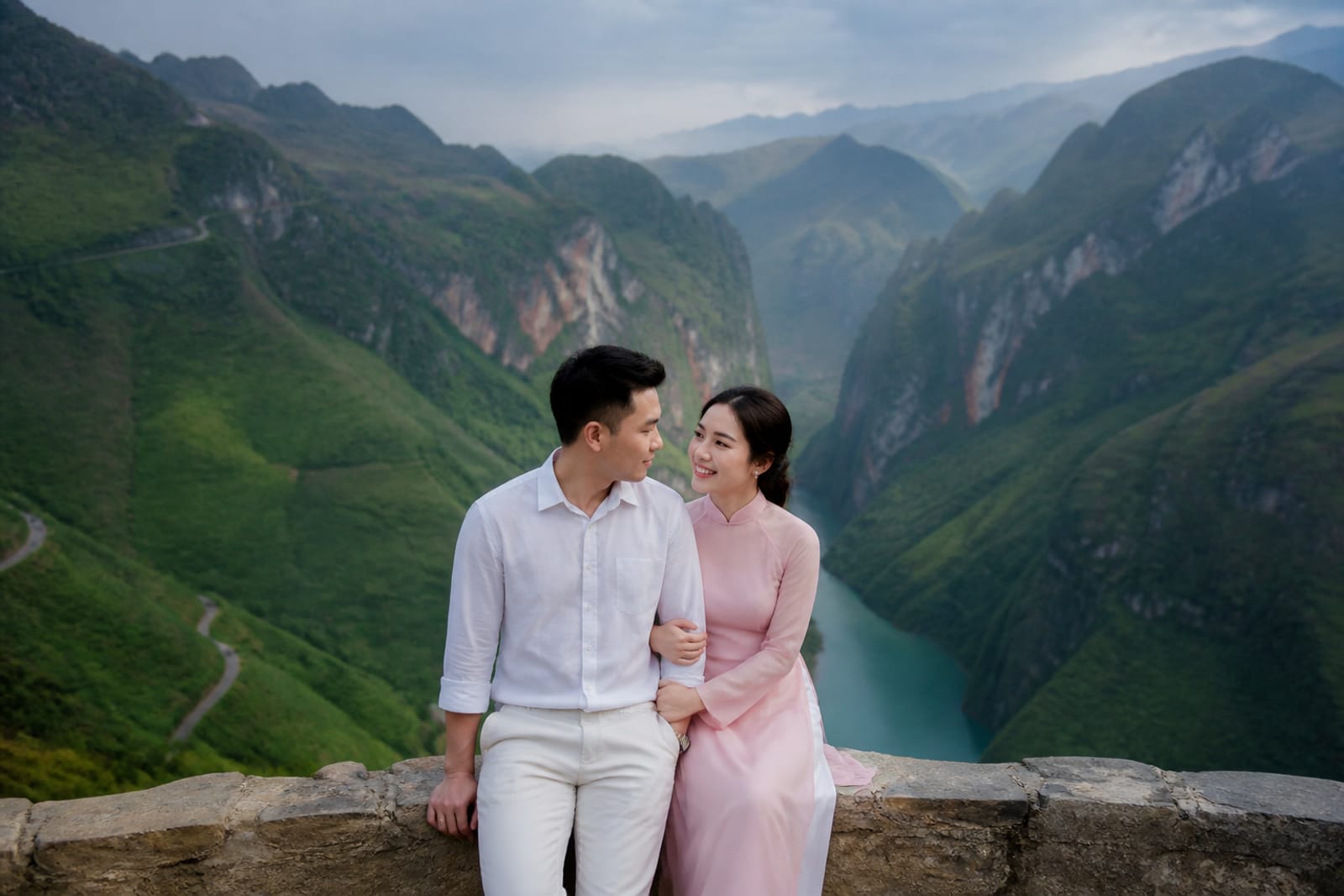
An ao dai is a silk tunic split to the hip, worn over a white or coloured silk under-tunic and matching silk trousers. In the mountains, wear a fitted long-sleeve shirt or thermal layer under the tunic—you'll be warm after 20 minutes of walking, but 6 am is cold. Pack a waterproof bag for the tunic; carry it to the shoot location, then change on-site in a sheltered spot (behind a hut, in a vehicle). Bring a microfibre cloth and a brush for dust. Shoes: not heels—wear flat leather loafers, ballet flats, or walking shoes you can slip off for shots. Groom wears a formal shirt, waistcoat, or suit jacket—same rule, a warm layer underneath. Bring a second outfit if the first gets dusty or wet; a one-day shoot often spans two light windows, so outfit changes add variety without a second full wardrobe. The outfit budget is real: ao dai rental from a Hanoi specialist, groom's suit rental, and a backup piece. Check with your photographer whether they include outfit coordination or whether you hire separately.
🌸 See the lookbook | 📸 Book on WhatsApp — pre-wedding photoshoot
Should you hire a local Ha Giang guide-photographer or book a team from Hanoi?
| Option | Best For | Trade-Offs |
|---|---|---|
| Local guide + photographer | Budget-conscious couples, flexible timing, cultural immersion | One person handles location, safety and camera—some struggle with formal styling or editing consistency |
| Hanoi-based team (Cáo Studio model) | Couples wanting one director, makeup/hair, styled outfit, polished edits | 2–3 hours travel; higher cost factor; must book weeks ahead; they own the creative direction |
| Hybrid: local guide + Hanoi photographer | Best locations + professional post-production | Twice the coordination; can feel disjointed if the guide and photographer don't communicate clearly |
A local guide knows the roads, the safe stopping points, and which homestay owners allow photography. They often have a camera and basic editing skills. The risk: they may not speak English clearly, they shoot in a documentary style (not directed), and their edited files arrive slow or inconsistent. A Hanoi team like Cáo Studio brings a director (who frames every shot), a makeup artist (who travels with you), and one consistent post-production workflow—you get one message across all frames. The cost factor is higher (transport, wages, 48-hour turnaround), but the frames feel intentional, not lucky. Hybrid approach: hire a local guide for safety and location scouting; hire a Hanoi photographer to handle the creative direction and edits. This works if both are briefed beforehand and coordinate on timing. For a one-day shoot, hybrid is risky—two photographers, two visions, and no director makes decisions at the moment of light.
What's the realistic breakdown of a one-day Ha Giang pre-wedding itinerary?
4:30–5:30 am — Depart Hanoi (or stay in Ha Giang town overnight). Breakfast in a local cafe. Reach your first location by 6:30 am.
6:30–8:30 am — Sunrise and early light. Shoot at terraces (Hoang Su Phi), valleys (Yen Minh), or a homestay courtyard. One outfit change mid-session.
8:30–10:00 am — Light hardens; drive to second location (15–30 minutes). Outfit change, hair/makeup touch-up.
10:00–12:00 pm — Mid-morning light is still usable for wide landscape frames with the couple in the landscape. Avoid close-up portraits; backlight and side light work best.
12:00–2:00 pm — Lunch and rest. Light is too harsh for new frames.
2:00–5:00 pm — Option A (stay one day): pack up and return to Hanoi/Ha Giang town by 6:30 pm. Option B (stay overnight): rest and shoot again at 5–6:30 pm golden hour.
5:00–6:30 pm — Second golden window (if you stay overnight or return the next day). Same location, different light angle—new frames without travel.
A realistic one-day itinerary covers two locations, two light windows, and two outfits. Add a third outfit only if you're staying overnight or willing to skip lunch. Travel time eats 3–4 hours; that leaves 5–6 hours of actual light-shooting. Plan for 100–150 edited frames across both windows. The photographer delivers within 48 hours (if Hanoi-based) or within a week (if local). Transport cost (fuel, driver, vehicle wear) is significant; this is not a Hanoi-city shoot in terms of logistics. Make peace with the drive before you book.
What should you check before booking a Ha Giang pre-wedding photographer?
Ask these before you pay a deposit:
- Do they know the Ha Giang roads and current access (some routes close during monsoon, Nov–Dec)? Have they shot there in the past three months?
- Will they provide a makeup artist and outfit coordination, or just the photographer? If separate, who manages timing on the mountain?
- What's included in the edit? How many final images? When do you receive files?
- Do they have a backup photographer or plan if the first person is ill?
- What happens if weather cancels the shoot (rain, landslide closure, extreme cold)? Can you reschedule?
- Is transport included, or do you hire a separate driver? Who pays for fuel?
- Will they visit your accommodation the morning of, or do you meet them at the mountain?
For a pre-wedding photoshoot in Ha Giang, expect a longer booking window (4–6 weeks, especially Dec–Feb) because roads and weather can shift plans. Get a contract in writing even if you're booking a local guide; it protects both of you. If you're booking a Hanoi team like Cáo Studio, confirm they've shot Ha Giang before and ask for sample frames from that region—terrain and light are different from urban Hanoi.
📸 Book on WhatsApp — pre-wedding photoshoot
FAQ
Can we do a one-day Ha Giang pre-wedding shoot without staying overnight?
Yes, but it's tight. You leave Hanoi at 4:30 am, shoot two locations across two light windows (6:30–8:30 am and 10 am–12 pm), and return by 6:30 pm. You get one early golden hour and one mid-morning window. Adding a third location or evening shoot requires staying overnight.
What's the difference between booking a local guide versus a team from Cáo Studio Hanoi?
A local guide knows the roads and homestays; a Hanoi team brings a director, makeup artist, and consistent edits. Local is cheaper and flexible; Hanoi-based offers more control and faster post-production. For one day, Hanoi-based is clearer (one vision) but costs more because of travel and crew wages.
Is winter really the only good season for Ha Giang pre-wedding shoots?
No. Winter (Dec–Feb) is best for clear skies and long light windows. Autumn (Sep–Oct) offers buckwheat flowers and dramatic cloud cover—second choice. Spring/summer have one early window and high afternoon rain risk; they work only if you stay multiple days and wait for clear light.
What should we pack for a one-day Ha Giang shoot besides the wedding outfit?
Warm layers (6 am is cold), flat shoes, a waterproof bag for the ao dai, a microfibre cloth, and a small first-aid kit. Bring a second outfit if you have it; one outfit across two locations risks visible dust or wrinkles. Sunscreen and a hat (for breaks, not shots) are essential.
How long before the shoot date should we book a Ha Giang photographer?
Book 4–6 weeks ahead, especially for Dec–Feb. Mountain roads can close due to weather or rockfall; late bookings risk cancellation with little notice. Hanoi-based teams book further in advance because they need to coordinate transport and crew.
What if it rains during our Ha Giang pre-wedding shoot?
Light rain (drizzle) can create moody frames—soft light, wet terraces, dramatic clouds. Heavy rain cancels the shoot; roads become unsafe and the ao dai gets damaged. Ask your photographer's rain policy before booking: do they reschedule, refund, or offer a partial day? This matters in Sep–Oct and May–Sep.
FAQ
Can we do a one-day Ha Giang pre-wedding shoot without staying overnight?
Yes, but it's tight. You leave Hanoi at 4:30 am, shoot two locations across two light windows (6:30–8:30 am and 10 am–12 pm), and return by 6:30 pm. You get one early golden hour and one mid-morning window. Adding a third location or evening shoot requires staying overnight.
What's the difference between booking a local guide versus a team from [Cáo Studio Hanoi](/hanoi)?
A local guide knows the roads and homestays; a Hanoi team brings a director, makeup artist, and consistent edits. Local is cheaper and flexible; Hanoi-based offers more control and faster post-production. For one day, Hanoi-based is clearer (one vision) but costs more because of travel and crew wages.
Is winter really the only good season for Ha Giang pre-wedding shoots?
No. Winter (Dec–Feb) is best for clear skies and long light windows. Autumn (Sep–Oct) offers buckwheat flowers and dramatic cloud cover—second choice. Spring/summer have one early window and high afternoon rain risk; they work only if you stay multiple days and wait for clear light.
What should we pack for a one-day Ha Giang shoot besides the wedding outfit?
Warm layers (6 am is cold), flat shoes, a waterproof bag for the ao dai, a microfibre cloth, and a small first-aid kit. Bring a second outfit if you have it; one outfit across two locations risks visible dust or wrinkles. Sunscreen and a hat (for breaks, not shots) are essential.
How long before the shoot date should we book a Ha Giang photographer?
Book 4–6 weeks ahead, especially for Dec–Feb. Mountain roads can close due to weather or rockfall; late bookings risk cancellation with little notice. Hanoi-based teams book further in advance because they need to coordinate transport and crew.
What if it rains during our Ha Giang pre-wedding shoot?
Light rain (drizzle) can create moody frames—soft light, wet terraces, dramatic clouds. Heavy rain cancels the shoot; roads become unsafe and the ao dai gets damaged. Ask your photographer's rain policy before booking: do they reschedule, refund, or offer a partial day? This matters in Sep–Oct and May–Sep.
Ao dai, makeup, hair and a local photographer in Hanoi or Saigon — one WhatsApp message.