services/pre-wedding-photoshoot
Overseas Pre-Wedding Shoot Vietnam for Australian Couples
Australian couples increasingly treat Vietnam pre-wedding shoots as a core part of their engagement story—not an add-on. You're investing 5–10 days, crossing hemispheres, and expecting images that rival studio portfolios back home. This guide cuts through Pinterest inspiration and gives you the real breakdown: where to shoot, how to book, what to avoid, and how to compare local photographers against international studios.
Why do Australian couples choose Vietnam over Bali or local studios?
Vietnam offers three elements most Australian photographers can't replicate in one trip: dramatic natural variety (mountains, rice fields, beaches, colonial towns), cultural authenticity (ao dai sessions feel earned, not performative), and session costs 40–60% lower than Sydney metro rates. You arrive for 8–10 days, change outfits 3–4 times across different locations, and leave with 200+ polished images. The time zone isn't a dealbreaker—it's actually an advantage if you book a studio with experience managing international clients.
Cáo Studio – Makeup & Photoshoot handles the logistics Australian couples stress about: WhatsApp communication (no language barrier), pre-shot planning with detailed location maps, and file delivery within 2–3 weeks. Your photographer understands Western couple dynamics (how you interact, your comfort zones, what "natural" means to you) because they've shot 50+ international sessions.
🌸 See the lookbook | 📸 Book on WhatsApp — pre-wedding photoshoot
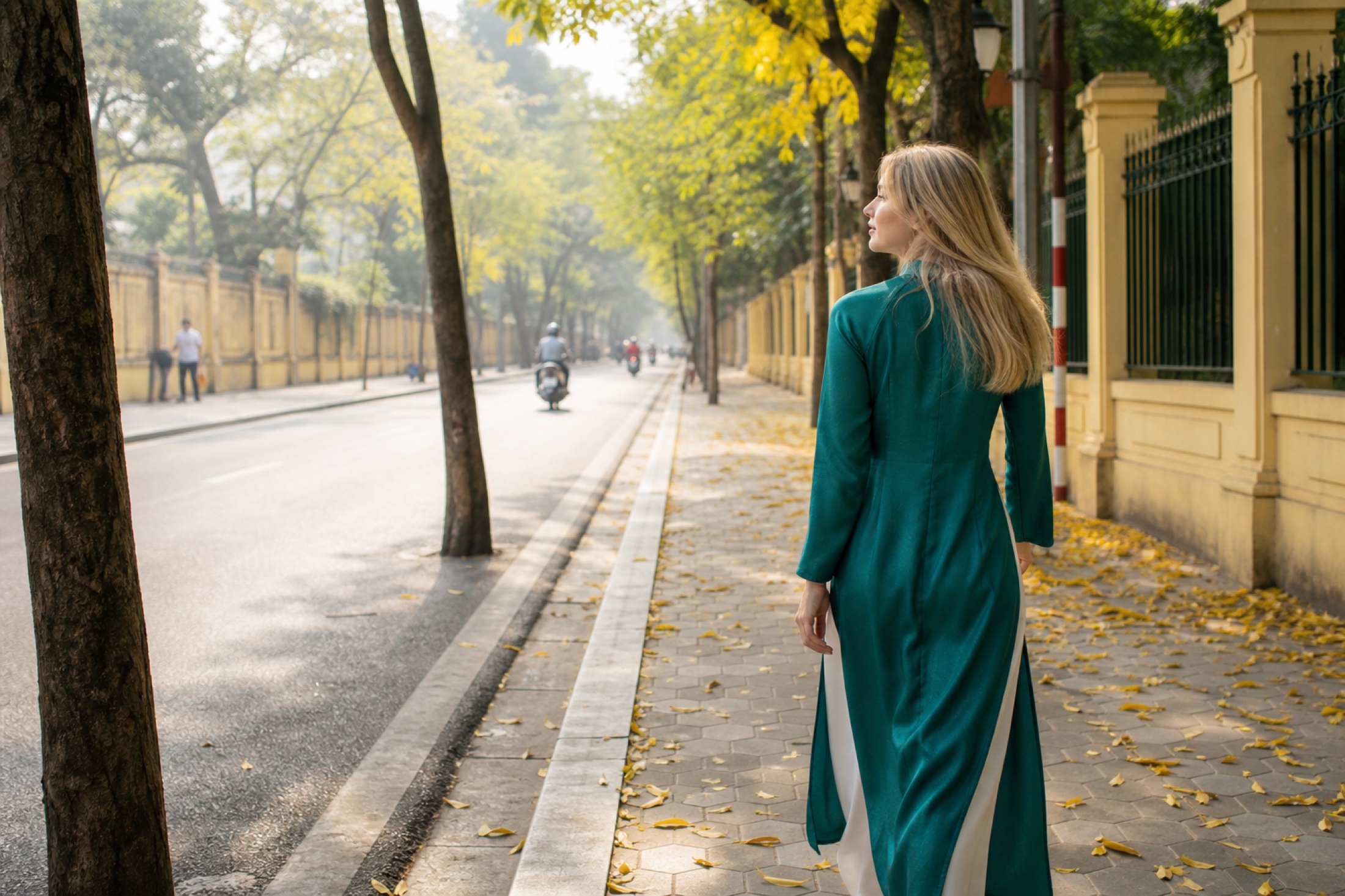
What's the real cost difference: Vietnam vs. Australia?
This is the number that shifts decisions. An equivalent Hanoi session (8 hours, 2–3 locations, 200+ edited images, one outfit change) runs roughly 1/3 the price of a Sydney CBD studio. But "cheap" doesn't mean corners cut—your crew has shot 200+ couples, owns three Hanoi studios, and invests in high-end equipment.
The full-trip calculation is different. You're factoring flights (AUD $600–900 per person), accommodation (AUD $40–100/night in old quarters; $150+ in hotels with makeup suites), and food (AUD $2–5 per meal). Flights are the sunk cost; sessions are the variable. If you're already traveling for a honeymoon or family trip, a 1–2 day pre-wedding shoot feels like a natural extension, not a second holiday.
Comparison: Session costs by approach
| Approach | Total AUD (session + travel) | Best for | Trade-offs |
|---|---|---|---|
| Destination Vietnam + Cáo Studio | $1,500–2,200 | Couples who want 2–3 locations, ao dai portraits, cultural depth | Flight cost is fixed; you're adding session + accommodation |
| Sydney studio (equivalent hours) | $2,500–4,000 | Local couples, clients who dislike travel | No travel; limited outdoor variety |
| Bali freelancer (unvetted) | $800–1,500 | Budget-first couples | Language gaps, unpredictable editing, no safety net |
| Vietnam + international studio (Airbnb photographer) | $1,200–2,000 | Couples who distrust unfamiliar local studios | Variable quality, no studio infrastructure, communication delays |
💄 Makeup & hair at your hotel for on-location prep that saves stress and adds 90 minutes to your day.
When should Australian couples shoot in Vietnam? Season by month.
October–March is the only window most international couples should consider. Outside it, humidity, monsoons, or harsh midday sun make sessions grueling and results unpredictable. Here's what each month actually delivers:
October–November (best window). Cool, dry, 22–26°C. Golden light lasts until 5:30 p.m. Skies are clear for mountain/water shots. Book 3–4 months ahead; studios fill.
December–January (second choice). Still dry, cooler (18–22°C in Hanoi highlands). Risk: occasional cloud cover. Hoi An and Saigon stay warm (24–28°C). Tourist season = crowded temples and street scenes; shoot early mornings (6–7 a.m.).
February–March (shoulder, viable). Warming up (20–26°C). Spring flowers bloom in Hoi An and Hanoi gardens. Humidity creeps in mid-March. Good for couple sessions; less ideal for full-day ao dai marathons.
April–September (avoid). Monsoon rains (May–August in the north; September in the south), 30–36°C heat, 85%+ humidity. Makeup runs. Outdoor light is harsh and diffused. A few couples shoot anyway for monsoon drama—expect reschedules and higher crew fatigue costs.
Your timeline: Book 4–6 months ahead for October–November, 2–3 months for December–January, 6–8 weeks for February–March. Cáo Studio's three Hanoi studios and Saigon location sync schedules across branches; ask on WhatsApp about your preferred dates and backup dates.
Which locations deliver the Instagram and album shots couples actually want?
Australian couples typically want a mix: one heritage/cultural scene (ao dai at a temple), one dramatic landscape (rice fields or mountain), one urban/modern (café, street art, old architecture), and one lifestyle moment (laughing, walking, genuine). Vietnam's geography naturally creates this variety without flying between countries.
Hanoi (3–4 day base). Colonial quarters deliver moody street light. Hoan Kiem Lake is overshot but works for sunrise. Nearby Tam Coc (90 minutes) offers dramatic limestone and river—worth the early drive. Cua Lo temples are quieter, less touristy. Makeup at your Hanoi hotel, then 1–2 hour transport to shoot at a country temple or rice field edge.
Hoi An (2–3 day trip). Ancient town is quintessential Vietnam—lanterns, yellow walls, narrow streets. Shoot golden hour (4:30–5:45 p.m.) to avoid tour groups. Beaches (An Bang, Cua Dai) are 5–10 minutes away for sunset couple portraits. Light is softer here than Hanoi; ao dai photography is stunning.
Ho Chi Minh City (1–2 days). War Remnants Museum exterior, Reunification Palace gardens, Ben Thanh Market early morning—urban energy is the point, not romance. Useful for second-half itineraries; fewer Australian couples base their shoot here unless combining a business trip. Makeup & hair services available at major hotels.
Ask on WhatsApp for Hoi An dates—the team travels there by appointment and can build 3–5 day itineraries combining Hanoi or Saigon with a Hoi An 2-day extension.
🌸 See couple & family photoshoot samples
What's unique about booking a Vietnam-based studio vs. a freelancer or Australian photographer traveling with you?
This is the decision that saves or costs you months of stress. Three models:
1. Local studio (Cáo Studio – Makeup & Photoshoot). You're hiring a team: photographer + assistant/stylist, makeup artist on standby (optional), location knowledge, editing QA. WhatsApp coordination across timezones (responds within 4 hours, usually same-day). Pre-shot planning includes location scouting, timing sun, confirming permits at temples. Backup plans if weather fails—they've rescheduled 50+ sessions and know pivots. Your AUD $1,600–2,000 covers a full shoot day (8 hours, 2–3 locations, 200+ images), makeup & hair if booked, and two location scouts. Files delivered in 2–3 weeks (editing is in-house, consistent).
2. Freelancer found via Instagram or Facebook. Usually AUD $800–1,200 for 6–8 hours. Likely one person (photographer only; no assistant or stylist). Communication is slower or spotty (WhatsApp delays, language gaps). Editing varies—you might get raw-look edits or over-processed colors. No backup plan if they're sick or cancel. Higher risk: no insurance, no studio safety net, unvetted reviews. Works if you want a relaxed, documentary feel and don't mind unknown outcomes.
3. Australian photographer flying to Vietnam with you. Your home photographer travels (AUD $3,000–5,000 in flights + accommodation), charges their normal Hanoi/Vietnam day rate (AUD $2,000–3,500), and you avoid a "new person" relationship. They know your vibe already. Trade-off: you're paying full Australian rates, they're jet-lagged, they don't know Hanoi light/locations as intimately, and permits/temple access can surprise them. Better for couples who already have a strong photographer relationship and want continuity.
Recommendation: If you've never worked with a Vietnamese studio, book Cáo Studio for your first Vietnam session. The crew's experience with Australian/Western couples (how you move, what you find funny, what "natural" means) is worth the direct booking. If you've shot 50+ international sessions and want total creative control, a freelancer is viable. If you want zero risk and you already love your Sydney photographer, bring them—but budget accordingly.
How do you check a local studio before you pay?
Ask these questions in order. Red flags are specific.
- "Can you show me 10 full client galleries from 2025?" Real studios have sequenced, full-session galleries with before/afters. Freelancers often show only hero shots. If they show you 3 edited singles, next.
- "How many international/Australian couples have you shot?" If they say "hundreds," ask for Instagram tags or client names (they'll reference a few). If they've shot fewer than 20 overseas couples, they haven't learned your communication style yet—that's not disqualifying, just a learning curve.
- "What happens if weather ruins the shoot date?" Listen for: "We reschedule for free" (good), "You choose: reschedule or I give you a refund" (solid), "We'll shoot in the rain and edit darker tones" (risky), silence (very risky).
- "Who's my photographer, and can I see their personal portfolio?" You want the actual shooter's name and work—not the studio's best editor assigned to your session. Ask if they're the only photographer or if your wedding might get a junior (not ideal for overseas couples paying premium rates).
- "What's your editing timeline, and can I request a second round of tweaks?" Cáo Studio delivers in 2–3 weeks with one free round of color/crop tweaks. If they say "5–6 weeks, no changes," you're low priority. If they say "same-week turnaround," that's editing, not curation.
- "Do you handle makeup/hair on shoot day?" If not, you're outsourcing—adds coordination overhead. Cáo Studio offers makeup & hair as an add-on, or you hire separately and brief them on mood/colors.
- "What format do I receive files? Watermarked or final?" Final, full-resolution files let you order prints independently. Watermarked "proofs" mean you're locked into their lab pricing.
Honest checklist before you book:
- [ ] Seen 10+ complete 2025 galleries from couples like you (engaged, international, 1–2 day shoots)
- [ ] Spoken to the actual photographer (not just the studio owner/booker)
- [ ] Know the reschedule policy in writing
- [ ] Confirmed makeup/hair is included or clear what you're sourcing separately
- [ ] Understand editing turnaround (2–3 weeks is standard; faster is risky)
- [ ] Received a quote that includes location count, hour count, file count, and delivery format
- [ ] Read recent client feedback (Google reviews, Instagram comments, or referrals from other couples)
📸 Book on WhatsApp — ao dai photoshoot to see how cultural sessions integrate into broader pre-wedding itineraries.
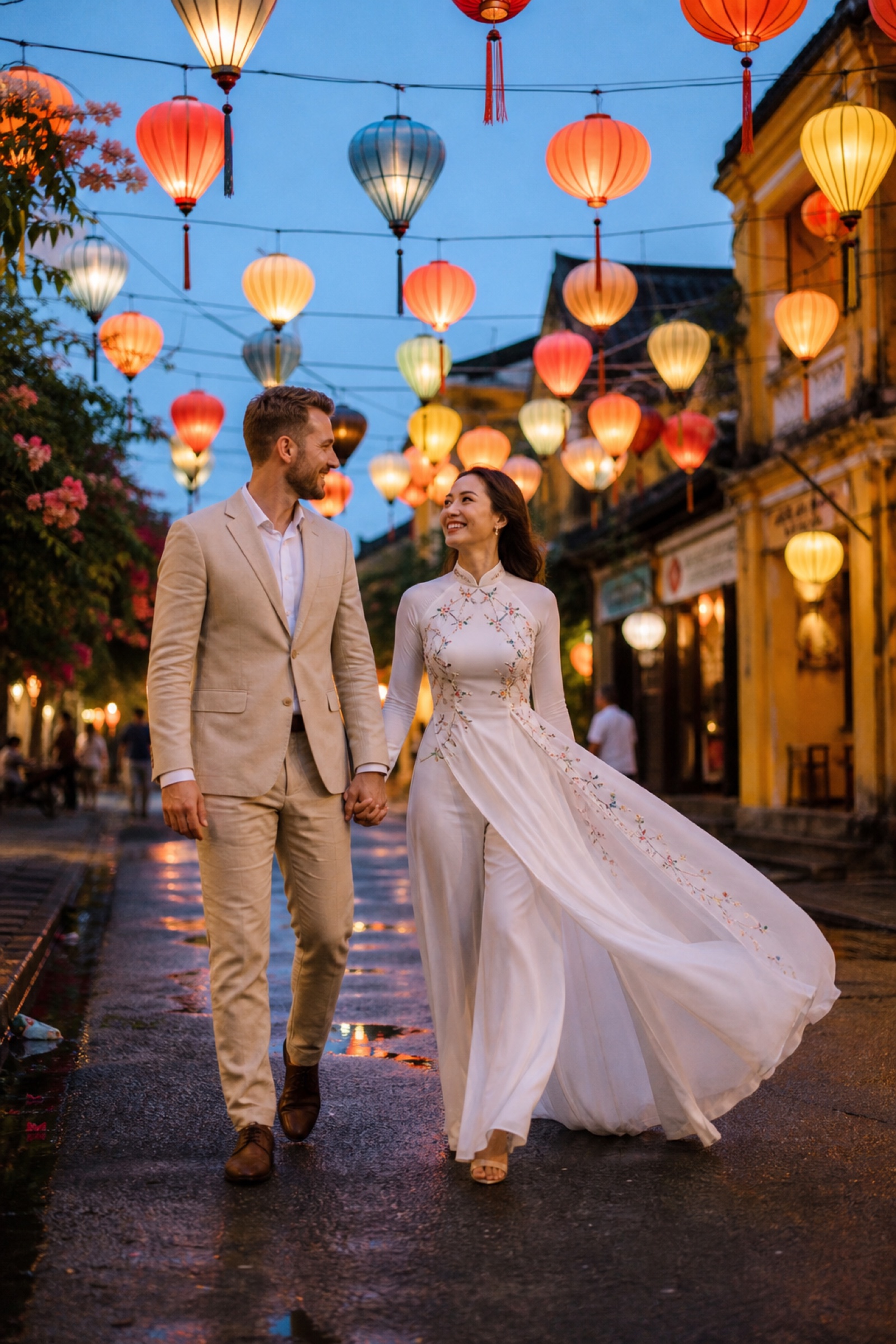
What should you actually wear under an ao dai, and how does outfit planning work?
This is the detail Australian couples often overlook until day-of, then panic. Ao dai is a two-piece: a long tunic worn over fitted pants. It's stunning, feels ceremonial, but you need to know the fit or you'll spend the shoot tugging at seams.
Under the ao dai: A fitted, smooth slip or bodysuit in nude or white (no visible bra straps, no thick seams under the tunic's chest). Nude or white pants. Many Australian couples bring a bodysuit from home (Spanx, Bonds) in their size; Vietnamese seamstresses can't always match Australian fit. If you buy an ao dai in Vietnam, they'll tailor the slip to your frame.
Outfit count for an 8-hour day:
- Ao dai (30% of shoot time). You feel cultural, images are heirloom-worthy, good for album opening pages.
- Second outfit (40% of shoot time). Could be a dress, skirt, or formal wear in a color that contrasts background (white/cream for fields, jewel tones for colonial streets). Australian couples often bring a rehearsal dinner dress or formal wear.
- Third outfit (20%, optional). Casual wear (jeans, linen shirt) for lifestyle moments, walking scenes, café portraits. Lighter, more playful.
Cáo Studio's approach: They'll ask you to email 3–5 outfit images ahead of time. They'll flag "that white dress will disappear against the temple walls" or "the black trousers match the timing of evening light nicely." They'll tell you what to bring and what to rent in Vietnam (ao dai rentals are AUD $20–40 per day; buying is AUD $60–150 if decent quality). Makeup adapts to each outfit's color palette.
Pro tip: Bring comfortable shoes in two colors (nude flats for temple/ao dai, darker shoes for second outfit). Flip-flops between shots. Vietnamese temples are often uneven stone; Australian couples trip more in unfamiliar terrain—flat shoes avoid twisted ankles mid-shoot.
What happens on shoot day, and how does the crew manage your timeline?
Real timeline (8-hour shoot in Hanoi, two locations):
6:00–6:30 a.m. Meet at studio or hotel (if makeup is booked). Stylist confirms outfit one, touch-ups, last-minute adjustments.
6:45–7:30 a.m. Transport to location one (temple, rice field, or old quarter). Arrive before sunrise/golden hour crowds. First 20 minutes are awkward—you're cold, caffeine-deprived, the photographer is testing light. Expect the first 50 shots to feel stiff. By minute 30, you're warm and laughing.
7:30 a.m.–12:00 p.m. Location one, uninterrupted. Photographer shoots 150–200 frames across 3–4 setups. You're changing angles, positions, walking, sitting. It feels like 1.5 hours. Your assistant/stylist is adjusting hair, tugging fabric, flagging sun direction.
12:00–1:00 p.m. Break. Snacks, water, photo review on camera (morale check). Outfit change two. If makeup refresh is needed, 15 minutes. Transport to location two.
1:00–4:00 p.m. Location two, same rhythm. You're more relaxed now. Photographer might try a harder direction ("now run toward me, laughing at nothing"). By 3 p.m., you're tired—this is when you get genuine, unguarded images. Shoot 150+ more frames.
4:00–4:30 p.m. Wrap. Quick debrief, discussion of next steps (file delivery timeline, color mood, any retake requests). You're dehydrated and happy.
Crew for a Cáo Studio session: Photographer (shooting, directing), assistant (managing poses, adjusting outfit, watching light shifts), optional makeup artist (touchups between locations). You manage yourselves—bring water, snacks, sunscreen. Hanoi humidity at 7 a.m. is 70%; by 10 a.m., it's 75%+. Makeup is designed to last, but if you're sweating, let the artist know.
What actually goes wrong and how to avoid it:
- Tired legs. You underestimate standing for 8 hours. Wear comfortable shoes beforehand; stretch calves the night prior.
- Makeup runs. Happens if humidity spikes or you cry (happy tears—allowed). Bring blotting sheets; the makeup artist has waterproof backup.
- Tourist groups photo-bombing your temple shoot. Cáo Studio books early morning (6:45 a.m.) specifically to avoid crowds. If crowds arrive anyway, the photographer pivots to tighter framing or moves 50 meters away. Never a deal-breaker.
- Outfit seams feel wrong. Try the ao dai on the day before, walk around your hotel. Tell the stylist immediately if it pinches—they can adjust in 10 minutes.
- You hate your hair mid-shoot. Bring a hair tie and bobby pins. The stylist can quickly redo sections. Photos of you from behind are often the best anyway.
💄 Makeup & hair at your hotel ensures you're camera-ready without hotel bathroom stress.
Should you book 3 hours (single location), full day (two locations), or multi-day (Hanoi + Hoi An)?
Depends on your photo needs and how much engagement-season feels like.
3-hour session (one location, 60–80 final images). For couples who want one iconic ao dai portrait or a quick city session. Works if you're already in Vietnam for a honeymoon and want a memory—not a "pre-wedding album." AUD $600–900 range. You're done by 10 a.m.; rest of day is yours.
8-hour session (two locations, 200+ images). The sweet spot. You get engagement variety (formal ao dai, couple moments in nature, lifestyle), you're exhausted but fulfilled, and your album flows across three distinct moods. AUD $1,500–2,000. Takes one full day; plan recovery day after (napping, exploring, light activity).
2–3 day shoot (Hanoi + Hoi An, or Hanoi + Saigon). For couples who want pre-wedding + engagement + honeymoon momentum. Day one: 8 hours in Hanoi (ao dai, temples, old quarter). Day two: travel south, rest, dinner. Day three: 6–8 hours in Hoi An (ancient town, beaches, lanterns). Total images: 350–450. AUD $2,200–3,000. Requires more planning, but you're capturing seasons/regions, not repeating one location's light.
Which model aligns with Australian couples I've seen:
- Budget-first + "honeymoon trip" vibe → 3-hour single-location session.
- Engagement-focused + wedding album planning → 8-hour full-day session.
- Anniversary + multi-region travel → 2–3 day spread.
Review the pre-wedding photoshoot pillar page for sample itineraries by duration.
Outdoor etiquette: temples, streets, and what photography permits actually mean in Vietnam.
Vietnamese temples are active worship spaces, not museum sets. Australian couples sometimes break protocol without realizing. Here's what Cáo Studio and your crew will coach you on:
At temples:
- Dress respectfully: shoulders covered, knees covered (ao dai does this automatically). Shoes off at altar areas.
- Don't pose at the main altar. Photograph at courtyards, side gates, or gardens.
- If a monk is meditating, shoot around them—don't position yourself to interrupt.
- Leave donations if you enjoy the space (10,000–50,000 VND, roughly AUD $0.60–$3).
- Smile at locals; brief chat with caretakers builds rapport and they're often more lenient about couple portraits if they see genuine interest.
On streets (old quarters, Hoi An):
- Hanoi's old quarter is chaotic—scooters, vendors, tourists. Your crew will scout safe zones (side alleys, early morning) to avoid traffic. Don't block shop doors.
- If locals are selling goods or photos, respect their business. Move your session if you're in their workspace.
- Hoi An's ancient town has informal "no professional photography after 5 p.m." in some zones—check with your crew beforehand.
Photography permits in Vietnam: Technically, the law requires permission for "professional" photography in certain heritage zones (War Remnants Museum, some temples). In practice: Cáo Studio handles this. They have relationships with common locations, pay modest fees (AUD $5–15) if required, and scout beforehand. You as a couple will never be hassled if you're with a recognized local crew. Solo freelancers or international photographers operating independently sometimes get asked to leave or pay on-the-spot fees. This is another reason local studio partnerships are seamless.
Pro tip: Carry a copy of your passport and shoot reference with your studio coordinator (WhatsApp message: "Shooting at X temple on Tuesday, 7–9 a.m."). If anyone questions you, you have documentation and a local crew member to explain. In 50+ sessions, Cáo Studio has never had a shutdown or fine.
---
What's the delivery and what do you actually get?
Timeline: Cáo Studio delivers edited full galleries in 2–3 weeks. They're not rushing you—they're editing 100+ images per couple, ensuring color consistency, skin tones that flatter both people, and scenic balance.
File format: High-resolution JPEGs (suitable for printing 12×18 inches without loss), organized by location and outfit in a private gallery link (via shared drive or cloud link). You can order prints directly, make albums through a third-party lab, or share with a videographer who might use stills.
Editing style: Warm, slightly saturated (not oversaturated), skin tones favor warm undertones common in Southeast Asian light. If your Sydney photographer color-grades differently, you might notice. Cáo Studio can adjust tone for one round of revisions (email feedback like "warmer whites" or "soften the greens").
Turnaround hiccups to avoid:
- Don't ask for 200+ individual retouches (skin removal, object cloning). That's custom portrait work, not session editing. One round of color/crop tweaks is included.
- Don't book a photographer and expect files same-week. If they deliver in 5 days, they're skipping proofing—you'll notice later.
- Do expect one "hero reel" teaser (10–15 preview images) within 3–5 days. This is morale-boosting and usually free.
🌸 Explore ao dai photoshoot details to see how cultural wardrobe integrates into pre-wedding editing & delivery.
FAQ
Is October–March really the only time to shoot outdoors in Vietnam?
Yes, practically. October–March offers cool temps (18–26°C), low humidity (50–65%), and reliable light. April–September brings monsoon rain (especially May–August in the north), 30–36°C heat, and 80%+ humidity. Makeup runs, outdoor light is harsh, and reschedule odds are high. Outdoor couples should avoid April–September unless they specifically want monsoon drama (rare).
How far in advance should Australian couples book?
4–6 months for October–November (peak season), 2–3 months for December–January, 6–8 weeks for February–March. Cáo Studio's three Hanoi studios fill early. Later bookings may have location conflicts or limited photographer availability. WhatsApp your preferred dates ASAP to secure.
Can we reschedule if weather is bad?
Yes. Cáo Studio reschedules free of charge if monsoon rain or unsafe conditions hit your original date. You choose a new date within 6 months. Freelancers vary—confirm their policy in writing before paying.
Do we need an ao dai if we're not Vietnamese?
No, but it's worth the investment (AUD $60–150 to buy, AUD $20–40 to rent). Ao dai portraits are the signature pre-wedding image from a Vietnam shoot—you'll regret missing them. Even one outfit change into ao dai rounds out your album.
What's the difference between booking directly with Cáo Studio vs. through an Australian travel agency?
Direct booking (WhatsApp with Cáo Studio) is cheaper—you skip agency markup. Travel agencies add convenience if you want flight + hotel + photoshoot bundled. For most Australian couples, WhatsApp booking is straightforward and saves 10–15% of session cost. Ask on WhatsApp about group discounts if you're bringing family.
FAQ
Is October–March really the only time to shoot outdoors in Vietnam?
Yes, practically. October–March offers cool temps (18–26°C), low humidity (50–65%), and reliable light. April–September brings monsoon rain (especially May–August in the north), 30–36°C heat, and 80%+ humidity. Makeup runs, outdoor light is harsh, and reschedule odds are high. Outdoor couples should avoid April–September unless they specifically want monsoon drama (rare).
How far in advance should Australian couples book?
4–6 months for October–November (peak season), 2–3 months for December–January, 6–8 weeks for February–March. Cáo Studio's three Hanoi studios fill early. Later bookings may have location conflicts or limited photographer availability. WhatsApp your preferred dates ASAP to secure.
Can we reschedule if weather is bad?
Yes. Cáo Studio reschedules free of charge if monsoon rain or unsafe conditions hit your original date. You choose a new date within 6 months. Freelancers vary—confirm their policy in writing before paying.
Do we need an ao dai if we're not Vietnamese?
No, but it's worth the investment (AUD $60–150 to buy, AUD $20–40 to rent). Ao dai portraits are the signature pre-wedding image from a Vietnam shoot—you'll regret missing them. Even one outfit change into ao dai rounds out your album.
What's the difference between booking directly with Cáo Studio vs. through an Australian travel agency?
Direct booking (WhatsApp with Cáo Studio) is cheaper—you skip agency markup. Travel agencies add convenience if you want flight + hotel + photoshoot bundled. For most Australian couples, WhatsApp booking is straightforward and saves 10–15% of session cost. Ask on WhatsApp about group discounts if you're bringing family.
Ao dai, makeup, hair and a local photographer in Hanoi or Saigon — one WhatsApp message.