/pre-wedding-photoshoot
Photography Rules at Dong Van Karst Plateau: Permits, Drones & Before
Dong Van Karst Plateau (Ha Giang province, northern Vietnam) is a UNESCO Global Geopark where commercial photography—including pre-wedding and professional shoots—requires a permit from the local Department of Tourism. Drones are restricted; you'll need separate approval from both the geopark authority and the provincial military (airspace clearance). Shoots happen during the dry season (October to May), with buckwheat flowers peaking October–November and terraces turning gold in September. Budget 3–5 days on-site (roads are winding); coordination happens via WhatsApp before any booking. Cáo Studio does not operate in Ha Giang, but this guide covers what to check and how to find a local photographer who handles permits and timing correctly.
What permits do you actually need for a commercial shoot at Dong Van?
Commercial photography at Dong Van—defined as a paid session for weddings, engagement, pre-wedding or brand content—requires a permit from the Ha Giang Department of Tourism and Culture. This is not optional; locals and park rangers enforce it. The permit is issued to the photographer or tour guide coordinating the shoot, not the couple. It typically covers one or two shoot dates and specific locations within the geopark. Apply 2–4 weeks before your shoot date through a local guide or tourism operator; processing takes 5–10 days. The permit cost and exact filing process vary annually—contact the Ha Giang Department of Tourism on-site or through a local agency to confirm current requirements. Without a permit, you risk being stopped mid-shoot and asked to leave or pay fines.
📸 Book on WhatsApp — couple photoshoot | 🌸 See the lookbook
Can you fly a drone at Dong Van Karst Plateau?
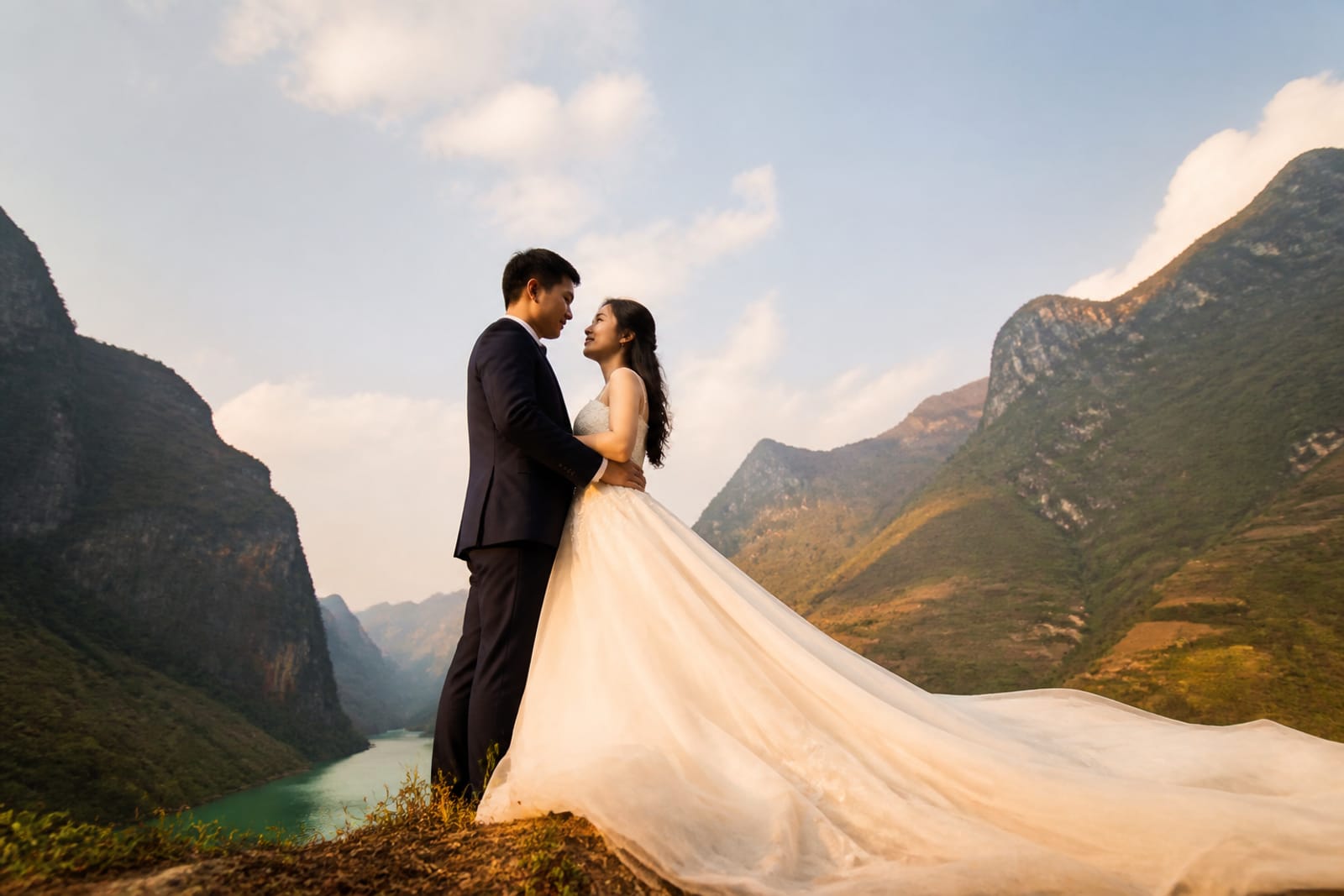
Drones are technically allowed in parts of Dong Van, but you need two separate approvals: a commercial drone permit from the geopark administration and airspace clearance from Ha Giang's military command (civil aviation authority liaison). Both are required for any drone footage or stills used in a paid photoshoot. The approval process takes 3–4 weeks and involves paperwork submitted by a licensed drone operator based in Vietnam. International travellers cannot operate drones themselves; you must hire a Vietnamese-licensed operator. Costs are significant (a factor that varies by season and operator availability). Most pre-wedding shoots at Dong Van skip drones entirely and rely on ground-level framing instead, which actually showcases the terraces and karst formations better in the low-angle light of early morning or late afternoon.
What is the best season and light window for shooting here?
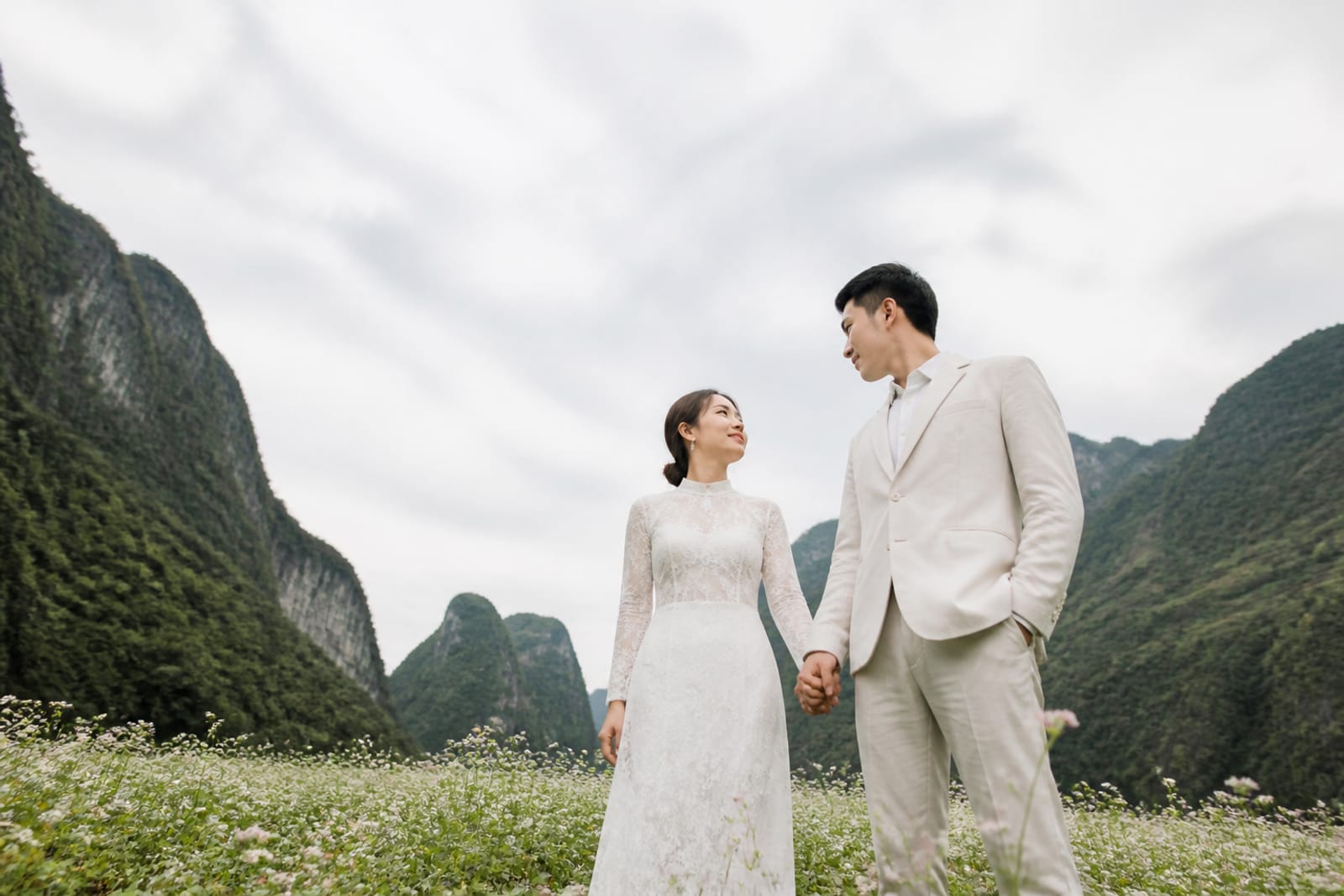
Dong Van has three distinct photo seasons: buckwheat flowers bloom roughly October–November (white fields, 5–6 weeks), rice terraces turn golden in September (3–4 weeks), and the dry season October–May offers clear skies and low morning/evening light. December–February is cold (5–15°C), so couples need layers under their ao dai or custom outfit. Summer (May–September) brings afternoon rain and landslides on mountain roads; avoid June–August for multi-day shoots. Best light arrives between 6:00–7:30 am and 4:30–6:00 pm. Midday (10 am–3 pm) produces harsh shadows and washes out the terraces' texture. Each season suits different visual stories: buckwheat for romantic contrast, terraces for scale and depth, and clear winter skies for drama. The tradeoff is cold-weather logistics and longer drives (4–5 hours from Hanoi base).
💄 Makeup & hair at your hotel | 📸 See the lookbook
How do you choose between Dong Van and other northern shooting locations?
| Destination | Best For | Light & Season | Why It Works |
|---|---|---|---|
| Dong Van Karst | Epic scale, terraces, cultural depth | Oct–May; 6–7 am or 5–6 pm | Permit + 3-day trip; UNESCO layers (flowers, stone, labour) |
| Hoang Su Phi terraces (Yen Bai) | Soft golden light, fewer crowds | Sep; best 6–8 am | No drone restrictions; 2-day trip; winter less dramatic |
| Sapa valley (Lao Cai) | Mist, dramatic drop-offs, market culture | Oct–Nov, Dec–Feb | Accessible day-trip from Hanoi; permit-free; iconic mist at dawn |
| Ninh Binh limestone (Ba Trang, Trang An) | Water reflections, boats, intimacy | Oct–Apr; 5:30–7 am | 2-hour drive from Hanoi; no permit; smaller crew logistics |
Dong Van requires the most planning (permits, 3-day minimum, winding roads) but delivers scale and story depth that one-day shoots cannot match. Sapa and Hoang Su Phi suit couples who want northern drama with simpler logistics. Ninh Binh works for intimate frames near Hanoi. Choose Dong Van if you have 4+ days, accept cold weather, and want your shoot tied to a specific cultural moment (buckwheat, harvest labour, stone terraces as protagonist).
What should you check before booking a photographer for Dong Van?
Before committing to a Dong Van shoot, ask a photographer or guide:
- Permit track record: Have they obtained permits for commercial shoots here before? Ask for the name of the geopark contact and the approval timeline they typically manage.
- On-site coordination: Who handles accommodation, permits, location scouting, and bad-weather pivots? Multi-day shoots fail when one vendor handles makeup, another shoots, and a third drives—confirm it's one team.
- Realistic timeline: Can they deliver edited photos within 48–72 hours, or does the 5-hour drive and remote location delay turnaround? Ask for a sample of their Dong Van work (not generic terraces, but actual client shoots with consistent framing).
- Seasonal weather plan: What happens if it rains October–November or snows in January? Do they have alternate locations scouted or a reshoot policy?
- Outfit logistics: If you're wearing an ao dai photoshoot outfit or rented dress, how is it packed and transported on a winding mountain road? Will humidity or cold affect fit?
📸 Book on WhatsApp — pre-wedding photoshoot
Cáo Studio operates in Hanoi and Saigon with a proven track record managing multi-day shoots in complex light. For Dong Van, we recommend working with a local Ha Giang operator who holds the permit and knows the terrain, then coordinating with Cáo Studio for post-production (editing, albums, video) via WhatsApp. This hybrid approach keeps on-site logistics lean and turnaround fast.
What costs do you actually budget for Dong Van beyond the photographer?
The biggest factors are accommodation (3–4 nights in a guesthouse near Dong Van town), transport (fuel, driver or rental 4–5 hours from Hanoi), meals, and the permit fee itself (varies by year and geopark). Seasonal costs shift: October buckwheat season books accommodation weeks in advance and prices rise; December–February is cheaper but colder and requires warmer outfits (cost factor: extra layers, heated spaces for makeup). Drone approval, if chosen, adds significant cost and processing time. Entry tickets to Dong Van itself are modest, but the cumulative cost of a 3–4 day trip (transport, lodging, permits, photography) is higher than a one-day Hanoi session or a couple photoshoot in Hoi An. Compare this against the outcome: a Dong Van shoot produces frames tied to a specific place and season—terraces, flowers, light—that cannot be replicated elsewhere. If your budget is tight, prioritize a day-long shoot at a closer location (Ninh Binh, Sapa valley) and save Dong Van for a multi-year anniversary return.
---
What to check before you book
✓ Photographer has obtained permits for Dong Van before (ask for geopark contact, timeline) ✓ One team handles scouting, permit, shoot, and edits (no three-vendor stitching) ✓ Edited photos promised within 48–72 hours (account for drive time and connectivity) ✓ Outfit plan accounts for cold, humidity, and winding-road transport ✓ Alternate locations scouted for rain or seasonal delays ✓ Realistic sample work from previous Dong Van shoots (not stock terraces) ✓ WhatsApp communication channel confirmed for pre-shoot and post-shoot coordination
---
FAQ
Do international visitors need a separate permit to pose for photos at Dong Van?
No—the permit is obtained by the photographer or tour operator, not the visitor. You can take personal photos without restriction. Commercial shoots (paid sessions) require the operator to secure the permit from Ha Giang's Department of Tourism and Culture before your shoot date.
Can I hire a local guide to handle the permit while using my own photographer?
Technically yes, but it creates coordination risk. The geopark requires one responsible party (usually the guide or photographer) to hold the permit and ensure compliance. If your photographer is from outside Ha Giang, work through a local guide or operator who knows the approval process and can file paperwork 3–4 weeks in advance.
Is Dong Van too expensive compared to shooting in Hanoi or Hoi An?
Cost is a factor of multi-day travel and accommodation, not the shoot fee alone. If you're staying in Ha Giang anyway, a Dong Van shoot adds modest incremental cost. If you're flying in from abroad, budget 3–4 nights on-site; compare this against a pre-wedding photoshoot in Hanoi or Hoi An, which require only a day or two. Dong Van suits couples who want a travel-adventure shoot as part of a longer northern trip.
What happens if it rains during my Dong Van shoot?
Rain is common October–November (drizzle, not downpours) and rare but possible December–May. Confirm the photographer's reshoot or reschedule policy before booking. Ask if they have scouted indoor or covered alternate locations (local heritage sites, family homes, markets). A one-day shoot in rain is lost; a 3–4 day trip can pivot to a second date.
Should I choose buckwheat season (October–November) or another time of year?
Buckwheat flowers create a signature contrast (white fields, dark couple, moody sky) that Dong Van is famous for, but the season is crowded and accommodation books early. September terraces are equally compelling (golden, layered light, harvest-season story). December–February offer clear skies and fewer tourists but require cold-weather planning. Choose based on your travel dates and willingness to coordinate 3–4 weeks ahead—all three seasons work if the photographer knows the light and permits.
FAQ
Do international visitors need a separate permit to pose for photos at Dong Van?
No—the permit is obtained by the photographer or tour operator, not the visitor. You can take personal photos without restriction. Commercial shoots (paid sessions) require the operator to secure the permit from Ha Giang's Department of Tourism and Culture before your shoot date.
Can I hire a local guide to handle the permit while using my own photographer?
Technically yes, but it creates coordination risk. The geopark requires one responsible party (usually the guide or photographer) to hold the permit and ensure compliance. If your photographer is from outside Ha Giang, work through a local guide or operator who knows the approval process and can file paperwork 3–4 weeks in advance.
Is Dong Van too expensive compared to shooting in Hanoi or Hoi An?
Cost is a factor of multi-day travel and accommodation, not the shoot fee alone. If you're staying in Ha Giang anyway, a Dong Van shoot adds modest incremental cost. If you're flying in from abroad, budget 3–4 nights on-site; compare this against a [pre-wedding photoshoot](/pre-wedding-photoshoot) in Hanoi or [Hoi An](/hoi-an), which require only a day or two. Dong Van suits couples who want a travel-adventure shoot as part of a longer northern trip.
What happens if it rains during my Dong Van shoot?
Rain is common October–November (drizzle, not downpours) and rare but possible December–May. Confirm the photographer's reshoot or reschedule policy before booking. Ask if they have scouted indoor or covered alternate locations (local heritage sites, family homes, markets). A one-day shoot in rain is lost; a 3–4 day trip can pivot to a second date.
Should I choose buckwheat season (October–November) or another time of year?
Buckwheat flowers create a signature contrast (white fields, dark couple, moody sky) that Dong Van is famous for, but the season is crowded and accommodation books early. September terraces are equally compelling (golden, layered light, harvest-season story). December–February offer clear skies and fewer tourists but require cold-weather planning. Choose based on your travel dates and willingness to coordinate 3–4 weeks ahead—all three seasons work if the photographer knows the light and permits.
Ao dai, makeup, hair and a local photographer in Hanoi or Saigon — one WhatsApp message.