/pre-wedding-photoshoot
Photography rules at Ma Pi Leng Pass: permits, drones and what to chec
Ma Pi Leng Pass, a limestone canyon on the Ha Giang Loop (northwest Vietnam), is a striking photoshoot location but comes with real constraints. You'll need a permit from the local commune; drones are restricted in the buffer zone; light is clearest and cleanest Sep–Nov and Feb–Apr (winter is cold, summer is wet and misty). The pass is a 4-hour drive from Ha Giang town and part of a multi-day trip—not a half-day shoot. If you're booking a photographer, hire a local operator licensed to work in the region, or book Cáo Studio's pre-wedding sessions in Hanoi and arrange a separate guide for Ha Giang. Key mistakes: ignoring permits (communes do check), flying drones without permission, shooting midday when canyon walls create hard shadow, and assuming one afternoon is enough. Plan 2+ days, check weather 48 hours before, and confirm your photographer has local credentials.
What permit do you actually need at Ma Pi Leng?
The pass sits within a protected scenic zone managed by Ha Giang's Department of Culture, Sports and Tourism. You'll need written permission from Meo Vac commune (the nearest administrative unit) before shooting commercially. Permits are issued at the commune office, sometimes take 2–3 days to process, and are free or low-cost but require a local contact or a travel agency familiar with the zone. If you hire a local photographer, they'll usually handle it. If you bring your own team from outside the province, expect delays—start the permit request at least one week before your shoot. Not having one won't stop a casual tourist snapshot, but it exposes you to a fine if authorities check during a professional shoot (cameraman, stylist, model in outfits not typical of a hiker).
📸 Book on WhatsApp — pre-wedding photoshoot
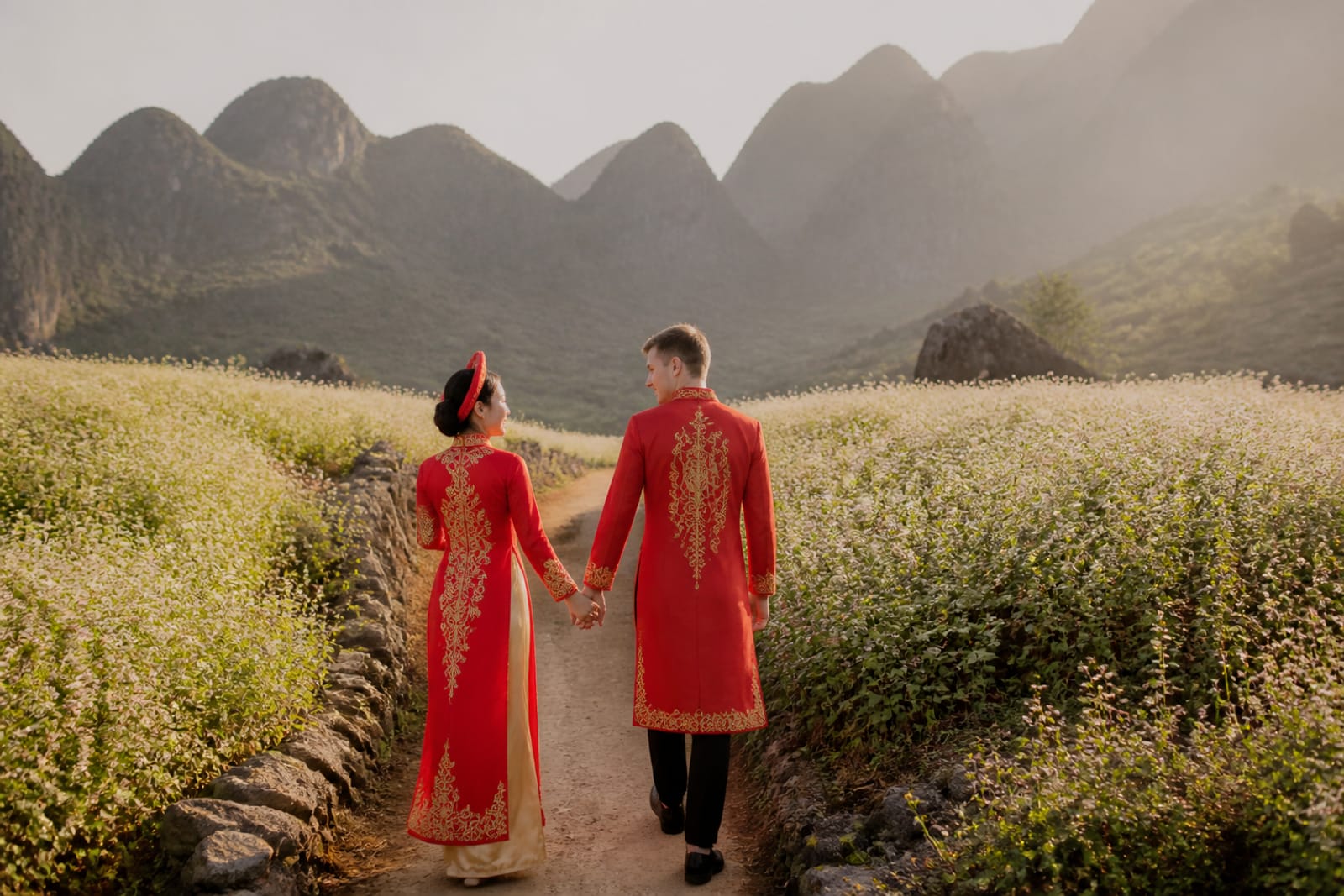
Can you legally fly a drone at Ma Pi Leng Pass?
Drones are allowed in Ha Giang Province, but Ma Pi Leng sits in a buffer zone where airspace is restricted for tourism and safety reasons. The pass itself and a 500-meter radius around the viewpoint are off-limits for drone flights. If you're shooting a film or commercial content, you'll need a separate drone permit from Ha Giang's Civil Aviation Authority, which can take weeks. Your photographer must apply in writing and submit a flight plan. Most travel photographers and couples avoid drones here and rely on wide-angle lens work from the ground instead—the landscape is dramatic enough without height. If your shoot director insists on drone footage, plan for an extra 10–14 days and ask a local production fixer to submit the application. Casual recreational flights by tourists are rarely enforced, but commercial shoots are monitored.
Which months have the best light and clearest skies?
Ma Pi Leng is at roughly 1,500 meters elevation and sits on the border of two weather systems. The dry window is Sep–Nov (early autumn, sharp light, low clouds) and Feb–Apr (pre-summer, crisp mornings, less humidity). December–January is cold (5–12°C), with grey skies and low-hanging mist—workable if you're prepared for cold outfits and muted tones, but light is flat. May–August brings afternoon rain, mist rolling in by 10 am, and humidity that fogs lenses. The light quality differs sharply: Sep–Nov gives direct, clean side light on the canyon walls by 6–7 am; Feb–Apr offers longer shadows and golden tones by 6:30 am. October is peak tourist season, so you'll share the viewpoint and sunrise slots with 50–100 people; November is quieter. Late February can be wet with unpredictable storms. Start your shoot at 5:30 am and wrap by 8:30 am to avoid midday hard light and afternoon crowds. Sunset (6–7 pm Sep–Nov, 6:30–7:30 pm Feb–Apr) also works if you avoid the backlit haze that builds late afternoon.
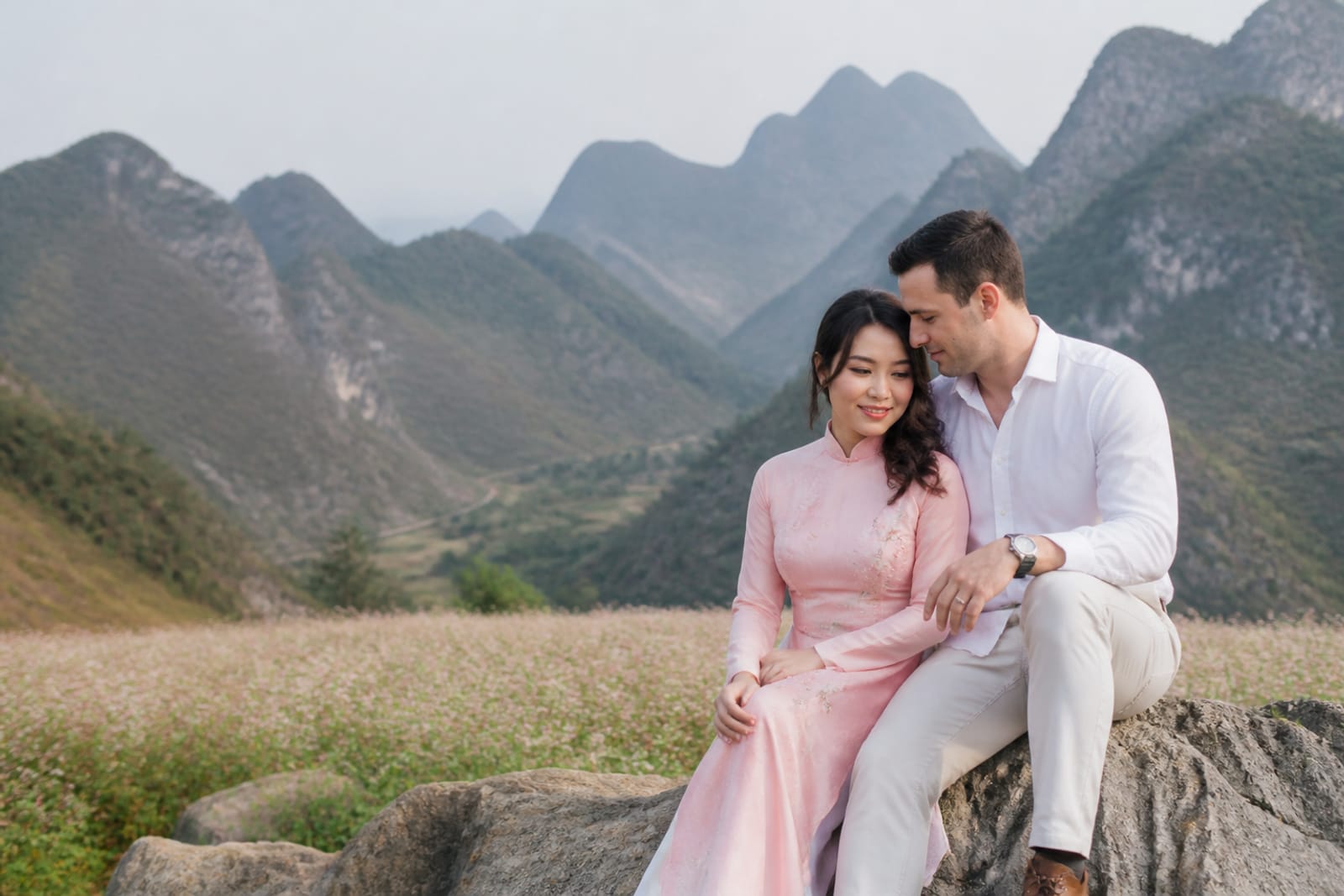
How do you compare hiring a local photographer vs. bringing your own team?
| Option | Best for | Light & season | Permits & time | Cost factor |
|---|---|---|---|---|
| Local photographer (Ha Giang-based) | Couples, elopement, documentary work | Familiar with canyon light cycles; knows sunrise timing | Handles permit; no delays | Base rate + travel from Ha Giang town (4 hrs) |
| Hanoi team traveling to Ma Pi Leng | Styled shoots, ao dai, pre-wedding with outfit changes | Bring their own lighting backup; dependent on weather windows | You or your agency arrange permit; 5–7 hr drive each way | Team fee + transport + overnight (shoot is part of multi-day Ha Giang trip) |
| DIY (your personal phone/friend with camera) | Casual elopement, self-portraits, no commercial use | Sunset/sunrise only; no backup for bad weather | No permit needed (not commercial) | Zero |
Hiring a local photographer (ask at your Ha Giang guesthouse or through a trekking guide) is fastest for permits and knows the light. Bringing Cáo Studio's pre-wedding team from Hanoi means one director handling styling, hair, makeup and camera—but you're committing to a 2-day trip and coordinating separate logistics in a remote area. A hybrid approach: book Cáo Studio for a styled shoot in Hanoi, then hire a local to capture your elopement hike at Ma Pi Leng separately. Most couples do one or the other, not both.
What weather and gear checks prevent a ruined shoot?
Before you book:
- Confirm your photographer or guide has shot at Ma Pi Leng in the past six months (conditions change; old advice is unreliable).
- Check the weather forecast 48 hours before—if rain or heavy mist is predicted, reschedule. The canyon fills with cloud by 9 am on humid days.
- If bringing a team from outside Ha Giang, hire a local assistant to carry backup batteries (cold drains them fast), extra lenses, and rain covers; Ha Giang shops won't have them.
- Wear layers (5 am is 8–10°C; afternoon sun is warm but wind is strong).
- If you're in an ao dai or formal wear, bring a windbreaker or shawl. The pass is exposed; fabric will billow unpredictably in the 10–20 km/h morning breeze. Cáo Studio offers ao dai photoshoots in Hanoi; if you're set on Ma Pi Leng, plan to do your styled ao dai shoot there and accept limited outfit changes (wind and cold limit options).
- Test your phone/camera in low light the evening before; Ma Pi Leng at 5:30 am is still dim.
- Plan for a 4-hour drive, 2.5-hour shoot (including outfit changes, walking, repositioning), and another 4-hour return—this is a full-day commitment, not a morning add-on.
On shoot day:
- Arrive at the commune office by 6 pm the evening before to confirm the permit is ready.
- Start hiking to the viewpoint by 5:15 am (15-minute walk, unlit trail).
- Shoot the first 90 minutes while light is soft and clean; by 7:30 am, shadows harden and mist rises.
- If midday shots are planned (they rarely work here), move to shaded spots under canyon overhangs or postpone to late afternoon (risk: weather degrades).
- Pack out all trash; the pass is ecologically fragile and locals are protective of it.
Who should book a shoot at Ma Pi Leng vs. book a shoot elsewhere?
Book a Ma Pi Leng shoot if: you're already doing a 3+ day Ha Giang Loop trek; you want a documentarian, minimal-outfit-change aesthetic; you're eloping and want dramatic remote landscape; you have 2–3 weeks to plan ahead (permit time). Hire a local photographer via your trekking guide or guesthouse—they know the light, have the permit relationships, and won't waste time on logistics.
Don't book Ma Pi Leng if: you want multiple outfit or ao dai changes (weather and cold limit this; consider Cáo Studio's ao dai photoshoot in Hanoi instead). You want a guaranteed sunny day (it's a mountain; mist happens and reschedule options are limited in remote areas). You're on a 1-week Vietnam itinerary and want a polished pre-wedding film (book Cáo Studio's pre-wedding sessions in Hanoi—they handle styling, hair, makeup and deliver in 48 hours, versus 2+ weeks of coordination in Ha Giang).
💄 Makeup & hair at your hotel | 🌸 See the lookbook
The simplest path: book Cáo Studio for a pre-wedding or couple photoshoot in Hanoi or Ho Chi Minh City, where one team manages everything and light is controlled. Pair it with a 2-day Ha Giang trek where you book a local photographer for candid or elopement-style shots at the pass. This splits the workload and gives you two distinct visual styles: polished and directorial in the city, raw and immersive in the mountains.
What to check before you book a shoot in Ha Giang:
- Does your photographer or guide have local credentials or a letter from the commune showing prior work permits?
- Have they shot at Ma Pi Leng in the last 6 months? Ask for sample images from that specific location and season.
- What's their backup plan if weather cancels the 5 am shoot? (Legitimate answer: reschedule within a 5-day window; unclear answer = walk away.)
- Do they provide a written itinerary with drive times, shoot duration, sunrise/sunset times, and outfit changeable moments?
- How much gear (lighting, backup batteries, rain covers) are they bringing? Remote mountain shoots need redundancy.
- Are they licensed to work commercially in Ha Giang Province? (Ask; answers vary; if unsure, have them get the commune permit before payment.)
FAQ
Do I need a permit to take photos at Ma Pi Leng Pass if I'm not hiring a photographer?
No permit is required for personal, non-commercial photos. If you're hiring a photographer or bringing a crew (stylist, makeup artist, lighting), it becomes a commercial shoot and you'll need written permission from Meo Vac commune—a 1-3 day process.
Can my photographer shoot with a drone at Ma Pi Leng?
No. The pass is in a restricted airspace buffer zone. Drones are not permitted within 500 meters of the main viewpoint. A separate Civil Aviation Authority permit takes weeks and is rarely approved for tourist shoots.
What's the best time of year to shoot at Ma Pi Leng?
September–November and February–April offer the clearest skies and best light. October is peak season (more people). December–January is cold with grey skies. May–August is wet and misty by mid-morning.
Should I hire a local Ha Giang photographer or bring my Hanoi/Saigon team?
Hire a local for speed (permits, light knowledge). Bring a Hanoi team if you want styled shoots with hair, makeup and outfit changes—but plan 2+ days and expect higher travel costs. Most couples choose one or the other.
How long does a Ma Pi Leng shoot actually take?
Count 4 hours driving round-trip, 2.5–3 hours shooting (sunrise light, outfit changes, repositioning), and a full day away. It's not a quick add-on; it's a dedicated shoot day as part of a Ha Giang trip.
Can I wear an ao dai at Ma Pi Leng Pass?
Yes, but only for a few shots. The pass is exposed, cold at dawn (8–10°C), and windy. Fabric billows unpredictably. Wear it for sunrise, then layer with a warm jacket for the rest of the day. For a full styled ao dai shoot with multiple outfits, book Cáo Studio's ao dai photoshoot in Hanoi instead. === 📸 Book on WhatsApp — pre-wedding photoshoot
FAQ
Do I need a permit to take photos at Ma Pi Leng Pass if I'm not hiring a photographer?
No permit is required for personal, non-commercial photos. If you're hiring a photographer or bringing a crew (stylist, makeup artist, lighting), it becomes a commercial shoot and you'll need written permission from Meo Vac commune—a 1-3 day process.
Can my photographer shoot with a drone at Ma Pi Leng?
No. The pass is in a restricted airspace buffer zone. Drones are not permitted within 500 meters of the main viewpoint. A separate Civil Aviation Authority permit takes weeks and is rarely approved for tourist shoots.
What's the best time of year to shoot at Ma Pi Leng?
September–November and February–April offer the clearest skies and best light. October is peak season (more people). December–January is cold with grey skies. May–August is wet and misty by mid-morning.
Should I hire a local Ha Giang photographer or bring my Hanoi/Saigon team?
Hire a local for speed (permits, light knowledge). Bring a Hanoi team if you want styled shoots with hair, makeup and outfit changes—but plan 2+ days and expect higher travel costs. Most couples choose one or the other.
How long does a Ma Pi Leng shoot actually take?
Count 4 hours driving round-trip, 2.5–3 hours shooting (sunrise light, outfit changes, repositioning), and a full day away. It's not a quick add-on; it's a dedicated shoot day as part of a Ha Giang trip.
Can I wear an ao dai at Ma Pi Leng Pass?
Yes, but only for a few shots. The pass is exposed, cold at dawn (8–10°C), and windy. Fabric billows unpredictably. Wear it for sunrise, then layer with a warm jacket for the rest of the day. For a full styled ao dai shoot with multiple outfits, book [Cáo Studio's ao dai photoshoot in Hanoi](/ao-dai-photoshoot) instead. === [📸 Book on WhatsApp — pre-wedding photoshoot](/pre-wedding-photoshoot)
Ao dai, makeup, hair and a local photographer in Hanoi or Saigon — one WhatsApp message.