/pre-wedding-photoshoot
Photography rules at Ti Top Island: permits, drones and what to check
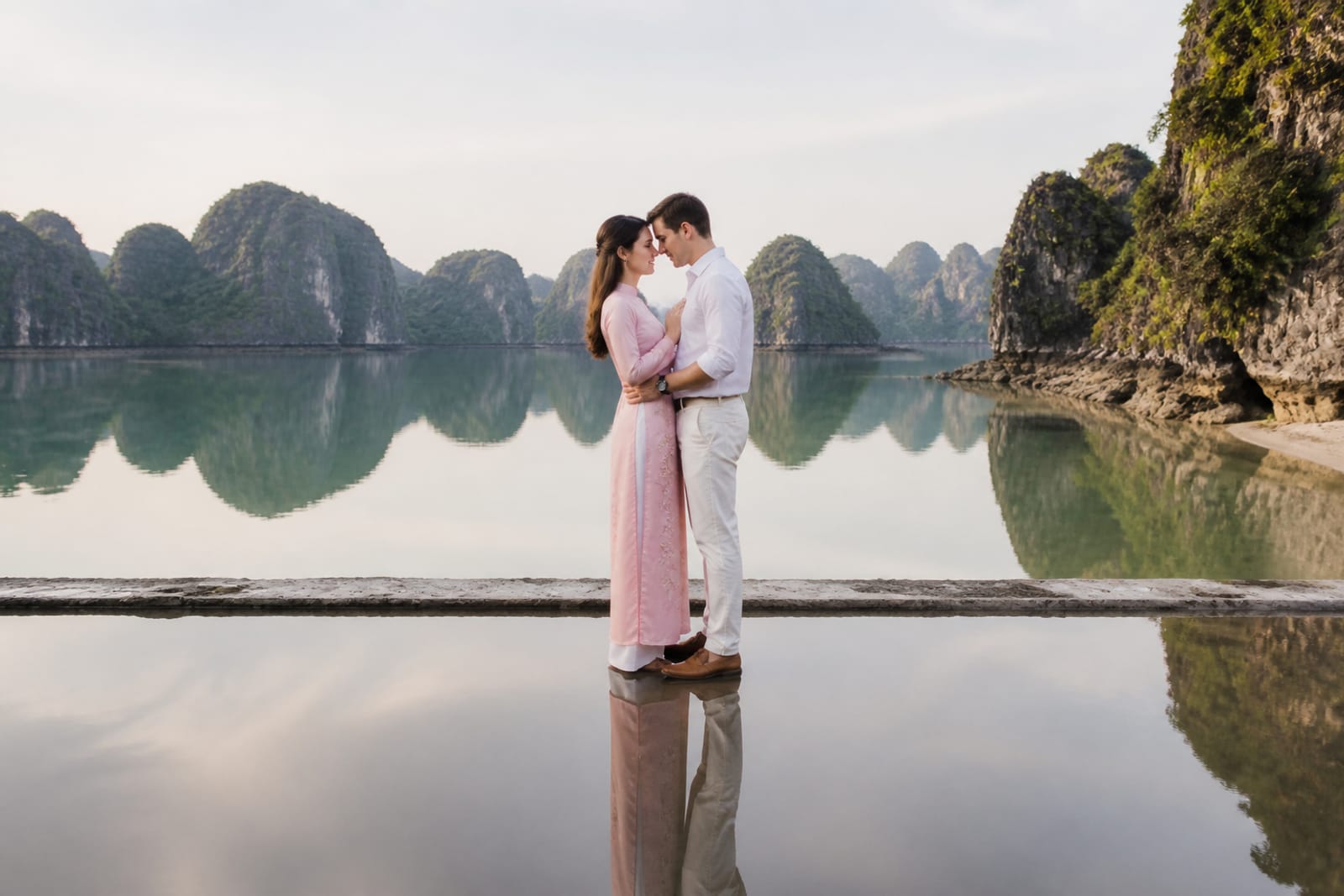
Ti Top Island (also called Titop) in Ha Long Bay is a scenic limestone peak with a panoramic viewpoint, stairs climbing through a cave, and a small beach—a popular cruise stop with strict regulations on commercial photography. Entry and basic sightseeing are allowed, but professional photoshoots (weddings, pre-wedding, portraits) require advance permits from Ha Long Bay management and the island operator; drones are banned by port authority. Most cruise operators and the port will not permit unscheduled commercial filming. Cáo Studio – Makeup & Photoshoot does not operate in Ha Long Bay; if you're set on Ti Top, you'll need to hire a local Ha Long–based photographer who holds current permits and has a relationship with the operator. Sessions there are weather-dependent (best Mar–May, Sep–Nov; Jun–Sep risks typhoon cancellations), involve boat logistics, and limited changing areas. Before booking any photographer for Ti Top, confirm in writing that they hold a permit, understand the island's no-drone policy, and have coordinated with the cruise or island operator—otherwise you risk being asked to leave mid-shoot.
Ti Top Island draws couples and pre-wedding photographers because of its dramatic limestone cave, steep staircase, and bay views—but that beauty comes with rules that trip up many bookers. The island sits in Ha Long Bay's protected marine reserve, controlled by the port authority and private cruise operators. Commercial photography is not automatically allowed; it's a special-use permit situation, not a public landmark. Permits take weeks to arrange, drones are off-limits entirely, and some operators refuse commercial shoots outright. This guide covers what to confirm before you pay a deposit, how to vet a local photographer, what to pack, and realistic timings.
Is a permit really required to shoot pre-wedding photos at Ti Top Island?
Yes. Entry to Ti Top as a day-tripper is permitted, but professional photography—defined as a scheduled session with a crew, makeup artist, multiple outfits, or any commercial intent—is a different status. Ha Long Bay Port Authority and the island concessionaire both require advance notification and, typically, a filming permit. Some cruise packages claim "free photo time," meaning snapshots during a normal visit; that's not a commercial shoot. If you're hiring a team, booking an outfit change, or paying for a dedicated session, you need a permit. Without one, security or crew can ask you to stop or leave. The permit process takes 2–4 weeks minimum and involves paperwork routed through the port authority—delays are common during Tet and peak summer.
📸 Book on WhatsApp — pre-wedding photoshoot
Why are drones completely off-limits at Ti Top?
Drones are banned throughout Ha Long Bay's controlled waters and airspace by the port authority, listed in navigation and tourism regulations. Unmanned aircraft, even if they stay within line-of-sight, pose collision risks over a busy marine reserve with multiple boats and cruises. Operators do not make exceptions for professional photographers or small craft. If you've seen drone footage labelled "Ti Top," it was likely shot illegally or from international waters offshore. Using a drone at Ti Top will result in confiscation, fines, and possible charter termination. Aerial shots of the island are available as licensed stock imagery or old archive footage; they're not part of a live shoot.
What seasons and light work best for a real shoot at Ti Top?
| Season | Light & Weather | Crowds | Suitability for Sessions | Why / Notes |
|---|---|---|---|---|
| Mar–May (spring) | Clear, soft morning light; 18–22°C | Moderate | Ideal | No typhoon risk; stable seas; good visibility for cave shots; humidity builds late May |
| Jun–Sep (summer) | Hot, bright overhead; high humidity; 26–32°C; typhoon risk | High | Risky | Cruises cancelled by port authority; afternoon heat drains energy; humidity causes makeup runoff; strong midday glare |
| Sep–Nov (autumn) | Clear; 22–26°C; last typhoons early Sep; stabilizes Sep mid-month | Moderate to high | Good (Oct–Nov best) | Best light and sea state mid-Oct to mid-Nov; early Sep still risky; good for soft morning shoots |
| Dec–Feb (winter) | Cool, grey, misty; 16–20°C | Low | Fair | Fewer tourists; calm seas; but persistent mist obscures views; limited-time windows; light is flat and cool-toned; fewer cruises run |
Best window: mid-October to mid-November, when seas are calm, light is clear, crowds are moderate, and typhoon risk is lowest. Spring (Mar–May) is second-best, though humidity rises by late May. Avoid June–early September entirely; the port frequently cancels cruises due to typhoons, and afternoon heat plus humidity will ruin makeup and energy. Winter is shootable but grey and misty—useful only if you love moody tones and accept mist-obscured backgrounds.
Light-wise, the cave staircase inside Ti Top benefits from early morning (7–9 a.m.) when diffused light enters from openings; by midday, it's dark and contrasty. The summit viewpoint is best lit 6–8 a.m. and 4–5 p.m.; midday creates hard shadows and washed-out skies. The small beach at the base is north-facing, so afternoon light is softer. Most cruises arrive 10 a.m.–2 p.m., which is the worst light window.
How do you find and vet a local photographer for Ti Top?
A Ti Top shoot requires a photographer who understands Ha Long Bay logistics, holds or can arrange permits, and has prior success on the island. Generic Hanoi studios without local contacts—or studios that claim they can "handle it"—will disappoint you. Here's how to vet a real option:
- Check permit history in writing. Ask: "Have you shot a pre-wedding/commercial session at Ti Top in the past 12 months? Show me a portfolio." If they hedge or show only tourist snapshots, they don't have a permit relationship. Legitimate photographers keep records and references.
- Confirm they've coordinated with the operator. Ask: "Which cruise operator or island concessionaire have you worked with? Can you name the contact?" Real photographers have standing relationships; they know who to call and how long approval takes.
- Get a signed booking agreement that names the island and permit status. It should state "Photography permit for Ti Top Island, Ha Long Bay, approved by [operator name] on [date]" or "Pending approval from [date]." If they won't commit this in writing, walk away.
- Ask about weather contingency. Typhoon season (Jun–Sep) means cancellations. A reliable photographer offers a rescheduling clause, not a cancellation fee.
- Check that they carry liability insurance covering marine locations. Not all do; it matters if someone is injured on the island.
Most professional pre-wedding photographers in Hanoi or Haiphong can research and arrange a Ti Top permit if you book 4–6 weeks ahead. Don't expect overnight approval. Cáo Studio – Makeup & Photoshoot operates in Hanoi, Ho Chi Minh City, and Hoi An; for Ha Long Bay shoots, you'll need a local Haiphong or Hanoi-based photographer with explicit Ti Top permits.
What do you actually pack and wear for a Ti Top shoot?
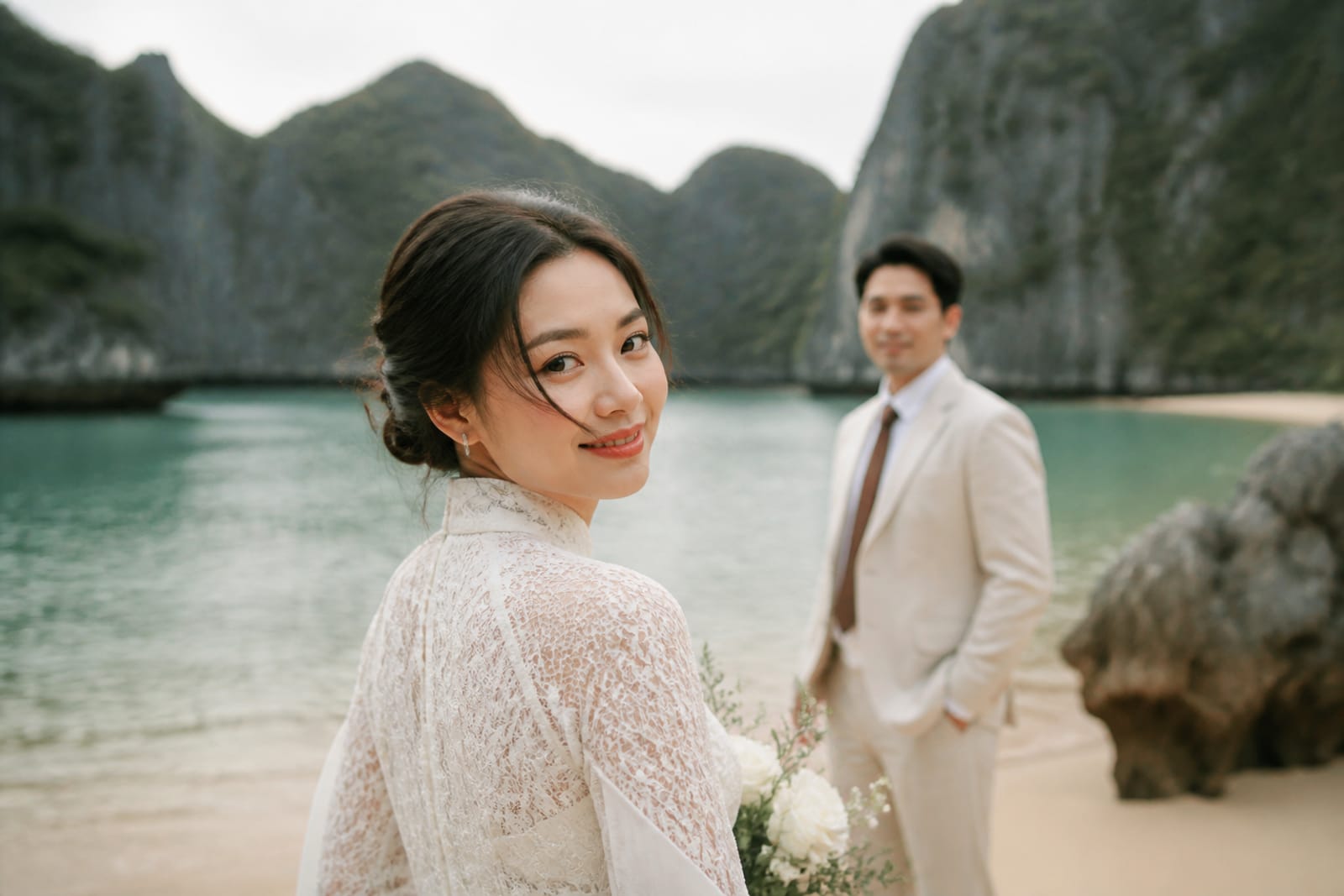
Outfits must work for the specific light and logistics of the island. The cave staircase is steep and partly slippery; the summit involves a cable handrail and exposed height. Ao dai, Western dresses, and suits can work, but there are constraints:
- Ao dai: A classic choice; the fabric drapes well in cave shadows. Avoid floor-length versions if the stairs are wet. Bring a silk underdress to prevent chafing on the metal handrail. Ao dai photographs beautifully against limestone, but the skirt catches wind at the summit—bring clips or a backup style.
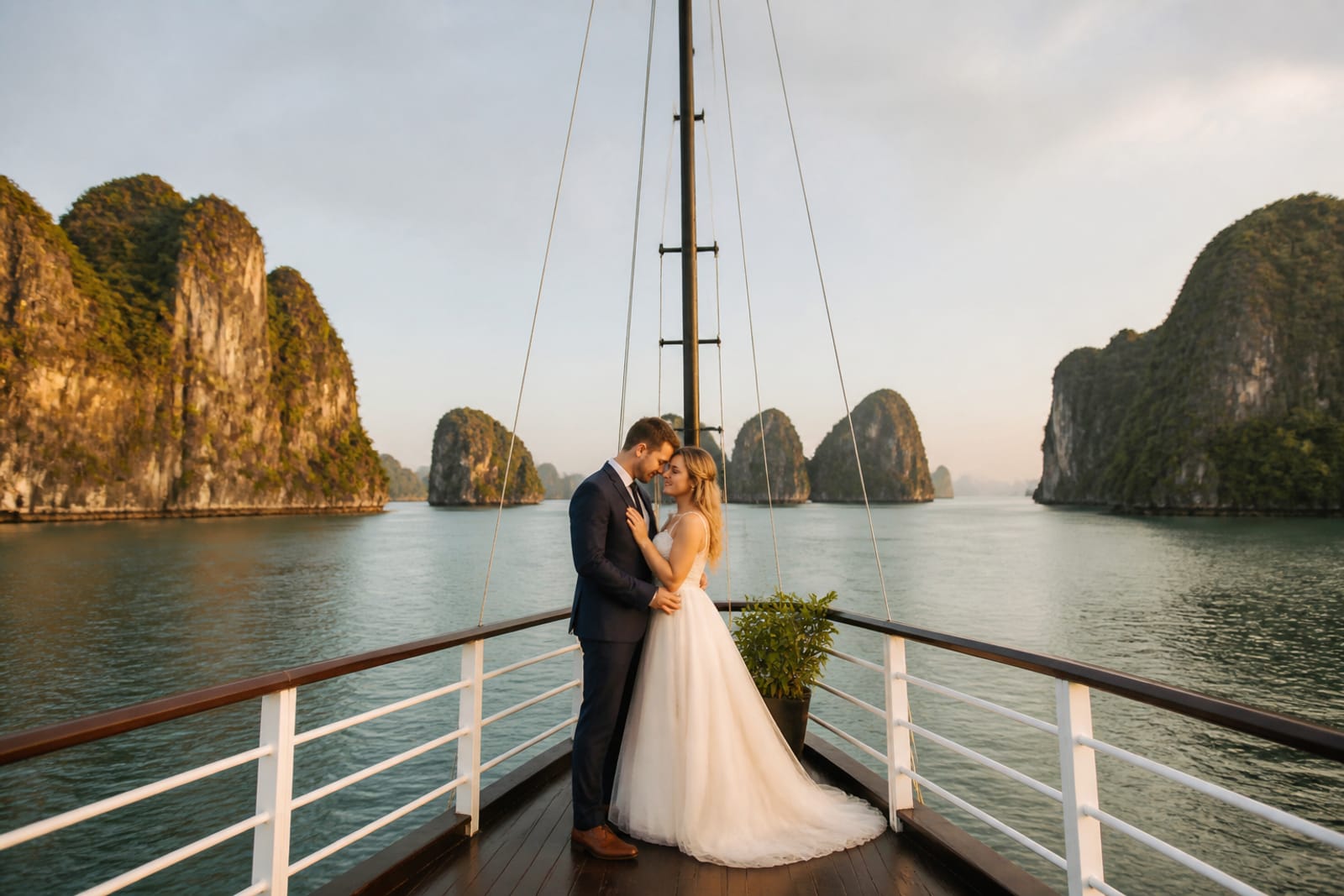
- Western dress (bridal or evening): Must be lightweight (breathable fabric, not heavy beading). Trains and long lengths are impractical on stairs and the beach. A-line or slip dresses work better than ballgowns.
- Suits and grooms' outfits: Lightweight linen or cotton blends only; wool will be soaked with sweat and humidity. Dark suits absorb midday heat; grey or natural tones photograph better in spring/autumn light.
- Footwear: Non-slip soles are essential; the stairs can be damp from sea spray or morning mist. Avoid heels (impossible on stairs). Flat sandals or minimal sports-style shoes are best, though they won't appear in summit shots.
- Changing areas: There is no private changing room on Ti Top. You'll change in a boat cabin or a small rock shelter on the beach—tight, humid, and without mirrors or good lighting. Bring pre-pinned makeup touch-ups, a compact mirror, and accept that garment changes will be rushed.
Makeup must account for humidity and salt spray. A makeup artist experienced in marine shoots uses setting spray, waterproof products, and lightweight foundations. Long sun-exposure times mean SPF primers and touch-up kits are essential. Makeup & hair at your hotel can prepare you in Hanoi before travel; for a Ti Top session, your local photographer should coordinate a makeup artist who knows the island.
What's the realistic timeline and cost factors for a Ti Top shoot?
A typical session involves:
- Permit application: 3–4 weeks before your desired date (longer during Tet or peak summer).
- Boat logistics: Hire a private longtail or small charter; cruises rarely accommodate formal photography schedules. Boats leave from Hanoi or Haiphong and take 1.5–3 hours each way depending on launch point.
- On-island time: 2–3 hours (most cruises allow 1–1.5 hours; a private charter can extend this). Factor cave exploration (30 min), summit visit (30 min), beach/lower shots (30–60 min), and outfit changes.
- Crew and services: A photographer, likely an assistant or guide, and ideally a makeup artist. The artist may need to travel from Hanoi, adding cost and logistical coordination.
Cost factors (never amounts; ask for quotes on WhatsApp):
- Permit fees (applied by the port or operator; varies by season and special requests).
- Private boat charter (depends on group size, season, and launch location).
- Photographer day rate (Ti Top requires experience and permit knowledge; expect premium pricing vs. inland sessions).
- Makeup artist travel and on-site service (if based in Hanoi or Haiphong).
- Outfit rental or purchase (ao dai, bridal dress, groom suit; see ao dai rental, wedding dress rental, suit rental).
- Backup/contingency days (typhoon season means rescheduling; confirm the photographer's policy).
A realistic Ti Top session will take 8–10 hours (travel + on-island work) and require coordination 6–8 weeks before your date. If you're set on Ti Top, budget significantly more time and cost than an inland Hanoi or Hoi An pre-wedding photoshoot.
What to check before you book: a pre-shoot checklist
Before you pay a deposit to any photographer for Ti Top Island, confirm all of these in writing:
- [ ] Photographer has shot a professional session at Ti Top in the past 12 months (ask for portfolio proof).
- [ ] They hold or can arrange a filming permit from the Ha Long Bay Port Authority and the island operator; they'll provide a copy when approved.
- [ ] Permit covers your specific date and number of crew (photographer, makeup artist, assistant).
- [ ] They've named the cruise operator or private boat charter and confirmed capacity for your group and outfits.
- [ ] No drones will be used (it's a written confirmation, not an assumption).
- [ ] Makeup and hair services are either included or they've pre-arranged a local makeup artist; confirm she/he has experience with marine humidity and salt spray.
- [ ] Your outfit choices (ao dai, dress, suit) have been approved for the stairs and weather conditions.
- [ ] Weather contingency and rescheduling terms are in the booking contract (typhoon season, especially Jun–Sep, is high-risk).
- [ ] Backup shooting location (if Ti Top permit is denied or sea state deteriorates on the day, what's the alternative?).
- [ ] Delivery timeline for edited images (confirm the number of edited photos and delivery weeks).
If a photographer can't or won't confirm these points in writing, look elsewhere. A vague commitment to "try" or "arrange later" is a red flag.
---
If Ti Top Island is non-negotiable for your vision, start your permit and photographer search 8–10 weeks before your target date. For a simpler, faster pre-wedding photoshoot, consider Hanoi locations (Old Quarter, Hoan Kiem Lake, French Quarter) or Hoi An's Ancient Town—both are permit-free and offer stunning light without marine logistics. Cáo Studio – Makeup & Photoshoot and our Hoi An team can arrange full sessions with makeup and styling in 2–3 weeks. Explore our pre-wedding photoshoot options and check our FAQ for more on logistics.
FAQ
Can we shoot at Ti Top Island as part of a regular cruise?
Cruises include a brief stop (1–1.5 hours) for sightseeing and snapshots. Professional photoshoots with a crew, multiple outfits, or makeup are not permitted during a regular cruise slot. You'll need a private charter and a formal permit, which the cruise operator cannot facilitate.
What happens if we arrive and the permit hasn't been approved?
You won't be allowed to dock or conduct a commercial shoot. The island operator checks permits at the pier. Without one, you'll be asked to leave or move to a different location. This is why confirming permit status 2 weeks before your date is critical; if approval is delayed, you have time to reschedule.
Can we hire a Hanoi photographer to shoot at Ti Top, or do we need someone local?
Either can work if they hold Ti Top permits and have coordinated with the operator. A Hanoi-based photographer with prior Ti Top experience can travel; a Haiphong or Ha Long–based photographer may have faster approval. The key is permit history, not location. Ask for references from their past Ti Top shoots.
Is makeup and hair practical on a boat or at Ti Top?
Makeup can be applied on the boat before arrival, but touch-ups at Ti Top are limited (small rock shelter or boat cabin, no mirrors, salt spray). Hair should be styled before boarding and secured for wind and humidity. If your photographer recommends a makeup artist, confirm she/he has marine experience and can work in confined spaces.
Why is our Ti Top quote so much higher than a Hanoi pre-wedding shoot?
Ti Top involves permit costs, private boat charter, longer crew day, and logistics risk (typhoon cancellations, rescheduling). A Hanoi pre-wedding photoshoot is permit-free, uses known light and locations, and can be scheduled with 2–3 weeks' notice. Ti Top requires 8–10 weeks and absorbs permit fees, marine transport, and contingency buffers. The cost reflects real operational complexity, not markup.
What if a typhoon cancels our shoot and we've already paid?
This depends on your photographer's booking terms. A reputable photographer offers rescheduling to a new date (within the season) or a partial refund, minus permit and admin fees. Always confirm the cancellation and force-majeure clause in writing before you book. Typhoon season (Jun–Sep) is high-risk; spring (Mar–May) and autumn (Oct–Nov) are safer.
FAQ
Can we shoot at Ti Top Island as part of a regular cruise?
Cruises include a brief stop (1–1.5 hours) for sightseeing and snapshots. Professional photoshoots with a crew, multiple outfits, or makeup are not permitted during a regular cruise slot. You'll need a private charter and a formal permit, which the cruise operator cannot facilitate.
What happens if we arrive and the permit hasn't been approved?
You won't be allowed to dock or conduct a commercial shoot. The island operator checks permits at the pier. Without one, you'll be asked to leave or move to a different location. This is why confirming permit status 2 weeks before your date is critical; if approval is delayed, you have time to reschedule.
Can we hire a Hanoi photographer to shoot at Ti Top, or do we need someone local?
Either can work if they hold Ti Top permits and have coordinated with the operator. A Hanoi-based photographer with prior Ti Top experience can travel; a Haiphong or Ha Long–based photographer may have faster approval. The key is permit history, not location. Ask for references from their past Ti Top shoots.
Is makeup and hair practical on a boat or at Ti Top?
Makeup can be applied on the boat before arrival, but touch-ups at Ti Top are limited (small rock shelter or boat cabin, no mirrors, salt spray). Hair should be styled before boarding and secured for wind and humidity. If your photographer recommends a makeup artist, confirm she/he has marine experience and can work in confined spaces.
Why is our Ti Top quote so much higher than a Hanoi pre-wedding shoot?
Ti Top involves permit costs, private boat charter, longer crew day, and logistics risk (typhoon cancellations, rescheduling). A [Hanoi pre-wedding photoshoot](/pre-wedding-photoshoot) is permit-free, uses known light and locations, and can be scheduled with 2–3 weeks' notice. Ti Top requires 8–10 weeks and absorbs permit fees, marine transport, and contingency buffers. The cost reflects real operational complexity, not markup.
What if a typhoon cancels our shoot and we've already paid?
This depends on your photographer's booking terms. A reputable photographer offers rescheduling to a new date (within the season) or a partial refund, minus permit and admin fees. Always confirm the cancellation and force-majeure clause in writing before you book. Typhoon season (Jun–Sep) is high-risk; spring (Mar–May) and autumn (Oct–Nov) are safer.
Ao dai, makeup, hair and a local photographer in Hanoi or Saigon — one WhatsApp message.