/pre-wedding-photoshoot
Phu Quoc or Quy Nhon for pre-wedding photos
Phu Quoc suits couples wanting tropical island drama with calm western-coast sunsets (best Nov–Apr, dry season); it's busier, has strong colour and works best with a photographer who knows the Kiss Bridge and Sunset Town timing. Quy Nhon offers rugged limestone cliffs, quieter beaches and a more intimate feel (dry Feb–Aug); fewer tourists mean more flexibility with light and location. Neither destination hosts a Cáo Studio base—both require a local photographer or coordination through a Hanoi or Saigon team. Choose Phu Quoc for bold colour and island energy; Quy Nhon for moody cliffs and solitude. Each demands a photographer versed in that coast's light angle, tidal schedules and crowd patterns. 📸 Book on WhatsApp — pre-wedding shoots | 🌸 See the lookbook
Which destination matches your couple's style?
Phu Quoc delivers saturated colour and resort-resort vibes; Quy Nhon whispers intimacy through weathered stone. Neither is objectively "better"—it hinges on whether you want volume or restraint. Phu Quoc's beaches and developed infrastructure (hotels, restaurants, transport) appeal to couples who treat the shoot as part of a larger holiday; you're not roughing it. Quy Nhon demands a slower pace and rewards patience—golden hour here lasts longer, shadows are kinder, and an empty beach at dawn isn't a miracle, it's routine. Ask yourself: does the couple want to be seen in the frame, or feel present in it? Phu Quoc leans the first way; Quy Nhon the second.
How does light behave differently on each coast?
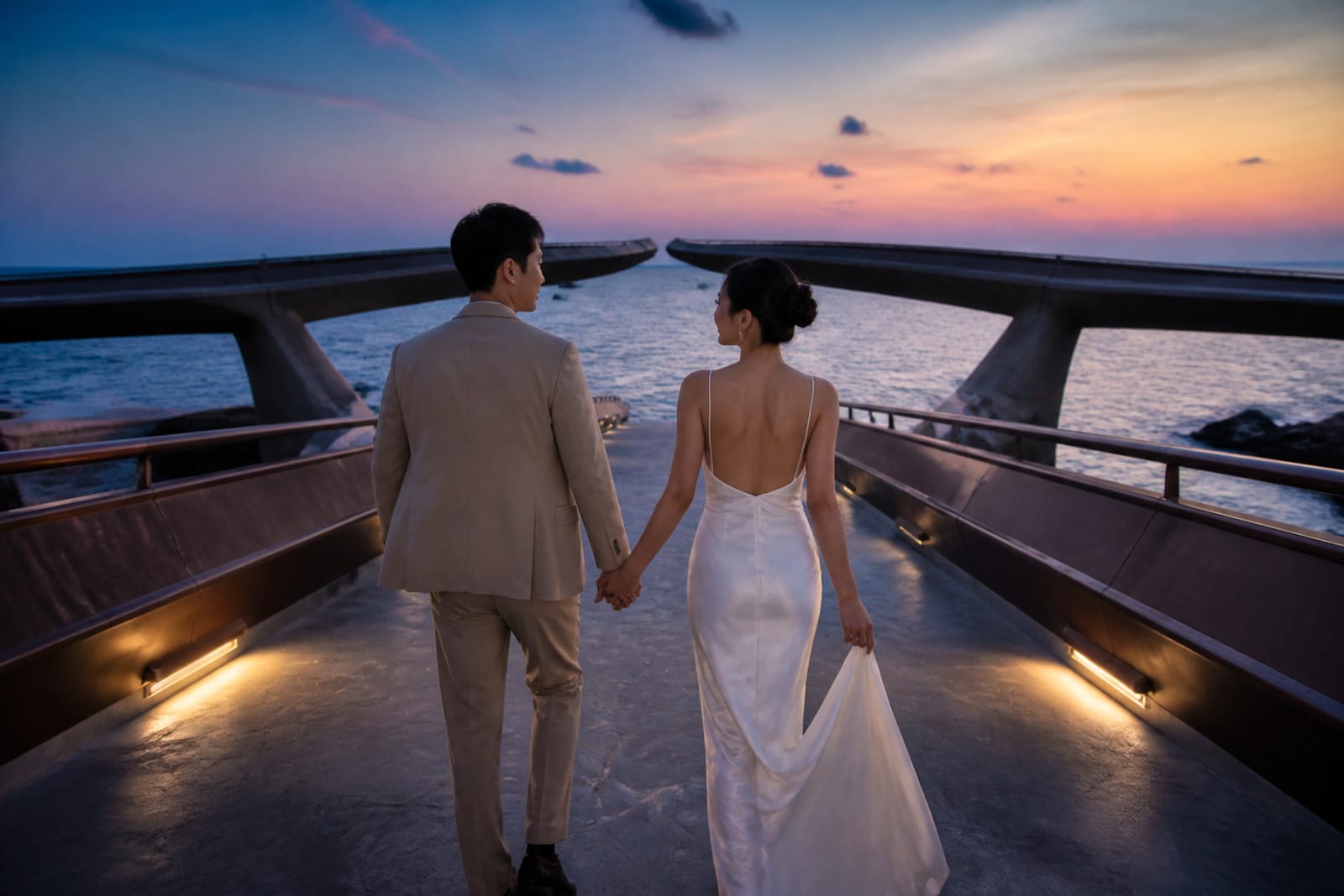
Phu Quoc's western beaches catch full sunset glow from 5:30 pm onward (dry season); the sun drops fast, so you have thirty minutes of usable colour before flat blue. The Kiss Bridge and Sunset Town face west directly—predictable, strong, sometimes blown-out if you're not careful. Quy Nhon's limestone cliffs (Eo Gio, Ghenh Rang) face east and north; morning light is soft and directional, raking across rock texture without harshness. By afternoon the cliffs throw deep shadow, which can feel moody or flat depending on your eye. Sunrise at Quy Nhon is quieter and often clearer; sunset at Phu Quoc is the whole event. A photographer who understands this difference will shoot Phu Quoc at 5:20 pm and Quy Nhon at 6:30 am—opposite rhythms, both timed to one usable hour.
| Aspect | Phu Quoc | Quy Nhon |
|---|---|---|
| Best season | Nov–Apr (dry, calm sea) | Feb–Aug (dry, no typhoons) |
| Light character | Direct, saturated, fast-moving | Soft, raking, lingers in shadow |
| Crowds | Peak Dec–Feb, busy resorts | Quieter year-round, fewer tourists |
| Sunrise/sunset | Sunset is the draw; sunrise flat | Sunrise dramatic; sunset haze |
| Beach access | Developed, facilities nearby | More remote, fewer services |
| Outfit fit | Bright ao dai, resort whites pop | Muted tones, traditional fabrics suit cliffs |
| Walking effort | Flat sand, easy movement | Uneven rock, worn paths, wear grip shoes |
What happens in the wet season at each place?
Phu Quoc (May–Oct) sees afternoon downpours, rougher western seas and haze that kills sunset colour. Beaches still exist, but the vibe shifts—rain is frequent, humidity is thick, and "golden hour" becomes "grey hour." If a couple is set on Phu Quoc's dry-season look, don't shoot May–October. Quy Nhon (Sep–Dec) enters typhoon season; October–November is riskiest for rain and rough swells. The upside: between downpours, light breaks through cloud in dramatic shafts—moody, cinematic, risky. Many photographers avoid this window; others chase it. Be honest with your couples: wet season means rescheduling risk, fewer outfit changes (wet hair and makeup don't reset), and shorter shooting windows. Book the shoot, plan backup dates and choose a photographer comfortable with rapid light shifts.
How do you find and vet a local photographer in each place?
Neither Phu Quoc nor Quy Nhon hosts a Cáo Studio team—you'll hire local talent or coordinate through Hanoi or Saigon. For Phu Quoc, ask hotels and resort concierges for photographer referrals; cross-check Instagram portfolios for how they light sunsets (crisp colour or blown-out?), where they shoot (always the same bridge?), and whether couples look directed or stiff. For Quy Nhon, the talent pool is smaller; look for photographers who've shot the cliff faces and understand tidal access. Ask every prospect: Have you shot your chosen location in this month? What time do you arrive? Do you scout the light first? A photographer who answers vaguely ("We'll find a nice spot") is guessing. One who names the hour, the angle and the backup plan is thinking. Request a contract that names locations, time window and rescheduling terms—wet-season shoots especially need clarity on refunds or rebooked dates.
What should you pack and wear to each location?
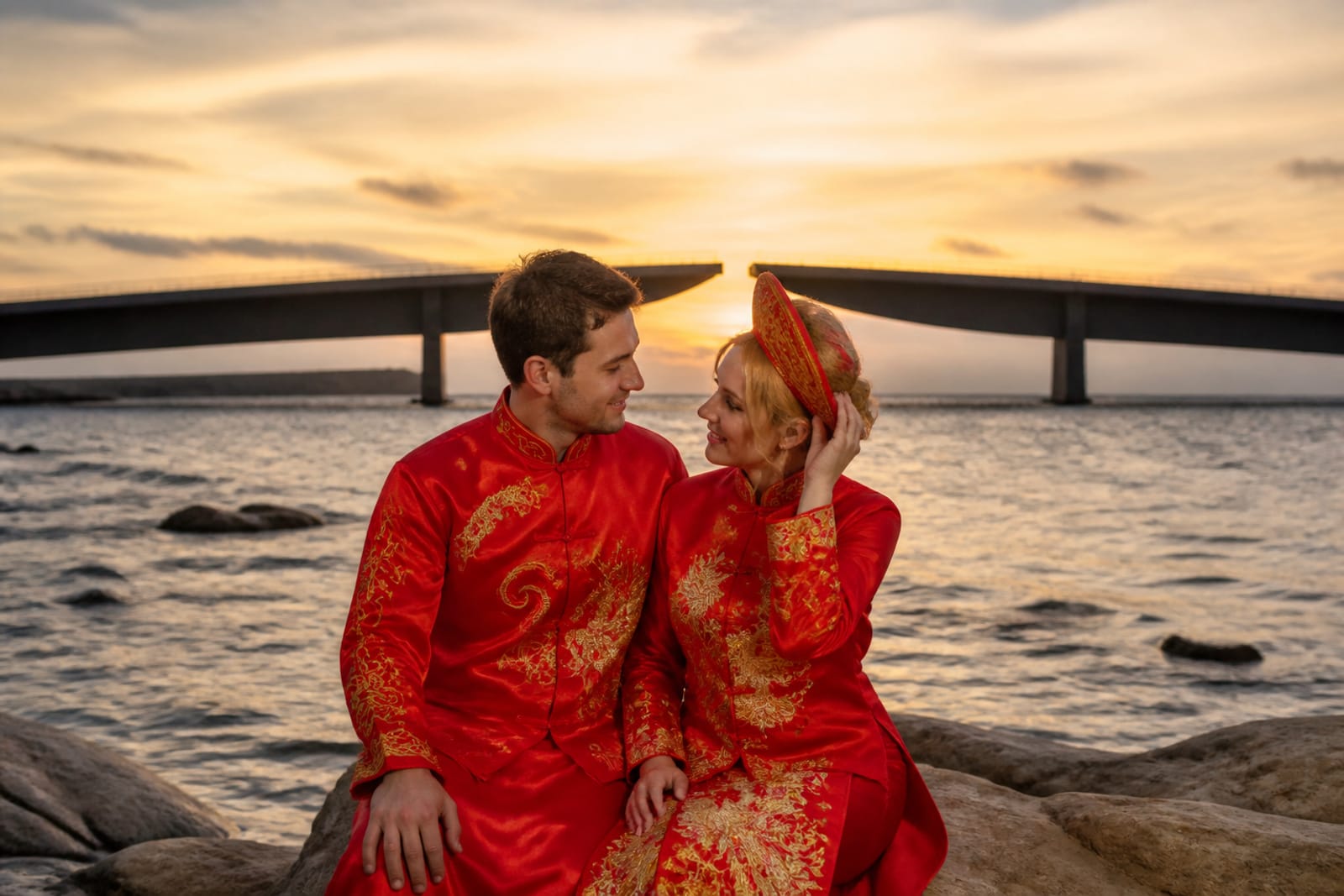
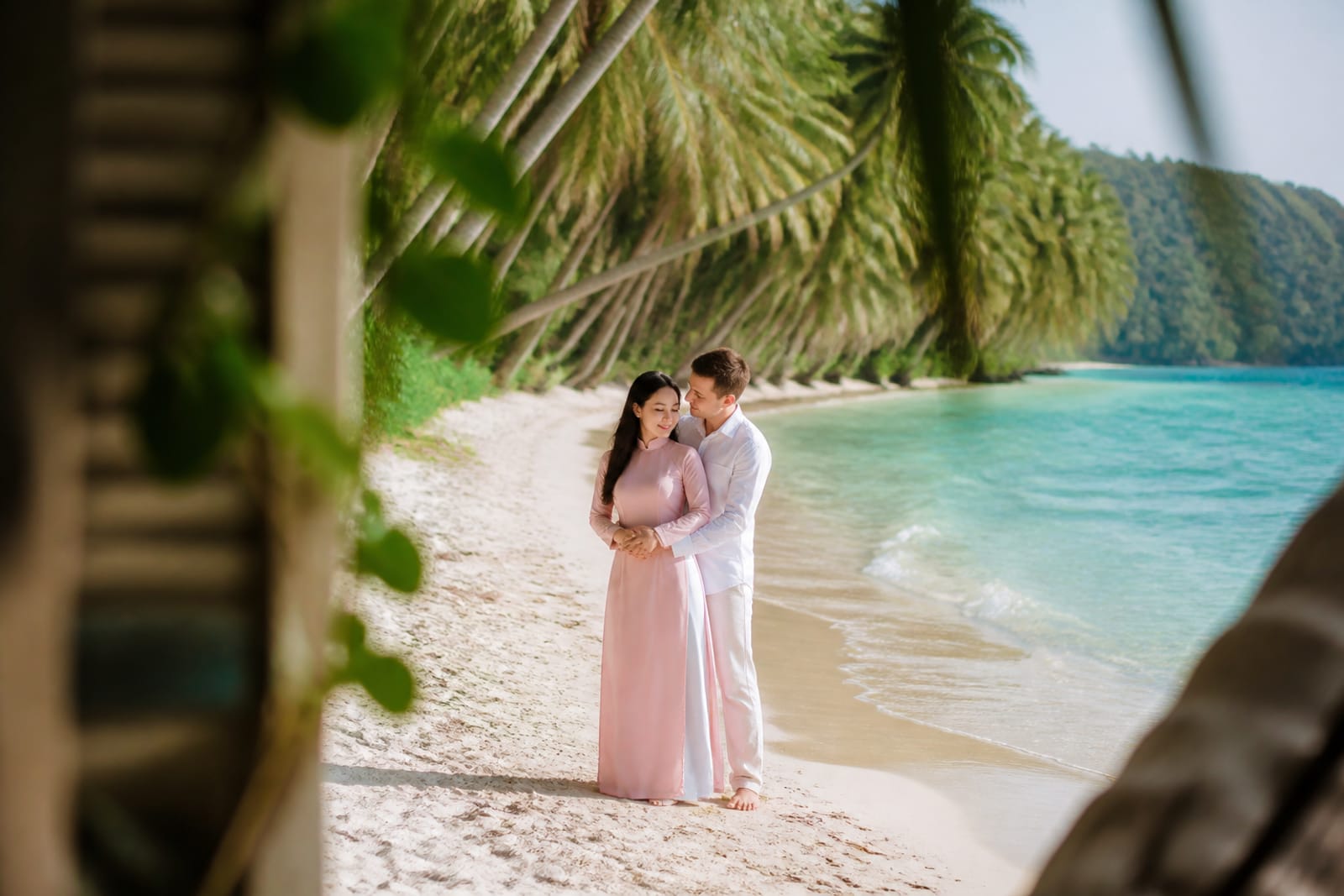
Phu Quoc's humidity and sand demand lightweight ao dai in breathable silk; white and pastels read against blue sky, but they show sweat fast. Pack a plain cotton robe for reapplication of makeup between outfit changes, and water-resistant shoes for beach walking (sand in formal footwear is a shoot-killer). Bring a sun hat and stay hydrated—golden hour is intense, and dehydration hollows the face. Quy Nhon's cliffs mean sturdy, grippy shoes (rocks are worn smooth and slick); ao dai in deeper or textured fabrics (jade, burgundy, subtle patterns) photograph better against grey stone than bright white. Humidity is lower, sweat is less of a crisis, but wind is real—secure hair and choose fabric weight accordingly. Both locations benefit from a light shawl or wrap (styling and wind management). Ask your photographer what they've seen work best in that month at that spot—their answer beats generic advice.
---
What to check before you book a pre-wedding shoot
- Season fit: Is your target date in the dry window for that coast? If not, accept haze or reschedule.
- Photographer's portfolio: Do their best shots come from your chosen location in your chosen month?
- Outfit plan: Will you rent locally or bring pieces? Coordinate this early—humidity and salt water are hard on ao dai.
- Backup dates: If weather closes the shoot, when can it reschedule? Get this in writing.
- Transport time: Will the photographer include travel, or do you meet on-site? Factor this into your shoot window.
- Makeup & hair: Does the photographer's contact team hair and makeup, or will you hire separately? Coordination matters—one unified team shoots faster and more cohesively.
For pre-wedding shoots in Hanoi or Saigon, Cáo Studio handles outfit, hair, makeup and photography as one team, turning around edited images and a short film in 48 hours. That integrated approach isn't available in Phu Quoc or Quy Nhon—you'll coordinate three or four vendors separately. It's possible, but slower and riskier. If you're open to a shoot in Hanoi or Saigon instead, or a hybrid (one session at base, one in Phu Quoc or Quy Nhon), ask on WhatsApp—Cáo Studio can guide the local hire or co-direct remotely.
💄 Makeup & hair at your hotel | 📸 Book on WhatsApp — pre-wedding shoots
How Cáo Studio could support a Phu Quoc or Quy Nhon shoot
If you're already booking a couple session in Hanoi or Saigon, Cáo Studio can help you prepare for a second shoot elsewhere. We can advise on timing, outfit layering, and how to brief a local photographer on the specific light you want. We've worked with couples on multiple destinations—Cáo Studio handles the primary pre-wedding photoshoot and coordinates the secondary one. Or, if your whole timeline is flexible, consider bringing your pre-wedding shoot to Hanoi or Saigon, where one team (outfit, hair, makeup, photography) means no vendor friction and guaranteed creative alignment. Ask on WhatsApp about hybrid plans or local-photographer briefing.
---
Practical next steps
- Confirm your dates. Check the dry season window for your chosen coast. Phu Quoc: Nov–Apr. Quy Nhon: Feb–Aug (avoid Sep–Dec for typhoon risk).
- Request portfolio samples. Find a local photographer and ask for 5–10 shots from your chosen location in the same calendar month you're planning.
- Visit the light yourself, if possible. Scout the spot at golden hour (sunset for Phu Quoc, sunrise for Quy Nhon). See the angle, the shadows, the crowds.
- Define the shot list. Work with your photographer to name 3–5 key moments (walking into frame, looking at each other, detail of hands/rings). Avoid stiff poses.
- Plan outfits and hair. Book makeup and hair at least one week before. Ask whether they're comfortable with ao dai styling and sand/salt spray.
- Lock rescheduling terms. Wet season especially: get in writing what happens if rain closes the shoot.
🌸 See the lookbook | 📸 Book on WhatsApp — pre-wedding shoots
---
FAQ
Can Cáo Studio shoot my pre-wedding in Phu Quoc or Quy Nhon?
No—Cáo Studio operates only in Hanoi, Ho Chi Minh City and Hoi An. We can advise you on hiring a local photographer or coordinate a second shoot in one of our bases. Ask on WhatsApp for guidance on finding and briefing talent in Phu Quoc or Quy Nhon.
What's the best time to shoot pre-wedding photos in Phu Quoc?
November through April (dry season): calm sea, clear sunsets, stable weather. December–February is busiest. Dry-season light is strongest at 5:30–6:00 pm on western beaches like Sunset Town and the Kiss Bridge. Avoid May–October (rain, haze, rough seas).
Is Quy Nhon easier to shoot than Phu Quoc?
Quieter, yes—fewer tourists and more flexible light windows. But the terrain is rockier; you need grippy shoes and a photographer who knows tidal access. Quy Nhon rewards patience; Phu Quoc demands speed. Different difficulties, not easier or harder.
Do I need to hire hair and makeup separately in these locations?
Most likely, yes. Neither Phu Quoc nor Quy Nhon has studio-based hair and makeup teams like Hanoi or Saigon do. Ask your photographer for referrals, or hire an artist locally and coordinate timing carefully—ideally arriving on-site 90 minutes before your shoot window.
How long is a typical pre-wedding shoot at each location?
Usually 2–3 hours, timed to one golden-hour window (5:30–7:00 pm for Phu Quoc sunset; 6:00–7:30 am for Quy Nhon sunrise). Ask your photographer to confirm the exact time window and whether it includes scouting, outfit changes or outfit-specific touch-ups.
Should I bring my ao dai or rent locally?
Bring it if you have a fit you trust—sand, salt spray and humidity are hard on fabric. If shipping is risky, rent locally (Phu Quoc and Quy Nhon have rental shops; ask your photographer for vetted contacts). Plan outfit swaps 30–40 minutes before each golden hour, not during it.
FAQ
Can Cáo Studio shoot my pre-wedding in Phu Quoc or Quy Nhon?
No—Cáo Studio operates only in Hanoi, Ho Chi Minh City and Hoi An. We can advise you on hiring a local photographer or coordinate a second shoot in one of our bases. Ask on WhatsApp for guidance on finding and briefing talent in Phu Quoc or Quy Nhon.
What's the best time to shoot pre-wedding photos in Phu Quoc?
November through April (dry season): calm sea, clear sunsets, stable weather. December–February is busiest. Dry-season light is strongest at 5:30–6:00 pm on western beaches like Sunset Town and the Kiss Bridge. Avoid May–October (rain, haze, rough seas).
Is Quy Nhon easier to shoot than Phu Quoc?
Quieter, yes—fewer tourists and more flexible light windows. But the terrain is rockier; you need grippy shoes and a photographer who knows tidal access. Quy Nhon rewards patience; Phu Quoc demands speed. Different difficulties, not easier or harder.
Do I need to hire hair and makeup separately in these locations?
Most likely, yes. Neither Phu Quoc nor Quy Nhon has studio-based hair and makeup teams like Hanoi or Saigon do. Ask your photographer for referrals, or hire an artist locally and coordinate timing carefully—ideally arriving on-site 90 minutes before your shoot window.
How long is a typical pre-wedding shoot at each location?
Usually 2–3 hours, timed to one golden-hour window (5:30–7:00 pm for Phu Quoc sunset; 6:00–7:30 am for Quy Nhon sunrise). Ask your photographer to confirm the exact time window and whether it includes scouting, outfit changes or outfit-specific touch-ups.
Should I bring my ao dai or rent locally?
Bring it if you have a fit you trust—sand, salt spray and humidity are hard on fabric. If shipping is risky, rent locally (Phu Quoc and Quy Nhon have rental shops; ask your photographer for vetted contacts). Plan outfit swaps 30–40 minutes before each golden hour, not during it.
Ao dai, makeup, hair and a local photographer in Hanoi or Saigon — one WhatsApp message.