/pre-wedding-photoshoot
Pre-wedding photo ideas and poses at Ba Son Bridge, Hanoi
Ba Son Bridge—a 1902 French colonial iron-steel span crossing the Red River in central Hanoi—offers dramatic foreground arches, layered water reflections, and golden-hour silhouettes that work for pre-wedding couples. Sessions run 1–2 hours: you arrive mid-morning or late afternoon (harsh midday sun ruins skin tone and casts hard shadows), walk the bridge for wide shots and couple embraces under the arches, then move to riverside access points for reflection frames and detail poses. Cáo Studio – Makeup & Photoshoot books Ba Son as part of pre-wedding shoots in Hanoi—makeup is applied at your hotel first, travel time to Ba Son is included, and the photographer knows how to position you to avoid glare and catch the bridge's best angles. Avoid Tet week (crowds, closed access) and the May–September heat; book February–April or September–November for comfortable light and cooler mornings.
Ba Son Bridge draws couples because its scale, history, and photogenic geometry feel both romantic and editorial. Unlike trendy café backdrops, it's a working bridge with free public access—but that means light, timing, and pose choice matter more. We guide couples through the real logistics.
What makes Ba Son Bridge special for pre-wedding photos?
Ba Son Bridge's 1902 French colonial design gives you layered composition: the double-arch structure frames couples in silhouette or backlit profile, the Red River below creates mirror effects during calm-water mornings, and Hanoi's skyline fills the far background. The bridge itself is elevated—you're not shooting at street level—so perspective shifts as you move.
The wrought-iron railings let you frame tighter couple portraits; the stone pylons anchor wide establishing shots. Sunrise and sunset (5:30–6:30 a.m., 5:00–6:30 p.m. depending on season) cast warm, directional light that flatters skin and dramatizes the arch shadows. The bridge's midpoint is highest—walking toward the far shore, you gain new angles every 20 meters.
No permit is required for couples posing on the bridge itself, but the riverbank below (if you want reflection shots or ground-level framing) may have local vendors or informal "watchers"—a small respectful acknowledgment costs nothing.
📸 Book on WhatsApp — pre-wedding photoshoot
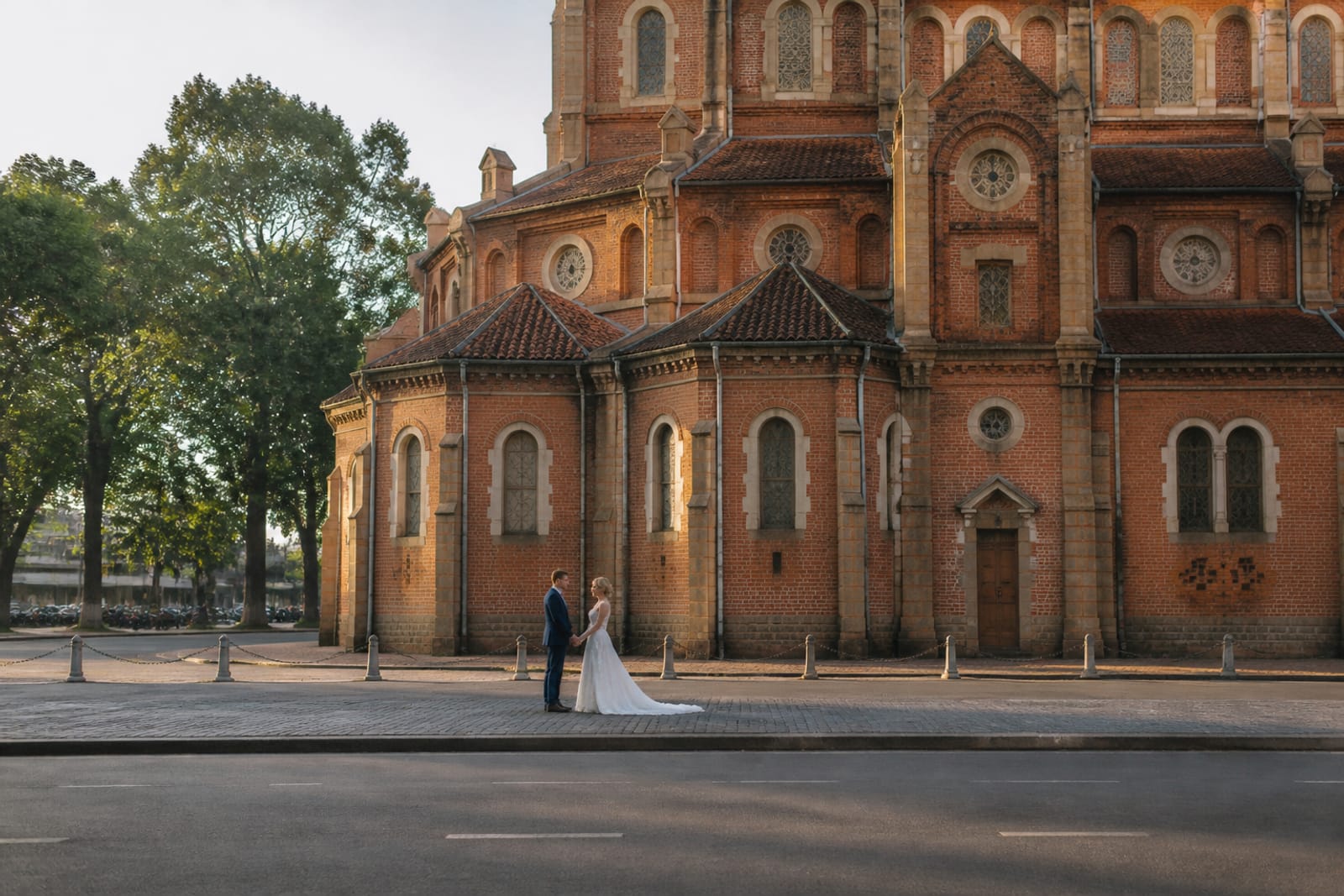
Which pre-wedding poses work best on a bridge arch?
Poses fall into two types: framed (couple inside the arch) and silhouette (couple centered, arch behind). Framed poses mean you stand close, arms linked or hands clasped at waist, light coming from one side—the photographer shoots from the opposite side to catch rim light on your shoulders. Walk slowly forward together—the motion reads as narrative, not static. Sit on the walkway (wear protection: bring a light shawl or stand tall) and frame the skyline behind; lean on the railing and look toward the river, letting the bridge's geometry anchor the composition.
Silhouettes work best 20–30 minutes before sunset: the couple is backlit, the bridge arch glows, and the sky shifts from warm orange to cool blue in real time. You'll need trust—the photographer shoots through the glare, and trust that the backlit outline feels intentional, not blown-out. Detail shots—your hands on the railing, feet, ring, veil corner—fill gaps between full-frame poses.
Walk the bridge as if discovering it (not modeling). That naturalness reads in the final image.
Which season and time of day gives the best light?
| Season | Best for | Light quality | Why it works |
|---|---|---|---|
| Feb–Apr (Spring) | Golden hour depth | Warm, directional, low glare | Clear skies, cool enough for midday breaks; morning mist on river adds texture |
| May–Sep (Summer) | Fast turnaround | Bright but variable | Heat, humidity, harsh noon shadows; early morning (5:30–6:30 a.m.) is best window |
| Oct–Nov (Autumn) | Consistent color | Soft, stable golden hour | Slightly humid; morning light stable 2+ hours; evening reflection water calm |
| Dec–Jan (Winter) | Crisp silhouettes | Cool-toned, long shadows | Grey skies can flatten; midday sun is still low; dress warmly (light layers). Avoid Tet (late Jan–mid Feb) due to crowds and partial closures |
Morning (6:00–8:30 a.m.): minimal people, smooth water, cool air, camera-ready makeup without sweat reapplication. Light is directional; the sun rises from the east, leaving the bridge's eastern arch in shadow (good for backlit rim-light). Walk the bridge east-to-west to keep light at your side.
Late afternoon (4:30–6:30 p.m., depending on season): more foot traffic, but dramatic warm tones, river reflects the sky more intensely, and the sun sets behind the Hanoi skyline—silhouettes are easier to frame. The bridge's western arch catches sidelight.
Midday (10:00 a.m.–4:00 p.m.): avoid. Sun is overhead; harsh shadows under eyes and on cheekbones; glare from the river is blinding. If you must shoot midday, use the arches for shade and shoot tight portraits (wide shots look flat).
What should you wear under your ao dai for a bridge shoot?
If you're wearing ao dai, wear a slip or fitted undergarment (a simple white or color-matched silk slip) that reaches mid-calf. The ao dai fabric is semi-sheer; direct light (especially backlit) will expose the silhouette of regular undergarments, which reads as unflattering in wide shots.
For the non-ao-dai option (Western dress, jumpsuit, or custom outfit), avoid pure white or neon—these blow out in backlit situations and create lens flare. Soft pastels (blush, sage, cream), jewel tones (emerald, burgundy, navy), and earth tones (terracotta, bronze) photograph warmer and give the photographer dynamic color range. Fabrics with texture (lace, linen, silk charmeuse) catch light better than flat synthetics.
Bring a light wrap or shawl—Ba Son has wind off the Red River, and if you sit on the walkway for detail shots, you'll need coverage. Shoes: wear something you can walk in confidently. Heels are slippery on the bridge's metal walkway; flats, dressy sandals, or leather loafers work. Remove shoes for sitting shots (the photograph reads more intimate, and you avoid slipping).
Jewelry: keep it minimal or statement-single. Stacked bracelets create distracting reflections; a bold ring or earrings anchors the frame.
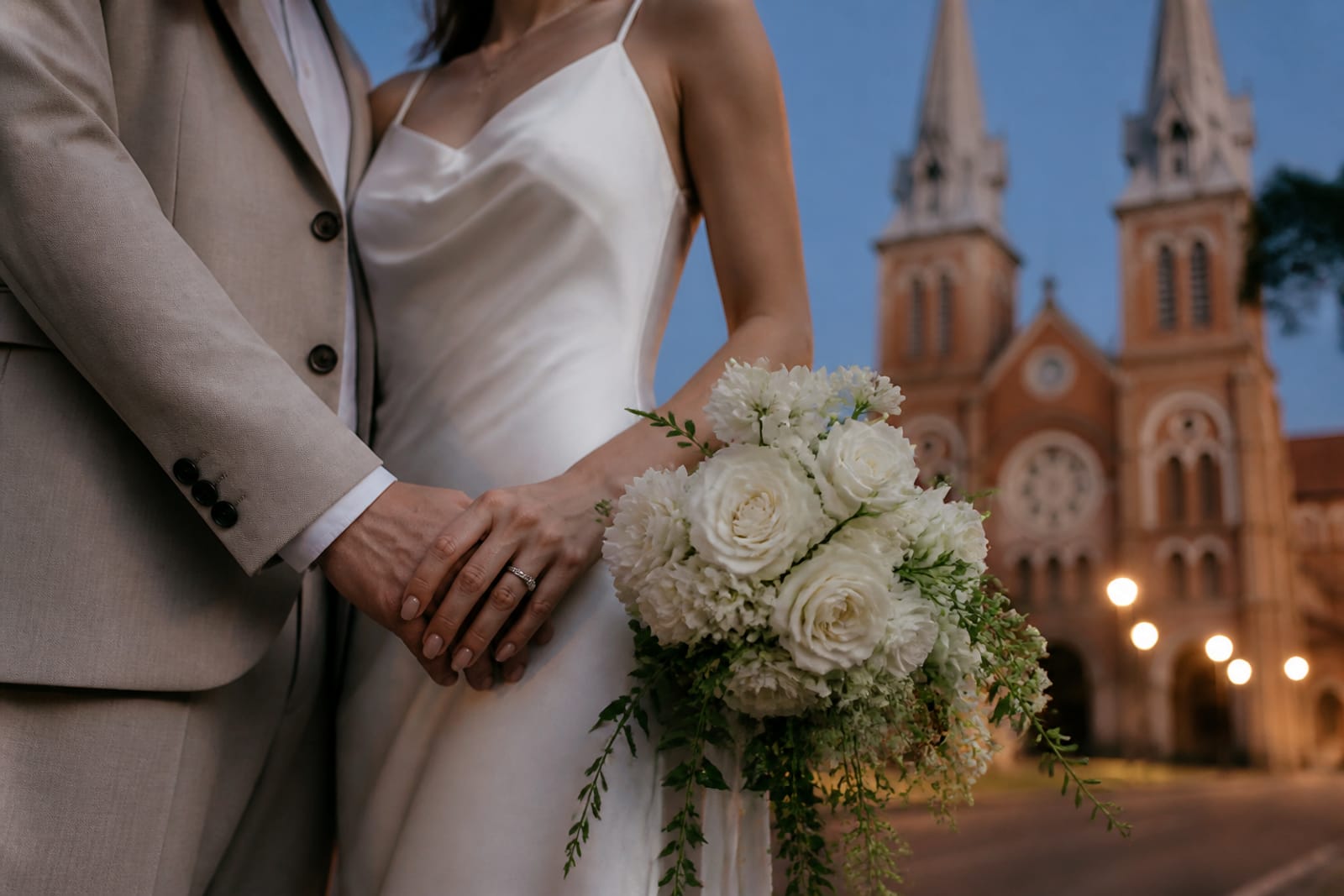
How does a Cáo Studio pre-wedding shoot at Ba Son actually run?
Cáo Studio – Makeup & Photoshoot coordinates Ba Son shoots as part of the pre-wedding photoshoot package. Here's the real workflow:
- Booking call (WhatsApp). You tell us your date, season, and outfit (ao dai, Western dress, or both). We confirm the light window and send a preparation checklist—hair/makeup timing, what to bring, weather alerts, bridge access notes.
- Makeup at your hotel. The makeup artist arrives at your hotel 60–90 minutes before the shoot. If you're wearing ao dai, she applies makeup with slight emphasis on cheekbones and under-eye brightness (because the bridge's light is directional and can cast shadows). Hair is set to withstand wind and humidity off the river. You're ready 2–3 hours before sunset (or 90 minutes before sunrise).
- Travel to Ba Son. The photographer meets you at the bridge entrance (public parking is 50 meters away). Travel time from central Hanoi is 10–20 minutes by taxi, depending on traffic. Morning shoots have light traffic; late-afternoon shoots may hit rush-hour congestion—plan accordingly.
- On-location timing. The photographer scouts the light first (2–3 minutes), then positions you for framing poses (10–15 minutes per setup). You'll move along the bridge, sit, stand, walk, and embrace. One outfit takes 30–45 minutes; two outfits take 60–90 minutes. Water bottles and touch-ups happen between setups.
- Delivery. Edited files are sent within the agreed timeframe (confirmed on WhatsApp during booking). Exactly what files and how many are delivered is specified in your package—ask for the full list before confirming.
Avoid: arriving in direct sunlight wearing makeup applied indoors (it may look too matte in outdoor light); wearing slippery-soled shoes; bringing only heavy outfits (wind and humidity cause fabric to cling, wrinkle, or cling). Go with one lightweight outfit and one structured outfit (ao dai + Western dress gives maximum visual range).
Pre-wedding shoot at Ba Son vs. studio + location hybrid—which is right for you?
| Option | Best for | Cost factors | Light control | Logistics |
|---|---|---|---|---|
| Full location (Ba Son only) | Couples wanting iconic, editorial-style frames; natural light enthusiasts | Season, travel time, 1–2 outfits | Dependent on weather and time of day; uncontrollable but authentic | Early morning or golden hour; must plan around traffic and weather windows; real crowds possible at late-afternoon peak times |
| Studio + location hybrid | Couples wanting guaranteed polished portraits AND iconic bridge framing | Travel time, two locations, 2–3 outfits, studio lighting rig, makeup reapplication | Studio: 100% controlled; location: natural; combined coverage gives editorial + intimate feel | Studio session first (2–3 hours); travel to Ba Son (1–2 hours). Total time 4–5 hours; scheduling flexibility; weather backup (studio) included |
| Studio-only pre-wedding | Couples prioritizing controlled light, privacy, makeup perfection; those with limited time or mobility concerns | Studio location, outfits, props (no travel time) | Perfect lighting; reflectors and fill-flash engineered; zero weather risk | Fastest option (2–3 hours); repeatable anytime; best for detailed makeup and jewelry showcase |
Recommendation framework: Choose full Ba Son if you've always imagined yourself on that bridge, you're shooting Feb–Apr or Oct–Nov (reliable light), and you're willing to commit to a 6:00 a.m. wake-up or 5:00 p.m. finish. Choose hybrid if you want iconic shots but also love the polished, intimate studio feel—and you have half a day free. Choose studio-only pre-wedding shoot if you're short on time, traveling in heavy rain season, or pregnant/mobility-limited.
What to check before you book a Ba Son pre-wedding shoot
Confirm in advance (on WhatsApp with Cáo Studio):
- Exact light window. Send your preferred date; we'll confirm the best 90-minute window and explain why. Don't assume "sunset" is 5:00 p.m.—in winter, it's earlier.
- Outfit count and type. Are you wearing ao dai, Western dress, or both? Ao dai requires a slip underneath; Western dress should photograph in your chosen color. Cáo Studio will advise on fit and fabric.
- Makeup refresh. If the shoot runs 2+ hours across midday or into evening, ask whether makeup touch-up is included or costs extra.
- Backup date. Pre-wedding shoots depend on light and weather. Ask what happens if rain or pollution (Hanoi's air quality varies) forces a reschedule—most studios offer a free rescheduled date within a set window.
- Delivery format and timing. Don't assume how many edited files you'll get or when they'll arrive. Confirm the exact number of photos, delivery date, and whether you receive RAW files or edited JPEGs only.
- Bridge access. Ask whether the photographer has recent knowledge of any bridge maintenance, barriers, or permit changes. Access is free for couples, but occasional construction can limit the best angles.
On-shoot day:
- Arrive 15 minutes early. Photographers need time to scout light and set up. Lateness eats into your prime light window.
- Wear weather-appropriate layers. Ba Son has river wind; bring a shawl or light jacket you can remove.
- Communicate boundaries. If a pose feels unsafe or uncomfortable, say so immediately. A good photographer will adjust.
- Check phone before shooting. Silent it or leave it behind. Your hands should be free to move naturally.
---
FAQ
Is a permit required to shoot pre-wedding photos on Ba Son Bridge?
No. Couples and photographers can access the bridge freely. The bridge is a working public structure, so avoid blocking traffic and be respectful of other pedestrians. Early morning or late afternoon shoots minimize foot traffic.
What's the best season for pre-wedding photos at Ba Son Bridge?
February–April and October–November offer warm, directional light and clear skies with minimal rain. May–September is hot and can bring afternoon thunderstorms; December–January is cool but skies are often grey. Avoid Tet week (late January–mid February) due to crowds and potential access changes.
How long does a pre-wedding shoot at Ba Son Bridge typically take?
One outfit takes 30–45 minutes; two outfits take 60–90 minutes. This includes scout time, pose setups, and walking the bridge. Travel time from Hanoi's center is 10–20 minutes by taxi.
Can we do a pre-wedding shoot at Ba Son Bridge if it rains?
Light rain doesn't always cancel—some couples love moody, wet-pavement reflections. Heavy rain or thunderstorms will reschedule. Ask Cáo Studio about your backup date and any rescheduling fees when you book.
What should I wear under an ao dai for a bridge photoshoot?
Wear a fitted slip or undergarment in white or a color matching your ao dai—this prevents the semi-sheer fabric from showing silhouettes of regular undergarments in backlit situations. The slip should reach mid-calf.
Do we need to bring anything for the shoot?
Bring a light shawl or wrap (bridge wind), comfortable walking shoes (heels are slippery on metal walkway), water, and any jewelry or props. Wear clothes you can change into at your hotel before the makeup appointment; avoid wrinkles and dirt en route.
FAQ
Is a permit required to shoot pre-wedding photos on Ba Son Bridge?
No. Couples and photographers can access the bridge freely. The bridge is a working public structure, so avoid blocking traffic and be respectful of other pedestrians. Early morning or late afternoon shoots minimize foot traffic.
What's the best season for pre-wedding photos at Ba Son Bridge?
February–April and October–November offer warm, directional light and clear skies with minimal rain. May–September is hot and can bring afternoon thunderstorms; December–January is cool but skies are often grey. Avoid Tet week (late January–mid February) due to crowds and potential access changes.
How long does a pre-wedding shoot at Ba Son Bridge typically take?
One outfit takes 30–45 minutes; two outfits take 60–90 minutes. This includes scout time, pose setups, and walking the bridge. Travel time from Hanoi's center is 10–20 minutes by taxi.
Can we do a pre-wedding shoot at Ba Son Bridge if it rains?
Light rain doesn't always cancel—some couples love moody, wet-pavement reflections. Heavy rain or thunderstorms will reschedule. Ask Cáo Studio about your backup date and any rescheduling fees when you book.
What should I wear under an ao dai for a bridge photoshoot?
Wear a fitted slip or undergarment in white or a color matching your ao dai—this prevents the semi-sheer fabric from showing silhouettes of regular undergarments in backlit situations. The slip should reach mid-calf.
Do we need to bring anything for the shoot?
Bring a light shawl or wrap (bridge wind), comfortable walking shoes (heels are slippery on metal walkway), water, and any jewelry or props. Wear clothes you can change into at your hotel before the makeup appointment; avoid wrinkles and dirt en route.
Ao dai, makeup, hair and a local photographer in Hanoi or Saigon — one WhatsApp message.