/pre-wedding-photoshoot
Pre-Wedding Photo Ideas and Poses at Eo Gio
Eo Gio sits on Quy Nhon's central coast, two hours south of Nha Trang. The site is a walking trail through scrub and rock that ends at a cliff edge with 180° views of the South China Sea. Best light runs Feb–Aug (dry season); golden hour is 5:45–6:30 am or 4:30–5:30 pm. Pre-wedding shoots here typically take two to three hours on foot—you'll walk in and out, so wear footwear that grips. Most couples hire a local Quy Nhon photographer familiar with the path and tidal conditions; Cáo Studio operates in Hanoi, Ho Chi Minh City and Hoi An, so for a Quy Nhon shoot ask us for photographer referrals on WhatsApp. Poses work best when you move: walk toward the cliff edge, hold hands at the viewpoint, sit on rocks with the sea behind you. Avoid stiff standing poses in direct sun; wait for the golden hour when light comes from the side and the cliff face turns amber. ---
How do you plan light and timing at Eo Gio?
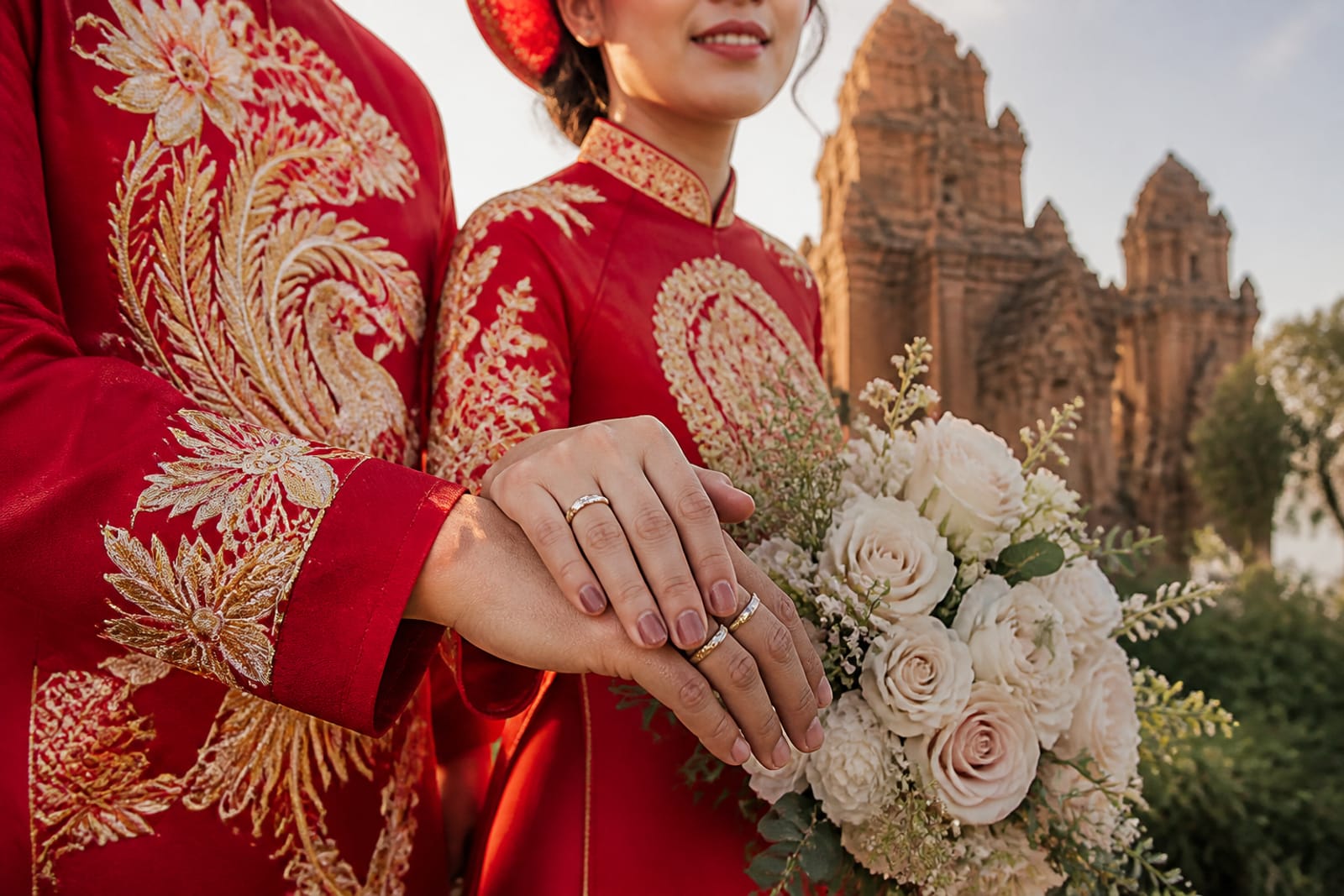
Golden hour—the hour before sunset or the first hour after sunrise—is when Eo Gio's rock face glows. At 5:00 pm in April, side light hits the western cliff, turning grey stone ochre and the sea into liquid gold. Sunrise is quieter (fewer tourists) but colder; sunset is warmer but crowded. Arrive 45 minutes before your chosen hour; the path takes 20–30 minutes from the parking area at a steady walk. Check the local tide table: high tide floods some lower rocks and makes the return walk tricky. Light metres change every five minutes in this landscape, so a photographer who knows Eo Gio will know to shoot wide frames first (you against the cliff edge and sea), then medium shots (you two walking, holding hands, light hitting your faces), then details (hands, the ring, textures of stone and water). Shooting on overcast days (common in Sep–Oct) gives even, shadowless light—useful if you want sharp detail, but less dramatic. The best pre-wedding frames at Eo Gio happen when the photographer times arrival exactly, knows how to expose for the bright water without losing your faces, and moves you toward the light rather than posing you in place.
📸 See pre-wedding shoots at Cáo Studio | 🌸 See the lookbook
What outfits and shoes work best on this terrain?
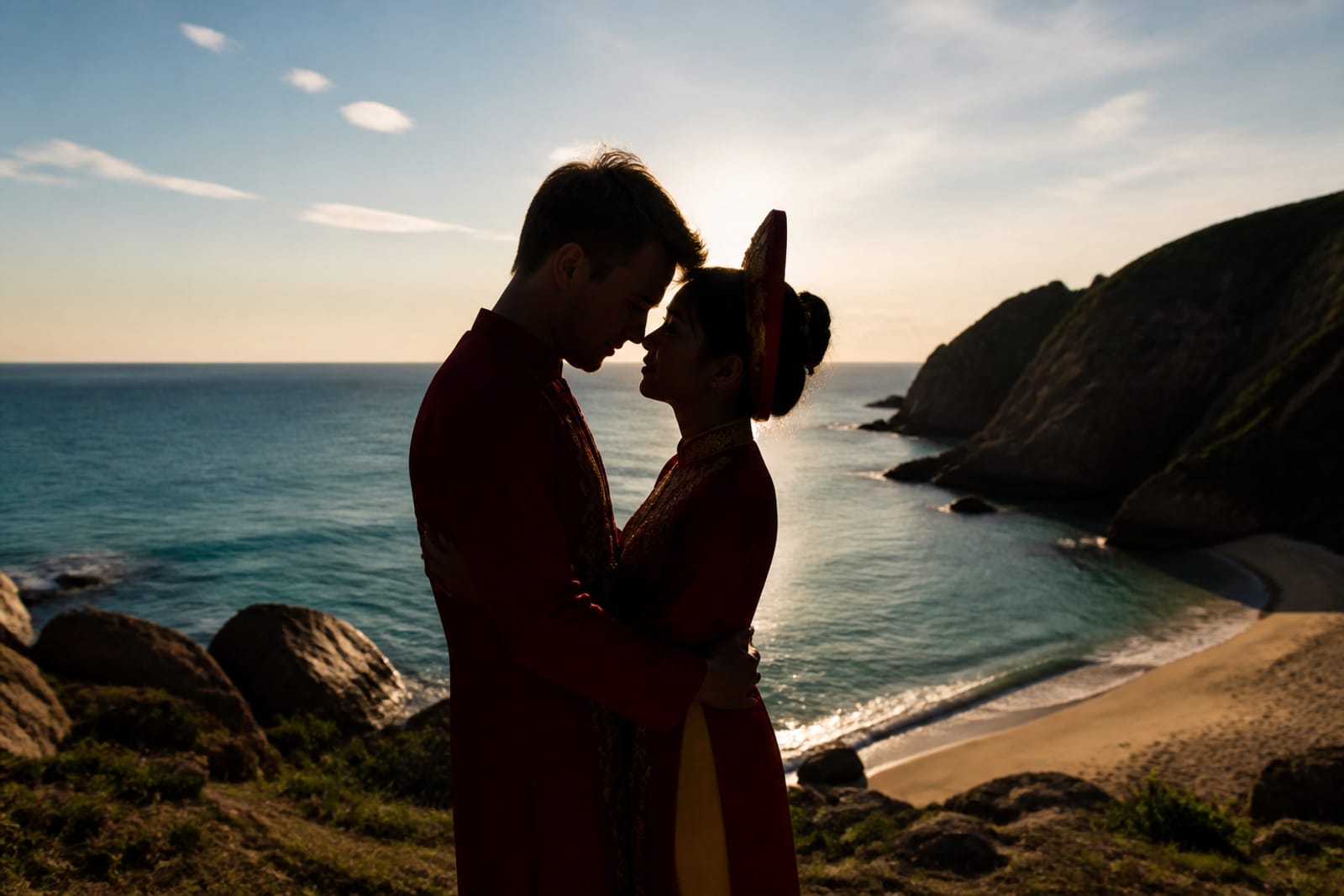
Quy Nhon's rocky coast demands footwear that grips: flat sandals, trainers or soft-soled climbing shoes beat heels or flip-flops. If you wear a wedding dress rental, choose a lightweight, shorter cut that won't catch on rocks—train dresses are risky on a steep path. Grooms in a suit rental should pick a breathable fabric (linen, cotton blend) because the walk generates heat and you'll be in direct sun for part of the approach. Bare feet work for detail shots on smooth stone if the shoot happens at the cliff base during low tide—test the rock first; it's rough and sharp after sea spray. Many couples shoot in casual outfits for the Eo Gio walk (linen, neutral tones), then change into formal wear at the cliff top for the key frames. Ao dai is possible but heavy in humidity and tricky on the steep sections; if you rent an ao dai, plan for a second outfit change at the summit. Coordinate with your photographer: they'll advise whether to carry a second outfit in a waterproof bag or stage it at a safe point on the trail. The sea breeze at the cliff face is strong (especially Feb–May), so hair and fabrics will move—this creates natural, windswept frames, not stiff poses.
| Outfit Type | Best For | Season | Why It Works |
|---|---|---|---|
| Linen casual shirt + neutral trousers | Approach and walking frames | Feb–Aug | Breathable, moves well, suits golden light |
| Lightweight wedding dress (short/tea-length) | Summit detail shots and embraces | Feb–Apr | Light fabric handles humidity; length won't catch rocks |
| Ao dai (rent locally or bring) | Climax frames at cliff edge, calm conditions | Feb–Mar (calm seas) | Iconic, but needs flat terrain or assistant to manage train |
| Suit (linen or cotton blend) | Groom frames, walking and seated poses | Feb–May | Won't overheat; formal enough for key shots |
| Swimwear + sarong | If timing permits a cove paddle or sit on rocks | Feb–Aug (daytime, not golden hour) | Adds variety; coves are turquoise, good contrast |
Which poses tell a story without looking stiff?
At Eo Gio, the landscape is the co-star—poses that anchor to it work best. Walk toward the cliff edge holding hands, then stop and turn toward each other with the sea behind. Your photographer should shoot this sequence: wide (you two small against the 180° vista), medium (stepping forward, light catching your profiles), close (your hands, faces, the cliff texture). Sit on a flat rock near the edge and look out to sea together—natural, contemplative, cinematic. Stand at the viewpoint with the photographer shooting from below (a low angle makes you taller against the sky) or from behind (you two walking away, receding into the landscape). Avoid standing still facing the camera—these freeze into portraits, not pre-wedding frames. Avoid group poses unless children or family are present; most Eo Gio shoots work best as intimate couple sessions. If you're doing a couple photoshoot with a local Quy Nhon photographer, brief them: "We want to walk, look at the view together, hold hands—not stiff poses." The best directors ask you to move toward something (the cliff edge, the sea, the light), look at each other for two seconds, then turn and walk. This produces the frames couples keep longest: real presence, not performed emotion.
How do you handle weather and safety at this exposed site?
Eo Gio is open to the South China Sea with no shelter. Feb–Apr brings steady sun and calm seas; these are peak months. May–Aug is hot and dry but occasional afternoon thunderstorms develop fast—ask your photographer to have an exit plan if dark clouds form. Sep–Dec is the rainy, typhoon-prone season; Quy Nhon's coast floods and winds gust dangerously. A responsible local photographer will check the weather and sea forecast at dawn and either proceed or reschedule. The path has no railings; one side drops steeply. Wear shoes with grip, watch your step on descent after light rain (rocks are slick), and never pose at the very cliff edge during wind—a gust can destabilize you. If anyone in your party is unsteady on slopes, reconsider: the walk is not suitable for mobility issues. Tell your photographer your fitness level; they'll know alternative viewpoints that are easier to reach. Always carry water (bring a bottle; there's no vendor on the trail). Mobile signal is weak to absent at the summit—make sure your photographer has a fully charged battery and a backup power bank. Shoot and leave before full dark; the descent in low light is risky.
💄 Makeup & hair at your hotel | 📞 Ask us on WhatsApp for photographer referrals
Where should you book a Quy Nhon photographer, and what questions to ask?
Cáo Studio operates in Hanoi, Ho Chi Minh City (Saigon) and Hoi An—not Quy Nhon. For a pre-wedding shoot at Eo Gio, contact a local Quy Nhon photographer who has shot the site before. Ask: "How many times have you shot at Eo Gio? What time of day do you recommend? Do you have a backup date policy if weather turns?" Request photos from past shoots at the location—not just retouched samples, but a series showing variety (wide, medium, close, different light). Confirm they scout the location within a week of your date (tide tables, light angle and weather change frequently). Ask whether your shot includes travel time within Quy Nhon or if you're paying extra for the Eo Gio walk. Discuss outfit changes and carrying logistics—do they coordinate with an assistant? What happens if the climb is steep for you? Agree on the number of edited photos and delivery timeline upfront. If you want makeup and hair done before the shoot, check whether the local photographer can coordinate with a stylist or if you need to hire separately. A strong pre-wedding photographer in Quy Nhon will know the answers to all these questions and will have a reputation—ask your hotel concierge or search local photography forums. Cáo Studio can offer referrals; message us on WhatsApp for recommendations.
---
What to check before you book
- Photographer's past work at Eo Gio: Ask for a portfolio of at least three shoots from the same location. Generic beach photos don't prove they know the terrain.
- Timing and logistics: Confirm start and end times, travel to the trailhead, and whether they carry a backup camera or power bank for a multi-hour shoot.
- Weather and reschedule policy: Feb–Apr is safest. Ask what happens if a storm forces a halt—do you reschedule free, or is there a fee?
- Outfit changes and styling: If you rent ao dai or a dress locally, tell your photographer in advance so they know how to time the approach and key shots.
- Delivery and formats: How many edited photos? Digital files, prints, or both? When will you have them? Don't commit until you see these in writing.
- Cost factors, not amounts: Local photographers in Quy Nhon price by session length, number of outfits, travel distance and editing time—not a single fixed rate. Ask for a quote on WhatsApp or over the phone.
---
FAQ
Is Feb–Aug the only time to shoot at Eo Gio?
Feb–Aug is driest and safest, with calm seas and reliable golden light. Sep–Dec brings rain, typhoons, and flooding; shoots are possible but riskier. Check the local weather and sea forecast 48 hours before—a responsible photographer will reschedule if storms threaten.
Can we do a pre-wedding shoot at Eo Gio with Cáo Studio?
Cáo Studio operates in Hanoi, Ho Chi Minh City and Hoi An. For a Quy Nhon shoot, contact us on WhatsApp for local photographer referrals, or book a photographer based in Quy Nhon who specializes in the coast. We're happy to advise on outfit, styling and framing ideas.
What's the hardest part of shooting at Eo Gio?
The walk is steep and exposed, with no shade or shelter. Golden light windows last only 45 minutes. A skilled photographer knows when to arrive, how to move you toward the light, and when to exit if weather turns. Physical fitness and proper footwear matter—it's not a flat beach shoot.
Should we wear a wedding dress and suit at Eo Gio?
Many couples wear casual outfits for the walk, then change into formal wear (or rent ao dai locally) at the summit for key frames. This avoids damage to expensive pieces and keeps you comfortable on the steep sections. Coordinate the outfit plan with your photographer beforehand.
How many photos will we get from an Eo Gio session?
That depends on the photographer and package. Ask your Quy Nhon photographer: typical ranges are 50–150 edited photos from a two-to-three-hour session, but rates vary. Confirm the number and delivery timeline in writing before booking.
Can we include family or a second couple at Eo Gio?
The site is small and the walk steep, so groups of more than two people can feel crowded and slow the pace. If you want family photoshoot frames, consider a larger, flatter beach nearby. Discuss with your photographer; they may have a better-suited backup location.
FAQ
Is Feb–Aug the only time to shoot at Eo Gio?
Feb–Aug is driest and safest, with calm seas and reliable golden light. Sep–Dec brings rain, typhoons, and flooding; shoots are possible but riskier. Check the local weather and sea forecast 48 hours before—a responsible photographer will reschedule if storms threaten.
Can we do a pre-wedding shoot at Eo Gio with Cáo Studio?
Cáo Studio operates in Hanoi, Ho Chi Minh City and Hoi An. For a Quy Nhon shoot, contact us on WhatsApp for local photographer referrals, or book a photographer based in Quy Nhon who specializes in the coast. We're happy to advise on outfit, styling and framing ideas.
What's the hardest part of shooting at Eo Gio?
The walk is steep and exposed, with no shade or shelter. Golden light windows last only 45 minutes. A skilled photographer knows when to arrive, how to move you toward the light, and when to exit if weather turns. Physical fitness and proper footwear matter—it's not a flat beach shoot.
Should we wear a wedding dress and suit at Eo Gio?
Many couples wear casual outfits for the walk, then change into formal wear (or rent ao dai locally) at the summit for key frames. This avoids damage to expensive pieces and keeps you comfortable on the steep sections. Coordinate the outfit plan with your photographer beforehand.
How many photos will we get from an Eo Gio session?
That depends on the photographer and package. Ask your Quy Nhon photographer: typical ranges are 50–150 edited photos from a two-to-three-hour session, but rates vary. Confirm the number and delivery timeline in writing before booking.
Can we include family or a second couple at Eo Gio?
The site is small and the walk steep, so groups of more than two people can feel crowded and slow the pace. If you want [family photoshoot](/family-photoshoot) frames, consider a larger, flatter beach nearby. Discuss with your photographer; they may have a better-suited backup location.
Ao dai, makeup, hair and a local photographer in Hanoi or Saigon — one WhatsApp message.