/pre-wedding-photoshoot
Pre-wedding photo ideas and poses at Hoang Su Phi rice terraces
Hoang Su Phi rice terraces, in Ha Giang Province (far north Vietnam), are a 5–7 hour drive from Hanoi; best photographed Sep–Oct when terraces are golden and weather is cool and dry. Pre-wedding shoots here work as part of a multi-day Ha Giang itinerary — a full day on-location with a local guide, photographer, and typically a makeup artist. Cáo Studio does not operate in Ha Giang; instead, you'll need to hire a Hanoi-based or local Ha Giang photographer experienced in mountain terrain, early starts (5–6 am for side light), and working with couples in elevation and narrow paths. Plan 2–3 months ahead; budget time for permits, weather backup dates, and a vehicle with a driver familiar with mountain roads. Poses work best when you walk, pause, look at the terraces or each other — never static framing in front of flat scenery. Avoid the rainy season (May–Aug, Dec–Feb cold), midday overhead light (11 am–3 pm), and booking without a clear weather contingency. ---
Where are Hoang Su Phi terraces and why do couples shoot there?
Hoang Su Phi sits in north-east Ha Giang, near the Chinese border, roughly 280 km from Hanoi. The valley floor is layered with hand-carved rice terraces that step down mountainsides; the scale is dramatic and human-made, not a processed landscape. Couples choose it because terraces photograph differently depending on the water level and season — reflections in flooded terraces (May–Jun) read graphically; golden dry terraces (Aug–Oct) feel warm and textured. The light at sunrise and golden hour catches the contours of each terrace edge, creating depth and shadow that flat photo spots cannot. The isolation also means fewer tourists at dawn, which matters for framing couple movement without crowds. A Hoang Su Phi shoot almost always anchors a longer Ha Giang trip — 3–5 days — because the drive is long and roads are winding; most couples combine it with photo stops at Lung Cu Flag Tower, Yen Minh, or Dong Van Old Town.
📸 Book on WhatsApp — ao dai photoshoot
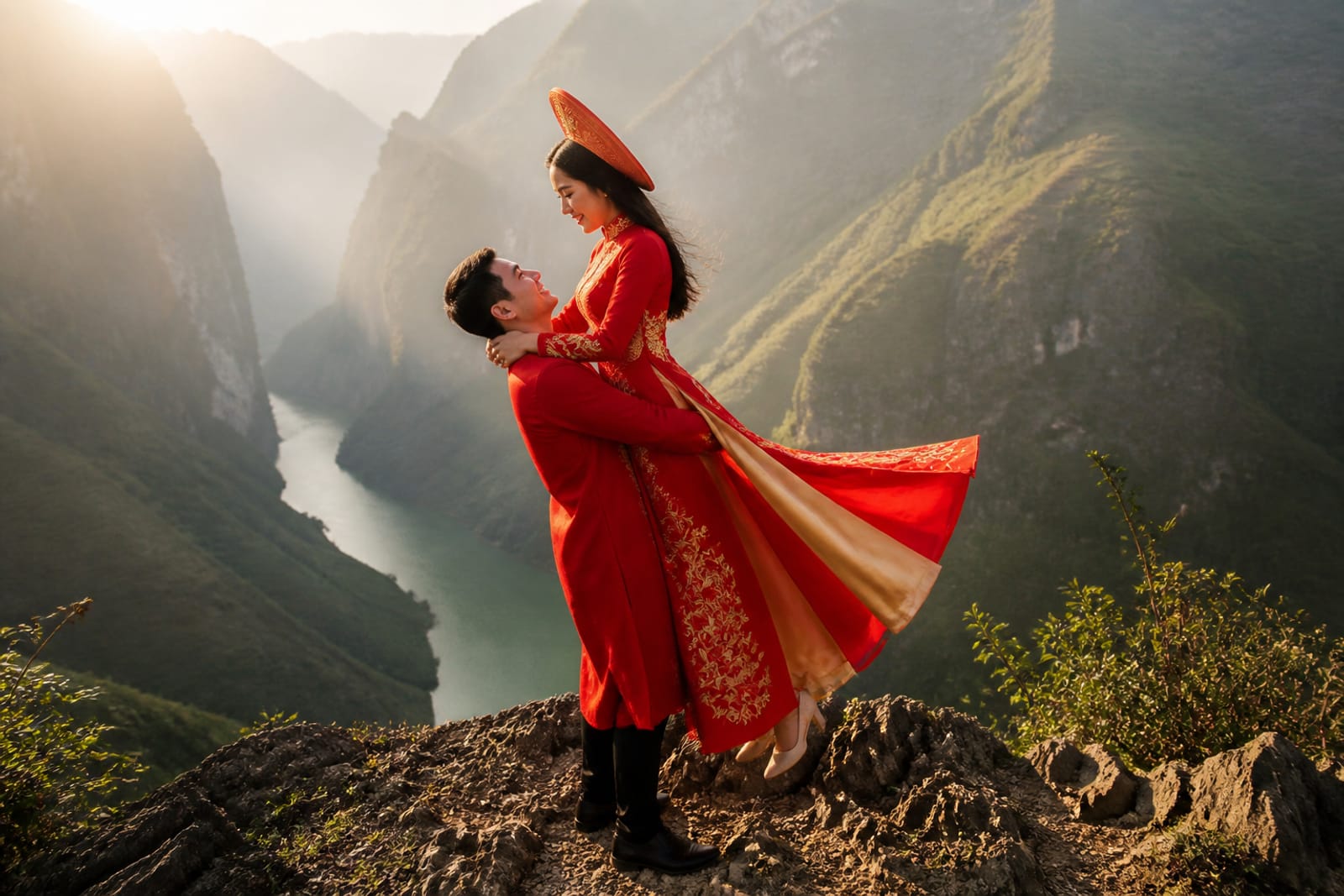
When is the best light and season for Hoang Su Phi photos?
Light windows:
- 5–7 am: Side light rakes across terrace edges; air is clearest, mist may linger in valleys.
- Golden hour (late afternoon): 4–6 pm, depending on month; warm, low angle flatters faces and terraces.
- Avoid 10 am–3 pm: Overhead sun flattens texture; harsh shadows on faces.
Season breakdown:
| Season | Months | Terrace state | Light quality | Weather risk | Outfit notes |
|---|---|---|---|---|---|
| Autumn (best) | Sep–Oct | Golden, dry | Warm, clear | Low | Layers; ao dai works |
| Spring/Early summer | Apr–May | Flooded, reflective | Soft, morning mist | Landslide risk on roads | Light fabrics |
| Winter | Dec–Feb | Dry, sometimes frosty | Clear but cold | Cold, icy roads | Thick sweaters, no ao dai without thermal base |
| Monsoon | May–Aug, Nov | Flooded or muddy | Grey, rain | High (landslides, road closure) | Not recommended |
Conclusion: September–October is non-negotiable for a professional pre-wedding shoot — clear skies, warm light, safe roads, and terraces in their most photogenic state.
What outfit and preparation work best on steep terrain?
Mountain terrain rules out formal wedding dresses unless you're shooting only on flat village paths. Successful couples at Hoang Su Phi choose:
- Ao dai (traditional silk tunic): works well on terraces if you wear sturdy sandals or ankle boots underneath and accept that fabric will collect dust. Ao dai rental and styling through Hanoi-based teams is reliable; confirm your photographer can coordinate with a stylist beforehand.
- Contemporary dresses (flowing knee-length, no train): easier to walk in; pairs well with boots or leather sandals. Avoid stiff ballgowns and bare feet.
- Groom outfit: tailored trousers, linen or cotton shirt, vest or lightweight jacket. Boots grip uneven paths better than dress shoes.
- Footwear: ankle boots or hiking sandals are non-negotiable. Mud, loose stones, and steep edges are real.
- Layers: mornings are cool (10–15°C Sep–Oct); bring a shawl or lightweight jacket to remove during warm hours.
Practical checklist:
- Confirm outfit with your photographer 1 month before; ask if they coordinate makeup and hair or if you hire separately.
- Break in footwear before the shoot day.
- Bring a towel and wet wipes; dust settles on fabric and skin quickly.
- Sunscreen and a hat for midday breaks.
- Hair: loose waves or half-up styles hold better in wind than stiff styles; confirm with your hairstylist that they've worked on mountain shoots.
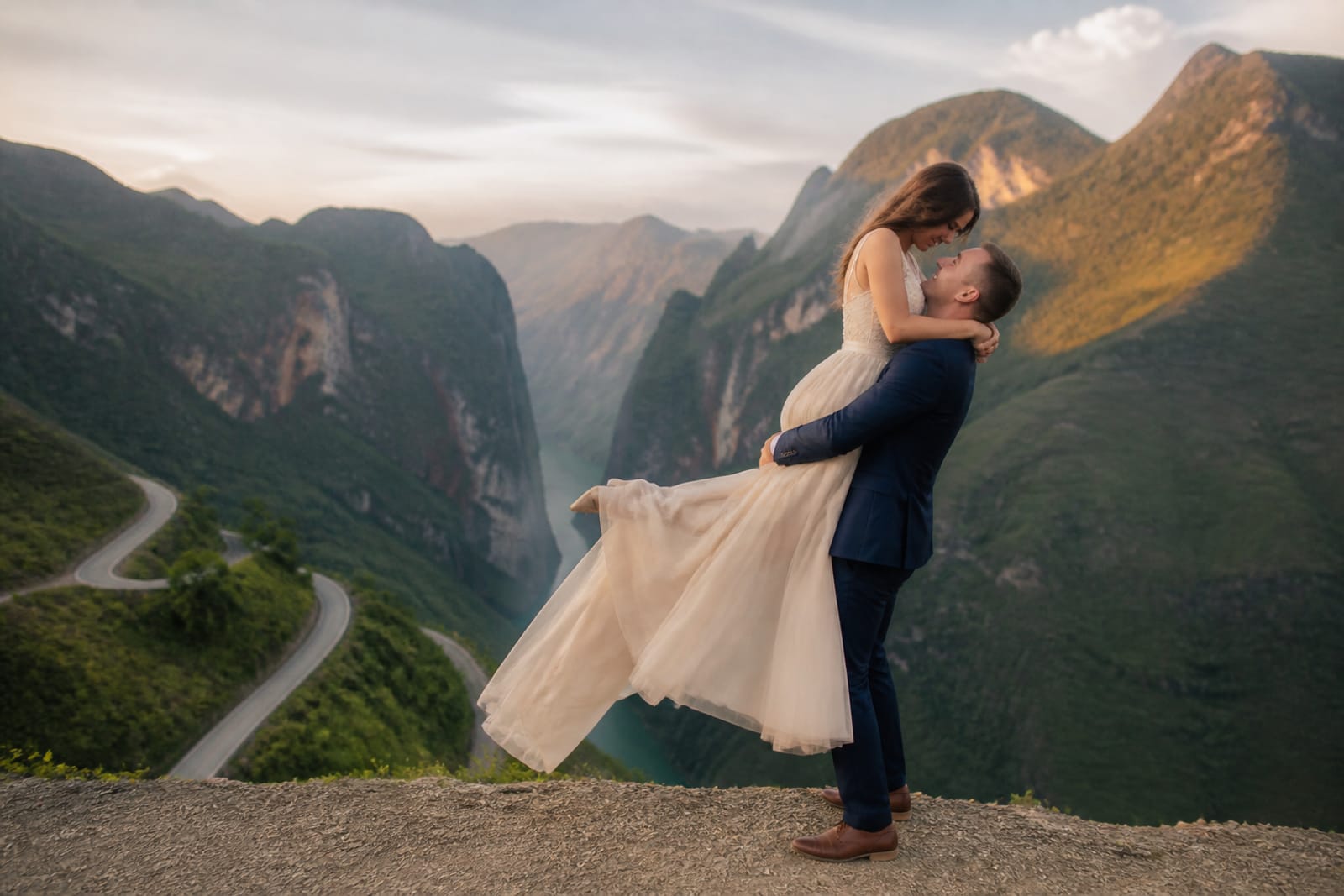
How do you pose naturally on rice terraces without looking stiff?
The cardinal rule: never stand still facing the camera. Terraces are layered and vast; posing dead-center in a field flattens the image. Work with your photographer on these framings:
Walking frames:
- Walk toward the camera, hand in hand or arm around each other, with terraces stepping behind you. Photographer shoots from a lower angle to emphasize scale.
- Walk away from the camera along a terrace edge; photograph from behind as you pause and look back over your shoulder at each other.
- Walk across a terrace (perpendicular to the camera) and pause mid-path; the layers line up naturally on either side.
Pause and interact:
- Sit together on a flat terrace edge, looking at the valley, not the camera. Photographer captures the moment you turn to each other or laugh.
- Stand close, foreheads together, eyes closed; terraces frame the couple as a small shape in a vast landscape.
- One person stands, the other sits on a low terrace wall; shoot from a wide angle so the asymmetry and landscape register.
Detail and texture:
- Hands: remove the ring from pocket and put it on; photograph the hand placement and background.
- Fabric: wind catches ao dai silk or dress fabric; shoot while walking so fabric moves and reads in three dimensions.
Why this works: movement and real interaction photograph better than poses because your photographer can shoot 20–30 frames and select the moment when light, expression, and landscape align. Stiff poses rely on a single perfectly-timed frame — wasteful on terraces where light changes every minute.
Who should you hire — local guide, Hanoi team, or a distant photographer?
Your choice depends on logistics, experience, and cost factors (not amounts — factors that affect what you'll pay):
| Option | Best for | Why | What to check |
|---|---|---|---|
| Local Ha Giang photographer | Budget-conscious, flexible dates | Knows terrain, early starts, backup locations; no travel time | Portfolio must show couples (not just landscapes); ask for recent work Sep–Oct; confirm they've hiked to each spot with gear |
| Hanoi-based team (including Cáo Studio if you pre-book a Hanoi shoot + hire local photographer for Ha Giang) | Couples who want Hanoi styling + Ha Giang as a secondary shoot | Cáo Studio handles Hanoi couple photoshoot, makeup, styling; you hire a local photographer for the mountain leg | Confirm Cáo Studio offers a pre-wedding package; coordinate handoff dates and outfit continuity |
| International destination photographer | Couples flying from abroad who want one familiar team | English-speaking, portfolio you trust, no language gap | Confirm they've shot Ha Giang terrain; factor in their travel time and accommodation cost (disclosed during inquiry) |
| DIY + guidebook | Adventurous, small budget, patient | You control timing and pace; hire a local guide for safety and logistics | Not recommended for professional pre-wedding — terrain is steep, early starts are critical, and light windows are narrow; a poor image is permanent |
Conclusion: hire a photographer with documented mountain experience and Sep–Oct portfolio work; never choose by price alone on terrain this technical.
What to check before you book a Ha Giang pre-wedding shoot
- Photographer's recent portfolio: ask for 5–10 images from Sep–Oct shoots on Hoang Su Phi, Lung Cu, or similar terrain. Landscapes alone don't prove couple experience.
- Road and weather contingency: confirm the photographer has a backup date offer and alternate locations if roads close or weather worsens. Early Sep can still see wet roads.
- Permit and access: some mountain areas require local guide permits. Ask if your photographer secures this or if you do.
- Makeup and hair coordination: if you want the same team as your Hanoi pre-wedding shoot, confirm logistics. Mountain air and early starts require different makeup (water-resistant, lighter) than studio sessions.
- Delivery timeline: ask when edited photos arrive — mountain shoots often require more editing (light correction, dust removal) than urban shots.
- Communication channel: for Cáo Studio, WhatsApp +84 338 762 340 is the only contact. For local photographers, establish a single messaging platform before deposit.
- Transport and driver: confirm a driver familiar with Ha Giang roads is included or if you hire separately. Bad driving = motion sickness and late arrivals.
---
FAQ
Can we wear a formal wedding dress at Hoang Su Phi?
Not safely. Train and heavy skirts catch on rocks and narrow paths; muddy terrain ruins silk. Wear a flowing midi dress or ao dai with proper footwear. Save formal dress for Hanoi or Hoi An photoshoots.
How early do we need to wake up for the sunrise shoot?
4:30–5 am on-location to be positioned before 5:30 am light. This requires staying overnight in nearby Yen Minh or Dong Van village.
Is Hoang Su Phi safe for non-climbers?
Yes, if you avoid rainy season (roads landslide; May–Aug, Nov–Dec) and hire a photographer who knows safe paths. Terraces are steep but walked daily by locals with proper footwear.
Can Cáo Studio photograph us at Hoang Su Phi?
Cáo Studio operates in Hanoi, Ho Chi Minh City, and Hoi An. For Ha Giang, we recommend hiring a local mountain photographer; if you want Cáo Studio for a Hanoi pre-wedding shoot before or after, WhatsApp us +84 338 762 340 to discuss a multi-location itinerary.
How long does a Hoang Su Phi shoot take?
A full day on-location (6–7 hours) covers sunrise, mid-morning, and golden hour at 2–3 locations. Most couples book this as one day within a 3–5 day Ha Giang trip.
What months should we avoid?
May–August (monsoon, landslides, grey light) and December–February (cold, icy roads) are high-risk. September–October is optimal; April and November are acceptable if weather holds.
FAQ
Can we wear a formal wedding dress at Hoang Su Phi?
Not safely. Train and heavy skirts catch on rocks and narrow paths; muddy terrain ruins silk. Wear a flowing midi dress or ao dai with proper footwear. Save formal dress for Hanoi or Hoi An photoshoots.
How early do we need to wake up for the sunrise shoot?
4:30–5 am on-location to be positioned before 5:30 am light. This requires staying overnight in nearby Yen Minh or Dong Van village.
Is Hoang Su Phi safe for non-climbers?
Yes, if you avoid rainy season (roads landslide; May–Aug, Nov–Dec) and hire a photographer who knows safe paths. Terraces are steep but walked daily by locals with proper footwear.
Can Cáo Studio photograph us at Hoang Su Phi?
Cáo Studio operates in Hanoi, Ho Chi Minh City, and Hoi An. For Ha Giang, we recommend hiring a local mountain photographer; if you want Cáo Studio for a Hanoi [pre-wedding shoot](/pre-wedding-photoshoot) before or after, WhatsApp us +84 338 762 340 to discuss a multi-location itinerary.
How long does a Hoang Su Phi shoot take?
A full day on-location (6–7 hours) covers sunrise, mid-morning, and golden hour at 2–3 locations. Most couples book this as one day within a 3–5 day Ha Giang trip.
What months should we avoid?
May–August (monsoon, landslides, grey light) and December–February (cold, icy roads) are high-risk. September–October is optimal; April and November are acceptable if weather holds.
Ao dai, makeup, hair and a local photographer in Hanoi or Saigon — one WhatsApp message.