/pre-wedding-photoshoot
Pre-wedding photo ideas and poses at Hoi An rice paddies
Pre-wedding rice-paddy shoots in Hoi An work best February through April, when fields are flooded and mirror the sky—avoid the rainy season (September–December, especially October–November, when typhoons flood the paddies). Shoot at sunrise (5:30–6:30 a.m.) for soft, directional light and empty paths; afternoon backlighting turns water golden but draws tourists. Wear a long undershirt under your áo dài to avoid chafing from muddy banks, and bring a second outfit for dry-ground poses near tree lines. Cáo Studio – Makeup & Photoshoot books Hoi An shoots by appointment; the team travels from Hanoi or Ho Chi Minh City, so confirm dates and logistics on WhatsApp. Expect 2–4 hours on-site (light permitting), unpredictable water depth, and slippery transitions between paddies—professional guidance cuts wasted setups and outfit changes.
Pre-wedding rice-paddy sessions in Hoi An sit between two very different experiences: a highly managed hotel or town photoshoot (controlled backdrop, makeup chair, fast turnover) and an outdoor adventure (weather risk, travel time, physical setup). The Hoi An rice fields offer authenticity and symmetry but demand precise timing, travel coordination, and realistic expectations about mud, insects, and season-specific flooding.
Why do Hoi An rice paddies work so well for pre-wedding photos?
Rice paddies create geometry—parallel water lines, grid-like paddy divisions, and the horizon—that frames a couple without requiring a landmark. Unlike the crowded Ancient Town or beach, early-morning paddies are empty: no tourists, no vendors, no reflections except water and sky. The landscape reads as "rural Vietnam" in every frame without feeling generic; it's specific to the region yet timeless. Light behaves predictably: sunrise gives you 45 minutes of diffuse, shadowless illumination; mid-morning backlight turns the water into a mirror; afternoon heat creates haze. Muddy banks and vegetation create natural depth layers, so your couple stays sharp while the background softens. A single paddy session yields outfit variety—standing in water, walking between fields, sitting on dry banks—without moving location.
📸 Book on WhatsApp — pre-wedding photoshoot
What are the best months and times of day for shooting?
February through April is the dry season with the mildest temperature and greenest paddy water. Fields are flooded for planting, so standing water is deepest and most photogenic. May through August remains dry but hits 35°C+ midday heat; if you shoot then, sunrise and sunset (around 5:30 a.m. and 6:30 p.m.) are mandatory—midday light is harsh and energy-sapping. September through December is the rainy season; October and November bring typhoons and flooding in the paddies and the Ancient Town, making movement dangerous and water murky. December through January is cool and often drizzly—moody but unreliable.
Sunrise (5:30–6:30 a.m.) is non-negotiable: it's the only window without tourists, heat, or harsh shadows. The light is even and cool-toned; water is still and reflective. You have 45 minutes before the sun climbs above the tree line and creates harsh contrasts. Late morning (7:30–9:30 a.m.) works for backlighting—the sun is 20–30° above the horizon, turning water gold and outlining your couple. Afternoon (after 1 p.m.) creates silhouettes and blown-out water; avoid unless you want that aesthetic intentionally.
Should you wear a traditional áo dài or Western dress?
This is the primary decision fork. An áo dài is visually cohesive with the landscape—the silhouette reads as Vietnamese, the silk catches light, and the side slits allow movement in water without dragging heavy fabric. The trade-off: mud stains easily, wet embroidery weighs more, and wet fabric clings to legs, limiting stride. A Western wedding dress (A-line, ball gown, sheath) photographs dramatically but the train and fabric pool in muddy water, requiring constant adjustment and carrying. Sheath dresses move easiest; ball gowns are impractical unless you have a dedicated dress assistant.
Hoi An has áo dài rental shops—renting on-location saves luggage and lets you choose a style suited to water work (lighter silk, shorter hem, no heavy beading). If you're wearing a dress, bring an alternate outfit: shorts or a wrap skirt and a simple top for paddy wading. Wear moisture-wicking undergarments and a long, fitted undershirt under your áo dài—it prevents chafing from wet embroidery and muddy water seeping to your skin.
🌸 See the lookbook (for áo dài styling on location)
How do logistics work when booking a Hoi An rice-paddy shoot?
Cáo Studio does not have a Hoi An office; the team travels from Hanoi or Ho Chi Minh City by appointment. When you contact them on WhatsApp, you'll confirm:
- Your shoot date and preferred time (sunrise preferred; they'll advise on season and light).
- Travel arrangements: Cáo Studio's photographer and makeup artist arrive in Hoi An 1–2 days prior; you coordinate your own arrival or stay.
- Location scout: they may select one paddy or suggest several based on current water levels and crop cycle (flooded fields change weekly).
- Session scope: makeup and hair at your hotel (see makeup & hair at your hotel), then shoot on-site for 2–4 hours. Exact inclusions (outfit changes, edited file count, delivery timeline) are confirmed on WhatsApp.
- Weather contingency: if typhoon warnings or unexpected heavy rain emerges 48 hours before, you reschedule or shift to an indoor backup (the Ancient Town, your hotel, a local café).
Avoid booking a Hoi An paddy shoot during October or November unless you have a flexible date; typhoon season makes water unpredictable and the Ancient Town flooded.
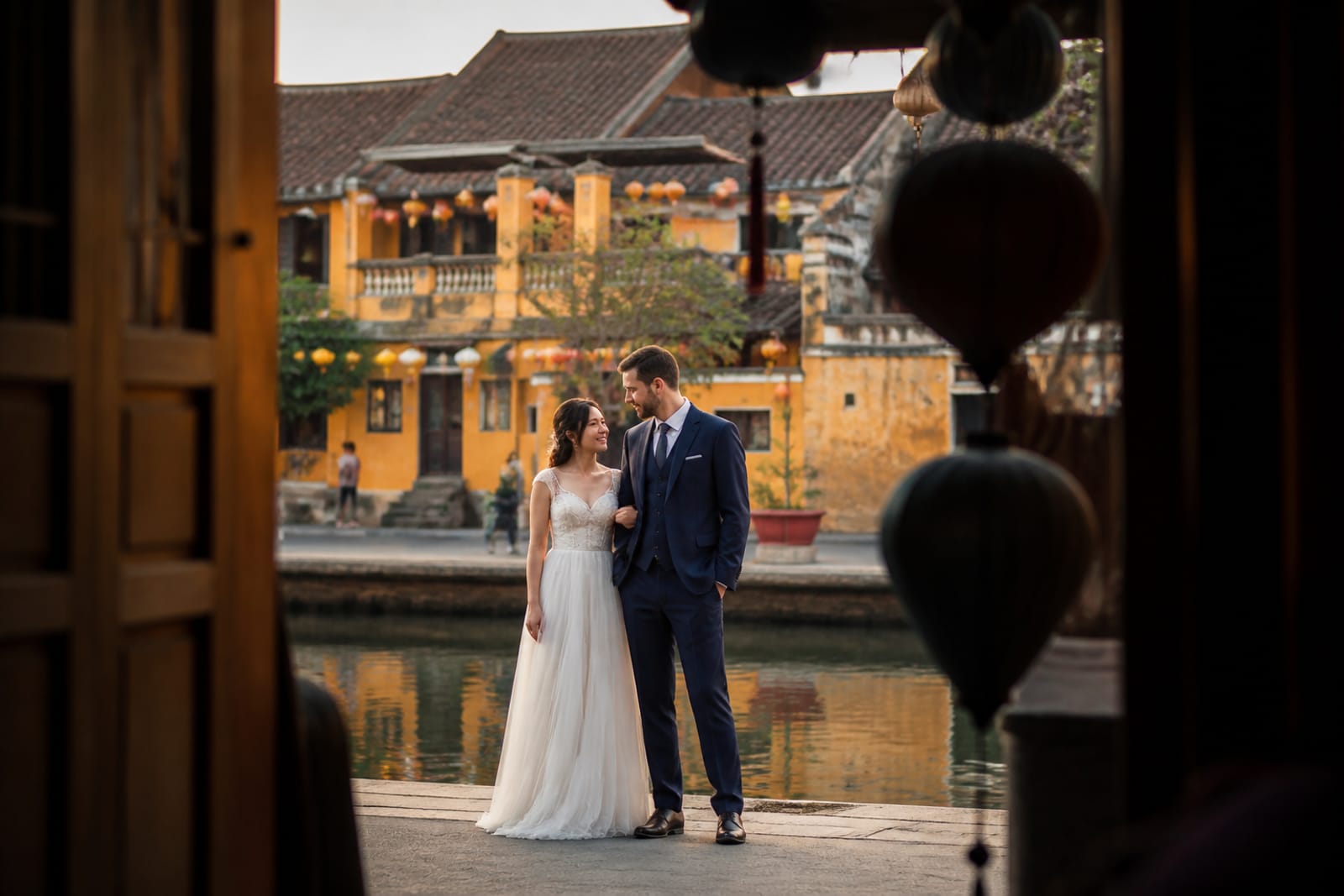
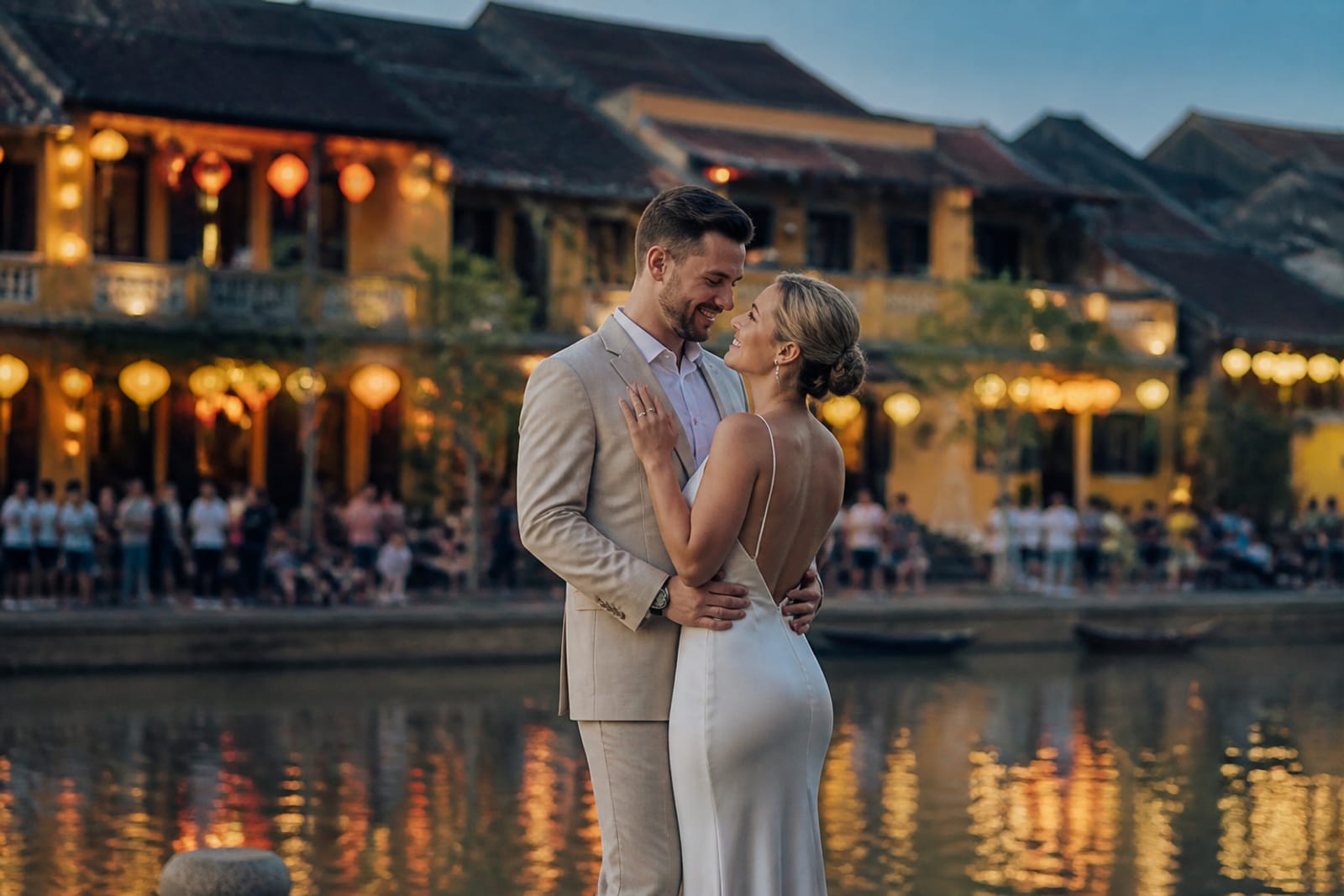
What's the realistic comparison: rice paddies vs. other Hoi An pre-wedding options?
| Option | Best for | Light & season | Why it works |
|---|---|---|---|
| Rice paddies (early morning) | Authentic, minimal crowds, geometry. Couples who want rural Vietnam. | Feb–Apr sunrise ideal; May–Aug sunrise only. | No tourists, soft light, repeating patterns, water mirror. |
| Ancient Town (sunrise) | Architecture, lanterns, Old-town romance. Couples who want iconic Hoi An. | Feb–Apr dry; Dec–Jan cool. Avoid Oct–Nov flooding. | Landmark recognizable; tight alleys hide crowds; lanterns at dusk. |
| Beach or cua Dai River | Relaxed, casual vibe. Sunset color. Couples with simple wardrobes. | Feb–Aug dry and calm. | Open light, no props needed, fewer rules. |
| Hotel gardens or private spaces | Control, comfort, back-up weather option. Couples with limited mobility. | Any time, any weather (covered/indoors). | No travel, makeup on-site, fast setup, multiple rooms. |
Rice paddies win for authenticity and quietness but require early rising, seasonal awareness, and mud tolerance. The Ancient Town wins for landmarks and evening light but crowds intensify by 8 a.m. Both require advance booking with Cáo Studio—WhatsApp availability, location scouting, and team travel logistics mean you can't walk in as a casual client.
💄 Makeup & hair at your hotel (coordinated with your Hoi An shoot)
What should you check before booking?
Before you commit to a rice-paddy pre-wedding shoot:
- Confirm the season matches your date. Ask on WhatsApp: "Is October a good month for rice paddies?" The answer is no—typhoon risk and flood water. Book February–April, or May–August if you accept a 5 a.m. wake-up.
- Check paddy flooding status 2 weeks before. Water levels vary by planting cycle. Cáo Studio can scout current conditions; empty or half-flooded paddies photograph differently than mirror-still water.
- Arrange on-ground logistics. You need transport to the paddies (a 20–30 minute drive from the Ancient Town). Ask if Cáo Studio's team arranges a driver or if you hire one locally. Either way, confirm it in WhatsApp beforehand.
- Plan a backup outfit and location. Mud stains fast. Bring a second (dry-ground) outfit so you have at least one pristine set of photos. Cáo Studio can pivot to your hotel or a café if morning light fails.
- Discuss hair and makeup durability. Humidity and water spray affect makeup longevity. Confirm that makeup & hair is waterproof and formulated for the season (Feb–Apr humidity is lower; May–Aug is swampy).
- Set edit and delivery expectations. Ask on WhatsApp: "When do I receive edited photos, how many, and in what format?" Timelines and file counts vary; don't assume.
---
Hoi An rice paddies are worth the early alarm and logistics coordination. They deliver a visual and emotional authenticity that hotel studios or tourist landmarks can't replicate. Work with Cáo Studio to align your date with the dry season, book a sunrise slot, and bring realistic expectations about mud and weather. Your pre-wedding story will read as specifically Vietnamese—not a generic destination backdrop.
📸 Book on WhatsApp — pre-wedding photoshoot
FAQ
Can we shoot rice paddies during the rainy season?
October and November bring typhoons and flooding in the paddies—unsafe and visually murky. December through January is cool and drizzly; light is unpredictable. Cáo Studio will advise rescheduling to February–April (dry and ideal) or May–August (requires 5 a.m. sunrise). Confirm on WhatsApp.
What if we're not wearing an áo dài?
A sheath wedding dress moves easiest in water; avoid ball gowns and long trains. Bring a backup outfit (shorts, wrap skirt, simple top) for paddy wading so your main dress stays clean. Hoi An has áo dài rental if you want to shoot in both traditional and Western styles.
How early do we need to wake up?
Sunrise is 5:30–6:30 a.m. February–April; you'll meet Cáo Studio at the paddy by 5:45–6 a.m. May–August sunrise is even earlier. Yes, it's early—that's why the paddies are empty and the light is perfect.
What if the paddies aren't flooded?
Water levels depend on the crop cycle (planting, growing, harvest). Cáo Studio scouts 2 weeks before and will confirm whether standing water exists. If paddies are empty, they may suggest an alternative location (a nearby field, a canal, or a pivot to the Ancient Town).
Do we need a permit to shoot in the rice paddies?
Cáo Studio handles permissions and relationships with local farmers. Confirm on WhatsApp that the team has secured access for your shoot date. Shooting without permission is disrespectful and may be refused on the day.
FAQ
Can we shoot rice paddies during the rainy season?
October and November bring typhoons and flooding in the paddies—unsafe and visually murky. December through January is cool and drizzly; light is unpredictable. Cáo Studio will advise rescheduling to February–April (dry and ideal) or May–August (requires 5 a.m. sunrise). Confirm on WhatsApp.
What if we're not wearing an áo dài?
A sheath wedding dress moves easiest in water; avoid ball gowns and long trains. Bring a backup outfit (shorts, wrap skirt, simple top) for paddy wading so your main dress stays clean. Hoi An has [áo dài rental](/ao-dai-rental) if you want to shoot in both traditional and Western styles.
How early do we need to wake up?
Sunrise is 5:30–6:30 a.m. February–April; you'll meet Cáo Studio at the paddy by 5:45–6 a.m. May–August sunrise is even earlier. Yes, it's early—that's why the paddies are empty and the light is perfect.
What if the paddies aren't flooded?
Water levels depend on the crop cycle (planting, growing, harvest). Cáo Studio scouts 2 weeks before and will confirm whether standing water exists. If paddies are empty, they may suggest an alternative location (a nearby field, a canal, or a pivot to the Ancient Town).
Do we need a permit to shoot in the rice paddies?
Cáo Studio handles permissions and relationships with local farmers. Confirm on WhatsApp that the team has secured access for your shoot date. Shooting without permission is disrespectful and may be refused on the day.
Ao dai, makeup, hair and a local photographer in Hanoi or Saigon — one WhatsApp message.