/pre-wedding-photoshoot
Pre-wedding photo ideas and poses at Hoi An yellow wall streets
The yellow-washed buildings along Hoi An Ancient Town's narrow lanes—especially around Tan Ky House, the Japanese Bridge approach, and the shopfront alleys near the central market—offer warm, diffused light that flatters couple poses from dawn until mid-morning. A pre-wedding session at these walls typically runs 2–3 hours across multiple locations; timing matters: February to April brings mild, dry weather and soft morning light; May–August is hot (35°C+) so early sunrise shoots (5:30–6:30 a.m.) avoid harsh shadows and crowds; September–December brings rain and flooding risk, especially October–November. Poses work best when one partner leans against the wall while the other stands close, or both walk naturally through an alley with the wall as backdrop. Cáo Studio – Makeup & Photoshoot coordinates pre-wedding shoots in Hoi An by appointment; the team travels from Hanoi or Saigon to guide you through light windows, outfit changes, and temple etiquette if you include the Old Town's sacred spaces. Book via WhatsApp to confirm dates, makeup inclusion, and exact locations before traveling.
The yellow walls of Hoi An Ancient Town are synonymous with romantic pre-wedding imagery. Their soft ochre tone catches morning and late-afternoon light in ways that minimize harsh shadows, making them forgiving for couples trying poses for the first time. But that Instagram appeal masks real logistical choices: time of year, time of day, what you wear under your ao dai, and whether you hire a local photographer or book a team that knows the town's light and permit requirements.
Why do Hoi An's yellow walls photograph differently by season?
Hoi An sits on Vietnam's central coast and receives the driest, most consistent light February to August. February–April brings cool, mild air (20–25°C), green rice fields surrounding the town, and soft morning light that spreads evenly across the yellow facades without burning out skin tones. By May, heat intensifies to 30°C+ with occasional afternoon cloud cover; the walls still read warm, but you'll need to shoot by sunrise to avoid sweat marks on fabric and blown-out highlights on faces. September–December marks the rainy season; October–November bring typhoons and flooding that pool in the Ancient Town's lanes, making the stone slippery and turning the alleys into obstacle courses. If you book December–January, expect cool drizzle and grey skies that flatten the walls' golden tone. The best pre-wedding light at Hoi An happens in early February or March, when the walls glow warm and the early-morning crowds are thin.
📸 Book on WhatsApp — pre-wedding photoshoot
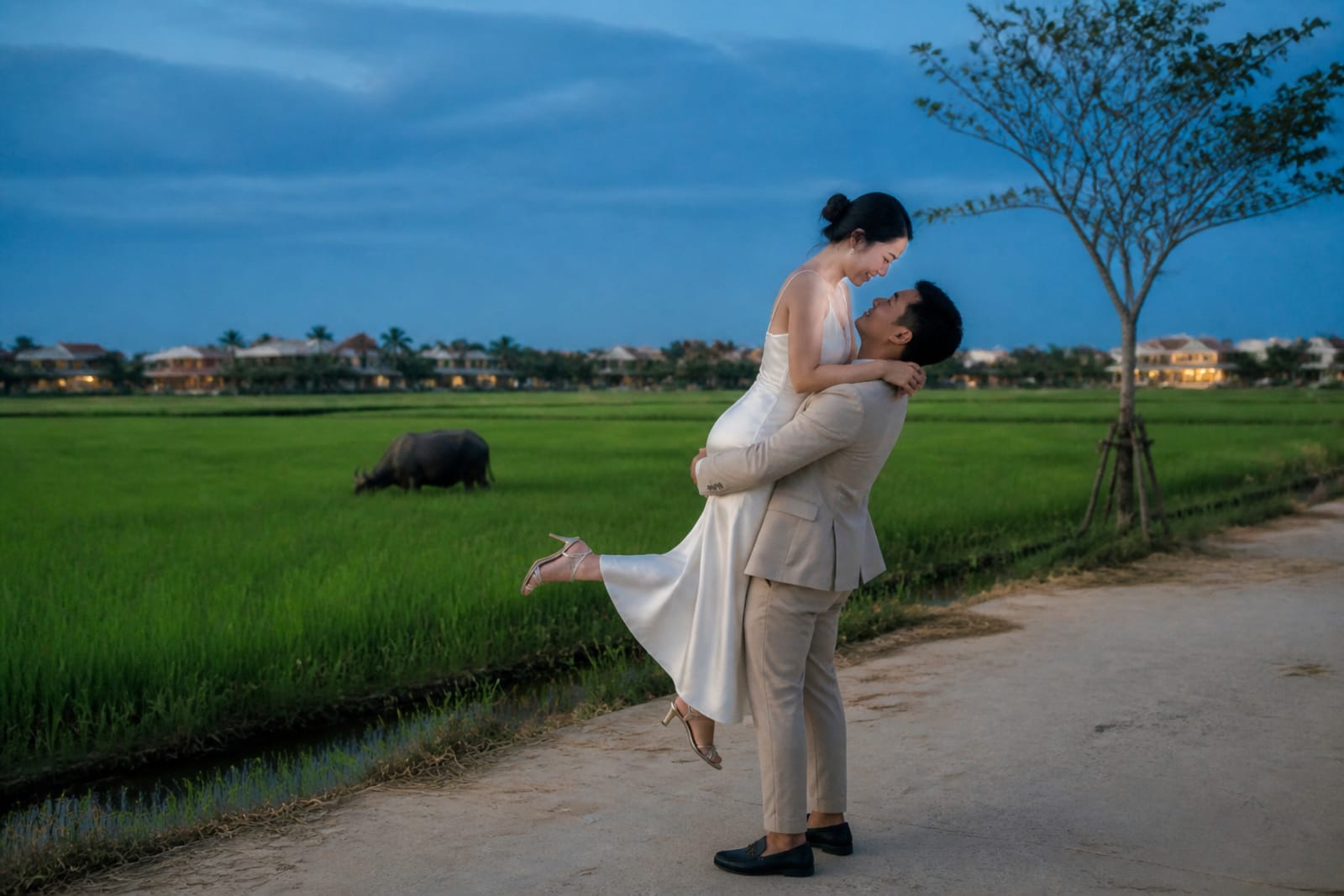
What poses work best against a flat yellow wall?
The yellow walls are not textured stone—they're smooth, painted surfaces. Poses that work: one partner seated on a low stool or against the base while the other stands, creating height difference; both walking toward the camera with hands linked or the taller partner's arm around the shorter one's waist; one leaning back against the wall with the other positioned in front at an angle (avoid facing the wall directly, which flattens the face). Avoid stiff facing-the-wall poses; movement and slight angles read more naturally. The alleyway width—often just 1.5–2 meters—constrains distance between you and the photographer, so wide-angle lenses work better than telephoto. Backlight at sunrise can rim-light your hair and outline your silhouettes if the wall is behind you and the photographer shoots toward the dawn; this is a professional technique that requires metering for skin tone and letting the wall go bright. Couples who have pre-wedding consultations with a photographer before the shoot tend to understand depth and angles better on the day. Ask your photographer to show you examples of poses they've shot in that specific alley so you're not improvising in real time.
Should you wear an ao dai, Western dress, or both?
This depends on tone and how much changeover time you want. An ao dai photoshoot at the yellow walls is the most popular choice because the silhouette complements the narrow lanes and the fabric's flow photographs gracefully in motion. Ao dais come in layers: the outer tunic, an inner long-sleeved silk shirt, and fitted trousers. Many couples wear the tunic alone over a thin slip or undershirt to stay cool in May–August heat; ask your photographer whether they recommend a slip so the tunic doesn't cling to your body in humidity. If you want Western dress too, bring a second outfit and plan for 15–20 minutes to change, which can happen at a nearby café or your hotel. Couples in ao dais sometimes pair the tunic with jeans or tailored shorts hidden under the side slits for a modern look; the walls' golden tone works with any neutral underlay. The Ancient Town's narrow lanes and temple entrances mean avoiding dragging fabric—so fitted, calf-length, or just-above-knee ao dais work better than floor-length Western gowns. If you do wear a wedding dress, choose A-line or slim silhouettes that fit through doorways; the streets are uneven stone, so avoid heels with thin heels that catch between stones.
| Outfit choice | Best season | Light advantage | Changeover time |
|---|---|---|---|
| Ao dai (single tunic + underlay) | Feb–Apr, early May | Fabric moves in breeze, warm tones match wall | None — one outfit |
| Ao dai + Western dress | Mar–Apr (mild temp) | Versatility for different alley moods | 15–20 min at café |
| Western wedding dress | Feb–Mar (coolest, dry) | Contrast with yellow, formal tone | 20–30 min; need safe storage |
| Ao dai + jeans/shorts | May–Aug (early sunrise) | Modern aesthetic, practical for heat | 10 min or layered under tunic |
What time of day gives the best light on the yellow walls?
Sunrise, 5:30–6:30 a.m., is optimal year-round. The sun is low, warm, and diffused by morning mist off the river; skin tones read peachy and the yellow walls glow without blown-out reflections. The Ancient Town is quiet—few tourists, open shutters just starting to appear. By 7:30 a.m., local vendors and early tourist groups multiply; by 9 a.m., it's crowded enough that framing clean shots becomes hard. Midday (10 a.m.–3 p.m.) is the worst: direct overhead sun creates harsh shadows under your eyes and chin, and the yellow walls can look washed-out or too bright for camera sensors to expose skin correctly. Late afternoon (4:30–5:30 p.m., depending on season) can work if you shoot away from the sun, letting it backlight you from behind the wall, but foot traffic peaks then and light bounces off the river and stones unpredictably. In overcast weather (Dec–Jan, or any rainy-season day), the lack of direct sun means even 10 a.m. is shootable because there's no contrast problem—but the walls lose their signature warmth and read beige or grey. If you cannot do sunrise, go in Feb–Mar and shoot 6:00–7:30 a.m., which still avoids crowds and keeps light soft.
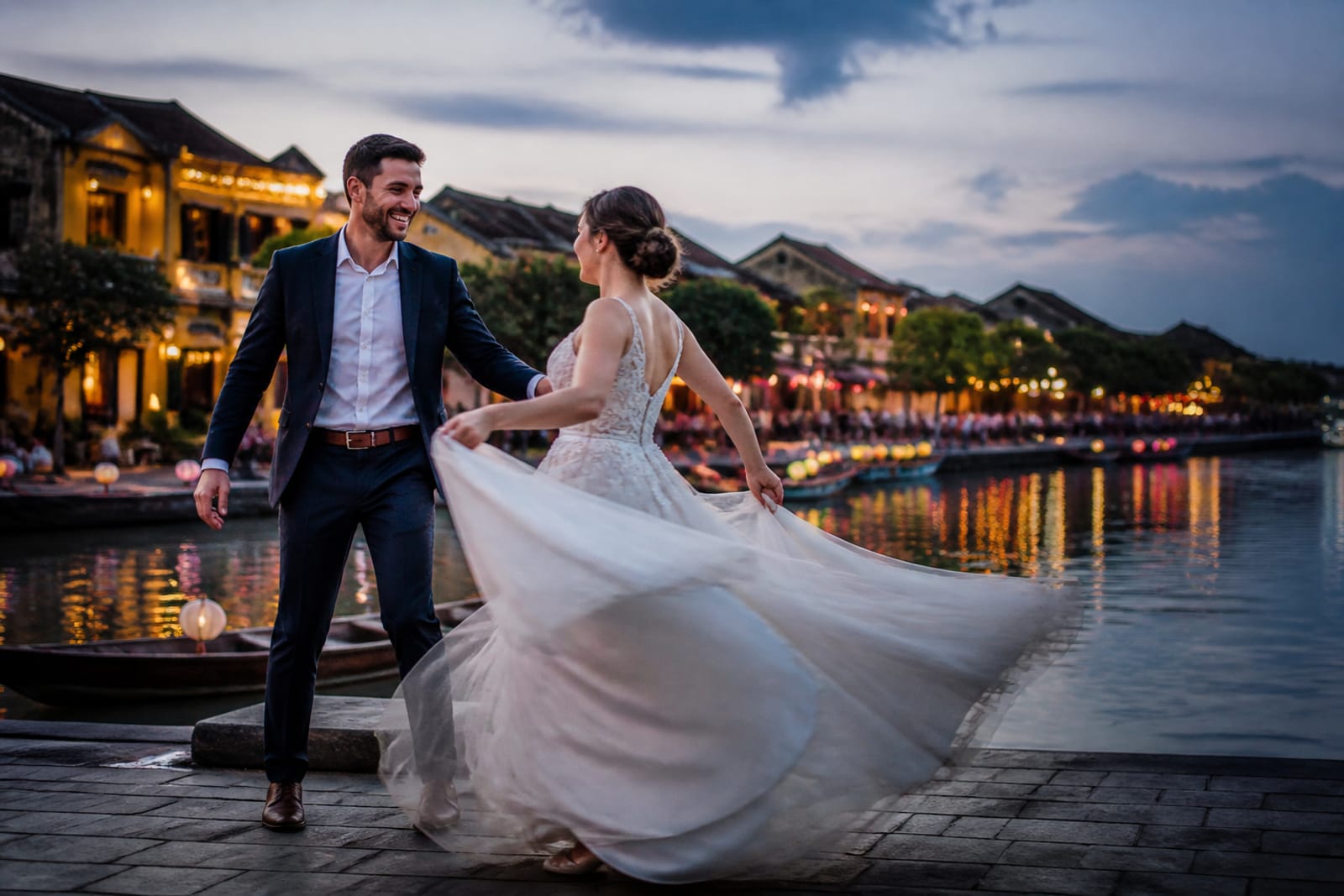
What should you check before booking a pre-wedding shoot in Hoi An?
Before you commit to a photographer, confirm: (1) Entrance ticket: the Ancient Town requires an entrance ticket for all visitors over 18; ask your photographer whether they include this or whether you buy it separately on arrival. (2) Parking and transport: if you're staying outside the Old Town, clarify how you'll get to the yellow walls—taxis cannot enter the narrow lanes, so you'll walk or cycle. Ask whether your photographer can meet you at a central point or your hotel. (3) Temple access: if you want to include sunrise shots at a temple (like Phung Hung Temple or Quan Cong Temple), some require modest dress (shoulders and knees covered) and early-morning access is negotiated, not guaranteed; a photographer familiar with local etiquette saves friction. (4) Makeup timing: if you want on-location hair and makeup, the photographer should coordinate with a makeup artist; Cáo Studio – Makeup & Photoshoot can arrange this—ask on WhatsApp whether they include makeup as part of the pre-wedding package or what the add-on cost factors are (travel time, early-morning rates, artist availability). (5) Edited-photo delivery: clarify how many edited photos you receive, how many outfit changes are included, and when files arrive; this prevents mismatched expectations. (6) Weather backup: if you book during rainy season (Sep–Dec) and typhoons close the town or flood the lanes, confirm whether you can reschedule without penalty or get a partial refund. Reputable photographers should have a contingency plan—ask what it is before you pay.
How does booking with Cáo Studio work for Hoi An shoots?
Cáo Studio operates branches in Hanoi and Ho Chi Minh City; Hoi An shoots are by appointment, meaning the team coordinates a date and travels to meet you. You contact the studio via WhatsApp (+84 338 762 340) with your preferred dates, outfit ideas, and any special requests (makeup, ao dai rental, proposal moment, family members). The coordinator confirms availability, weather expectations for your chosen month, and sends a quote—pricing depends on travel time, number of outfits, makeup inclusion, and how many edited files you want. You're not paying for a fixed "package"; instead, the quote reflects the specific session you've described. Once you confirm, you book a hotel and notify the studio 1–2 weeks before so the team can arrange transport and brief you on where to meet. See the lookbook and FAQ for examples of pre-wedding sessions and how Cáo Studio approaches couple poses and light. The pre-wedding pillar page explains the process, and the Hanoi and Saigon pages show the team's approach—same photographers handle Hoi An appointments.
---
What to check before you book
- Season for light: Feb–Apr = mild, golden light. May–Aug = hot, need sunrise. Sep–Dec = rainy, risk of flooding.
- Time of day: aim for 5:30–7:30 a.m. sunrise. Avoid 10 a.m.–3 p.m. harsh light.
- Outfit logistics: one ao dai needs no changeover; ao dai + Western dress takes 15–20 min. Wedding dress needs safe storage.
- Entrance ticket: confirm who buys it—photographer or you.
- Makeup/hair: if included, clarify timing and artist arrival; if not, ask about add-on cost factors.
- Edits and delivery: how many photos, how long until files arrive?
- Weather backup: what's the reschedule policy if rain or typhoons hit?
📸 Book on WhatsApp — pre-wedding photoshoot
FAQ
Do I need a permit to shoot pre-wedding photos in Hoi An Ancient Town?
The Ancient Town requires an entrance ticket for all visitors; photographers do not need a separate permit, but confirm with your photographer whether they know current rules. Shooting inside temples requires modest dress and respect for prayer times—a photographer familiar with the town's etiquette prevents friction.
Can we do a pre-wedding shoot in Hoi An if we live overseas and are flying in?
Yes. Cáo Studio books Hoi An shoots by appointment; you coordinate dates via WhatsApp, the team travels to meet you, and you stay in Hoi An for 1–2 days. The early-morning timing (5:30 a.m. start) means a pre-dawn pickup from your hotel; confirm transport arrangements when you book.
What happens if it rains on our Hoi An pre-wedding shoot day?
Light drizzle in Dec–Jan or Sep–Oct is common. A photographer can still shoot because overcast light is soft; however, confirm your photographer's backup plan before booking—some offer rescheduling, others shoot in rain if you consent. Avoid Oct–Nov if flooding is a concern; the Ancient Town's lanes pool water and walkways become unsafe.
Should we rent an ao dai or bring our own?
Cáo Studio can arrange ao dai rental if you ask on WhatsApp; rentals usually include sizing, tailoring if needed, and accessories. If you own an ao dai, bring it; many couples prefer the fit and familiarity. Either way, confirm with your photographer whether the outfit works for the light and lanes you're shooting.
How long does a pre-wedding session at Hoi An take?
Typical sessions run 2–3 hours, covering 3–5 alley locations, one outfit change (optional), and sunrise or early-morning light. Exact length depends on your outfit choices and number of locations—ask for a timeline when you request a quote on WhatsApp.
Can we include family or friends in the pre-wedding shoot?
Yes, if you want. A photographer can frame couple shots and group shots in sequence; this extends the session time. Cáo Studio also offers couple and family photoshoots that blend both. Discuss group size and roles when you book.
FAQ
Do I need a permit to shoot pre-wedding photos in Hoi An Ancient Town?
The Ancient Town requires an entrance ticket for all visitors; photographers do not need a separate permit, but confirm with your photographer whether they know current rules. Shooting inside temples requires modest dress and respect for prayer times—a photographer familiar with the town's etiquette prevents friction.
Can we do a pre-wedding shoot in Hoi An if we live overseas and are flying in?
Yes. Cáo Studio books Hoi An shoots by appointment; you coordinate dates via WhatsApp, the team travels to meet you, and you stay in Hoi An for 1–2 days. The early-morning timing (5:30 a.m. start) means a pre-dawn pickup from your hotel; confirm transport arrangements when you book.
What happens if it rains on our Hoi An pre-wedding shoot day?
Light drizzle in Dec–Jan or Sep–Oct is common. A photographer can still shoot because overcast light is soft; however, confirm your photographer's backup plan before booking—some offer rescheduling, others shoot in rain if you consent. Avoid Oct–Nov if flooding is a concern; the Ancient Town's lanes pool water and walkways become unsafe.
Should we rent an ao dai or bring our own?
Cáo Studio can arrange [ao dai rental](/ao-dai-rental) if you ask on WhatsApp; rentals usually include sizing, tailoring if needed, and accessories. If you own an ao dai, bring it; many couples prefer the fit and familiarity. Either way, confirm with your photographer whether the outfit works for the light and lanes you're shooting.
How long does a pre-wedding session at Hoi An take?
Typical sessions run 2–3 hours, covering 3–5 alley locations, one outfit change (optional), and sunrise or early-morning light. Exact length depends on your outfit choices and number of locations—ask for a timeline when you request a quote on WhatsApp.
Can we include family or friends in the pre-wedding shoot?
Yes, if you want. A photographer can frame couple shots and group shots in sequence; this extends the session time. Cáo Studio also offers [couple and family photoshoots](/couple-photoshoot) that blend both. Discuss group size and roles when you book.
Ao dai, makeup, hair and a local photographer in Hanoi or Saigon — one WhatsApp message.