/pre-wedding-photoshoot
Pre-wedding photo ideas and poses at Muong Hoa valley rice terraces
Muong Hoa valley (Sapa district, north Vietnam) works for pre-wedding shoots during March–May and September–November, when weather is clear and terraces are either green or golden. Book a photographer who shoots wide first (to capture the landscape geometry), then medium (you two walking or standing close), then detail (hands, fabric, faces in side light). Avoid midday harsh sun and the December–February fog season. Wear layered, muted-tone outfits (cream, grey, dusty rose) that contrast gently against green or brown earth. Plan 2–3 hours on-site; light windows are narrow. Cáo Studio does not operate in Sapa — see the planning guide below to vet a local Sapa photographer and understand the logistics before you commit.
Why Muong Hoa valley works for pre-wedding frames (and when it doesn't)
Muong Hoa's terraces form natural leading lines that draw the eye through a frame. The valley slopes are steep enough to create layered depth — foreground, terrace wall, far ridge — which separates you from the background and stops the shot feeling flat. Early light (6:00–7:30 am) rakes across the terrace walls, throwing shadow lines that sculpt the land. By 10:00 am, light hardens and washes out terrace definition. The valley is coldest and foggiest December–February; wet season typhoons (September–November peak) can close trekking trails within hours. Best windows: March–May (clear, cool, terraces green after planting) and mid-September to early November (post-harvest gold, dry air). Book a scout trip or phone call with your photographer weeks ahead — weather windows are real constraints, not suggestions.
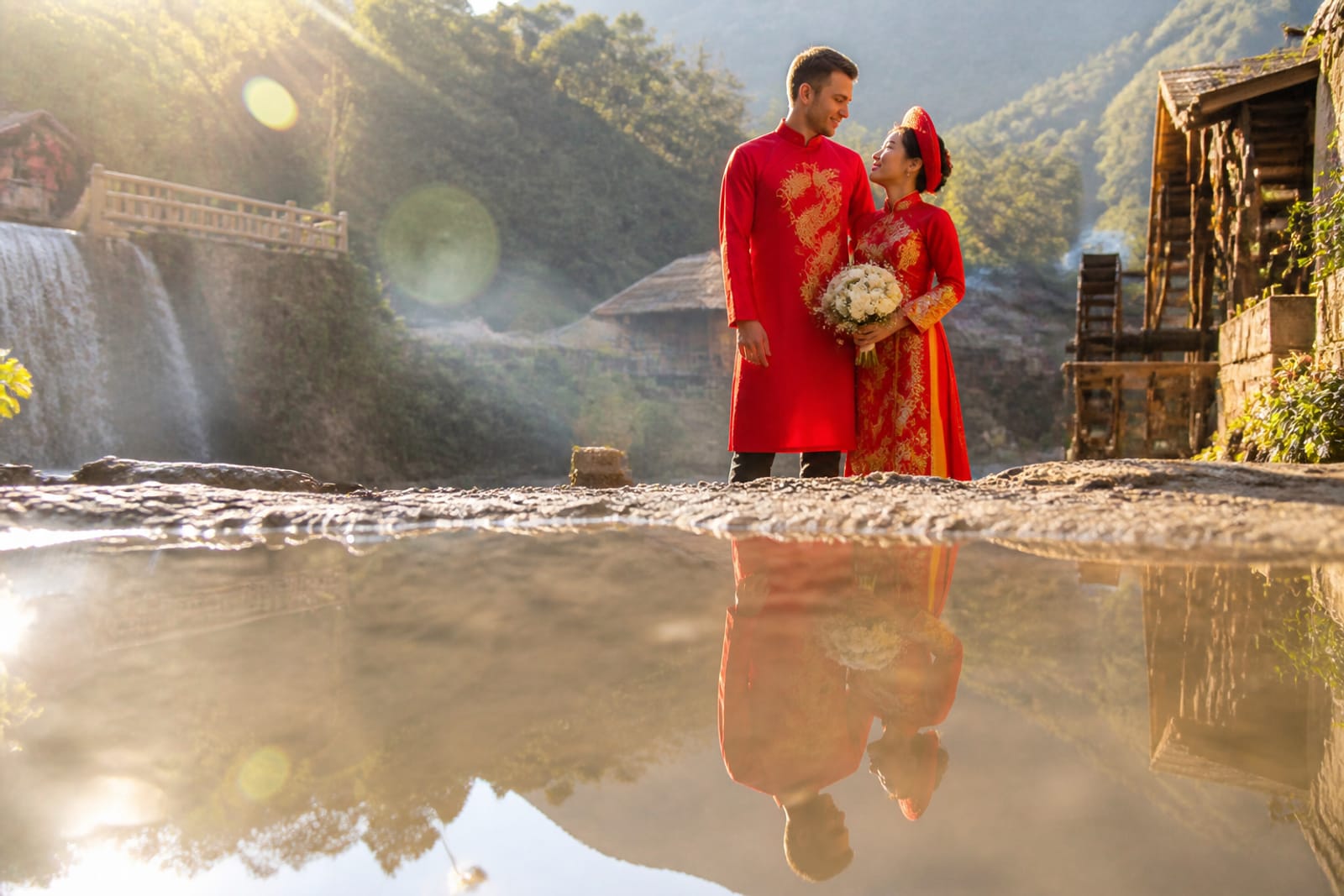
How to pose so you look directed, not stiff
The strongest pre-wedding frames at Muong Hoa come from movement and real interaction, not fixed monument poses. Brief your photographer to capture: (1) you two walking down a terrace path, bodies angled toward each other, one looking at the other (not the camera), (2) sitting on a flat rock or terrace edge with hands touching or interlaced, bodies close, one looking out at the view while the other looks at them, (3) dancing or swaying (if the path is wide enough) with the valley behind, (4) standing back-to-back, turning heads toward each other over shoulders, (5) her adjusting his collar or him holding her close mid-walk. Avoid: standing still facing the camera, both looking at the lens, rigid arm positions, symmetrical poses mirrored left-right. Ask your photographer for a "walking shot list" — specific moments tied to light hour and path geometry — before the shoot. Rehearsing three poses with a local guide the day before saves confusion on-site.
Which outfit layers work in cool mountain light
Muong Hoa sits at roughly 900–1,000 meters elevation; morning air is cooler than Hanoi or Saigon by 8–12 degrees Celsius. Wind is common, so loose fabric flaps and layers shed heat fast. Muted, warm tones (cream, off-white, soft grey, dusty rose, sage green, rust) sit quieter against the brown and green terrace earth than bright white, neon, or jewel tones. If you wear an áo dài, choose a lightweight silk or linen blend (not heavy brocade) and layer a long cardigan or áo tứ thân (traditional tunic) over it to keep warm and add texture. Jeans should fit close at the calf (loose legs flap in wind and read as shapeless in wide shots). Boots or neutral walking shoes grip wet terrace stone — avoid heels or bright white sneakers. Bring a spare top in case mud splatters during the walk; terraces are slippery after rain. Ask your photographer if they recommend a fabric steamer or iron on-site (many Sapa hotels offer this). Pre-wedding shoots here are 60% logistics, 40% posing — comfort and grip are not afterthoughts.
📸 Book on WhatsApp — ao dai photoshoot
Comparing Muong Hoa to other Sapa pre-wedding locations
| Location | Best for | Light window | Why it works | Season fit |
|---|---|---|---|---|
| Muong Hoa terraces (valley base) | Layered depth, leading lines, muted earth tones | 6:00–7:30 am | Terraces form natural geometry; soft side light sculpts walls | Mar–May, Sep–Nov |
| Silver Waterfall path (forest) | Intimate close-ups, green canopy, moody texture | 8:00–9:30 am | Overcast diffuse light; moss and water add color. Fewer tourists early | Mar–May, Sep–Nov |
| Tram Ton pass (alpine meadow, open) | Wide landscapes, sky drama, couple silhouette | 5:30–6:30 am, 4:30–5:30 pm | High elevation, unobstructed light; wildflowers May–Jul; fog Dec–Feb risk | Mar–May, Sep–Nov |
| Fansipan summit (cable car, extreme) | Epic scale, proposal reveals | 5:00–6:00 am (weather-dependent) | Above cloud layer; fast weather changes; logistical gamble | Mar–May, Sep–Oct only |
| Ta Phin village (red Dao community) | Cultural story, local fabric, warm tones | 9:00–11:00 am | Morning light on traditional indigo-dyed textiles; authentic context | Year-round, best Mar–May |
Muong Hoa wins if you want geometry and scale without extreme logistics. Silver Waterfall suits couples seeking intimate, moody close-ups. Tram Ton demands early wake-up but offers uncluttered skies. Fansipan is high-risk, high-reward. Ta Phin works year-round if you pair it with cultural storytelling.
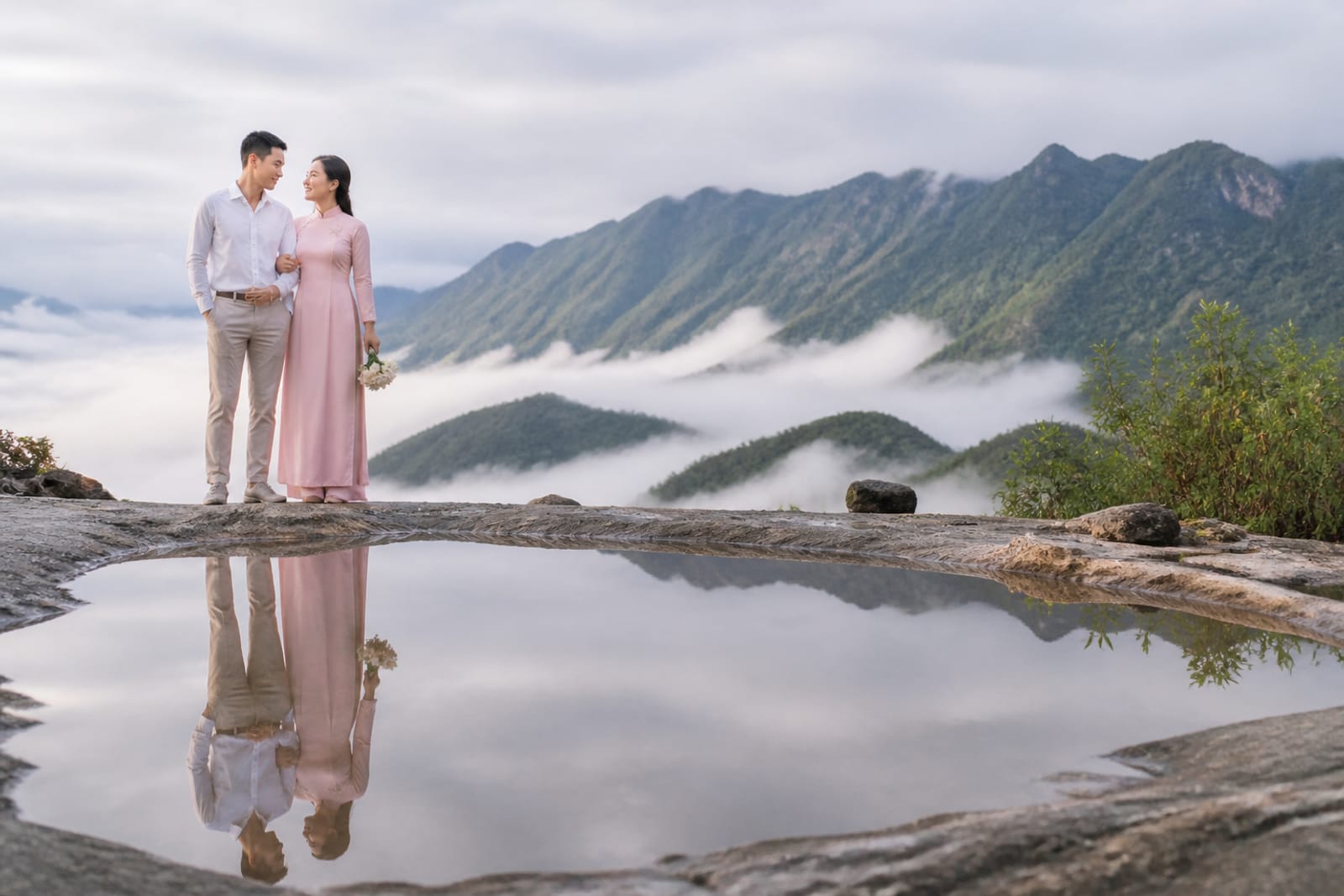
Light, seasons and the trekking reality: what affects the shoot
Pre-wedding shoots in Muong Hoa are tied to trekking conditions, not just light. A "2-hour" shoot on paper often means 30 minutes of actual shooting and 90 minutes of walking, rest, and light waiting. Factor these real constraints:
- Early light window (6:00–7:30 am). You leave your hotel at 5:00 am. Walk 45 minutes downhill to valley floor. Photographer sets up tripod for couple walk-shot. By 7:00 am, light is optimal; 15 minutes of strong frames. Rest, move to second location, 10 minutes of medium shots (close detail, faces). Done by 8:00 am. Return uphill 45 minutes. Back at hotel 9:00 am.
- December–February fog. Terraces disappear into white. Forecast looks clear; you arrive to grey. Risk is high; flexibility is essential. Book a weather-cancel clause in your contract.
- May (planting season). Terraces are flooded for rice seedlings. Water mirrors sky and adds reflection, but paths are muddy and boots sink. Budget extra time.
- Mid-September to early October (harvest). Terraces are golden-brown, beautifully textured. Weather is still warm enough to linger. This is peak pre-wedding season for Sapa; local photographers book 3–4 weeks ahead.
- Wind. Fabric blows, hair tangles, dust swirls. Tie loose ends, bring hair clips, and don't expect perfection mid-gust. A good photographer uses wind motion as energy, not flaw.
How to find and vet a pre-wedding photographer in Sapa (since Cáo Studio doesn't shoot there)
Cáo Studio operates in Hanoi, Ho Chi Minh City, and Hoi An only — we do not have a Sapa team. If you're set on Muong Hoa, here's how to find a trustworthy local photographer:
- Search for "Sapa pre-wedding photographer" on Instagram. Look at 20–30 recent shoots (from the last 6 months). Check if the photographer's own frames are sharp, colors are true (not over-processed), and poses feel natural. Avoid overly filtered or blurry work.
- Ask for references from hotels or wedding planners in Sapa. Sapa has several boutique hotels that coordinate weddings; staff know reliable photographers and will recommend by reputation, not hype.
- Request a phone or WhatsApp call. Vet the photographer directly. Ask: How many pre-wedding shoots have you done in Muong Hoa? What's your backup plan if weather closes trails? Do you scout the location the day before? Can you do a pre-shoot walk-through with us? Do you edit and deliver files within a week? Honest answers are signs of professionalism.
- Check contract terms. Confirm cancellation/weather policy, editing timeline, file count and format (RAW or JPEG), and whether they handle video (many Sapa photographers do not). Avoid open-ended promises like "as many photos as you want."
- Tip on pricing. Sapa pre-wedding shoots cost less per hour than Hanoi or Saigon (logistics and demand differ), but trekking time extends the total day. Ask the photographer to quote for the whole package (walk, shoot, return, editing), not hourly rates.
If you'd prefer to move your pre-wedding shoot to Hanoi (Huc Bridge at dawn, Temple of Literature, Red River at dusk) or Hoi An (lantern streets, Thu Bon riverside, rice fields), Cáo Studio offers pre-wedding & elopement packages with your choice of áo dài or Western dress, full hair and makeup, and edited frames in 48 hours.
What to check before you book a Sapa pre-wedding shoot
Before committing to a photographer or date, confirm:
- Weather window confidence. March–May and September–November are best; December–February fog and May mud are real risks. Ask your photographer: "What's your cancellation policy if conditions close the valley?" A yes/no answer to rain is vague — request specifics.
- Walking fitness. Muong Hoa involves 45–60 minutes of steep downhill (hard on knees on return) and uneven terrace edges. If you or your partner has any joint concern, scout the path with a local guide first or choose a flatter location.
- Outfit fit in cool, windy air. Try layered pieces at home in cool conditions. Á o dài and heavy fabrics billow and catch wind awkwardly. Muted tones photograph better here than bright colors.
- Photographer's experience with couples (not solo tourists). Ask to see 5–10 recent couple or elopement shoots. Solo-tourist photographers may not know how to direct interaction or choose flattering couple framing.
- Editing style. Request sample edits (same location, different couples). Some Sapa photographers over-saturate or blur backgrounds; confirm the style matches your taste.
- Timeline and file delivery. Confirm you'll receive edited files within 7 days and in a usable format (JPEG or downloadable cloud link, not low-res preview). Video (if offered) should also have a delivery date.
- Total cost factors. Location, walk length, number of outfits, guide fees, and editing time all shape cost — but never a fixed hourly rate alone. Ask for a package quote.
FAQ
Is Muong Hoa valley better for pre-wedding photos than other Sapa locations?
Muong Hoa excels for layered geometry and soft light, but Silver Waterfall suits intimate close-ups, and Tram Ton offers open-sky drama. Choose based on your style — landscape scale, forest mood, or alpine drama — not default fame.
What should I wear under an áo dài for a Sapa pre-wedding shoot?
Wear a fitted slip or undergarment in cream or ivory (áo dài is semi-sheer). Layer a lightweight cardigan or tunic over the áo dài to stay warm and add texture against cool mountain air. Avoid puffy layers that bulk the silhouette.
How early do I need to wake up for good light at Muong Hoa?
Plan to leave your hotel by 5:00 am to reach the valley by 6:00 am when light turns soft. Peak light window is 6:00–7:30 am; by 8:00 am, sun is higher and harsher. Return to hotel by 9:00–9:30 am.
Can we do a Muong Hoa pre-wedding shoot in December, January, or February?
Not reliably. The valley is often blanketed in fog December–February, erasing terrace detail and light. March–May and September–November are dependable. If you're set on winter, ask your photographer about a backup location (Ta Phin village or town-based spots) and a flexible date to wait for a clear day.
What's the difference between hiring a local Sapa photographer and Cáo Studio?
Cáo Studio operates in Hanoi, Saigon, and Hoi An — we don't have a Sapa base. A local Sapa photographer knows the terrain and trekking logistics intimately. If you prefer a unified team (photographer, hair, makeup, styling) handling your shoot, Cáo Studio offers pre-wedding packages in Hanoi or Hoi An with guaranteed 48-hour delivery. For Muong Hoa, you'll coordinate a local photographer separately.
Do I need a permit to do a pre-wedding photo shoot in Muong Hoa valley?
Confirm current permit requirements with your hotel or local guide in Sapa — regulations can change. Most trekking companies include permit fees in their package. Ask your photographer if they handle permits or if you need to arrange separately.
FAQ
Is Muong Hoa valley better for pre-wedding photos than other Sapa locations?
Muong Hoa excels for layered geometry and soft light, but Silver Waterfall suits intimate close-ups, and Tram Ton offers open-sky drama. Choose based on your style — landscape scale, forest mood, or alpine drama — not default fame.
What should I wear under an áo dài for a Sapa pre-wedding shoot?
Wear a fitted slip or undergarment in cream or ivory (áo dài is semi-sheer). Layer a lightweight cardigan or tunic over the áo dài to stay warm and add texture against cool mountain air. Avoid puffy layers that bulk the silhouette.
How early do I need to wake up for good light at Muong Hoa?
Plan to leave your hotel by 5:00 am to reach the valley by 6:00 am when light turns soft. Peak light window is 6:00–7:30 am; by 8:00 am, sun is higher and harsher. Return to hotel by 9:00–9:30 am.
Can we do a Muong Hoa pre-wedding shoot in December, January, or February?
Not reliably. The valley is often blanketed in fog December–February, erasing terrace detail and light. March–May and September–November are dependable. If you're set on winter, ask your photographer about a backup location (Ta Phin village or town-based spots) and a flexible date to wait for a clear day.
What's the difference between hiring a local Sapa photographer and Cáo Studio?
Cáo Studio operates in Hanoi, Saigon, and Hoi An — we don't have a Sapa base. A local Sapa photographer knows the terrain and trekking logistics intimately. If you prefer a unified team (photographer, hair, makeup, styling) handling your shoot, Cáo Studio offers [pre-wedding packages in Hanoi or Hoi An](/pre-wedding-photoshoot) with guaranteed 48-hour delivery. For Muong Hoa, you'll coordinate a local photographer separately.
Do I need a permit to do a pre-wedding photo shoot in Muong Hoa valley?
Confirm current permit requirements with your hotel or local guide in Sapa — regulations can change. Most trekking companies include permit fees in their package. Ask your photographer if they handle permits or if you need to arrange separately.
Ao dai, makeup, hair and a local photographer in Hanoi or Saigon — one WhatsApp message.