/pre-wedding-photoshoot
Pre-wedding photo ideas and poses at Ta Phin village
Ta Phin sits 1,500 metres above sea level in the northern highlands, a two-hour drive from Sapa town. The village is known for flooded rice fields (May–August, best for reflection frames), golden harvest terraces (mid-September to early October), and Red Dao homestays that double as intimate settings. A full-day pre-wedding session here—wide landscape shots, then medium frames of you two walking or standing at the terrace edge, then detail portraits near the homestay entrance—takes 4–6 hours depending on light and outfit changes. Book a photographer who understands mountain light (it shifts fast in valleys); Cáo Studio coordinates similar sessions in Hanoi and can advise on local timing, but shoots directly in Hanoi, Ho Chi Minh City, and Hoi An by appointment. The main risk is weather: mist rolls in by 10 a.m. most days Dec–Feb, and rain is frequent May–Sep; aim for March–May or September–early October, and start before 7 a.m. to catch side light on the terraces before crowds and haze arrive.
Why is Ta Phin a pre-wedding photoshoot destination?
Ta Phin works because the setting does half the storytelling. Red Dao women in indigo head wraps walk the terraces daily; wooden stilts and bamboo fences frame naturally; water reflects sky in May–August without a crane or reflector. You're not posing in front of a landmark—you're moving through a landscape where light and culture already exist. The village has homestays (family-run guesthouses) where you can shoot arrival scenes, morning coffee on a porch, or dressing moments. Most couples choose Ta Phin over Sapa town itself because the streets are quieter and the terraces offer depth—wide, medium, close—without reset time between frames.
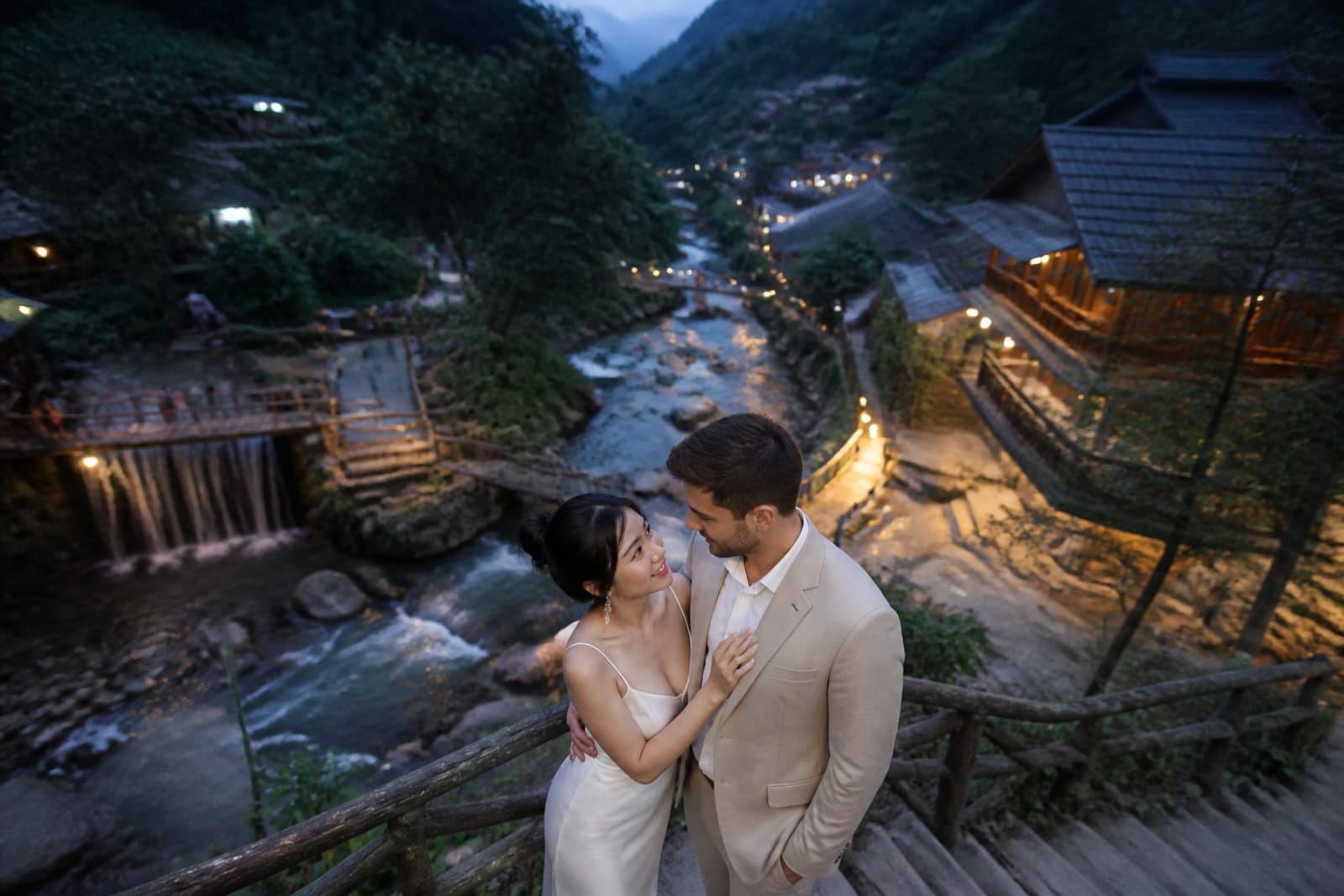
What poses actually work on rice terraces?
Forget the "bride on one knee" or "groom carrying bride" clichés. On wet terraces, stability matters. Walk side-by-side down a terrace path (the photographer shoots from ahead or to the side, capturing your silhouette and the fields beyond). Stand at a terrace edge facing the valley, him behind her, hands around her waist—the terrace line and distant fields create layers. Sit on a dry stone wall between fields; look at each other, not the camera. Move: walk away from the camera toward the next terrace, hold hands, let the landscape swallow you. For detail: sit on the homestay steps, she in his lap, morning light across her shoulder. The photographer should shoot wide first (you in the landscape), then medium (you two), then close (hands, shoulders, faces). Avoid standing still; motion reads as intimacy, stillness reads as a pause for the camera.
| Pose type | Best for | Light / season | Why it works |
|---|---|---|---|
| Walking away (terraces behind) | Full-day storytelling | Early morning side light (6:30–8 a.m.) | Distance + movement + field layers in one frame |
| Sitting on wall (facing valley) | Medium shot, connection | Late morning golden side light (8:30–10 a.m.) | Backlighting on hair, terrace line at waist level, depth |
| Standing at edge (him behind) | Silhouette / intimate scale | Sunrise or overcast (even light, no harsh shadows) | Her profile, his frame, foreground terrace sharp |
| Homestay porch moments | Detail + culture | Golden hour (early morning or 4–5 p.m.) | Real light, real setting, no "photoshoot" feel |
| Walking through (path between terraces) | Narrative sequence | Any time with side light, avoid midday flat sun | Three-frame story: approach, mid-path, arrival |
Peak seasons by terrace state:
- May–August: Water-filled terraces reflect sky; muddy footpaths. Bring waterproof shoes. Mist lifts by 8–9 a.m. most days.
- Mid-September to early October: Golden harvest color; dry paths; clearer air. Terraces still hold some water. Weather most stable this window.
- March–May: Green young growth; dry earth; clearest light. No crowds. Mild temperatures.
- December–February: Bare soil or sparse green; cold (5–12°C), frequent fog. Light arrives late (7:30+ a.m.). Misty frames possible but unpredictable.
How does light timing change your frame quality?
Mountain valleys trap mist and clouds. At Ta Phin, direct sunlight appears 30–60 minutes later than in the lowlands. Before 7 a.m., light is soft and diffused—good for faces but weak for terrace texture. By 8–9 a.m., side light from the east hits the west-facing terraces, creating shadow lines that define the water and ridges; this is the strongest window (1–2 hours). By 10–11 a.m., mist or clouds often roll in, flattening contrast. Afternoon light (2–5 p.m.) can be harsh and behind the main terraces. Your photographer must scout at the exact session date to know where the sun clears the opposite ridge; a "best light window" valid in May may not apply in October. Many couples hire a photographer the day before to scout and time the sunrise, then return at that exact hour the next morning. Overcast days (common June–September) are soft but dimmer; the edit needs lift and the session may take longer to gather strong frames.
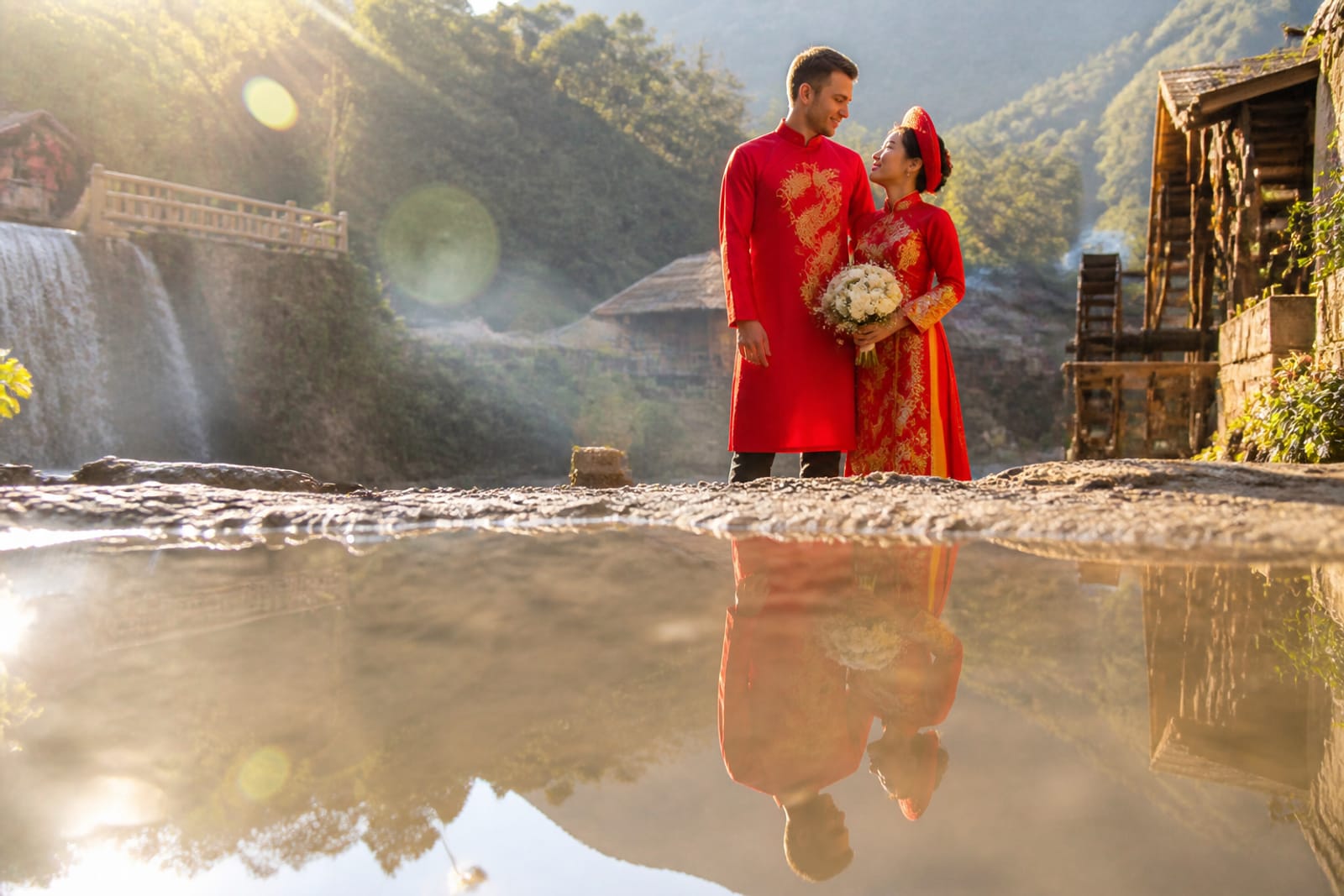
What should you wear for Ta Phin terrain and culture?
Ao dai (traditional Vietnamese silk tunic) is the standard choice—it photographs beautifully, respects the cultural setting, and many ao dai rental services include tailoring for the terrain. Wear it over trousers or leggings (not bare legs on muddy paths). Bring waterproof flats or hiking sandals; stilettos sink and snap. If wearing Western dress, choose fitted fabrics (loose skirts catch wind and mud); layers for cold mornings (10–12°C at 6 a.m.). The groom in a tailored suit or traditional áo groom looks sharp in golden light but risks overheating by mid-morning; linen or lightweight fabric helps. Cáo Studio's makeup & hair teams in Hanoi and Saigon can prep you for mountain conditions—hold hair against wind, waterproof makeup. Bring a second outfit (casual, or a second ao dai) for the homestay and close frames; a change offers editorial depth and breaks the monotony if shooting 5+ hours.
Should you hire a local Ta Phin photographer or book through a studio?
A local Sapa photographer knows the villages, homestays, and light patterns—a real advantage. But you'll coordinate separately: outfit, hair, makeup—three vendors instead of one message. A pre-wedding studio (like Cáo Studio, based in Hanoi) can manage hair, makeup, and the photographer as one team, brief on direction, and deliver edited frames in 48 hours. The trade-off: a studio may not have a scout on-site that morning, so your photographer arrives with a shot list but less intuition about that day's mist or cleared ridge. Best hybrid: book a studio that works with a trusted local photographer or has done Ta Phin before. Ask your photographer or studio:
- Have you shot at Ta Phin in this season and weather window? (Ask for a lookbook or recent frames.)
- Will you scout the morning before or arrive on-site by 6 a.m.?
- Do you include hair and makeup, or will I book them separately?
- Are edited photos delivered within 48 hours?
If you're based in Hanoi and prefer a directed, full-service approach, Cáo Studio's pre-wedding shoots include styling and on-location direction; ask on WhatsApp for Ta Phin logistics and availability.
What are the practical logistics for a Ta Phin pre-wedding session?
Travel: Hanoi to Ta Phin is 5+ hours by car (via Hoa Binh and Sapa). Most couples break it into two days: drive to Sapa town the day before, stay overnight, then wake at 5 a.m. for the one-hour drive to Ta Phin and a 6–7 a.m. shoot start. Alternatively, fly Hanoi to Sapa (1.5 hours), skip the drive.
Duration: 4–6 hours on-site, including arrival setup (30 min), light scouting (15 min), three outfit changes or 2–3 locations (3–4 hours), and travel back to Sapa. Budget a full day plus travel.
Permits and access: No formal permit required to photograph at Ta Phin, but ask the homestay owner or your photographer about etiquette (some homestays prefer advance notice; Red Dao women may ask for a small fee if featured in frames—discuss with your photographer).
Homestay coordination: Book your overnight Sapa accommodation in advance. Many homestays in Ta Phin itself (wooden stilts, basic but photogenic) allow photography. Confirm with your photographer or travel coordinator that the homestay is accessible on foot and permits a 6–8 a.m. arrival.
Backup weather: Spring and autumn are most reliable, but expect one rainy day per week. Plan your session date to allow a one-day reschedule if heavy rain hits.
What to check before you book:
- Photographer experience: Ask for five frames shot at Ta Phin in your season. (Generic Sapa or northern Vietnam frames don't prove high-altitude light knowledge.)
- Styling included: Confirm whether hair, makeup, and outfit changes are included or contracted separately.
- Delivery timeline: Ask for edited frames within 48 hours or a clear deadline.
- All-in cost factors: Travel distance, number of outfits, editing time, and homestay booking are real cost drivers—get a quote via WhatsApp.
- Contract clarity: Who arranges the homestay? Who is liable if weather forces a reschedule?
📸 Book a pre-wedding session on WhatsApp
FAQ
Is May–August (water-filled terraces) better than harvest season (golden fields)?
Water reflects sky and creates mirror effects; harvest is warm and dry. May–August light is softer but mist-prone before 9 a.m. Harvest (mid-Sep to early Oct) is clearer and more stable. Choose based on your color preference—turquoise water or gold fields—not light quality alone.
Can we shoot in December–February?
Yes, but expect cold mornings (5–12°C), frequent fog, and mist until 8–9 a.m. Light arrives late. Bare or sparse terraces are less visually dense. February (approaching Tet) can see crowds. March–May or September–early October are more reliable.
Do we need permits or permission from the Red Dao community?
No government permit is required, but ask your photographer to brief you on respectful framing. If Red Dao women appear in photos, a small gesture (tea, snacks, or a print) is considerate. Discuss in advance with your photographer or homestay.
How many outfit changes fit in a 4–6 hour session?
Typically two (ao dai, then casual or Western dress). Each change takes 20–30 minutes including touch-up and light adjustment. More than two compresses shooting time per outfit. Discuss with your photographer based on the story you want.
Should we hire a Sapa-based photographer or book through a studio in Hanoi?
Local photographers know the terrain and morning light intimately but require separate hair and makeup coordination. A studio (like Cáo Studio) manages styling and direction as one team but may have less on-site scouting time. Ask both for recent Ta Phin frames and turnaround time. Cost factors are travel distance (local = lower; studio = higher) and coordination overhead.
What if weather is bad on our session date?
Heavy rain or thick fog can ruin light and terrace visibility. Confirm a reschedule window (one week, same season). Overcast days still work—light is soft, editing will lift contrast. Most photographers push through drizzle; heavy rain (>10 mm/hour forecast) usually triggers a postpone.
FAQ
Is May–August (water-filled terraces) better than harvest season (golden fields)?
Water reflects sky and creates mirror effects; harvest is warm and dry. May–August light is softer but mist-prone before 9 a.m. Harvest (mid-Sep to early Oct) is clearer and more stable. Choose based on your color preference—turquoise water or gold fields—not light quality alone.
Can we shoot in December–February?
Yes, but expect cold mornings (5–12°C), frequent fog, and mist until 8–9 a.m. Light arrives late. Bare or sparse terraces are less visually dense. February (approaching Tet) can see crowds. March–May or September–early October are more reliable.
Do we need permits or permission from the Red Dao community?
No government permit is required, but ask your photographer to brief you on respectful framing. If Red Dao women appear in photos, a small gesture (tea, snacks, or a print) is considerate. Discuss in advance with your photographer or homestay.
How many outfit changes fit in a 4–6 hour session?
Typically two (ao dai, then casual or Western dress). Each change takes 20–30 minutes including touch-up and light adjustment. More than two compresses shooting time per outfit. Discuss with your photographer based on the story you want.
Should we hire a Sapa-based photographer or book through a studio in Hanoi?
Local photographers know the terrain and morning light intimately but require separate hair and makeup coordination. A studio (like Cáo Studio) manages styling and direction as one team but may have less on-site scouting time. Ask both for recent Ta Phin frames and turnaround time. Cost factors are travel distance (local = lower; studio = higher) and coordination overhead.
What if weather is bad on our session date?
Heavy rain or thick fog can ruin light and terrace visibility. Confirm a reschedule window (one week, same season). Overcast days still work—light is soft, editing will lift contrast. Most photographers push through drizzle; heavy rain (>10 mm/hour forecast) usually triggers a postpone.
Ao dai, makeup, hair and a local photographer in Hanoi or Saigon — one WhatsApp message.