/pre-wedding-photoshoot
Pre-wedding photo ideas and poses at Truc Lam Monastery
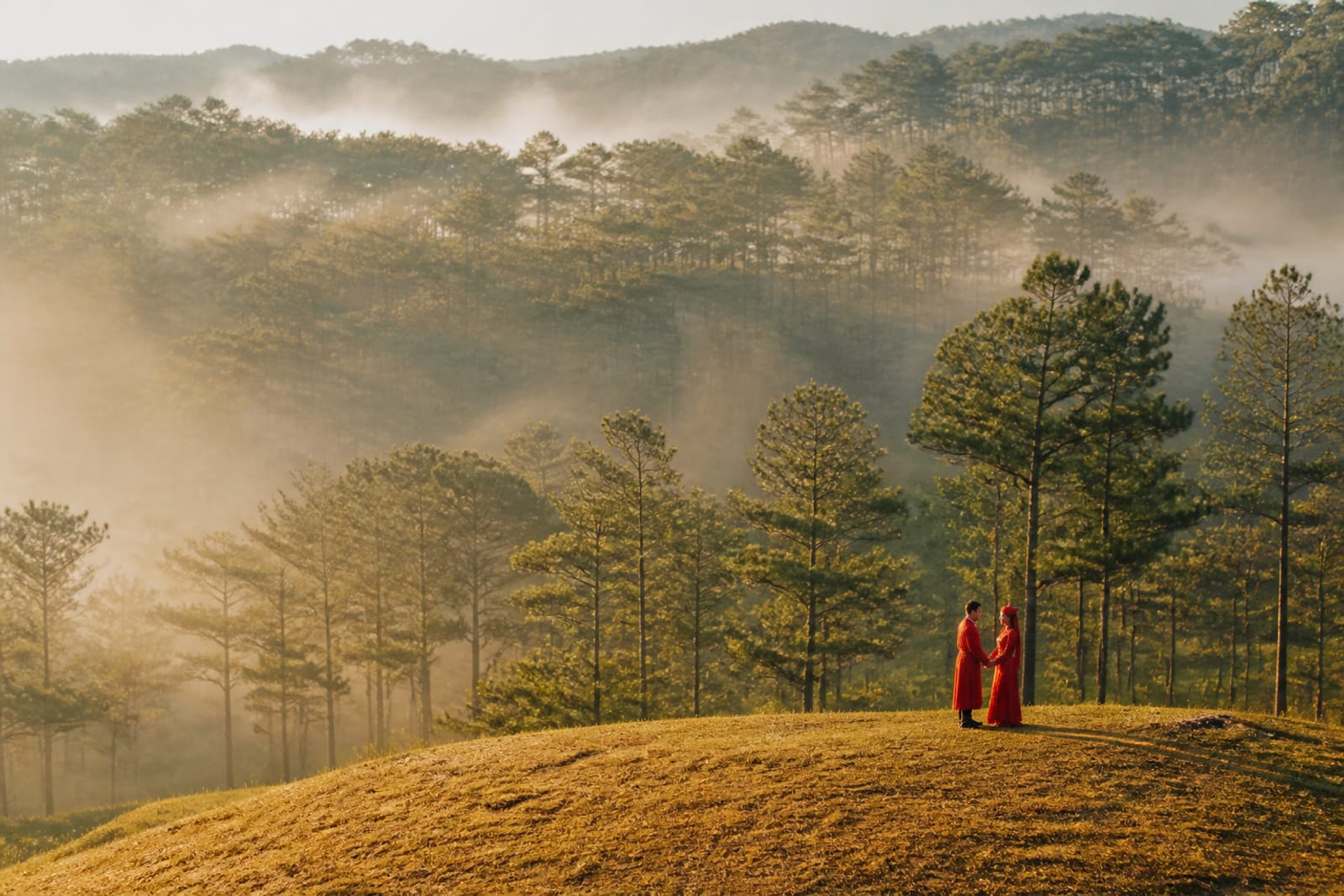
Truc Lam Monastery, high on Da Lat's Chicken Mountain, offers mist-draped pine forest and timber temple grounds ideal for pre-wedding shoots. Morning light (6:00–7:30 am, before tourists arrive) hits the wooden halls and pine trunks soft and directional—no harsh shadows across faces. The site demands one rhythm: walk, pause where real light lands, look at each other, let the photographer catch that moment. Avoid facing the temple head-on; instead, frame yourselves walking into or out of its shadow, or standing beside railings where side light shapes your silhouettes. Cáo Studio directs this sequence—wide shot of you both entering the grounds, medium of you walking the timber path, detail of hands or an exchanged glance. Weather matters: visit Dec–Feb for cool, stable mornings; avoid May–Oct (afternoon downpours, humidity). Budget 3–4 hours total (travel, makeup, 1.5 hours on-site). Check entry opening times locally and book a photographer who understands how temple grounds change light every 20 minutes. ---
What times of day work best at Truc Lam Monastery?
The monastery's timber buildings face northeast, so sunrise and early morning (before 8:00 am) deliver side light that wraps around wooden columns and catches mist rising off the valley. By 9:00 am, light flattens. Late afternoon (after 4:00 pm) brings warm backlight through the pines, but crowds swell and mist disappears. Dawn is rare and cold—bring a robe or shawl in Dec–Feb. If you can't arrive at sunrise, 6:45–7:45 am is the window where light stays directional enough to avoid squinting.
Early morning is the only time light respects the architecture and your faces equally.
How do you pose at a temple without looking stiff?
Stiff poses happen when couples face the camera and the temple. Instead: walk the timber path side by side, hand in hand, and pause where a tree shadow splits your faces half-lit; the photographer shoots you mid-step, not mid-freeze. Sit on a low wall and look toward the valley, not the lens. Stand at a railing with your back to the building and turn to each other—the photographer captures the moment you look, not the pose. Frame yourself entering a doorway, so one of you is partly in shadow. These are movements, not positions. A directed photographer will say "walk to that post and pause when the light hits you," not "stand here and smile."
Movement and light matter more than positioning the body.
Do you need to wear traditional ao dai at Truc Lam, or other outfits?
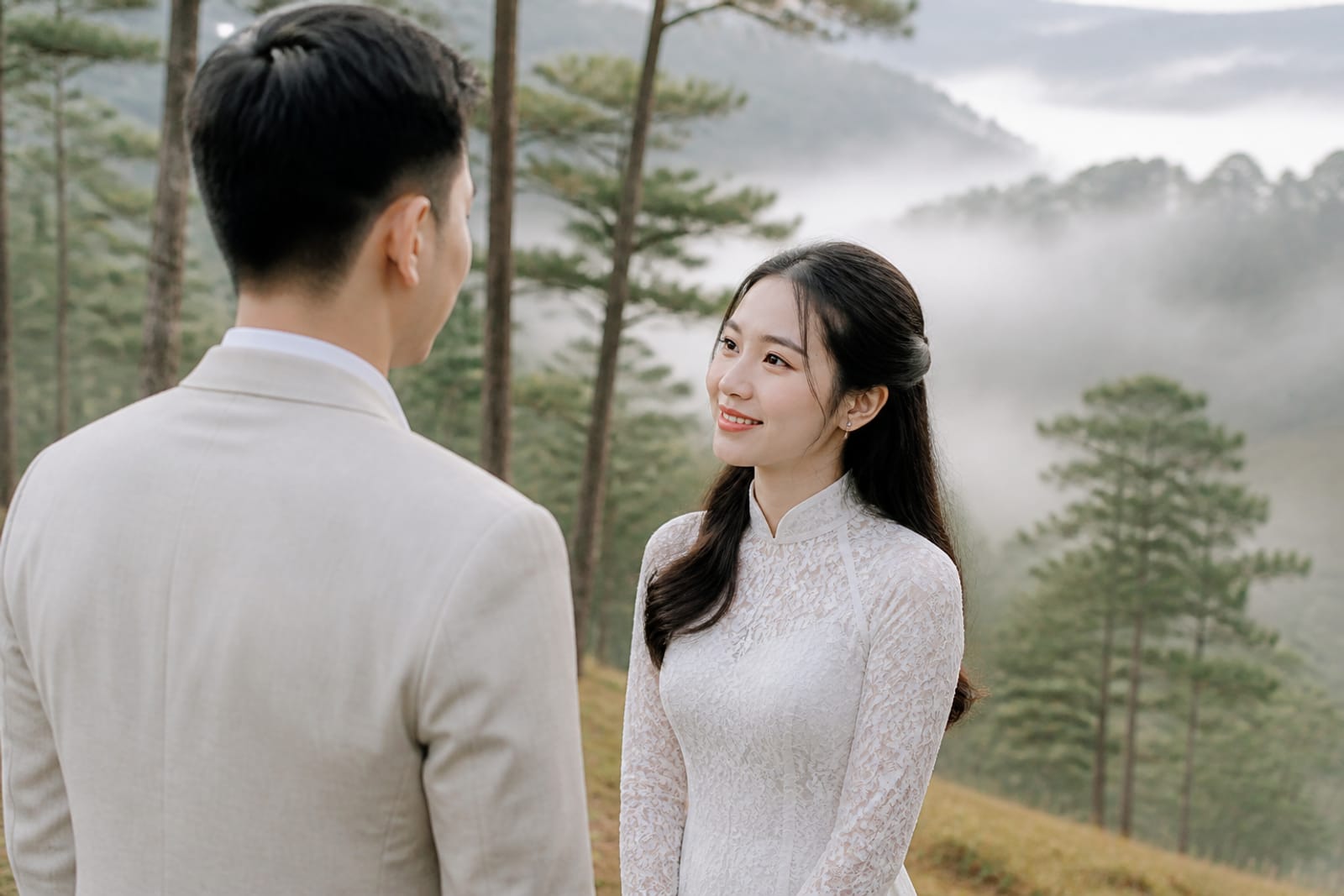
An ao dai works beautifully here—the flowing fabric photographs well against stone and wood, and it honours the spiritual setting. But temple etiquette asks for covered shoulders and knees, so an ao dai's long tunic and loose pants fit perfectly. If you choose Western formal wear (e.g., a dress or suit), ensure shoulders are covered and hems reach the knee; many temples ask visitors to cover up. Neutral or jewel tones (deep blue, emerald, burgundy, cream) hold up against the monastery's greys and browns better than bright colours. Avoid white (too bright in morning mist) and logos or busy patterns (they fight the landscape). Rent or bring one outfit, not three—a real pre-wedding shoot uses continuity, not fast changes. If you hire makeup & hair at your hotel, arrive in Da Lat the night before so styling happens fresh and you're ready to drive to the monastery at 5:45 am.
One well-chosen outfit outperforms three rushed outfit swaps at a temple.
Should you work with a local Da Lat photographer or bring a Hanoi/Saigon team?
Cáo Studio operates from Hanoi and Ho Chi Minh City, not Da Lat; Truc Lam sits in a third climate zone. If you book Cáo Studio for a pre-wedding shoot in Hanoi or Saigon, the team coordinates everything—outfit, makeup, hair and photography—as one unit, so there's no gap between stylist and camera. For a Da Lat shoot, you have two routes: hire a local photographer (who knows the monastery's light intimately but may not direct poses as a unified vision) or book Cáo Studio for shoots in Hanoi/Saigon and plan a separate trip to Da Lat with a vetted local. The trade-off is coordination (one Cáo Studio team) versus local knowledge (a Da Lat photographer). If you choose local, ask them for portfolio samples shot at Truc Lam at 7:00 am in Dec–Feb—that's your proof they understand the site's best light window.
| Option | Best For | Coordination | What to Check |
|---|---|---|---|
| Cáo Studio (Hanoi/Saigon shoot + local Da Lat photographer) | One team handling outfit/makeup/hair elsewhere; separate local photographer for Da Lat | Split—Cáo team in your city, local shooter in Da Lat | Ask local for Truc Lam sunrise portfolio; confirm outfit/hair travel to Da Lat |
| Local Da Lat photographer only | Budget-conscious; you hire makeup/hair separately | You manage three vendors | Do they have 6+ Truc Lam sunrise samples? Ask for testimonials from couples. |
| Cáo Studio-directed shoot (Hanoi/Saigon) | Full one-team experience; curated styling and direction | One Cáo Studio team, everything included | Suits pre-wedding shoots in Hanoi/Saigon; for Da Lat, ask on WhatsApp about a planning guide. |
One team outperforms three vendors stitched together—even across regions.
💄 Makeup & hair at your hotel | 🌸 See the lookbook | 📸 Book on WhatsApp — pre-wedding
What season and weather should you plan for?
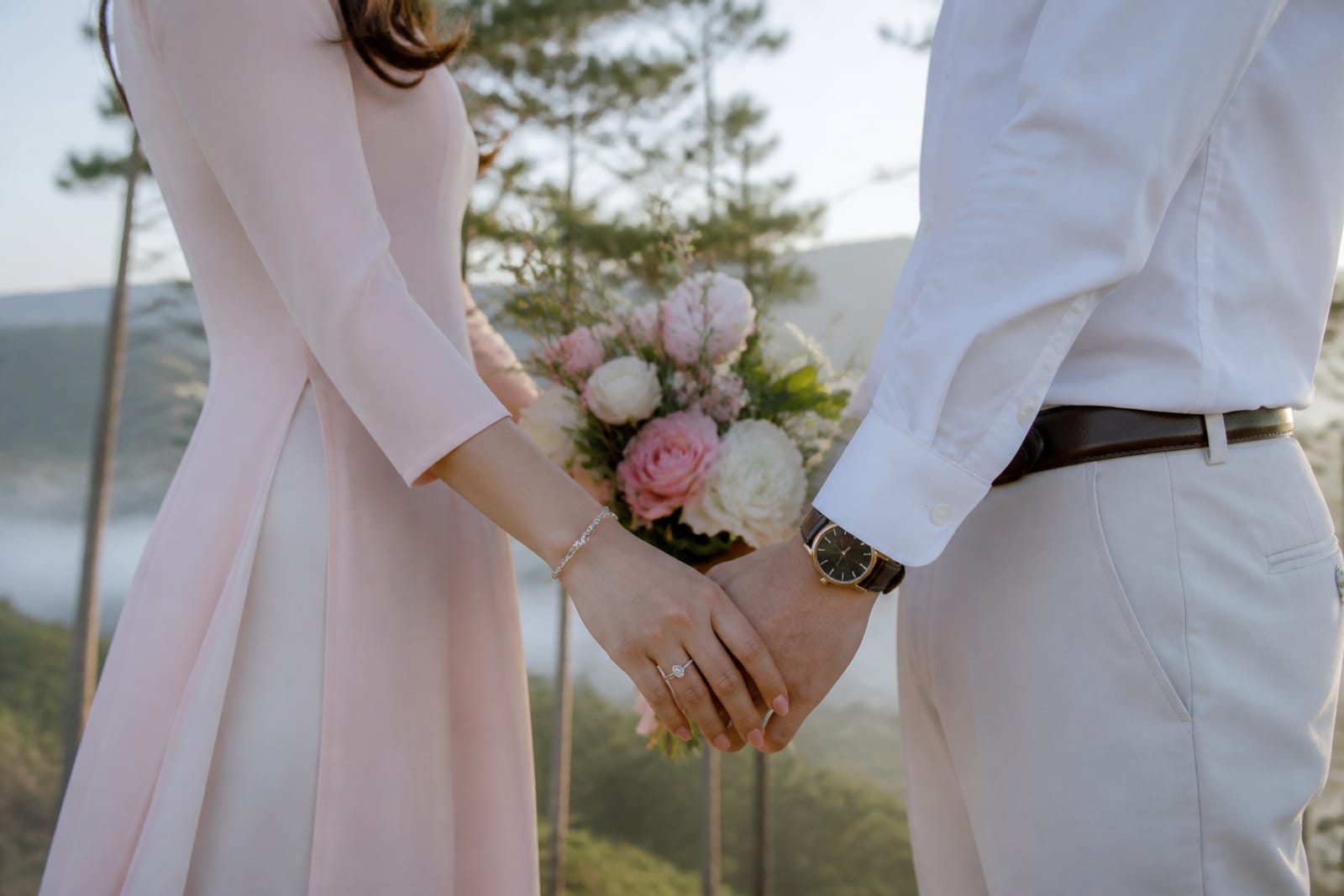
Da Lat's highland climate sits at 1,500 m elevation: Dec–Feb is cool (13–20°C), dry, and mist-heavy at dawn—ideal for moody, atmospheric frames. Mar–Apr warms up (18–25°C) with less mist. May–Nov brings afternoon downpours, humidity and occasional fog that obscures the valley. Sunrise mist is a gift in winter; by mid-morning, it burns off. If you shoot in the dry season (Dec–Feb), pack a light robe or shawl for the 5:45 am drive and allow your makeup artist to use long-wear formulas. Humidity in rainy season (May–Nov) breaks makeup fast, so ask makeup & hair staff for their monsoon adjustments. Clear sky is less important than soft, directional light—overcast mornings at Truc Lam often feel more cinematic than sunny ones because clouds diffuse harsh shadows. Avoid Tet (late Jan–mid Feb) when the monastery hosts crowds and some paths close for ceremony.
Dec–Feb delivers the light and quiet you need; rainy season adds the mist but costs humidity and time pressure.
📸 Book on WhatsApp — pre-wedding
---
What to check before you book a Truc Lam pre-wedding shoot
- Photographer's Truc Lam portfolio. Ask for 5+ samples shot at the site between 6:30–8:00 am in Dec–Feb. Generic sunrise photos don't prove they know the monastery's layout and light angles.
- Entry time and temple rules. Call ahead to confirm opening hours and whether photography is allowed in certain halls. Some wings close for ceremony.
- Your travel logistics. Truc Lam is a 30–45 minute drive from Da Lat town; if your photographer is based in Da Lat town, budget 1.5 hours total travel. If you're in Hanoi/Saigon, coordinate outfit and makeup timing carefully.
- Makeup and hair for altitude. Da Lat's cool air and elevation mean products set differently than at sea level. If using makeup & hair services, brief them on the 5:45 am start and cool temperature so they use formulas that hold.
- Backup weather plan. Heavy rain (May–Oct) or fog above eye level makes it hard to see the valley. Ask your photographer: do we reschedule, or shoot in the mist as planned?
- Outfit care in humidity. If you're wearing an ao dai, ask how to pack and travel it without wrinkles. A garment bag in a car beats wrapping it in a suitcase.
- Walking shoes and comfort. The monastery path is uneven stone. You'll be in formal wear for 1.5 hours; wear practical shoes during setup and change into heels (or stay barefoot) for final frames.
---
Comparing pre-wedding shoot options in Vietnam
If Truc Lam appeals to you but you're open to other locations, consider how Cáo Studio's pre-wedding shoots in Hanoi, Saigon, or Hoi An differ. Hanoi offers urban geometry (train tracks, French villas, water reflections) with winter light and crowds. Saigon brings tropical drama and colonial architecture with hot, humid mornings. Hoi An gives lantern-lit nights and riverside calm with dry-season perfection. Truc Lam is the contemplative mountain choice—misty, cool, spiritual and quiet. All suit different moods and energy. If your vision is intimate and serene, Truc Lam wins. If you want energy and colour, urban Hanoi or riverside Hoi An fit better. Cáo Studio's lookbook shows real frames from each region; comparing them helps you feel which setting matches your story.
---
Real frames over styled perfection
Pre-wedding shoots at temples often trap couples in "pose and stare at the camera" because the setting feels formal. The shift that changes everything: treat the monastery as a place you're moving through, not performing at. A directed photographer guides you to walk a path, pause where light lands, look at each other naturally, and captures that second—not a held smile. The frames that matter to you in five years are the ones where you're present, not perfect. Truc Lam's mist, timber and silence give you space to be quiet with each other. The camera catches that, not you trying to look in love.
💄 Makeup & hair at your hotel | 📸 See the lookbook | Pre-wedding & elopement shoots
---
FAQ
Can you shoot inside the temple halls at Truc Lam, or only outside on the grounds?
Outdoor grounds and timber walkways are open to photographers; some inner halls may restrict cameras during ceremony. Call ahead or ask your photographer to check current temple policy. Outdoor frames—mist through pine trees, your silhouette at a doorway—often work better than interior shots anyway.
What's the dress code for couples shooting at a Buddhist monastery?
Covered shoulders and knees are standard temple etiquette. An ao dai ticks both boxes. If wearing Western dress, ensure sleeves cover shoulders and hems reach the knee. Avoid tight or sheer fabrics. Neutral colours (cream, blue, grey) are more respectful than neon.
How early do we need to arrive for the best light?
Plan to be on-site by 6:45 am. Light starts shifting warmly around 7:00–7:30 am; by 8:30 am, it flattens. Arriving earlier gives you a 45-minute window of directional, gentle light before tourists arrive.
Is it worth paying for makeup and hair on-site, or should we do it in Da Lat town beforehand?
Doing it the night before (or very early morning) in your Da Lat accommodation works best. Early morning touch-ups on a moving car ride risk smudges. A makeup & hair team briefed on your 5:45 am timeline can prep you at your hotel so you're camera-ready before the drive.
Should we hire a national photographer or someone local to Da Lat?
Local photographers know Truc Lam's subtle light and access. Cáo Studio (Hanoi/Saigon-based) excels at one-team coordination—outfit, makeup, hair, photography as one vision. For Da Lam shoots, a local photographer often makes sense; ask for their Truc Lam sunrise portfolio before booking. If you want Cáo Studio's integrated style, book a shoot in Hanoi or Saigon and treat Da Lat as a separate trip.
What happens if it rains on the morning of our shoot?
Light rain at dawn often brings dramatic mist and moody frames. Discuss your photographer's backup plan: shoot in the mist as planned, or reschedule. Heavy downpours may close paths; ask the monastery's opening status before you drive up. Bring a compact umbrella for crew comfort, not for the couple's frames.
FAQ
Can you shoot inside the temple halls at Truc Lam, or only outside on the grounds?
Outdoor grounds and timber walkways are open to photographers; some inner halls may restrict cameras during ceremony. Call ahead or ask your photographer to check current temple policy. Outdoor frames—mist through pine trees, your silhouette at a doorway—often work better than interior shots anyway.
What's the dress code for couples shooting at a Buddhist monastery?
Covered shoulders and knees are standard temple etiquette. An ao dai ticks both boxes. If wearing Western dress, ensure sleeves cover shoulders and hems reach the knee. Avoid tight or sheer fabrics. Neutral colours (cream, blue, grey) are more respectful than neon.
How early do we need to arrive for the best light?
Plan to be on-site by 6:45 am. Light starts shifting warmly around 7:00–7:30 am; by 8:30 am, it flattens. Arriving earlier gives you a 45-minute window of directional, gentle light before tourists arrive.
Is it worth paying for makeup and hair on-site, or should we do it in Da Lat town beforehand?
Doing it the night before (or very early morning) in your Da Lat accommodation works best. Early morning touch-ups on a moving car ride risk smudges. A [makeup & hair team](/makeup-and-hair) briefed on your 5:45 am timeline can prep you at your hotel so you're camera-ready before the drive.
Should we hire a national photographer or someone local to Da Lat?
Local photographers know Truc Lam's subtle light and access. Cáo Studio (Hanoi/Saigon-based) excels at one-team coordination—outfit, makeup, hair, photography as one vision. For Da Lam shoots, a local photographer often makes sense; ask for their Truc Lam sunrise portfolio before booking. If you want Cáo Studio's integrated style, book a shoot in Hanoi or Saigon and treat Da Lat as a separate trip.
What happens if it rains on the morning of our shoot?
Light rain at dawn often brings dramatic mist and moody frames. Discuss your photographer's backup plan: shoot in the mist as planned, or reschedule. Heavy downpours may close paths; ask the monastery's opening status before you drive up. Bring a compact umbrella for crew comfort, not for the couple's frames.
Ao dai, makeup, hair and a local photographer in Hanoi or Saigon — one WhatsApp message.