/pre-wedding-photoshoot
Pre-Wedding Photo Ideas at Ban Gioc Waterfall: Poses, Light & Planning
Ban Gioc Waterfall sits in Cao Bang province, three hours northeast of Hanoi, straddling the Vietnam–China border. Pre-wedding shoots there work best in the rainy season (roughly July–September) when the falls are fullest; the surrounding rice paddies turn golden in September. Morning light (6–8 am) shoots across the cliff face and water, creating soft side-lit frames. Afternoon (3–5 pm) backlights the mist and spray. A local photographer familiar with the permit process, terrain and light angles is essential — Cáo Studio does not operate in Cao Bang, so book a photographer based in Cao Bang or Hanoi who knows the site. Expect wet rocks, muddy paths and strong water spray; wear water-resistant clothing under formal outfits, and plan a makeup touch-up between locations.
Why is Ban Gioc special for pre-wedding photos?
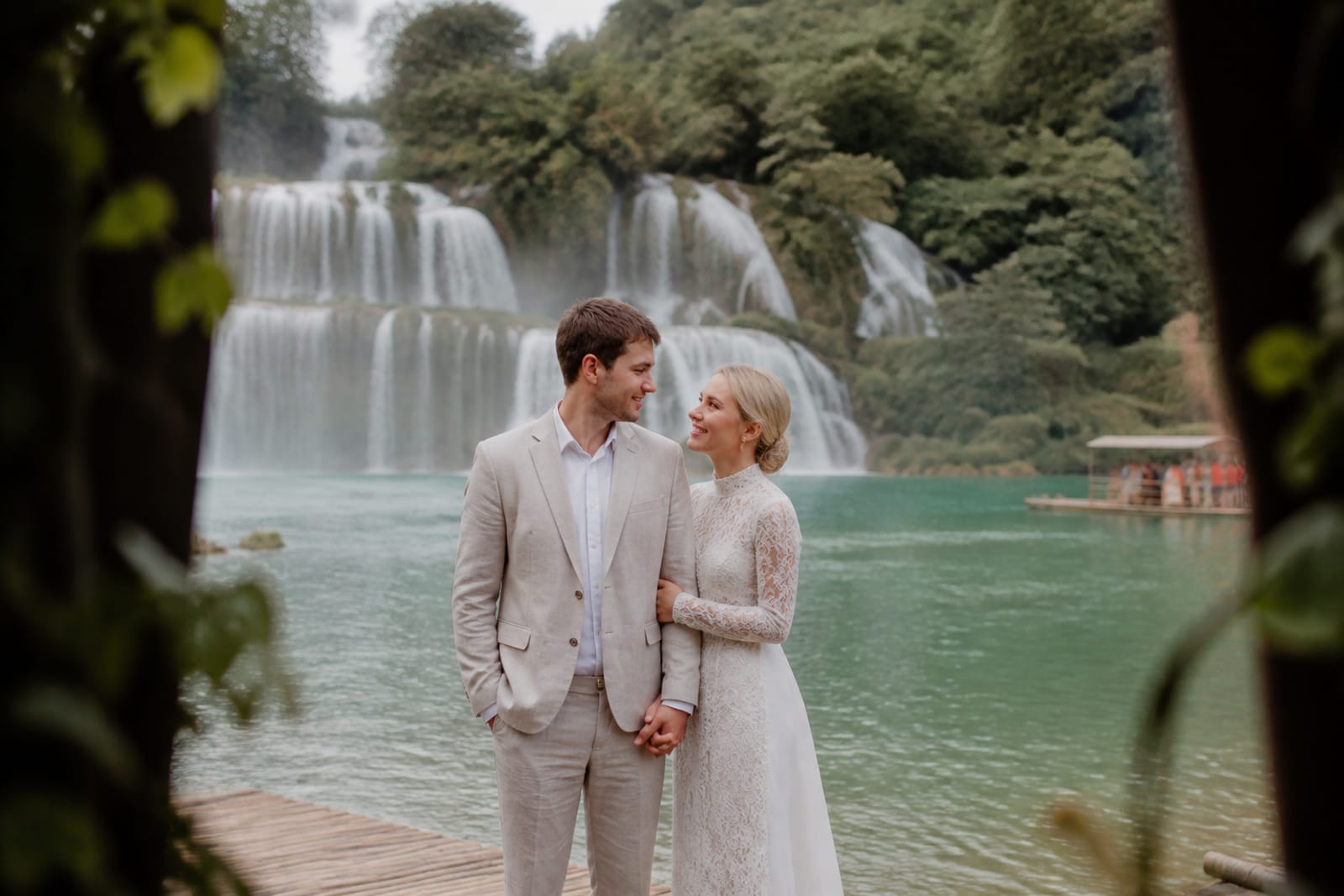
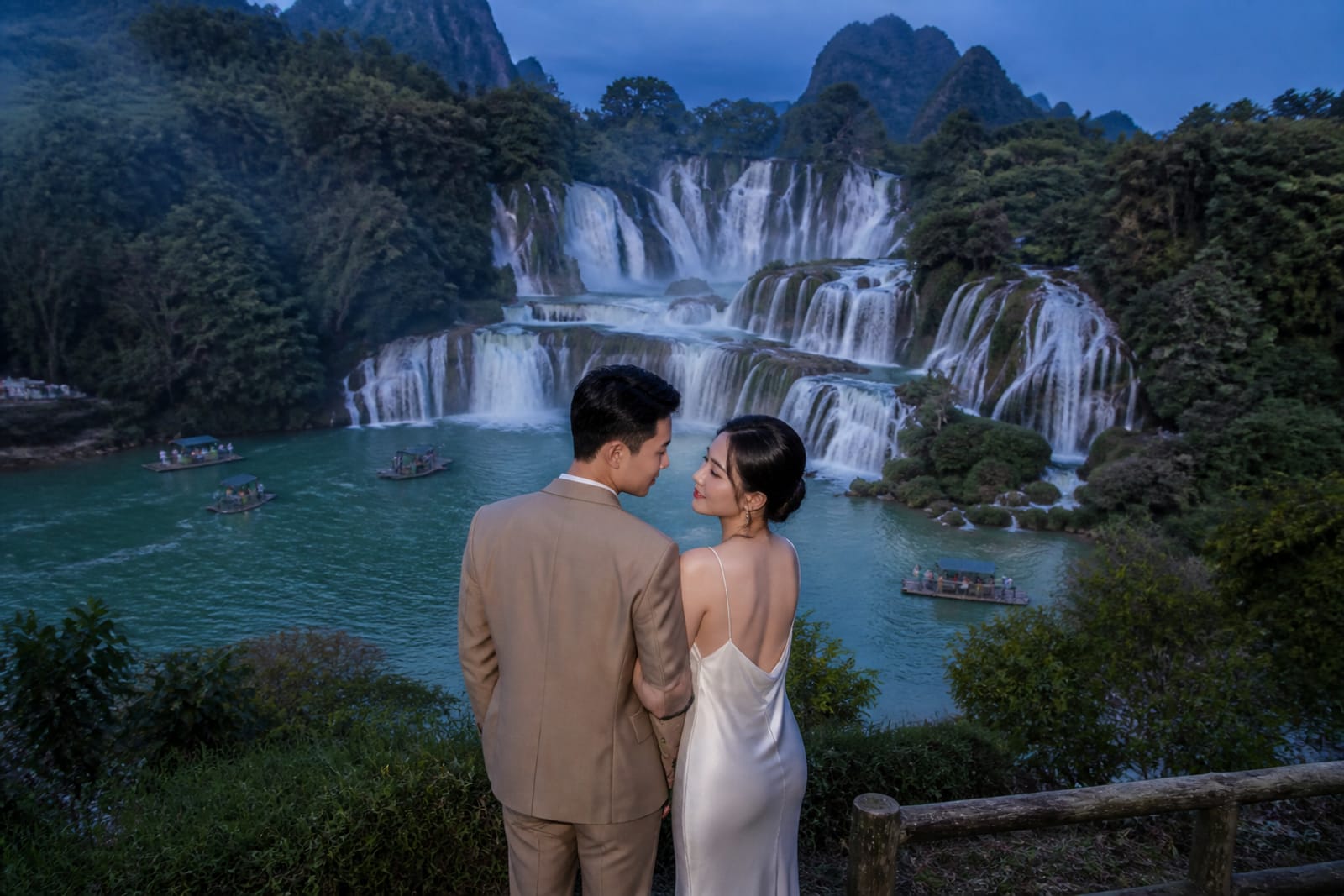
Ban Gioc is Vietnam's largest waterfall and sits at the international border — that geography creates a rare landscape: the waterfall itself, a smaller cascade beside it, karst limestone walls, and forested banks within walking distance. Most pre-wedding shoots rely on repetitive urban or beach backdrops. Here, each frame sits against a wild, unfamiliar geography that reads as a journey, not a photo stop. The water moves constantly, the mist shifts, and the surrounding rock changes colour with light — so no two frames are identical. This makes it worth the travel time.
📸 Book on WhatsApp — pre-wedding photoshoot | 🌸 See the lookbook
When should you shoot: season, weather and water levels?
The waterfall's power and appearance shift dramatically by season. Here's what you're deciding between:
| Season | Water Level | Light Quality | Best For | What to Check |
|---|---|---|---|---|
| Jul–Sep (rainy) | Fullest; strong spray and mist | Soft, dramatic at dawn; backlight mist at dusk | Epic, romantic frames; strong water story | River can swell dangerously; confirm access with local guides |
| May–Jun (late spring) | Moderate; falling from rains | Clear morning side-light on rocks and cliff | Intimate poses with waterfall backdrop; drier rocks | Afternoon heat; brief afternoon showers possible |
| Sep–Oct | High; rice paddies golden nearby | Golden-hour glow on limestone walls | Couple walking through paddies + waterfall in distance | Border zone flooding risk late Oct; check conditions week before |
| Nov–Feb (dry) | Lower; thinner cascade | Harsh midday sun; cool mornings | Detail shots of rocks and flora; fewer tourists | Early morning essential; water less dramatic; cold nights |
The rainy season (July–September) fills the falls spectacularly but brings unpredictable afternoon storms and muddy access paths — plan a 5–6 am start to shoot before weather shifts. May–June offers balance: water is strong, light is clean, and the terrain is safer. September has golden rice paddies within sight of the waterfall but carries flood risk as the month progresses — consult a local guide. Winter (November–February) is dry and cool, but the waterfall thins considerably, and the limestone loses its wet drama.
What poses and angles work at Ban Gioc?
A pre-wedding shoot at Ban Gioc works best when you move through distinct zones rather than pose statically in front of the waterfall. Here's how a shoot usually unfolds:
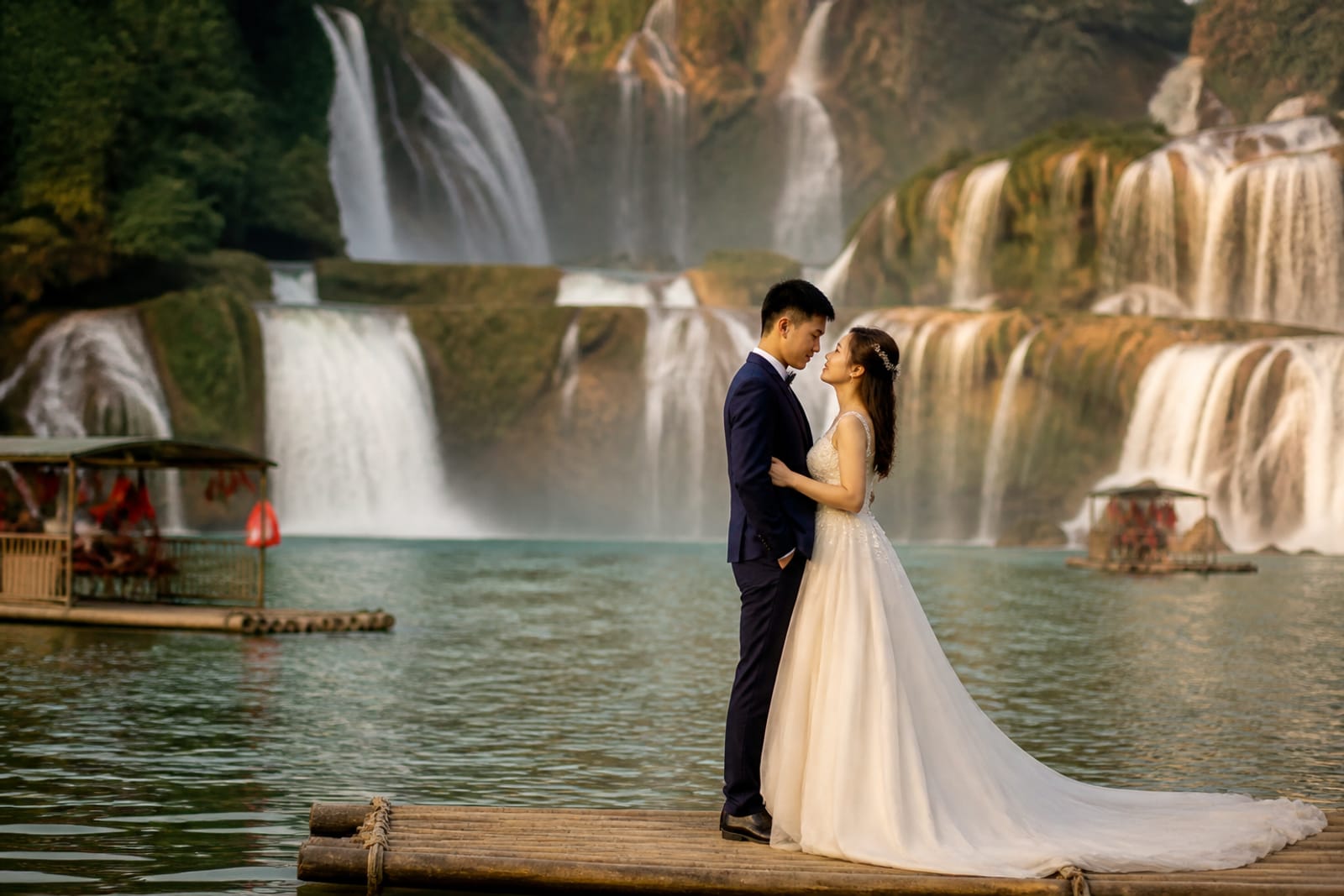
Zone 1: The viewpoint and wide frame (6–7 am). The official viewpoint sits on the Vietnamese side, looking at the full waterfall and mist. Shoot wide first — the couple walking into frame along the overlook, the waterfall behind them. This works best in soft side-light, before direct sun hits the cliff face. Poses: walking slowly hand-in-hand, stopping to look at the water together (not at the camera), one partner standing still while the other walks toward or past them.
Zone 2: The rocks and splash zone (7–8 am, if water permits). Closer to the base, rocks are wet, smooth and dramatic. The closer you get, the stronger the spray — water will hit the lens and clothes. This zone works for detail frames: her dress catching mist, his hand on a wet rock, both of them mid-laugh as spray hits. Lighting here is directional; backlight from the rising sun turns mist into a glow. Poses: standing on a rock formation (confirm safety with your guide), her dress billowing in wind and spray, turning toward each other as water falls behind them.
Zone 3: The approach and walking (early morning, 6:30–7:30 am). The path to the viewpoint winds through forested edges and small cascades. Shoot the couple's arrival: walking through shade, emerging into light, stopping at viewpoints. This narrative approach creates frames that feel like a story, not a formal session. Poses: walking ahead of the camera (so you see their backs), pausing to take in the view, holding hands on the path.
Zone 4: The golden fields (if September, late afternoon). If rice paddies are golden, shoot the couple in the fields with the waterfall visible in the distance. This gives scale and context — the waterfall becomes part of their landscape, not the entire focus. Shoot from within the paddies looking toward the waterfall at backlit hour (around 4–5 pm). Poses: walking through crops, the couple silhouetted against the water, turning to each other with light behind them.
Avoid: standing still directly in front of the waterfall during midday sun (harsh shadows, blown-out mist). Do not pose on unstable rocks without a guide's confirmation — water and moss make surfaces treacherous.
What should you wear, and how do you protect formal outfits?
Ban Gioc's environment — spray, mud, wet rocks, forested paths — conflicts with traditional formal wear. A successful shoot requires strategic layering and timing.
Outfit layers:
- Wear your formal wedding dress, suit or áo dài over water-resistant base layers (microfibre or quick-dry fabric) so if spray hits, the inner layer absorbs moisture and the formal piece dries quickly.
- If you're wearing an áo dài, choose silk or silk-blend (absorbs and releases moisture faster than cotton) and have a stylist bring a dry backup. The áo dài's side slits and flowing nature actually suit water and movement well — the challenge is the inner áo dài (the fitted underdress), which can cling if wet.
- For formal dresses, consider a tea-length or knee-length cut rather than a full-length train — mud and water will damage a long hem, and you'll trip on wet rocks.
- Grooms: a suit jacket or vest gets heavy and restrictive when damp. Bring a linen shirt or formal vest as a lighter backup for mid-morning shots.
Practical steps:
- Arrive early (5:30–6 am) so your first frames are dry, formal and sharp.
- Bring a second outfit or key pieces (a dry áo dài top, a clean shirt) so you can refresh between zones.
- Have towels and a stylist on-site to dry and adjust clothing every 20–30 minutes.
- Wear water-resistant shoes with grip (not heels). You'll change into formal shoes only for static poses on safe, dry ground.
- Makeup and hair should use long-wear, waterproof products — spray and mist will test them. Budget 15 minutes for touch-ups between zones.
Budget factor: If you're renting an áo dài or dress for this shoot, confirm with the rental company that water exposure is acceptable and what happens if the piece is stained. Some rentals charge repair fees for watermarks. Work with a rental partner familiar with outdoor, high-moisture shoots.
How do you find and book a photographer for Ban Gioc?
Cáo Studio operates in Hanoi, Ho Chi Minh City and Hoi An — not in Cao Bang. For a Ban Gioc shoot, you'll need to book a photographer or team based locally or in Hanoi who understands the site, permits and light.
What to verify with a local photographer:
- Border permit experience. Ban Gioc is in a border zone; Vietnamese photographers need to be accustomed to occasional security checkpoints. Confirm they've shot there before and know which areas require permits or have restrictions.
- Rainy-season logistics. If you're shooting in July–September, ask if they've worked in those months and how they handle flash, lens protection and backup equipment if weather turns.
- Team size and support. A solo photographer at Ban Gioc is risky — paths are slippery, light shifts fast, and you need someone to hold an umbrella or adjusting lighting gear. Confirm the team includes at least a second person (assistant or stylist).
- Edited turnaround. Ban Gioc shots are often high-contrast (bright mist, dark limestone) and require careful colour grading to preserve detail in both. Ask for an honest turnaround time — 48 hours may be rushed if they're also editing travel, not just studio frames.
- Backup plan. Request what happens if weather closes the waterfall that day — do they have an alternative shoot location, a reschedule option, or a refund policy?
Alternative: book a pre-wedding photoshoot in Hanoi or Hoi An with Cáo Studio, then hire a separate local guide for Ban Gioc. Some couples do this to get a full pre-wedding series (directed, one team, makeup and hair) in a major city, then add a Ban Gioc day-trip with a local photographer who knows the site. This splits cost and risk.
🌸 See the lookbook | 💄 Makeup & hair at your hotel
What are the logistical challenges, and how do you avoid them?
Ban Gioc requires more planning than an urban pre-wedding shoot. Here's what often goes wrong and how to prevent it.
Challenge 1: Transport and timing. Cao Bang is three hours from Hanoi by car. If you hire a Hanoi-based photographer, travel time cuts into shooting time. Start very early (4–5 am departure) so you're on-site by 6 am, which is the prime light window. Confirm transport arrangements — is it included in the photographer's quote, or do you hire a separate car? A delayed journey means you miss the best light.
Challenge 2: Water access and safety. The path to the waterfall base is steep, muddy and can be slippery, especially in rainy season. Confirm with your photographer or a local guide whether the rocks are safe that day. Bring proper grip shoes, not formal footwear, until you're on the actual pose spot. Do not let excitement override safety — a fall ruins the shoot and the day.
Challenge 3: Mist and lens fogging. When you move from a dry zone into full spray, camera lenses fog immediately. A good photographer brings lens cloths, a UV filter (sacrificial, to protect the main lens), and a camera rain sleeve. If mist is heavy, frames shot in the spray zone will be soft or blown out unless the photographer knows how to expose for backlit mist.
Challenge 4: Formal outfit degradation. Even quick-dry fabrics take 10–15 minutes to fully dry. If you're shooting multiple zones over 3–4 hours, your outfit will look progressively wetter and crumpled. Mitigate this by finishing the highest-drama wet-zone shots first (when you're fresh and dry), then moving to drier, shaded zones for intimate poses.
Challenge 5: Backup and contingency. Bad weather can mean the waterfall is inaccessible (flooding, closed by authorities) or the shoot is unsafe (lightning risk, high water). Ask your photographer: do they offer a reschedule, a partial refund, or an alternative date? Do not assume weather is your problem alone.
Step-by-step pre-booking checklist:
- [ ] Confirm shoot date is outside typhoon season (avoid October–November in this region).
- [ ] Verify photographer has shot Ban Gioc pre-wedding shoots before (ask for references or past portfolio frames from the site).
- [ ] Clarify transport: who provides the vehicle, how early do you depart, who pays for fuel or car hire?
- [ ] Confirm team size: at least photographer + assistant (or stylist/guide).
- [ ] Ask about weather backup: reschedule option, refund policy, or alternative location if the waterfall is closed.
- [ ] Discuss outfits: confirm the photographer has experience with formal wear in high-moisture environments and knows how to style and protect them.
- [ ] Request edited turnaround time in writing.
- [ ] Verify border-zone permit requirements and that your photographer handles them.
- [ ] Ask for a sample timeline: what time you depart Hanoi, arrive Ban Gioc, start shooting, and finish.
---
If you prefer a pre-wedding shoot with a full team (photographer, stylist, makeup artist) all working together, Cáo Studio offers pre-wedding photoshoot sessions in Hanoi, Ho Chi Minh City, and Hoi An. A Ban Gioc day-trip can complement a multi-location pre-wedding series, or you can book a standalone Ban Gioc shoot with a local photographer using the vetting steps above.
FAQ
Can we shoot Ban Gioc during the dry season (December–February)?
Yes, but the waterfall is thinner and less dramatic. Light is clearer, rocks are drier, and paths are safer — ideal if safety is your priority. Ask yourself: do you want epic water spray and mist, or intimate detail frames against the cliff? Dry season suits the latter.
Do we need a permit to photograph at Ban Gioc?
Ban Gioc is a public tourist site, and photography for personal use is permitted. A commercial shoot may require additional permissions — your photographer should clarify this when you book. Always defer to your photographer's knowledge of local rules.
How much will a Ban Gioc shoot cost?
Cost depends on photographer experience, team size, transport, and location. Ask your photographer for a quote — factors include distance from their base, outfit changes, and whether they cover both sides of the border. Cáo Studio's pricing is available on WhatsApp; for Ban Gioc, contact a local Cao Bang or Hanoi-based photographer directly.
What's the best time of day to shoot at Ban Gioc?
Early morning (5:30–8 am) offers soft side-light across the waterfall and cliff face, with minimal mist interference. Late afternoon (3–5 pm) backlights the mist beautifully but brings heat and shadows. Shoot early, rest midday, and return late afternoon if weather and time permit.
Can we combine Ban Gioc with other pre-wedding locations?
Yes. Many couples do a full series in Hanoi or Hoi An with Cáo Studio, then add a Ban Gioc day-trip with a local photographer. This gives you variety, professional editing from both teams, and spreads the logistics load. Coordinate dates and outfit continuity between photographers.
What should we bring on the day of the shoot?
Bring towels, a change of clothes or key outfit pieces (dry áo dài top, clean shirt), water-resistant shoes with grip, and a waterproof bag for phones and electronics. Your photographer should bring lens protection, backup batteries, and a rain sleeve. Confirm with them beforehand.
FAQ
Can we shoot Ban Gioc during the dry season (December–February)?
Yes, but the waterfall is thinner and less dramatic. Light is clearer, rocks are drier, and paths are safer — ideal if safety is your priority. Ask yourself: do you want epic water spray and mist, or intimate detail frames against the cliff? Dry season suits the latter.
Do we need a permit to photograph at Ban Gioc?
Ban Gioc is a public tourist site, and photography for personal use is permitted. A commercial shoot may require additional permissions — your photographer should clarify this when you book. Always defer to your photographer's knowledge of local rules.
How much will a Ban Gioc shoot cost?
Cost depends on photographer experience, team size, transport, and location. Ask your photographer for a quote — factors include distance from their base, outfit changes, and whether they cover both sides of the border. Cáo Studio's pricing is available on WhatsApp; for Ban Gioc, contact a local Cao Bang or Hanoi-based photographer directly.
What's the best time of day to shoot at Ban Gioc?
Early morning (5:30–8 am) offers soft side-light across the waterfall and cliff face, with minimal mist interference. Late afternoon (3–5 pm) backlights the mist beautifully but brings heat and shadows. Shoot early, rest midday, and return late afternoon if weather and time permit.
Can we combine Ban Gioc with other pre-wedding locations?
Yes. Many couples do a full series in Hanoi or Hoi An with Cáo Studio, then add a Ban Gioc day-trip with a local photographer. This gives you variety, professional editing from both teams, and spreads the logistics load. Coordinate dates and outfit continuity between photographers.
What should we bring on the day of the shoot?
Bring towels, a change of clothes or key outfit pieces (dry áo dài top, clean shirt), water-resistant shoes with grip, and a waterproof bag for phones and electronics. Your photographer should bring lens protection, backup batteries, and a rain sleeve. Confirm with them beforehand.
Ao dai, makeup, hair and a local photographer in Hanoi or Saigon — one WhatsApp message.