/pre-wedding-photoshoot
Pre-wedding photoshoot at Mai Chau and Pu Luong: plan it right
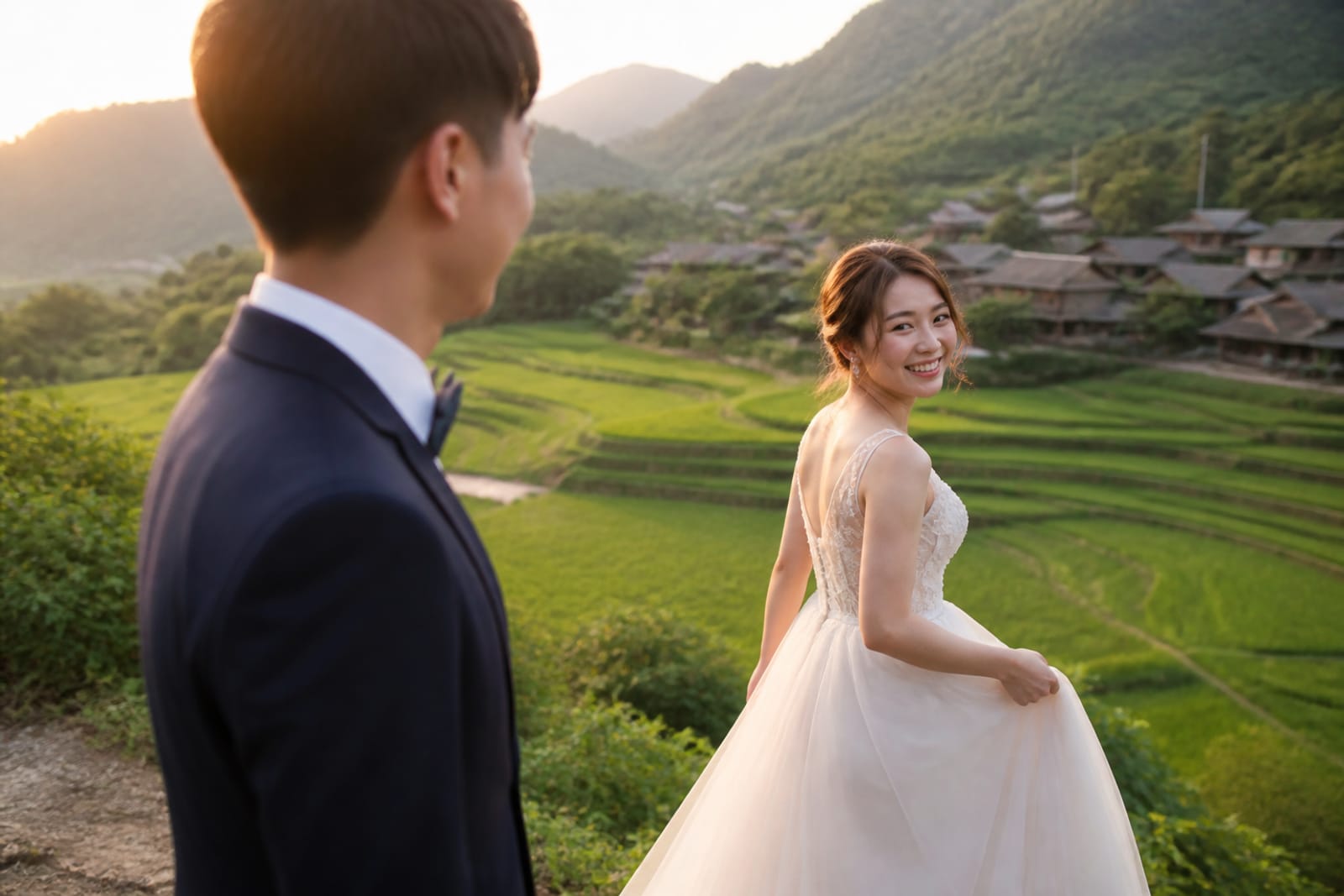
Mai Chau and Pu Luong are adjacent valleys in Hoa Binh Province, roughly 200 km west of Hanoi, best visited for photoshoots during golden rice (late May–June and Sep–Oct) or misty winters (Dec–Feb). A pre-wedding session in either location runs one full morning or afternoon, typically four to six hours, shooting wide landscape frames at viewpoints and walking moments through terraces. Cáo Studio does not operate in Mai Chau or Pu Luong — the team is based in Hanoi and Saigon and does not travel to these valleys. Instead, you can hire a local photographer in Hoa Binh town (vet portfolios on Instagram and ask about editing style and delivery time) or coordinate a shoot with Cáo Studio in Hanoi before or after a separate trip to the valleys. The key decision: rice season timing, which outfit suits the landscape (avoid heavy fabrics in humidity), and whether mist or clear light matters most to your vision.
Why choose Mai Chau or Pu Luong for a pre-wedding shoot?
Both valleys offer terraced rice paddies, local ethnic minority villages, misty mornings and walking paths where two people naturally move through landscape rather than stand in front of it. Mai Chau is slightly more developed for tourism, with guesthouses and easy viewpoint access; Pu Luong feels quieter and more remote, with steeper terrain. Neither is a city studio backdrop — you're trading controlled light (reflectors, flash) for authentic geography. Choose these valleys if your aesthetic is earthy, documentary-style framing with natural light and if you have time for a road journey as part of your wedding story.
📸 Book on WhatsApp — ao dai photoshoot | 🌸 See the lookbook
What season gives you the best light and crowds?
Rice ripens (golden-yellow color) roughly late May through June and again late September through October; winter (December through February) brings cool temperatures and mist that photographers love but requires layers and cold-weather clothing. Summer (June–August) is hot and wet with afternoon downpours that halt shooting. Early autumn (September–mid-October) is often ideal: less rain than peak monsoon, rice still visible, fewer tourists than peak season. Check local weather forecasts one week before your trip — mist clears by 9 a.m. in most cases, so morning shoots depend on an early departure from Hoa Binh town.
Mai Chau versus Pu Luong: which fits your vision?
| Aspect | Mai Chau | Pu Luong | Best if… |
|---|---|---|---|
| Landscape | Wider, gentler terraces | Steeper, more dramatic slopes | You want epic scale (Mai Chau) or intimate close-ups (Pu Luong) |
| Access | Paved roads, easy viewpoints | Dirt tracks, more walking | You're comfortable hiking 2+ hours in wedding clothes (Pu Luong) |
| Light timing | Sunrise 5:30–6:30 a.m.; golden hour 4–5 p.m. | Same, but viewpoints higher — clearer at dawn | You prefer mist (Pu Luong peak) or clear sky (Mai Chau) |
| Crowds | Moderate, tour buses mid-morning | Sparse; fewer tourists | You want solitude or authentic feel (Pu Luong) |
| Outfit fit | Ao dai works; wide paths for movement | Heavy fabrics trap sweat on steep climbs; lighter silks better | You want comfort to walk naturally for 4+ hours |
| Local services | Homestays, guides, food easily booked | More self-reliant; book guides ahead | You prefer organized logistics (Mai Chau) or adventure (Pu Luong) |
Conclusion: Mai Chau suits couples wanting iconic rice valley framing with manageable hiking; Pu Luong suits couples who hike regularly and want a less-photographed, steeper dramatic setting.
How to hire a photographer in Mai Chau or Pu Luong.
Cáo Studio's team is based in Hanoi and Saigon and does not shoot in these valleys — you'll need a local photographer based in Hoa Binh Province or Pu Luong area. Search Instagram hashtags like #MaiChauPhotography or #PuLuongPhotographer and look for portfolios that show:
- Natural light and walking frames (not stiff poses at one viewpoint).
- Editing style you recognize (warm tones, detail shots of hands or fabric).
- Written feedback from couples (check comments on posts).
- A clear delivery timeline (48 hours to two weeks is reasonable).
- A WhatsApp or Messenger contact and willingness to discuss your specific dates and outfit ideas.
Ask any local photographer: How many hours do you typically shoot? Do you provide edited JPEGs or RAW files? Do you know the best light times for this valley on this month and date? Honest answers signal a practitioner, not a novice. Also confirm they have transport or if you must provide a driver — road access can be rough in monsoon season. A local photographer typically costs less than traveling a team north, but you forfeit the makeup, hair and outfit coordination that a studio handles.
Alternatively: shoot in Hanoi, then visit the valleys.
If you want Cáo Studio's one-team approach — photographer, makeup artist and outfit coordinator all in one booking — book a pre-wedding session in Hanoi or Saigon first, then travel to Mai Chau or Pu Luong afterward as a honeymoon or couple's retreat. This splits the shoot: structured frames in the city (temple light, river mist, urban architecture) where Cáo Studio's crew handles hair and makeup, then candid landscape moments captured by you or a local guide with your phone or a hired valley photographer. Many couples shoot ao dai photoshoots in Hanoi before their wedding, and it works equally well as a pre-wedding session — the valleys become a separate memory, not a logistical pressure.
💄 Makeup & hair at your hotel | 🌸 See the lookbook
What to wear for rice valley light and terrain.
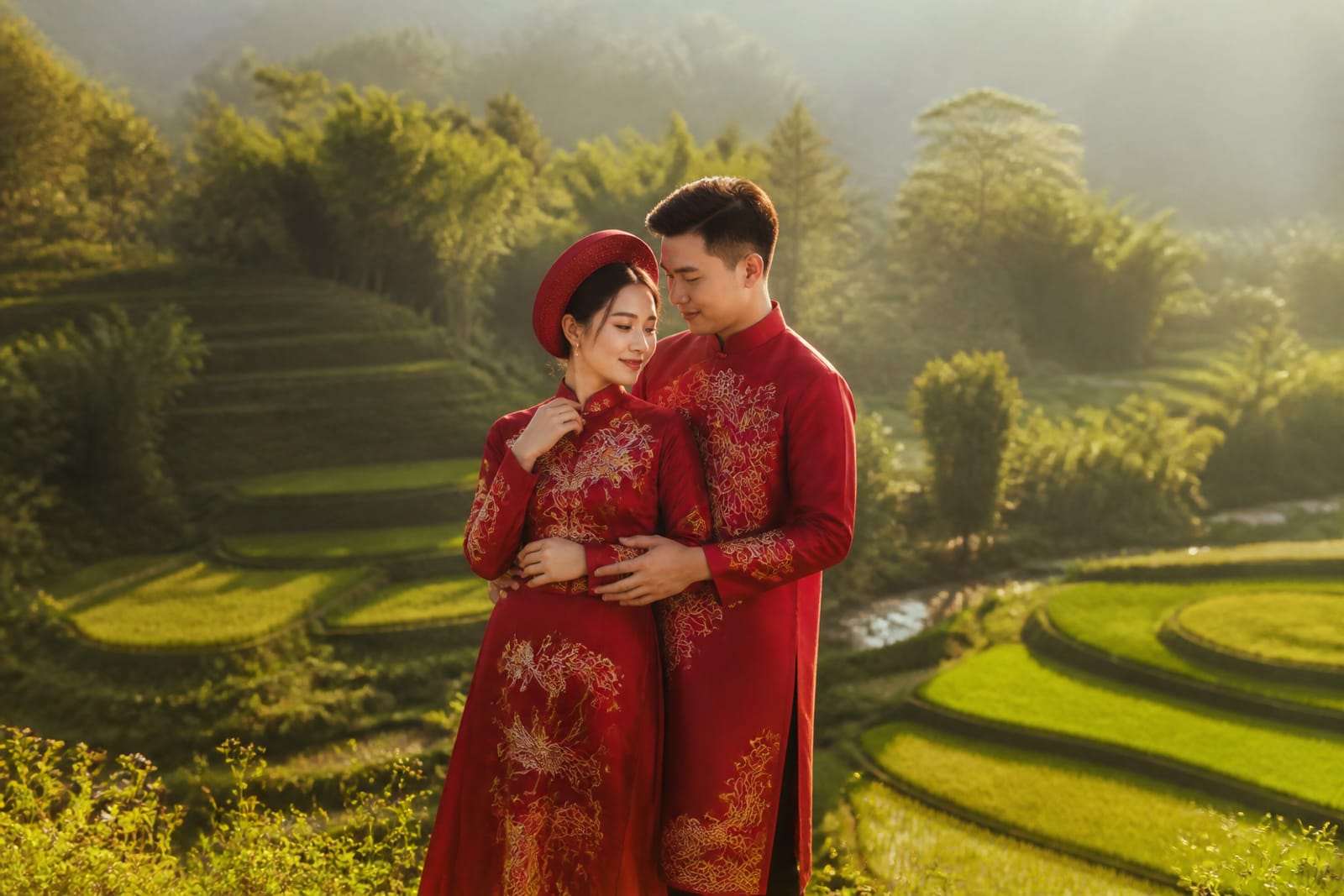
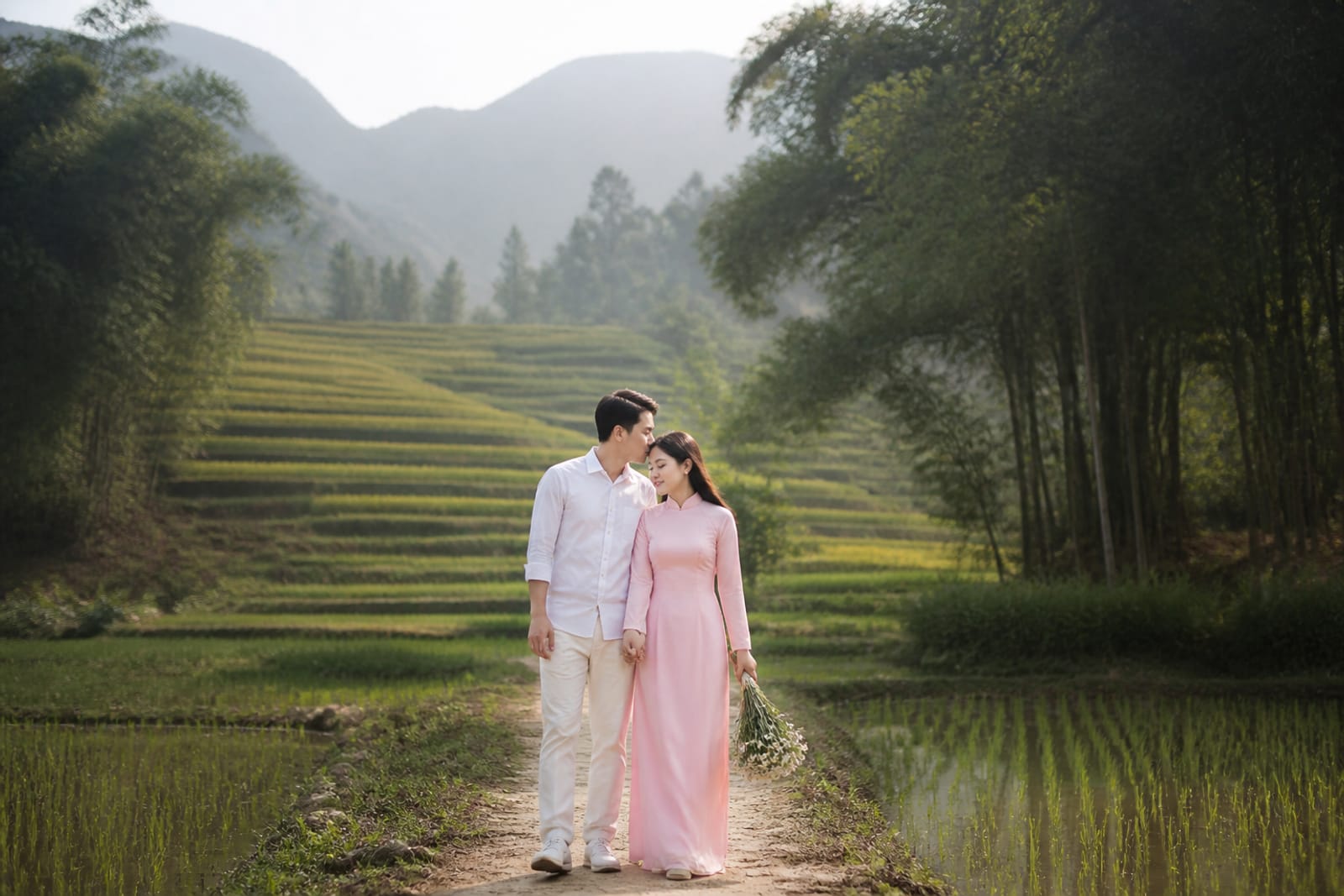
Avoid heavy, stiff fabrics — ao dai silk works beautifully if it's lightweight, but polyester absorbs heat and sweat. Layers matter: mist in December means a cool morning (12–15°C at dawn) that warms by noon. Wear breathable under-layers, and bring a light shawl or overshirt that photographs well but peels off. Flat shoes or sandals you can walk in for hours without blisters are non-negotiable — terraces have muddy or rocky patches. White or cream ao dai reads beautifully against green rice; jewel tones (deep blue, emerald) photograph well in overcast light. Groom or partner: neutral, layered (linen shirt, lightweight trousers, sturdy shoes) that won't snag on rice plants or mud. Avoid black entirely — it heats up fast and reads as a void in landscape frames.
Check the weather one week before; if rain is forecast, ask your photographer if they shoot in light drizzle (mist actually enhances mood) or prefer to reschedule. Most local photographers have rescheduling clauses for typhoons or heavy downpour, so confirm terms in advance.
The logistics: timing, transport and backup dates.
Early start is non-negotiable. Meet your photographer in Hoa Binh town by 5:30 a.m. if shooting sunrise; this means leaving Hanoi the night before or arriving by 4:30 a.m. — factor in a one-hour drive from Hanoi. Most couples stay overnight in a Mai Chau or Pu Luong guesthouse, shoot the following morning, then depart by early afternoon. Afternoon light (4–5 p.m.) is equally viable if you'd rather sleep in Hanoi and depart midday, but you lose mist and have four hours of usable light rather than five or six.
Transport: hire a private car with driver from Hanoi (check with your guesthouse) or book a tour operator who adds a photographer. Cáo Studio's team cannot arrange valley transport since they don't operate there — you're coordinating independently. Backup dates: book your guesthouse and photographer with a flexible cancellation window (at least two alternate dates within a two-week frame) in case rain or mist is poor on your first choice.
After the shoot: expect edited photos within 5–14 days if shooting with a local photographer (overseas studios often deliver faster). Ask if delivery includes a digital album link, printed photos, or a short film — these vary widely. If you booked via a tour operator who added a photographer, clarify who owns the files and whether you can reuse them for print or social media.
What to check before you book with a local photographer.
- Portfolio specificity: Do they have five to ten shoots in this exact valley during the season you're shooting? Generic "rice terrace" photos suggest they rarely return.
- Communication in English: Will you be texting with them, or through a guide or guesthouse who translates? Miscommunication on outfit details or timing is costly.
- Backup plan: If light is poor on your date, do they offer a free reshoot, a discount, or a cancel-only clause?
- Edited style: Ask to see three full edited galleries (not Instagram highlights). Do all images have the same color grading? Do they include close-ups of hands, shoes, rice detail—or only wide couple shots?
- Payment and contract: Confirm whether payment is 50% upfront (deposit) or full at booking, and what happens if you reschedule.
- Permit or access: Some viewpoints require local permits or guide fees for photography (especially if shooting in a homestay's private terraces). Confirm your photographer handles this or tells you upfront.
📸 Book on WhatsApp — ao dai photoshoot | 💄 Makeup & hair at your hotel
---
Why Cáo Studio does not shoot in Mai Chau or Pu Luong.
Cáo Studio's model is one team: photographer, makeup artist and hair stylist in one direction. Mai Chau and Pu Luong are two hours from Hanoi on rough roads — coordinating a team's travel, accommodation and early-morning transport adds cost and complexity that doesn't serve the couple better. Instead, Cáo Studio focuses on Hanoi, Saigon and Hoi An shoots, where the team can deliver hair and makeup the morning of your session and edited photos within 48 hours. Couples who want a valley shoot can hire a local specialist and book Cáo Studio for a separate pre-wedding session in the city — often a stronger combination, since both shoots tell different parts of your story.
---
FAQ
Can Cáo Studio shoot my pre-wedding in Mai Chau or Pu Luong?
No. Cáo Studio operates in Hanoi, Saigon and Hoi An only. For valleys, hire a local photographer based in Hoa Binh Province. Many couples book Cáo Studio in Hanoi for an ao dai shoot before their valley trip as a separate memory.
What's the best month for rice terraces and clear light?
Late September through October (golden rice, fewer tourists, less rain) and December through February (cool mist, fewer crowds). Avoid June–August (hot, wet, afternoon downpours).
Should I wear an ao dai in the rice valleys?
Lightweight silk ao dai photographs beautifully, but wear breathable layers underneath and flat shoes for walking. Avoid polyester — it absorbs sweat in humidity. Jewel tones or white work best against green rice.
How do I find a good local photographer in Mai Chau or Pu Luong?
Search Instagram hashtags like #MaiChauPhotography, check portfolios for natural walking frames (not stiff poses), read couple feedback, and ask their delivery timeline and editing style. Confirm they know the valley's best light times for your chosen month.
How much does hiring a local photographer in Mai Chau cost?
Pricing varies by photographer and season. Ask directly via WhatsApp or Instagram DM—costs depend on shoot length, outfit changes and editing delivery. A local photographer typically costs less than flying a full studio team.
Can I shoot valleys if it rains on my booked date?
Light drizzle and mist often enhance mood, but heavy downpour usually pauses shoots. Book with a photographer who offers at least two alternate dates within a two-week window, or confirm their cancellation and reshoot terms upfront.
FAQ
Can Cáo Studio shoot my pre-wedding in Mai Chau or Pu Luong?
No. Cáo Studio operates in [Hanoi](/hanoi), [Saigon](/saigon) and [Hoi An](/hoi-an) only. For valleys, hire a local photographer based in Hoa Binh Province. Many couples book [Cáo Studio in Hanoi](/hanoi) for an ao dai shoot before their valley trip as a separate memory.
What's the best month for rice terraces and clear light?
Late September through October (golden rice, fewer tourists, less rain) and December through February (cool mist, fewer crowds). Avoid June–August (hot, wet, afternoon downpours).
Should I wear an ao dai in the rice valleys?
Lightweight silk ao dai photographs beautifully, but wear breathable layers underneath and flat shoes for walking. Avoid polyester — it absorbs sweat in humidity. Jewel tones or white work best against green rice.
How do I find a good local photographer in Mai Chau or Pu Luong?
Search Instagram hashtags like #MaiChauPhotography, check portfolios for natural walking frames (not stiff poses), read couple feedback, and ask their delivery timeline and editing style. Confirm they know the valley's best light times for your chosen month.
How much does hiring a local photographer in Mai Chau cost?
Pricing varies by photographer and season. Ask directly via WhatsApp or Instagram DM—costs depend on shoot length, outfit changes and editing delivery. A local photographer typically costs less than flying a full studio team.
Can I shoot valleys if it rains on my booked date?
Light drizzle and mist often enhance mood, but heavy downpour usually pauses shoots. Book with a photographer who offers at least two alternate dates within a two-week window, or confirm their cancellation and reshoot terms upfront.
Ao dai, makeup, hair and a local photographer in Hanoi or Saigon — one WhatsApp message.