/pre-wedding-photoshoot
Pre-wedding photoshoot at Pu Luong rice terraces: planning guide
Pre-wedding shoots at Pu Luong or Mai Chau rice terraces mean shooting in real light on emerald hillsides 200 km west of Hanoi—a 4–5 hour drive each way. The golden window is late May–June or September–October, when rice glows amber and shadows sculpt the landscape; winter (Dec–Feb) brings mist and cool, soft light but overcast skies. Sessions run 6–8 hours on location and require a team (photographer, makeup artist, stylist) who can direct posture and walking within the terrain, not pose stiffly. You must book either a local Pu Luong or Mai Chau photographer (or travel team—rare, costly), or book a Cáo Studio pre-wedding shoot in Hanoi and replicate the concept there with scouting; Cáo Studio does not operate in Pu Luong or Mai Chau. Check visas, weather forecasts and road conditions one month ahead; hire a guide familiar with rice-terrace access and safe walking at twilight.
Pre-wedding shoots in rice terraces rank among Southeast Asia's most photogenic backdrops—but the distance from Hanoi, the unpredictable monsoon, and the scarcity of integrated teams (photographer + makeup + stylist working as one) mean many couples end up with pretty stills rather than frames that narrate their story.
Cáo Studio's approach—one team, one message, directed light—works anywhere, but because we're based in Hanoi and Saigon, couples shooting in Pu Luong or Mai Chau face a choice: hire a local photographer (often excellent for landscapes, less trained in directing movement and fashion), or book a Cáo Studio pre-wedding session in Hanoi, video-call the locations, and bring the same directed, integrated approach to a city shoot. This guide walks you through the terrain, light and logistics so you choose what fits your vision.
Why do Pu Luong and Mai Chau draw pre-wedding couples?
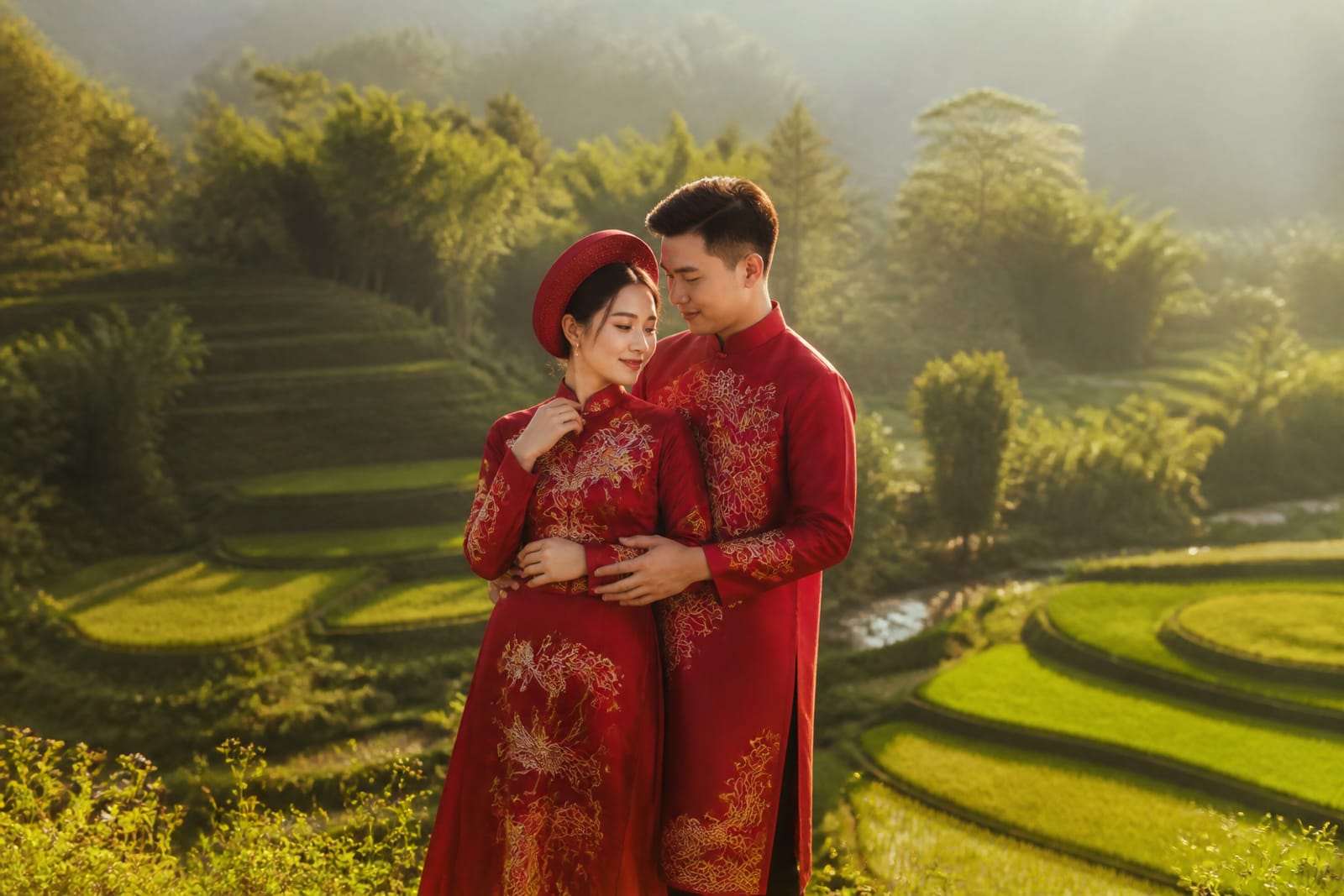
Pu Luong and Mai Chau sit in the limestone karst belt northwest of Hanoi, where rice terraces wrap mountainsides in waves of green (monsoon, May–Sep) or gold (late dry season, May–June and Sep–Oct). The scale is human but epic—walkable terraces, not remote. Sunrise and sunset hit the valleys at shallow angles, creating the directional shadow that separates a silhouette from a face and makes fabric drape visible. Unlike urban shoots, there's no monument distraction; the land is your stage. The drive is long (4–5 hours each way), but one afternoon there yields frames couples print for decades because the light and scale felt real, not styled. For couples willing to spend a full travel day, Pu Luong or Mai Chau justify the effort.
What's the best time of year to shoot rice terraces?
Golden hour happens year-round, but rice terraces demand a decision: rice color or weather reliability. Late May–June and September–October are the sweet spots—rice matures (shifting from green to amber), and the monsoon has not yet unleashed. Winter (December–February) offers cooler, softer light and clear morning mist, but overcast skies are common and the rice is harvested (brown, stubble). Spring (March–April) brings warmth and growth but unpredictable showers. Summer (July–August) is hot, green, and rainy—difficult for hair and makeup continuity. Ask a local guide about this year's irrigation schedule; rice cycles shift. The pillar page pre-wedding photoshoot explores how Hanoi light works year-round—a useful comparison for understanding seasonal trade-offs.
| Season | Rice stage | Light quality | Weather risk | Outfit fit |
|---|---|---|---|---|
| Late May–June | Amber, mature | Directional, warm | Low | Breathable ao dai, linens ideal |
| July–August | Green, thick | Soft, diffuse | High humidity, rain | Silk wrinkles; quick drying needed |
| September–October | Amber, second harvest | Sharp, golden | Low–medium | As above; cool mornings |
| December–February | Harvested, brown | Cool, misty | Overcast; mud | Layered ao dai, sturdy shoes |
| March–April | Green, young | Warm, variable | Showers likely | Rain contingency essential |
How do you direct a couple walking rice terraces without it looking posed?
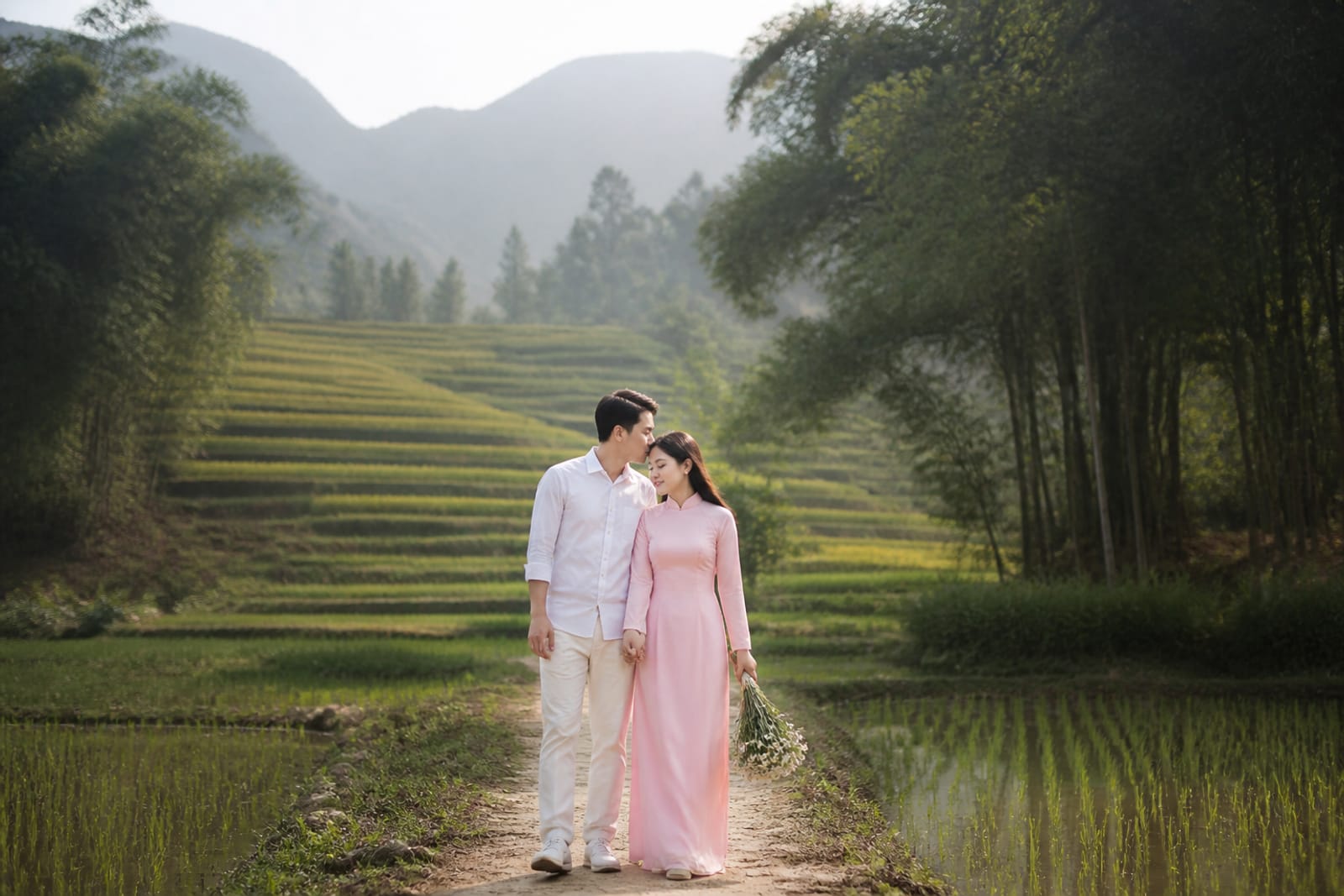
Real movement beats posture. Cáo Studio's method—wide frame first (both of you walking toward the horizon), then medium (turning, talking, his hand finding her waist), then detail (fabric, light on a cheekbone)—works in rice terraces because the landscape absorbs staged stiffness. A photographer directing on-location must know where safe paths are, read light timing (sun dips behind mountains fast), and give simple cues: "Walk toward the next terrace, don't look at the camera; when you reach it, turn and hold her hand." Couples who chase monuments end up with trophy shots; couples who walk and pause generate the frames they actually print. If you hire a local photographer, ask to see their couple work—how many frames show walking versus static posing. If you book Cáo Studio's pre-wedding package in Hanoi, you get the same directed methodology on a city route, with makeup and styling included; you can then hire a local shooter in Pu Luong as a second team if you want both locations.
What makes a local Pu Luong or Mai Chau photographer different from a studio team?
Local photographers excel at terrain, light timing and access—they know which terrace catches dawn, where paths are muddy, how long sunrise lasts. Many are landscape-trained and shoot couples against those landscapes beautifully. The gap: they often work solo (no makeup artist, no stylist on-set), so your hair clips mid-shoot, your ao dai wrinkles and sits unpredictably, and posture isn't continuously corrected because the photographer is 20 meters away framing the wide shot. Integrated teams—photographer + makeup + stylist + videographer—cost more but move as one; the makeup artist adjusts your face between setups, the stylist tugs fabric, the photographer directs movement, and all four watch light together. Cáo Studio is built this way in Hanoi and Saigon; we don't operate in Pu Luong, but if you're torn between a local photographer and a studio team, check whether your local choice includes on-set makeup and styling continuity—if not, expect touch-ups between major setups and fewer frames where you look exactly as you intended.
How do you find and vet a Pu Luong or Mai Chau photographer?
Search "Pu Luong pre-wedding photographer" or "Mai Chau couple shoot" on Instagram; filter by frames you'd print (not just pretty landscapes—look for movement, fabric, facial expression). Ask shortlisted shooters for their couple portfolio specifically, not landscapes. Confirm they offer makeup and hair services or work regularly with a makeup artist (and see that artist's work too). Request a timeline—how many hours, how many outfit changes, when do you eat, what if weather fails? Ask about editing turnaround (48 hours is fast; 2–4 weeks is standard). Request references from one couple they've shot in the past 12 months. Agree on a scout visit beforehand (ideally, you drive out with the photographer one weekend before the shoot, pick exact spots and times, and confirm light). For a safer, fully integrated approach, book a Cáo Studio pre-wedding shoot in one of our Hanoi or Saigon bases, where you control the team and guarantee the art direction.
📸 Book on WhatsApp — pre-wedding photoshoot | 🌸 See the lookbook | 💄 Makeup & hair at your hotel
What logistical details matter most?
Transportation. Hanoi to Pu Luong or Mai Chau is a winding 4–5 hour drive, often on roads that deteriorate in rain. Budget 10+ hours for a day-trip; many couples overnight near Pu Luong or Mai Chau. Arrange a driver separately from the photographer (the photographer needs to scout and shoot, not drive).
Road condition. June–October and monsoon season (May–Sep in the north) can bring washouts. Check road reports 1 week and 3 days before your shoot. Confirm with your photographer that the route is passable.
Permits. Pu Luong and Mai Chau do not require tourist permits, but some homestays or guide services may request local tourism fees—ask your photographer.
Guide. Hire a local guide if you're unfamiliar with the terrain; guides know safe walking routes and can warn of uneven edges and water channels.
Outfit fit. Ao dai (traditional tunic) can catch on rice-terrace edges and mud. Wear a short inner slip underneath, durable shoes or sandals for the drive, and a change of shoes for the shoot (lightweight, non-slip). Test walking in your ao dai on stairs before the day.
Backup plan. Heavy rain can halt a shoot; agree with your photographer on rescheduling terms before you book.
Editing and delivery. Ask whether turnaround is 48 hours (Cáo Studio's standard) or weeks. Get the promise in writing.
💄 Makeup & hair at your hotel | 🌸 Browse ao dai rental options
What's the workflow on shoot day?
Morning: you depart Hanoi/Mai Chau town at 5–6 a.m. (to catch golden hour sunrise on terraces); drive to the scouted location; the photographer does a final light check while makeup touches up your face.
6:30–7:30 a.m.: sunrise shoot—wide frames of both walking, medium frames of detail, close-up of your expression against the sky.
7:30–9 a.m.: outfit change or relocation to the next terrace; the photographer shoots again as light softens.
9 a.m.–12 p.m.: break (eat, rest, makeup touch-up); light is overhead and harsh—often skipped or used for detail shots (hands, feet, fabric).
12 p.m.–4 p.m.: move to a shadier location or a second terraced area; afternoon light is cooler and directional again.
4:30–6:30 p.m.: sunset shoot—golden hour again; often the richest light and the final outfit.
7 p.m.: return to the car; drive back to Hanoi or your hotel.
Within 48 hours (if shooting with an integrated Hanoi team like Cáo Studio) or 1–4 weeks (typical for local photographers): edited images delivered; sometimes a short vertical film clip is included.
What can go wrong, and how do you prevent it?
| Risk | Prevention |
|---|---|
| Makeup melts in heat or humidity | Waterproof products; frequent powder touch-ups; a makeup artist on-site |
| Ao dai wrinkles between setups | Travel with a portable steamer or accept imperfection (adds authenticity) |
| Weather changes mid-shoot | Check forecast 3 days and 1 day ahead; discuss rain backup plan with photographer |
| Tiredness shows in your face | Take 15-min naps between setups; hydrate constantly; eat light carbs |
| Light changes faster than expected | Scout the exact sunrise/sunset times on location the day before |
| Photographer misses a moment because they're adjusting light meters | Hire a team with a dedicated videographer or ask the photographer to shoot video simultaneously |
| Long drive causes motion sickness | Leave early; eat a light breakfast; sit in the front; bring ginger sweets |
| Local guide gets directions wrong | Confirm meeting point and route with the photographer 3 days before |
📸 Book on WhatsApp — pre-wedding photoshoot
How does a Hanoi-based team like Cáo Studio fit into a Pu Luong shoot?
Cáo Studio operates from Hanoi and Saigon, not Pu Luong or Mai Chau. We don't offer shoots in those locations. However, many couples who want the Cáo Studio integrated approach (photographer + makeup + stylist + videographer working as one team, 48-hour turnaround, directed movement) book a pre-wedding session with us in Hanoi, and then hire a separate local photographer for a Pu Luong or Mai Chau day-trip. The advantage: you get one flawless, directed shoot with guaranteed production standards in Hanoi (city landmarks, hotel settings, ao dai rental included), and a second, landscape-rich shoot with a local team in the terraces. Both sets of frames come back in a wedding photo album or print and frame collection. If you prefer to consolidate, book a Cáo Studio pre-wedding shoot in Hanoi and invest in a professional local team for Pu Luong rather than splitting between a studio and an amateur local photographer.
Before you book a photographer, ask these questions.
Couple work. "Show me 10 recent couple shoots. How many show walking or movement? How many are static?" (Movement > static.)
Team. "Who shoots? Is makeup included? Is a videographer available?" (Integrated teams are rarer but superior.)
Timing. "How long is the session? When do you stop if light is still good?" (8+ hours is standard for a full day.)
Weather. "What happens if it rains heavily? Do I reschedule or forfeit?" (Get this in writing.)
Outfit changes. "How many outfits can we do? Is change time built in?" (1–2 is realistic; 3+ is rushed unless overnight.)
Edits. "When do I get images? How many are edited? Can I request recolours or retouches?" (48 hours is very fast; ask if it's a realistic promise for your team size.)
Backup. "Do you have backup gear or a backup photographer if you fall ill?" (Matters for a full-day investment.)
Location scout. "Can we scout the terrace a week before?" (Yes = serious; no = risky.)
🌸 See the lookbook | 📸 Book on WhatsApp — pre-wedding photoshoot
---
FAQ
Does Cáo Studio shoot in Pu Luong or Mai Chau?
No. Cáo Studio operates in Hanoi, Ho Chi Minh City, and Hoi An (by appointment). For Pu Luong or Mai Chau, hire a local photographer or scout one on Instagram. We can book you a Hanoi pre-wedding shoot as a complementary session if you'd like both locations.
What is the best month to shoot rice terraces?
Late May–June and September–October are ideal: rice is amber, light is directional, and monsoon risk is low. December–February offers cool, misty light but overcast skies and harvested (brown) rice. Ask your photographer about this year's water schedule.
How much does it cost to hire a Pu Luong photographer for a pre-wedding shoot?
Pricing varies by photographer, team size, and travel distance. Contact shortlisted local photographers directly for quotes. As a reference, Cáo Studio pre-wedding sessions have pricing confirmed on WhatsApp; ask about comparable options during consultation.
Can I wear an ao dai on rice terraces?
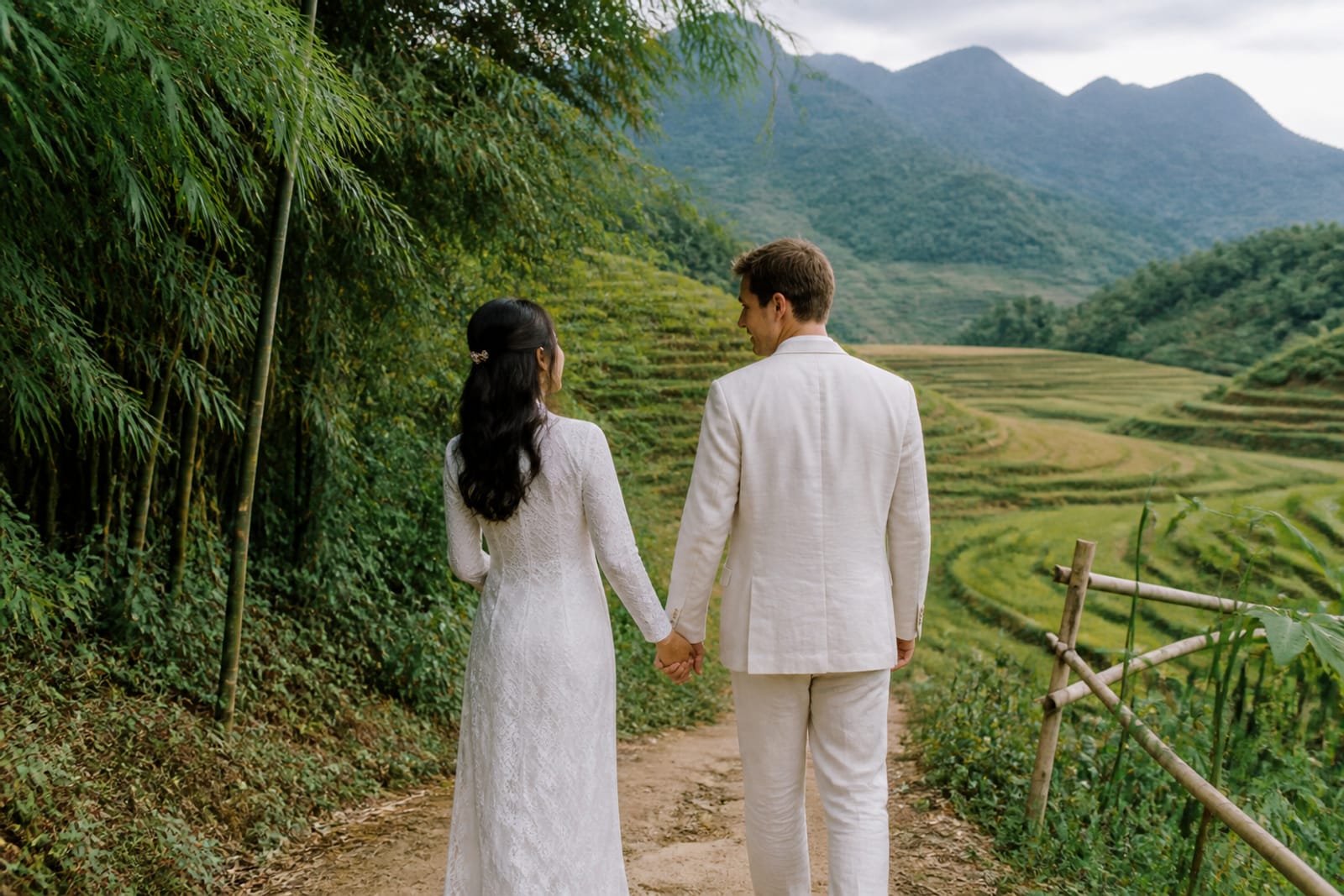
Yes, but choose a breathable silk or lightweight cotton ao dai (not heavy embroidered versions). Wear a short slip underneath and bring sturdy, non-slip shoes. Test walking on stairs beforehand to avoid tripping on the hem.
How long is the drive from Hanoi to Pu Luong or Mai Chau?
Approximately 4–5 hours each way on winding mountain roads. Most couples spend a full travel day (10+ hours including shoot time) or overnight near the location. Confirm road conditions with your photographer before the day.
What if it rains heavily during the shoot?
Discuss a rain-date or backup plan (indoor homestay, different location, or rescheduling) with your photographer before you book. Have this agreement in writing, including refund or rescheduling terms.
FAQ
Does Cáo Studio shoot in Pu Luong or Mai Chau?
No. Cáo Studio operates in Hanoi, Ho Chi Minh City, and Hoi An (by appointment). For Pu Luong or Mai Chau, hire a local photographer or scout one on Instagram. We can [book you a Hanoi pre-wedding shoot](/pre-wedding-photoshoot) as a complementary session if you'd like both locations.
What is the best month to shoot rice terraces?
Late May–June and September–October are ideal: rice is amber, light is directional, and monsoon risk is low. December–February offers cool, misty light but overcast skies and harvested (brown) rice. Ask your photographer about this year's water schedule.
How much does it cost to hire a Pu Luong photographer for a pre-wedding shoot?
Pricing varies by photographer, team size, and travel distance. Contact shortlisted local photographers directly for quotes. As a reference, [Cáo Studio pre-wedding sessions](/pre-wedding-photoshoot) have pricing confirmed on WhatsApp; ask about comparable options during consultation.
Can I wear an ao dai on rice terraces?
Yes, but choose a breathable silk or lightweight cotton ao dai (not heavy embroidered versions). Wear a short slip underneath and bring sturdy, non-slip shoes. Test walking on stairs beforehand to avoid tripping on the hem.
How long is the drive from Hanoi to Pu Luong or Mai Chau?
Approximately 4–5 hours each way on winding mountain roads. Most couples spend a full travel day (10+ hours including shoot time) or overnight near the location. Confirm road conditions with your photographer before the day.
What if it rains heavily during the shoot?
Discuss a rain-date or backup plan (indoor homestay, different location, or rescheduling) with your photographer before you book. Have this agreement in writing, including refund or rescheduling terms.
Ao dai, makeup, hair and a local photographer in Hanoi or Saigon — one WhatsApp message.