/pre-wedding-photoshoot
Pre-wedding photoshoot at Tra Su cajuput forest: complete guide
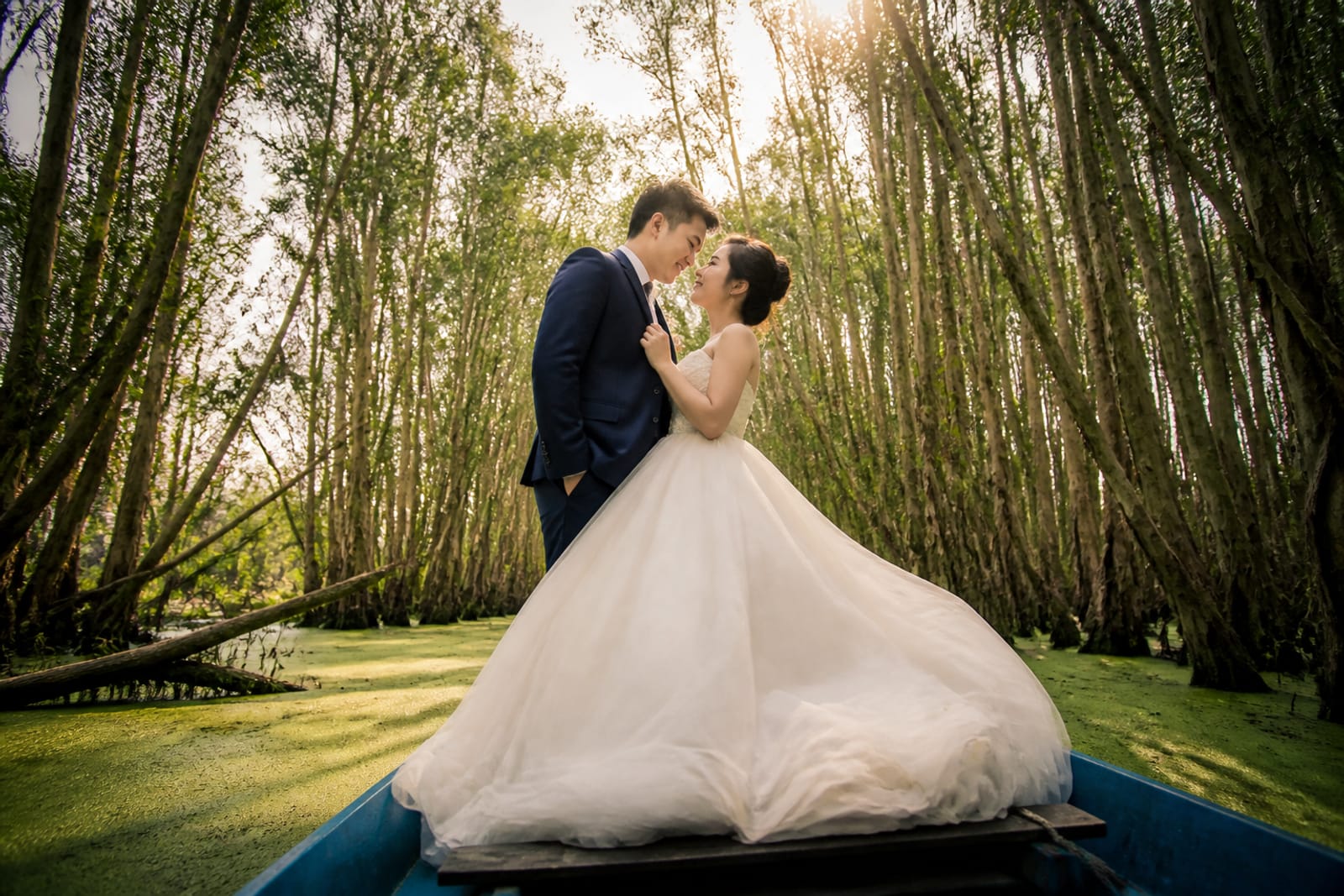
Tra Su cajuput forest, near Ca Mau in the Mekong Delta, offers pre-wedding shoots in a water-and-forest setting unavailable in Hanoi or Saigon. The forest floods in the high-water season (Sep–Nov), creating mirror reflections; the dry season (Dec–Apr) shows muddy channels and thinner canopy light. A shoot takes 4–6 hours on-site, including boat travel through channels and walking on wooden paths; you'll change outfits twice (ao dai works beautifully, plus one Western dress or suit). Light is diffuse and even—ideal for skin tones, hard to ruin—but humidity is high and insects are constant; bring repellent and a light robe for between setups. Cáo Studio does not operate in Ca Mau; book a local Ho Chi Minh City–based photographer or ask us on WhatsApp for a referral and planning call before you commit.
Why Tra Su suits some pre-wedding shoots but not others
Tra Su is chosen for its isolation and water. If you want monumental Hanoi landmarks (Huc Bridge at dawn, temple gates) or Hoi An lantern rows, Tra Su is wrong—it's a nature shoot, not a city frame. If you're drawn to quiet, repetitive compositions (you walking between trees, you both rowing, you reflected in still water), Tra Su delivers. The trade: a 2–3 hour drive from Ho Chi Minh City, boat logistics, full-body muddy shoes, and a tight window before crowds arrive at 9 am. Best for couples who love slowness and don't mind being slightly uncomfortable for the frame.
When to shoot: dry season versus flood season
| Season | Best for | Light & water | What to expect |
|---|---|---|---|
| Dec–Apr (dry) | Earthy, intimate frames | Bright, directional; channels are shallow, muddy | Fewer reflections; walking is easier; 6 am start captures softer warmth before harsh midday |
| Sep–Nov (high water) | Reflective, symmetrical frames | Even and diffuse; water mirrors trees perfectly | Boat-dependent; early start avoids afternoon rain; humidity high; insects peak |
The dry season (Dec–Apr) is more practical: you can walk the wooden boardwalks without slipping, boats navigate shallower channels faster, and light is directional enough to sculpt faces. High-water season (Sep–Nov) is more graphically dramatic—the water reflects the canopy, doubling the green—but requires early arrival (5:30 am, before tour groups) and careful outfit planning (muddy water splashes, humidity wilts non-breathable fabrics). Avoid Tet (late Jan–mid Feb): the site is often closed or flooded with domestic tourists. The driest, clearest days are Feb–Apr; book at least 4 weeks ahead during this window.
What to wear and pack for a Tra Su pre-wedding session
An ao dai is the strongest choice. The flowing silk catches diffuse light evenly, moves naturally in the humid air, and photographs as an extension of the water—not against it. Pair it with a simple underdress (ask your hotel concierge or rent locally; we can refer rental studios). A Western wedding dress works only if it's lightweight cotton or silk (avoid heavy beading or tulle—humidity clings, and boat spray stains); ball gowns are impractical on boardwalks. The groom should wear a simple linen shirt or a lightweight suit jacket over linen pants; formal black absorbs heat and reads flat in diffuse light.
Bring: waterproof footwear (water shoes or sandals you're willing to discard), a light rain jacket or shawl for between-outfit moments, high-SPF sunscreen (even on cloudy days, reflection off water burns), insect repellent (mosquitoes are fierce at dawn and dusk), and a small towel to wipe sweat and water off camera equipment. Avoid heavy jewelry—it catches water droplets and reads cluttered in close-ups. One jewelry rule: simple earrings or a single bracelet, never both. Your photographer should bring: polarizing filters (they reduce water glare), fast lenses (the green canopy eats light), and a weather-sealed camera body (humidity and spray are relentless).
How a Tra Su shoot unfolds, hour by hour
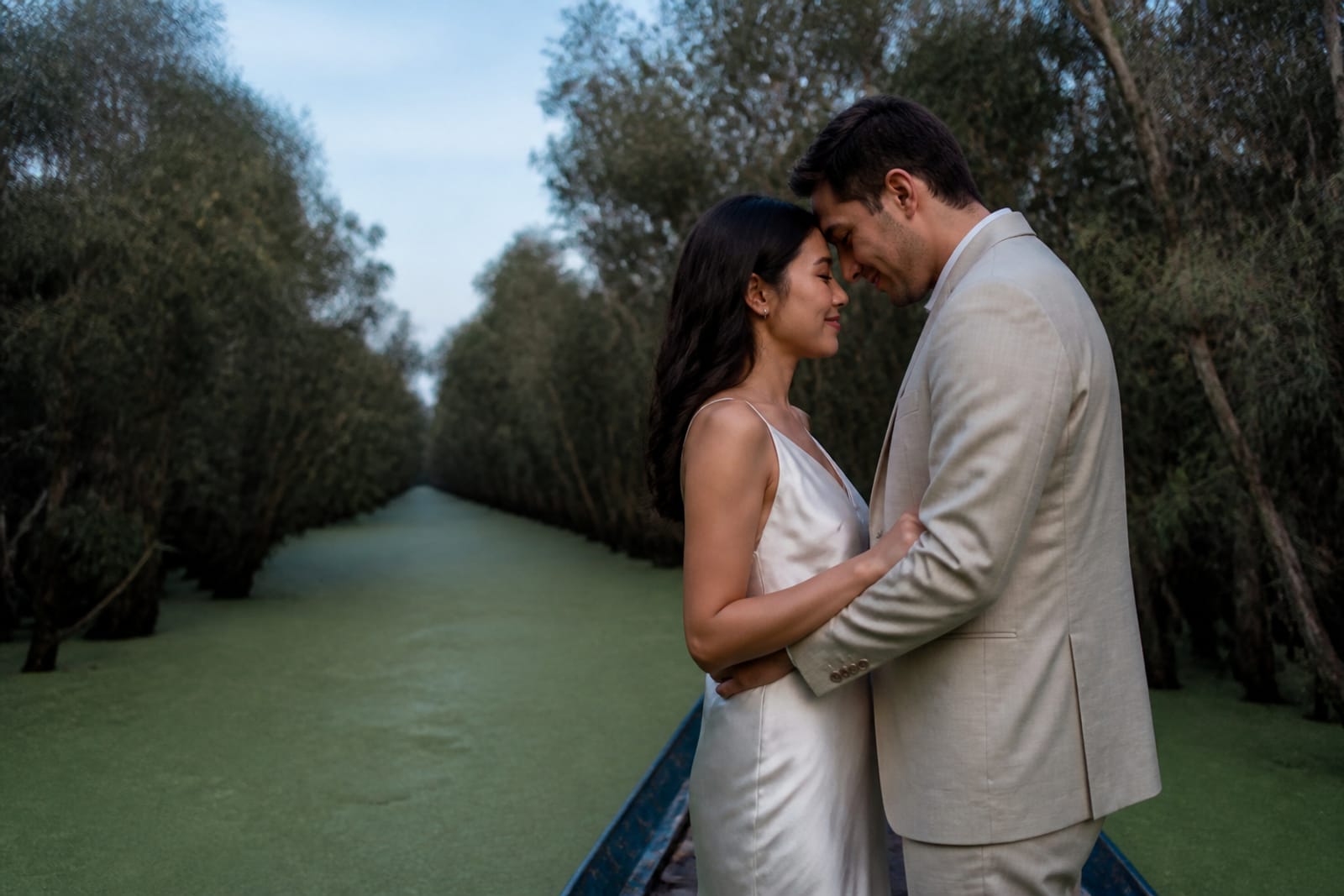
5:30–6:15 am: Arrival at the forest gate. You change into outfit one (usually the ao dai) in a basic shelter or your vehicle. The photographer scouts for the cleanest boat launch and softest light angle. This is the golden window—few visitors, trees are still, water is flat.
6:15–8:00 am: Boat phase. You float through narrow channels while the photographer shoots from a second boat or kneeling in the bow. The wooden paths are slick; the photographer directs you to walk slowly, look at each other, pause where light through the canopy is softest. No posing—just movement and presence.
8:00–9:00 am: Exit boat, change outfit two (Western dress or suit). Walk the main boardwalk loop while light is still manageable. By 9:30 am, tour groups arrive in clusters; frames become harder to compose without strangers in the background.
9:00–10:00 am: Final detail shots—hands, rings, fabric close-ups—then pack and drive back. Total on-site time: 4–5 hours. Edited photos are delivered within 48 hours (check exact turnaround when you book); a short vertical video montage is optional.
The biggest logistical challenge: boat availability and timing. Local boat operators often run tours on fixed schedules; hiring a private boat for a photoshoot may cost more than the shoot itself, depending on your photographer's arrangements. Ask your photographer whether they have a standing relationship with a boatman and whether the boat fee is included in their quote or added separately.
Cáo Studio shoots in Hanoi, Saigon and Hoi An—not Ca Mau
We operate in Hanoi, Ho Chi Minh City, and Hoi An by appointment. Tra Su is outside our service area. If you're committed to a Tra Su pre-wedding shoot, we recommend:
- Hire a local photographer based in Ho Chi Minh City or Ca Mau. Search by portfolio—look for consistent light handling, natural poses (not stiff group photos), and at least five Tra Su or Mekong Delta shoots in their lookbook.
- Vet their equipment: ask whether they use weather-sealed cameras and polarizing filters. Humidity and water reflection are unforgiving; a photographer unfamiliar with delta conditions will deliver flat or washed-out frames.
- Agree on logistics upfront: who arranges the boat, when arrival happens, how many outfit changes fit the schedule, and when edited files are sent.
- Ask for references: request contact details of two couples who shot at Tra Su with them in the past six months. Ask those couples about boat delays, outfit-change timing, and how long editing took.
If you'd prefer a studio shoot with controlled lighting and guaranteed timings, consider a pre-wedding session in Hanoi or Saigon—both offer ao dai changes, makeup and hair on-site, and indoor/outdoor flexibility. For a destination shoot that combines Mekong scenery with professional logistics, ask us on WhatsApp whether we can coordinate a referral and planning call for your Tra Su booking.
What to check before you book a Tra Su photographer
Portfolio depth: Do they have at least five Tra Su shoots? Look for consistent skin tones and light, not just dramatic compositions. One shoot where everything went wrong tells you more than one perfect day.
Boat arrangement: Is the boat fee included in the quote, or is it your responsibility? If they've never arranged a Tra Su shoot, they may underestimate timing and weather risk.
Turnaround time: Ask for a written commitment on when edited photos arrive. Humidity can corrupt memory cards; confirm they back up files on-site.
Outfit changes: How many outfits fit the schedule? Changing in a basic shelter in 40-degree heat and humidity is not comfortable; clarify dressing logistics with your photographer before the shoot date.
Early-morning readiness: Ask whether they've shot at 5:30 am starts regularly. Some photographers quote Tra Su but have never woken up that early; fatigue shows in the work.
Weather backup: What happens if it rains hard or the boat can't launch? Is the fee refunded, rescheduled, or forfeited? Get this in writing.
Insect and humidity handling: This is not aesthetic—it's practical. Do they carry bug spray for you, towels for equipment, and a basic first-aid kit for insect bites or heat stress? Professionalism includes comfort.
---
📸 Book on WhatsApp — pre-wedding photoshoot | 🌸 See the lookbook | 💄 Makeup & hair at your hotel
For a coordinated pre-wedding session that includes makeup and hair, outfit sourcing, and editing—without the Ca Mau logistics—Hanoi and Saigon offer faster turnarounds and more control. We also coordinate ao dai shoots and couple sessions with a single team, eliminating the vendor-stitching problem. If you're still set on Tra Su, WhatsApp us—we'll help you plan and vet a local photographer before you commit.
FAQ
Is Tra Su cajuput forest worth the 3-hour drive from Ho Chi Minh City for a pre-wedding shoot?
Yes, if you're drawn to quiet, reflective frames and don't mind early starts and high humidity. No, if you want iconic Mekong Delta scenery (floating markets, temples) or multiple outfit changes in comfort. Most couples choose Tra Su for its isolation and water, not for variety—one location, two outfits, one story.
Can a pre-wedding shoot at Tra Su be done in one morning, or does it need a full day?
One morning works: depart Ho Chi Minh City at 3 am, arrive 5:30 am, shoot until 10 am, drive back by noon. No overnight stay needed. On-site time is 4–5 hours, including outfit changes and boat logistics.
What's the best season to avoid crowds and insects at Tra Su?
Feb–Apr (dry season) has fewer insects and tour groups before 9 am. Sep–Nov (high water) has more mosquitoes and afternoon rain risk, but more dramatic reflections. Tet (late Jan–mid Feb) is closed or overcrowded; avoid it entirely.
Should I rent an ao dai or bring my own wedding dress to Tra Su?
Ao dai is ideal—silk moves beautifully, photographs lighter in diffuse forest light, and reads as part of the landscape. A wedding dress works only if it's lightweight cotton or silk and fits boardwalk walking. Avoid heavy beading, tulle, or ball gowns—humidity and water splash will damage them.
How do I vet a local photographer for a Tra Su pre-wedding shoot if Cáo Studio doesn't operate there?
Search their portfolio for at least five Tra Su or Mekong Delta shoots. Ask for references from couples who shot there in the past six months. Confirm boat arrangements, weather backup, and whether they use weather-sealed cameras and polarizing filters. WhatsApp us—we can suggest vetting questions and may have a referral.
FAQ
Is Tra Su cajuput forest worth the 3-hour drive from Ho Chi Minh City for a pre-wedding shoot?
Yes, if you're drawn to quiet, reflective frames and don't mind early starts and high humidity. No, if you want iconic Mekong Delta scenery (floating markets, temples) or multiple outfit changes in comfort. Most couples choose Tra Su for its isolation and water, not for variety—one location, two outfits, one story.
Can a pre-wedding shoot at Tra Su be done in one morning, or does it need a full day?
One morning works: depart Ho Chi Minh City at 3 am, arrive 5:30 am, shoot until 10 am, drive back by noon. No overnight stay needed. On-site time is 4–5 hours, including outfit changes and boat logistics.
What's the best season to avoid crowds and insects at Tra Su?
Feb–Apr (dry season) has fewer insects and tour groups before 9 am. Sep–Nov (high water) has more mosquitoes and afternoon rain risk, but more dramatic reflections. Tet (late Jan–mid Feb) is closed or overcrowded; avoid it entirely.
Should I rent an ao dai or bring my own wedding dress to Tra Su?
Ao dai is ideal—silk moves beautifully, photographs lighter in diffuse forest light, and reads as part of the landscape. A wedding dress works only if it's lightweight cotton or silk and fits boardwalk walking. Avoid heavy beading, tulle, or ball gowns—humidity and water splash will damage them.
How do I vet a local photographer for a Tra Su pre-wedding shoot if Cáo Studio doesn't operate there?
Search their portfolio for at least five Tra Su or Mekong Delta shoots. Ask for references from couples who shot there in the past six months. Confirm boat arrangements, weather backup, and whether they use weather-sealed cameras and polarizing filters. WhatsApp us—we can suggest vetting questions and may have a referral.
Ao dai, makeup, hair and a local photographer in Hanoi or Saigon — one WhatsApp message.