/pre-wedding-photoshoot
Pre-wedding photoshoot at Vung Tau lighthouse: planning guide
Vung Tau Lighthouse is a three-tier colonial structure on Ba Ria headland, 120 km south of Ho Chi Minh City, with sweeping sea views and weathered stone steps. Pre-wedding shoots here work best in the dry season (December–April), shot at sunrise (6:00–6:45 am) or late afternoon (4:30–5:30 pm) when light rakes across stone and water without harsh midday shadows. Sessions run 2–3 hours, require entry permission (check locally for current rules), and suit couples wanting cinematic, movement-based frames over posed portraits. Cáo Studio operates in Hanoi, Ho Chi Minh City and Hoi An; for a Vung Tau shoot, hire a local Ho Chi Minh City–based photographer who understands the site's tidal light and logistics, or coordinate with Cáo Studio's Saigon team via WhatsApp to explore options.
Why Vung Tau Lighthouse attracts pre-wedding photographers
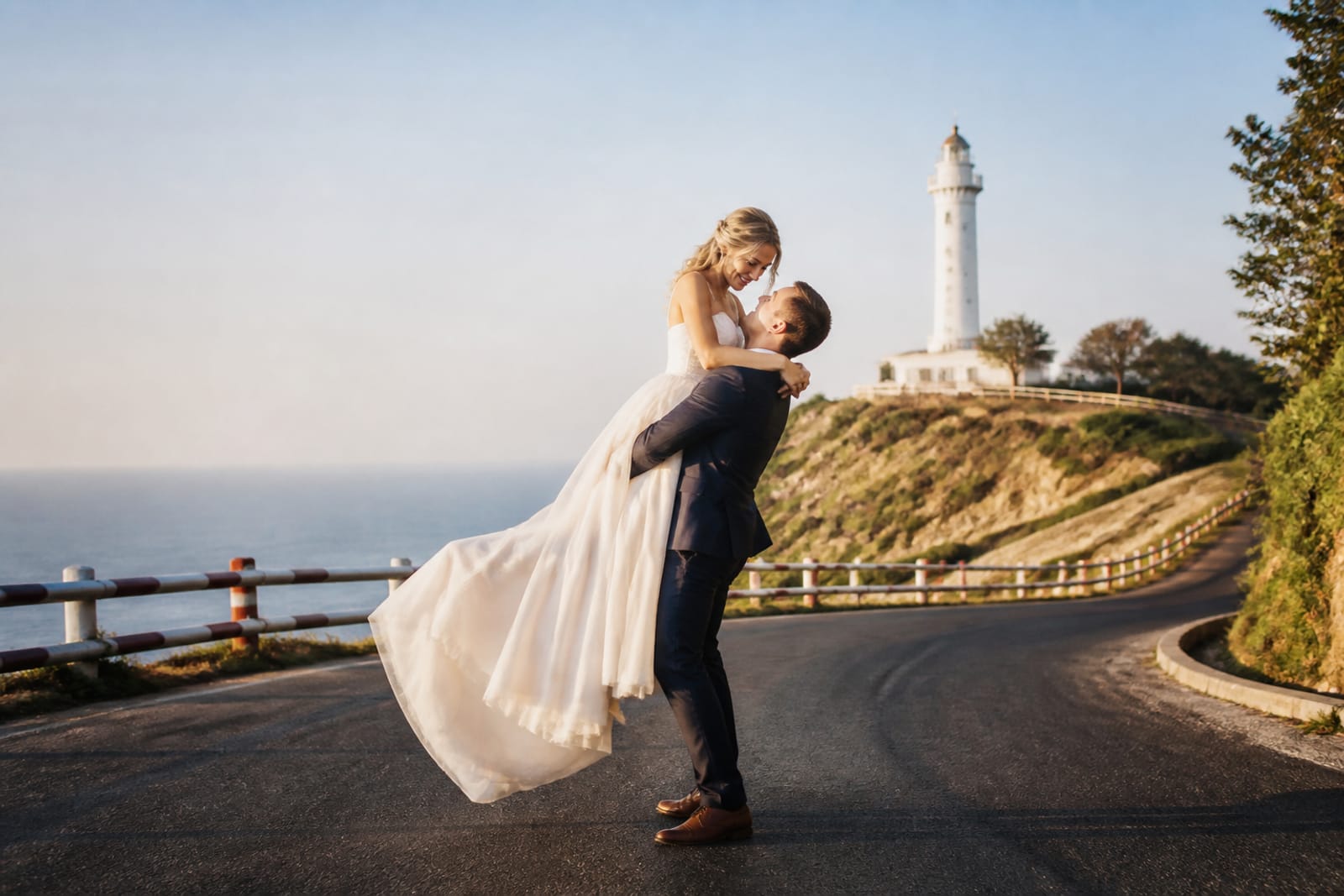
Vung Tau Lighthouse draws couples for its isolation, layered geometry and the way light fractures through salt air. The site has no competing tourist crowds at dawn, no wedding-photo restrictions, and a natural narrative arc: couples walk up worn steps, pause at rail overlooks, descend toward the shore. The stone is warm-toned and non-reflective, which means skin tones read true even in high-angle backlighting. Weather, however, is the catch: the monsoon and typhoon season (September–November) brings grey skies and unpredictable downpours, while dry-season mornings (December–April) often deliver glassy calm and soft side light across the sea. The trade-off is that many couples book the same time window, so early timing (before 6:30 am) secures solitude.
When to shoot: season and time-of-day trade-offs
| Season | Light quality | Crowds | Sea state | Best time | Notes |
|---|---|---|---|---|---|
| Dec–Feb | Soft, low-angle, cool tone | Fewer weekday mornings | Calm, blue water | 6:15–6:50 am | Cool air, long shadows; dry and predictable. Weekend mornings busy with day-trippers. |
| Mar–Apr | Warm, golden, mid-angle | Few before 7 am | Calm; occasional haze | 5:50–6:40 am | Heat rises by 7 am; water clarity good. Late afternoon (4:30–5:15 pm) also strong but humid. |
| May–Aug | Bright, harsh midday; softer edges | Light mornings heavy by 8 am | Warm, sometimes turbid | 5:30–6:30 am only | Hot and humid; afternoon light too overhead. Afternoon showers possible. |
| Sep–Nov | Grey, diffused, or stormy | Variable | Rough, grey | Avoid | Typhoon and flood season. Light flat; unpredictable weather. Not recommended. |
Dry season (December–April) is non-negotiable for Vung Tau Lighthouse. Within that window, December–February offer the coolest air and most dramatic shadows; March–April warm up but are still reliable. Sunrise wins because it delivers side light that sculpts the stone's texture and separates you from the sea. Late-afternoon shoots (4:30–5:30 pm) work if you accept diffused light and competition from day-trippers; dawn solitude is worth the early alarm.
What to wear: dress codes and fabric fit at a coastal site
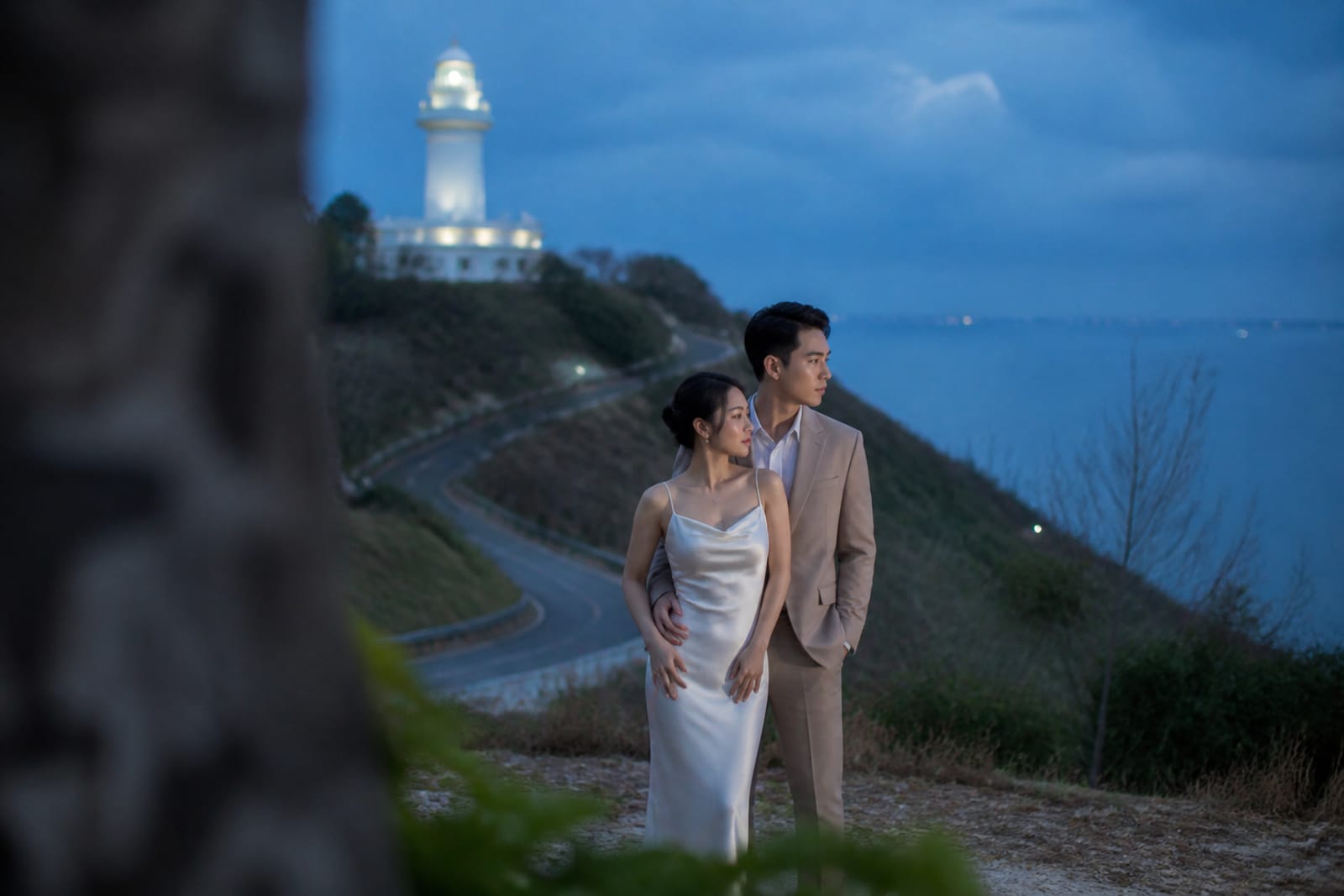
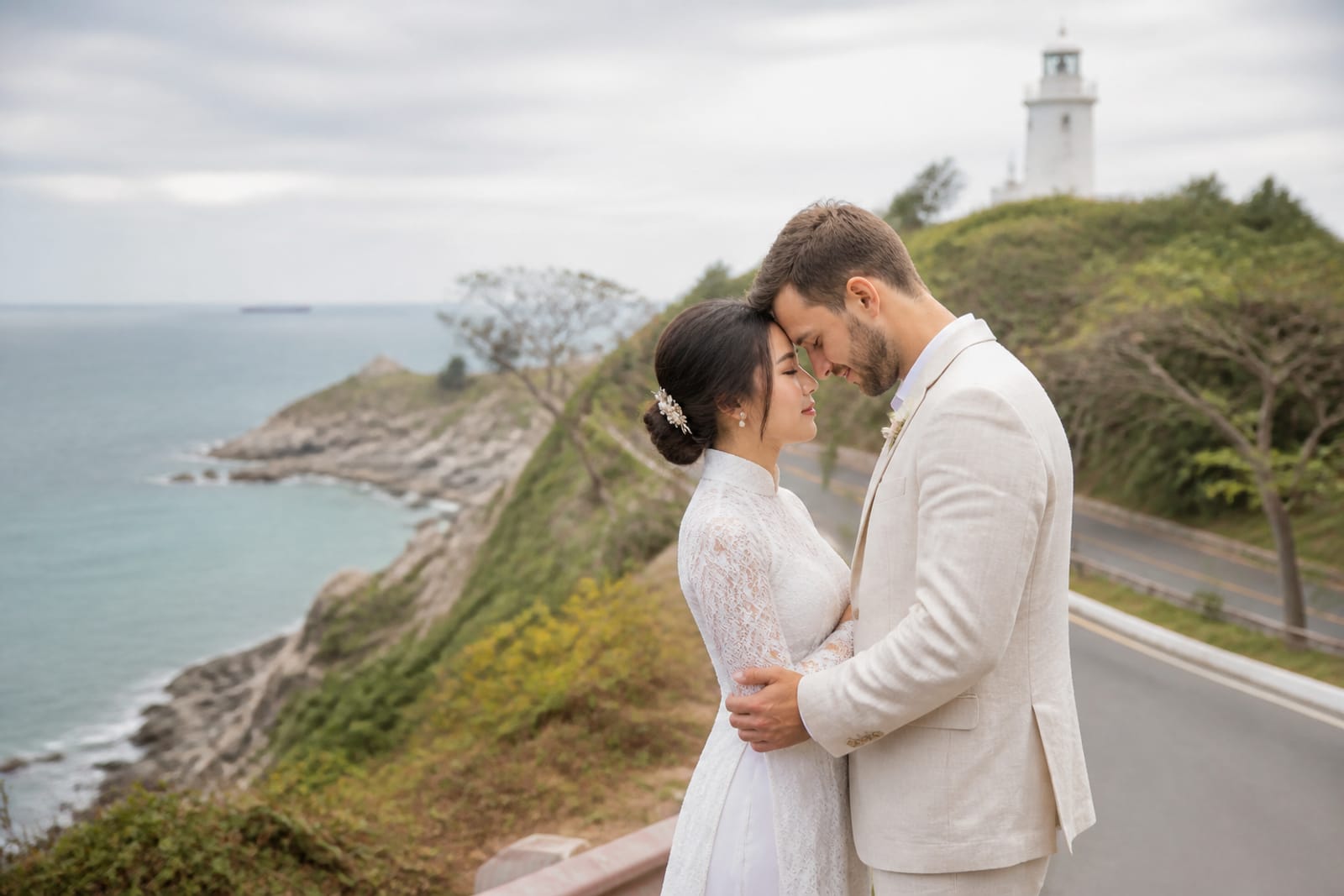
An ao dai is the traditional choice and photographs beautifully against weathered stone, but wind and salt air demand preparation. Lightweight silk or cotton blends move gracefully on camera without clinging to skin; heavy brocades photograph rich but feel stiff during long walks. Avoid excess beading on the skirt front—it catches light unpredictably and reads as noise in wide frames. For the groom, fitted linen or cotton shirts photograph better than heavy jackets; lightweight trousers in neutral tones (cream, grey, soft black) allow the lighthouse and sea to dominate. Footwear is critical: bring trainers for climbing, heeled shoes for the final frames if you wish, and a damp cloth because salt spray and loose stone grit shoes.
Bring two outfits if budget allows—one formal (ao dai or dress suit) for the lighthouse frames, and a casual second look (linen shirt, light trousers, no jacket) for walking the shoreline. Sea wind is a feature, not a flaw; it animates fabric and hair, which reads as motion in stills and film. Plan hair and makeup for durability: waterproof products, secured pins (wind will test them), and lip colour that survives salt spray. Have your photographer shoot sequences—one step, another step, pause, look at each other—rather than static poses, because movement masks wind's chaos and frames feel cinematic instead of wind-blown.
Logistics: permits, travel time and safety checks
Entry to Vung Tau Lighthouse requires permission; check directly with the site or the local Ba Ria–Vung Tau tourism office for current rules and fees. Travel from Ho Chi Minh City takes 2–2.5 hours depending on traffic and parking. Depart at 4:15 am if you aim for a 6:15 am shoot, to account for congestion on the national highway and time to park and walk to the lighthouse entrance. The path up has uneven stone steps, no handrails in places, and loose gravel; wear non-slip shoes during the ascent. Sunrise timing is non-negotiable because the lighthouse is a working navigation aid with active staff and occasional early visitors. Tides do not affect the shoot directly, but calm seas (neap tide, roughly twice monthly) produce glassier reflections in tidepools near the base if your photographer plans to use them.
Hire a local photographer based in Ho Chi Minh City or Vung Tau; they will know current entry procedures, peak traffic hours, and the exact angle of light at each level of the lighthouse. Ask your photographer to scout the site within the same season and time window you plan to shoot—dawn light in February is different from March—so they can plan the sequence (wide establishing shot from the base, medium shots on the stairs, detail frames at the railing) without wasting daylight. Confirm insurance, backup equipment and a contingency time slot in case weather delays the schedule.
Choosing a photographer: vetting a local team vs. coordinating from your home base
Vung Tau Lighthouse shoots are best served by a photographer physically based in or regularly working in Ho Chi Minh City, because they understand the site's tidal changes, the timing of early morning traffic, and the logistics of coordinating with the lighthouse staff. If you are booking from abroad, interview potential photographers about their portfolio at this exact location (not generic "lighthouse" images), their light metering strategy for dawn backlit scenes, and their plan for two or three outfit changes.
Cáo Studio operates in Hanoi, Ho Chi Minh City and Hoi An; if you are planning a pre-wedding shoot in Ho Chi Minh City or nearby, contact the team via WhatsApp to explore whether a Vung Tau shoot fits your vision and timeline. For a lighthouse-specific shoot, Cáo Studio can advise on logistics and potentially coordinate with local specialists. For couples who prefer an all-in-one team—photographer, hair, makeup and styling—Cáo Studio's makeup and hair service can travel to your hotel in Ho Chi Minh City the morning of the shoot, so you arrive at the lighthouse fully prepared.
If you are working with a local independent photographer, ask for a contract specifying the number of edited photos, delivery timeline, backup dates due to weather, and cancellation terms. Confirm they carry liability insurance and have shot coastal dawn shoots before. Request a test image or two taken at the same site in the same season to verify their exposure metering (dawn backlit scenes are prone to underexposure if the photographer relies on in-camera metering alone).
📸 Book on WhatsApp — pre-wedding photoshoot | 💄 Makeup & hair at your hotel | 🌸 See the lookbook
What to check before you book: a pre-shoot checklist
- Season and weather forecast: Confirm the shoot falls within December–April. Check a 10-day weather forecast two weeks before the date and reserve a backup date within the same season.
- Photographer's site portfolio: Ask for 3–5 images shot at Vung Tau Lighthouse specifically, ideally from the same month and time of day you plan to shoot. Generic "lighthouse" or "coastal" work does not tell you how they handle this site's light.
- Permits and access: Confirm your photographer or a site liaison has checked current entry rules and obtained permission if required. Clarify any entry fees or restrictions.
- Hair and makeup plan: Decide whether you are doing your own hair and makeup (bring waterproof products and a secured style that suits wind) or hiring a team to come to your hotel pre-dawn. Waterproof products are non-negotiable for a coastal shoot.
- Outfit logistics: Confirm how many outfits you plan, where they will be stored between changes, and whether your photographer has experience styling outfit transitions in a remote location without a dedicated changing room.
- Backup communication: Agree on a communication protocol if weather forces a reschedule. Confirm the photographer's cancellation policy and your options for a full refund or rescheduling.
- Edited files and timeline: Agree on the number of edited photos, the format (JPEG, RAW, or album print), and the delivery date. Dawn shoots often allow editing within 48 hours.
- Contingency time: Book a 3-hour window with a 1-hour buffer, in case light is slower to arrive or you need extra time between outfit changes.
💍 Plan a pre-wedding photoshoot | 📷 Family photoshoot in Vietnam | 👗 Ao dai rental for your shoot
FAQ
Can Cáo Studio shoot at Vung Tau Lighthouse?
Cáo Studio operates in Hanoi, Ho Chi Minh City and Hoi An. For a Vung Tau Lighthouse shoot, contact the Saigon team via WhatsApp to discuss logistics and potential coordination with local specialists, or hire a Ho Chi Minh City–based photographer familiar with the site.
What is the best month to shoot at Vung Tau Lighthouse?
December–April (dry season) offers the most reliable weather and soft light. December–February are coolest and produce dramatic shadows; March–April warm up but remain predictable. Avoid May–November due to heat, humidity and typhoon season.
Do I need permission to shoot at Vung Tau Lighthouse?
Entry rules vary; check the current policy with Vung Tau's local tourism office or your photographer's local contacts. Confirm whether permits or fees apply before you book, and factor access time into your dawn schedule.
How early should I arrive for a sunrise shoot?
Aim to start framing by 6:15 am in winter, 5:50 am in spring. Depart Ho Chi Minh City at 4:15 am to account for highway traffic and the walk to the lighthouse. Arriving early also secures solitude before day-trippers arrive.
Should I hire a local Ho Chi Minh City photographer or book with Cáo Studio?
A local photographer saves travel time and knows the site's exact timing and logistics. Cáo Studio's strength is one all-in-one team (photographer, hair, makeup, styling); contact the Saigon base via WhatsApp to explore how pre-wedding photoshoots or makeup and hair services could support a Vung Tau shoot coordinated locally.
What do I wear for a pre-wedding shoot at a lighthouse?
An ao dai photographs beautifully against stone; choose lightweight silk or cotton to move gracefully in wind. Bring trainers for climbing and heeled shoes for final frames. A second casual outfit (linen, neutral tones) works for shoreline sequences. Waterproof hair and makeup products are essential for salt spray and wind.
FAQ
Can Cáo Studio shoot at Vung Tau Lighthouse?
Cáo Studio operates in Hanoi, Ho Chi Minh City and Hoi An. For a Vung Tau Lighthouse shoot, contact the Saigon team via WhatsApp to discuss logistics and potential coordination with local specialists, or hire a Ho Chi Minh City–based photographer familiar with the site.
What is the best month to shoot at Vung Tau Lighthouse?
December–April (dry season) offers the most reliable weather and soft light. December–February are coolest and produce dramatic shadows; March–April warm up but remain predictable. Avoid May–November due to heat, humidity and typhoon season.
Do I need permission to shoot at Vung Tau Lighthouse?
Entry rules vary; check the current policy with Vung Tau's local tourism office or your photographer's local contacts. Confirm whether permits or fees apply before you book, and factor access time into your dawn schedule.
How early should I arrive for a sunrise shoot?
Aim to start framing by 6:15 am in winter, 5:50 am in spring. Depart Ho Chi Minh City at 4:15 am to account for highway traffic and the walk to the lighthouse. Arriving early also secures solitude before day-trippers arrive.
Should I hire a local Ho Chi Minh City photographer or book with Cáo Studio?
A local photographer saves travel time and knows the site's exact timing and logistics. Cáo Studio's strength is one all-in-one team (photographer, hair, makeup, styling); contact the Saigon base via WhatsApp to explore how [pre-wedding photoshoots](/pre-wedding-photoshoot) or [makeup and hair services](/makeup-and-hair) could support a Vung Tau shoot coordinated locally.
What do I wear for a pre-wedding shoot at a lighthouse?
An ao dai photographs beautifully against stone; choose lightweight silk or cotton to move gracefully in wind. Bring trainers for climbing and heeled shoes for final frames. A second casual outfit (linen, neutral tones) works for shoreline sequences. Waterproof hair and makeup products are essential for salt spray and wind.
Ao dai, makeup, hair and a local photographer in Hanoi or Saigon — one WhatsApp message.