/pre-wedding-photoshoot
Pre-wedding photoshoot in Da Lat in February: weather, light and crowd
February is Da Lat's best pre-wedding month: temperatures hover around 15–20°C (cool, clear air), rainfall is minimal, and the light—especially at sunrise—is soft and directional. Morning mist clings to Xuan Huong Lake and surrounding hills, framing couples in their own story without harsh shadows. Cherry blossoms (around early February) add botanical depth without staging. Crowds thin after Tet (early February), so iconic spots like Valley of Love and Thien Vien Tru Nhan feel open. The catch: early mornings (5:30–7 am) require your team onsite before dawn, and outfits must layer (silk ao dai over a fitted base; jackets for breaks). Cáo Studio coordinates pre-wedding shoots in Hanoi, Ho Chi Minh City and Hoi An—for Da Lat, we can guide you to a local vetted photographer and walk you through the logistics. 📸 Book on WhatsApp — pre-wedding photoshoot | 🌸 See the lookbook ---
Why is February the ideal month for Da Lat pre-wedding shoots?
February sits between two disruptions: Tet (late January–early February, when many services close) and the rainy season (May–November, with afternoon showers). The sweet spot is mid to late February. Days are dry and cool; nights drop to 12–15°C, which means zero humidity and crystalline air for your camera. The low-angle morning sun—rising around 6:30 am—creates rim light on faces and textiles without the washed-out glare of midday. Cherry blossoms peak in early to mid-February, and by late February, wild da quy sunflowers appear on hillsides. Mist rolls off lakes until around 8 am, then burns off, leaving a pale-gold sky for wide shots. Hotels and restaurants are 60–70% less crowded than December or Tet week, so you can shoot uninterrupted at Valley of Love, Thien Vien Tru Nhan (Buddhist monastery overlooking the valley), and Xuan Huong Lake without waiting for foot traffic to clear.
The trade-off: your team must move fast. February mornings are short—you have roughly 90 minutes of usable mist light before the sun rises high. Late starts (after 7 am) waste the day's best cinema. Layers are non-negotiable; silk ao dai feel magical in still air, but wind picks up mid-morning and cold creeps in without a structured base layer underneath.
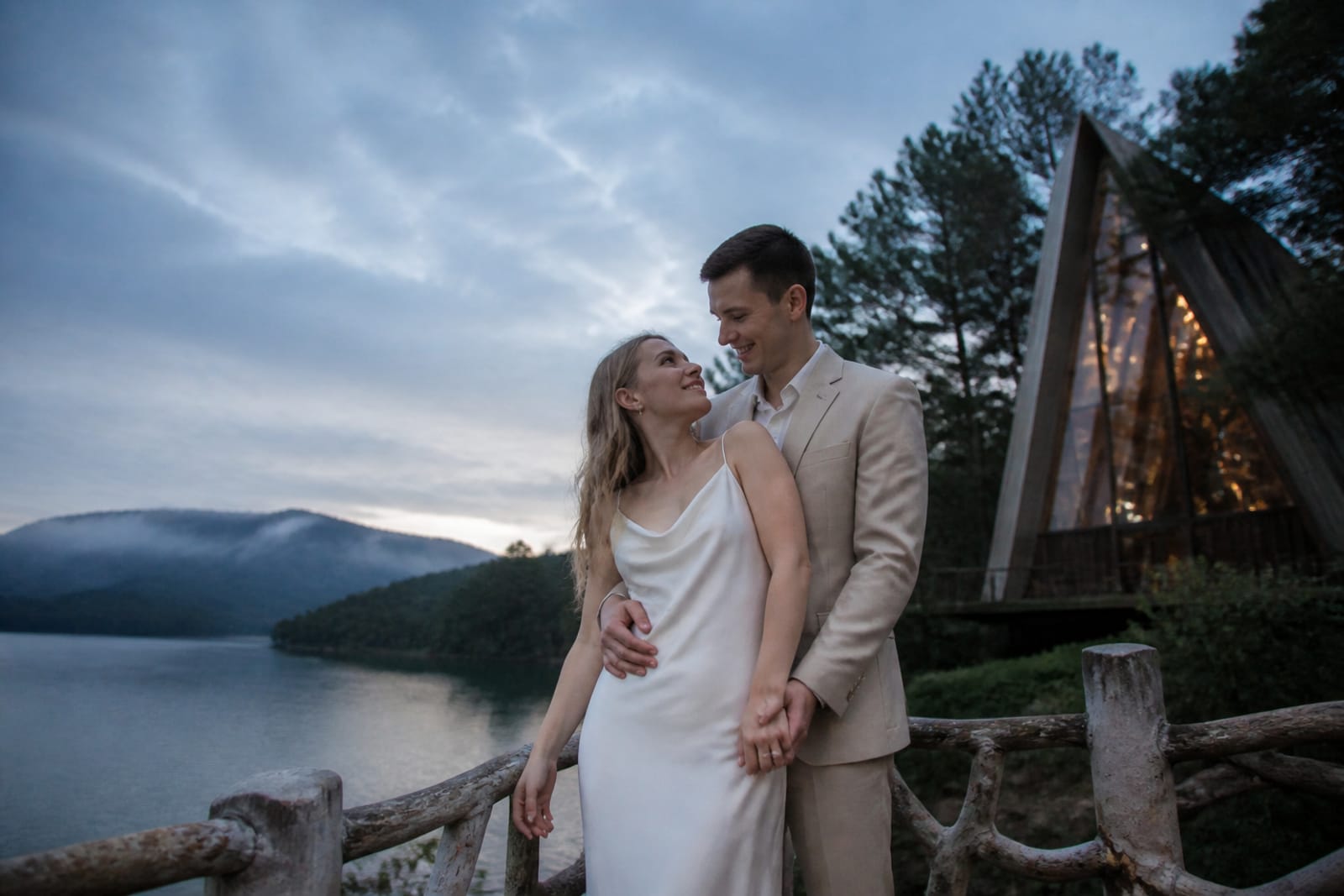
What weather should you expect, and how does it affect your outfit and timing?
Temperatures in February range from 12–20°C (warmest around midday, coldest at dawn). It rarely rains mid-February, but the first week can overlap with Tet weather (residual winter moisture), so check the 7-day forecast before you book. Wind is light and variable—not strong enough to disrupt a shoot, but enough to cool skin and require your stylist to anchor hair and fabric.
Humidity is at its annual low (around 65–75%), which means makeup doesn't melt, silk doesn't cling, and camera lenses don't fog when you move between cold air and warm indoor spaces. This is the opposite of May–September, when 90% humidity makes every breath visible in backlit shots.
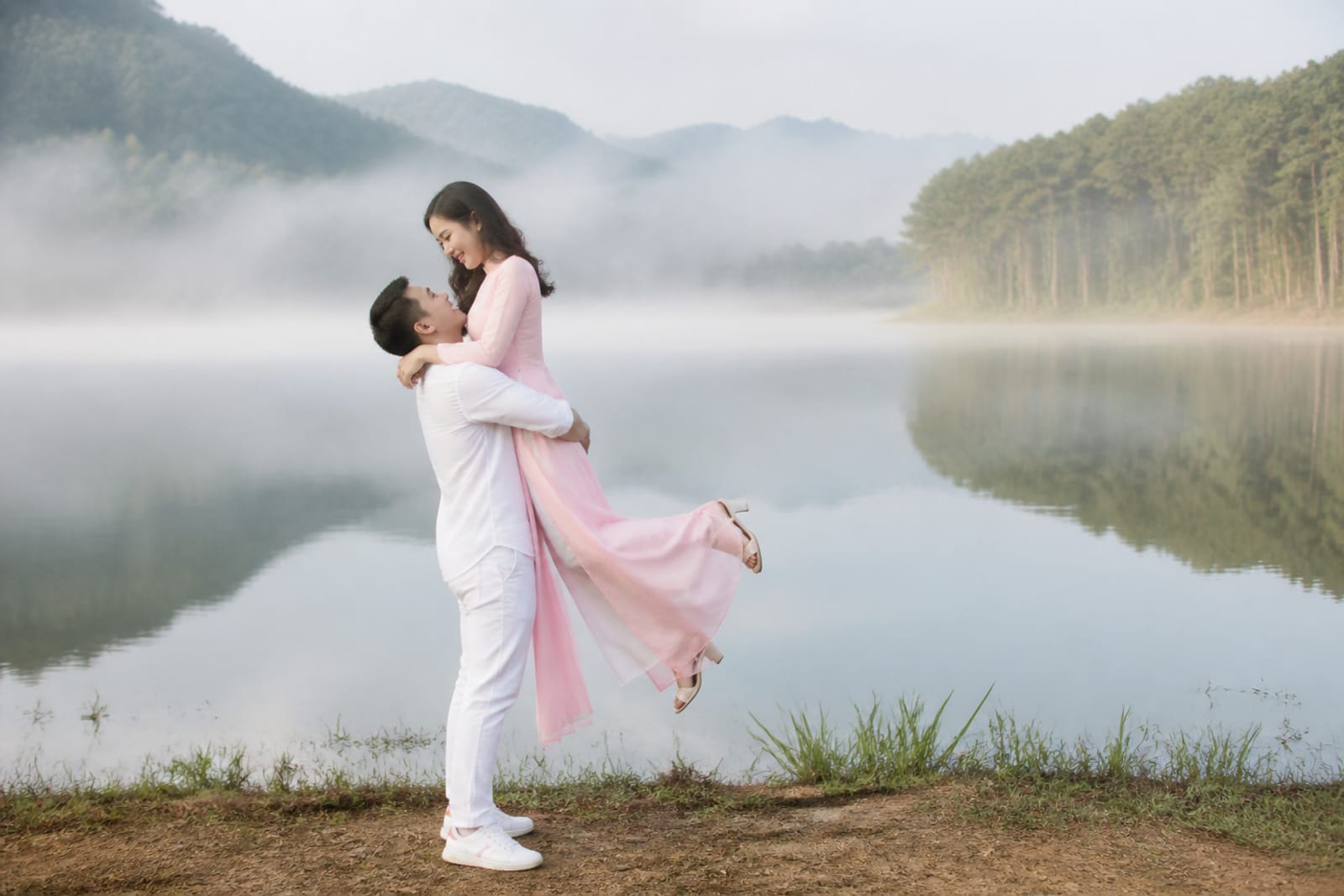
For outfits, ao dai layering is essential. A fitted turtleneck or soft long-sleeve base under the silk tunic traps warmth and creates clean lines (avoiding bunching or slipping). Grooms in tailored suits work perfectly—jackets don't feel overdressed in February cool. Bring a neutral shawl or light cardigan for breaks; it doubles as a styling prop for wide shots on hillside backdrops. Avoid cotton or linen alone; they wrinkle in cool, damp valley air and lack the presence silk has in low light.
Timing shifts the mood: sunrise shoots (5:30–7 am) give you mist and rim light for 90 minutes, then a pivot to golden hour (around 4:30–5:30 pm) for a second location. This demands a full-day crew and pre-planned routes to avoid dead time and costume fatigue.
How do crowds and tourist flow change in February?
January and early February are peak Tet season—temples and tourist spots overflow before the holiday. By mid-February, tourist buses thin out by 50–60%, and restaurants operate at normal capacity. This matters: popular spots like Valley of Love and Thien Vien Tru Nhan have fewer background foot traffic and fewer selfie sticks in your frame.
However, weekends (Friday–Sunday) still draw domestic couples for casual shoots and family photos. If you can shoot mid-week (Monday–Thursday), you'll have those backdrops nearly to yourself. Early mornings (before 6:30 am) are always empty, regardless of day—the payoff is your crew and subject in the mist with no bystanders.
Parking is simpler than summer months (May–September), and local taxi or driver availability is better—your coordinating photographer can arrange transport without negotiating surge pricing.
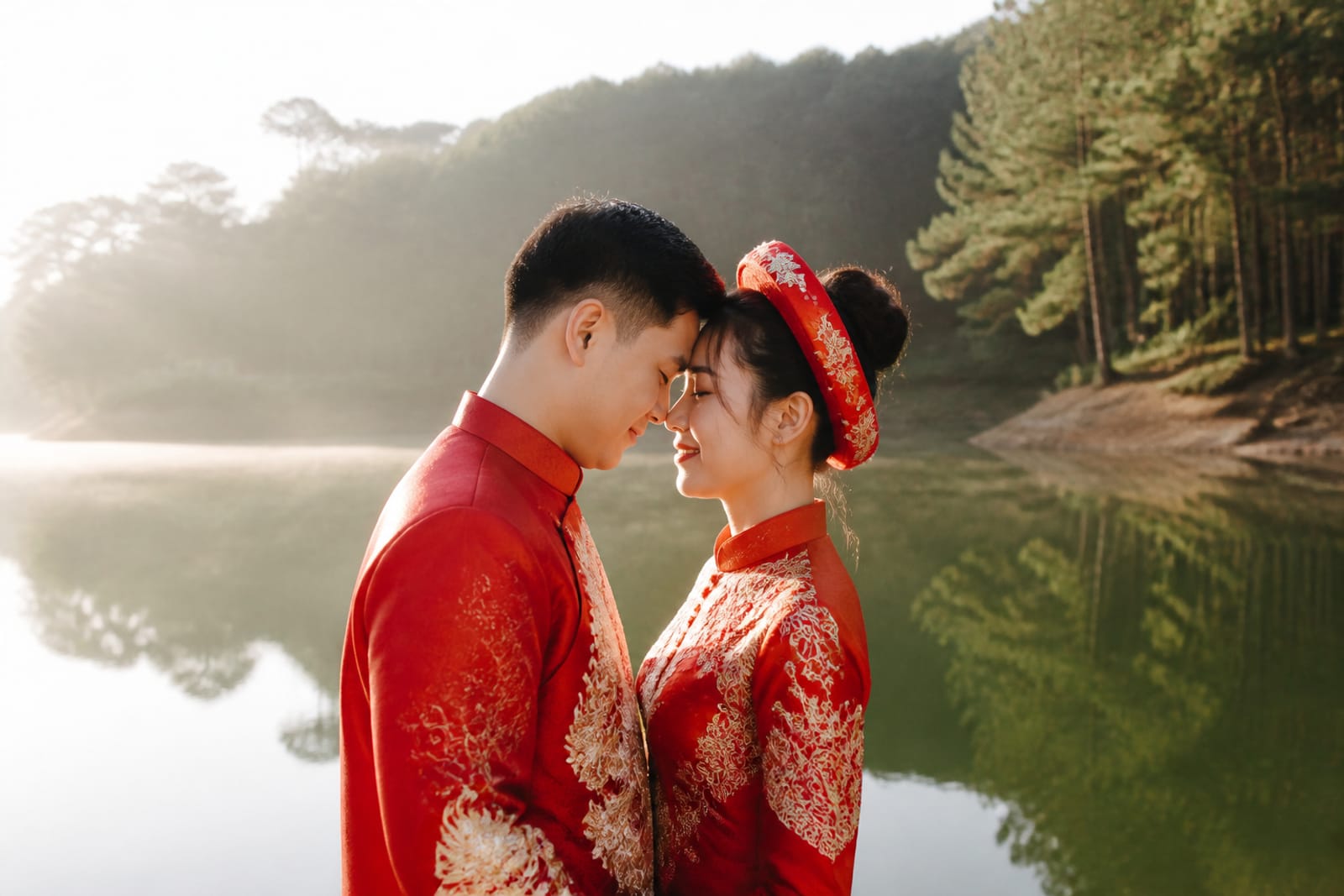
What light patterns should you plan around: sunrise, golden hour and mist?
Da Lat's highland plateau (around 1,500 m elevation) funnels morning air into valleys, creating fog that sits until 7:30–8:00 am on clear mornings. This mist is cinematic—soft-focus backdrops for close-ups, and diffused light that flatters skin without shadows. The sun rises behind the hills to the east, so you're shooting into gentle rim light rather than direct glare.
Golden hour in February runs from 4:15 pm onward (sunset around 5:15–5:20 pm), giving you 60 minutes of directional warmth. This is ideal for walking shots—couple moving toward camera, silhouettes, and holding hands with light catching fabric and jewelry.
Midday (11 am–3 pm) is hard light, washed-out sky. Avoid it. If your schedule demands midday, move to shaded locations (tree canopies, monastery interiors, covered market arcades) and rely on fill-flash or reflectors.
Overcast days (possible early February, if Tet weather lingers) flatten the sky but soften shadows everywhere—still shootable, but less dramatic than clear mist mornings.
| Lighting Window | Time | Best For | Mood | Challenges |
|---|---|---|---|---|
| Sunrise mist | 5:30–7:30 am | Close-ups, walking, backlit detail | Soft, intimate, cinematic | Early call-time; crew fatigue by 8 am |
| Golden hour | 4:15–5:15 pm | Wide landscape, silhouette, movement | Warm, romantic, directional | One hour only; must scout route beforehand |
| Midday clear | 11 am–3 pm | Avoiding entirely recommended | Flat, washed | Skip or move to shade; light is unforgiving |
| Overcast (early Feb) | 9 am–4 pm | Backup plan; soft light, no shadows | Muted, even, safe | Flat sky; less emotional range in frames |
What's the honest checklist before booking a Da Lat pre-wedding shoot in February?
1. Lock your dates 4–6 weeks ahead. February fills up, especially mid-February. Hotels book out. Local photographers' calendars close by late January.
2. Confirm weather forecast 10 days before. Check a reliable source (not tourism sites) for rain, mist and temperature. Early February can carry tail-end winter moisture; late February is safer.
3. Scout locations and light timing beforehand. Drive or walk Valley of Love, Thien Vien Tru Nhan, and Xuan Huong Lake at sunrise and golden hour to see where light hits. Note vehicle access, parking, and whether permits are required (temples often need permission for commercial shoots).
4. Brief your stylist on layers, wind and altitude. Da Lat is cool and windy; ao dai that works in Hanoi's warmth may feel insubstantial here. Bring backup shawls, clips for hair, and tight undergarments to prevent slipping.
5. Hire a local photographer or coordinator. Cáo Studio operates in Hanoi, Ho Chi Minh City, and Hoi An. For Da Lat, we can recommend vetted local photographers via WhatsApp and walk you through the shoot plan, but the on-ground team must be based in Da Lat to navigate permits, light-chasing and weather pivots.
6. Plan transport and crew timing. Your photographer, stylist, and any second camera operator need to arrive before 5 am for sunrise shoots. This means overnight stay or 2-hour pre-dawn drive. Budget for a driver or arrange local taxis familiar with steep, winding roads.
7. Prepare backup indoor locations. If mist doesn't materialize or rain hits, have a Plan B: Thien Vien Tru Nhan interiors, a covered market, or a boutique hotel lobby with north-facing windows for soft, even light.
8. Confirm final look and props 5 days ahead. Ao dai, jewelry, bouquets (local florist or brought from Hanoi)—finalize everything before the shoot week to avoid last-minute sourcing in Da Lat's limited inventory.
---
What to check before you book
Photographer credentials: Ask to see a Da Lat portfolio (not just generic pre-wedding work). Light-chasing at sunrise is a skill; not all photographers are organized enough for 5:30 am starts.
Outfit logistics: Confirm whether your ao dai or suit will be rented/brought from Hanoi or sourced locally. Local rentals often lack premium quality; Cáo Studio's rental partners operate in Hanoi and Saigon, so if you're booking a local Da Lat photographer, you'll need to arrange clothing separately or ask us on WhatsApp for referrals.
Crew inclusion: Verify whether your photographer is solo or part of a team. Hair and makeup on-location are essential in February cold—a stylist can re-pin and touch up every 30 minutes while you're shooting. If your local photographer works solo, hire a separate makeup artist.
Permit and access: Some temples and gardens require fees or shoot permits. Ask your photographer to confirm these upfront; don't discover them on shoot day.
Backup plan: Ask explicitly how the photographer pivots if mist doesn't appear or rain hits. Do they shoot anyway? Reschedule? What's the refund policy?
---
💄 Makeup & hair at your hotel | 🌸 See the lookbook | 📸 Book on WhatsApp — pre-wedding photoshoot
For Hanoi, Ho Chi Minh City, or Hoi An pre-wedding shoots, Cáo Studio handles everything—directing, styling, makeup and photography—in one team. For Da Lat, message us on WhatsApp and we'll connect you with a trusted local photographer and walk you through weather, light and outfit planning.
---
FAQ
Is February actually better than December or March for a Da Lat pre-wedding shoot?
Yes. December is peak tourist season (crowded, expensive). March begins warmer (16–22°C) and morning mist thins earlier (by 7 am). February's cool, dry air and lingering mist (until 8 am) create the softest light and fewest tourists. Early February overlaps Tet closures, so aim for mid to late February.
What happens if there's no mist on the morning of my shoot?
Overcast February mornings still diffuse light beautifully—no harsh shadows. You lose the romantic separation between subject and background, but exposure and skin tone improve. If skies are completely clear and bright, shoot in shade (tree canopies, monastery arcades) or wait for golden hour (4:15 pm). Your photographer should have a backup plan before shoot day.
Should we rent ao dai and suits in Da Lat, or bring them from Hanoi?
Bringing from Hanoi is safer. Da Lat rental shops stock limited sizes and styles, and quality varies. If your ao dai and suit are tailored or premium fabric, pack them. If renting locally, order 2–3 weeks ahead and allow 3 days for fittings and adjustments—don't wait until the week of your shoot.
How early must we wake up, and is 5:30 am really worth it?
Yes. By 5:30 am, mist is thick, light is soft, and you're alone at iconic spots. By 7:30 am, mist burns off and tourists arrive. You'll spend 90 minutes shooting sunrise; then a break for rest and makeup touch-up; then golden hour starting around 4:15 pm. It's a full day, but the light is irreplaceable.
What if we can't shoot at sunrise—can we do a full session at golden hour only?
Possible, but limited. Golden hour runs 60 minutes (4:15–5:15 pm), enough for two locations and wide, medium, and detail shots if your photographer is fast and your route is tight. You lose the mist-light intimacy and must move quickly. Sunrise + golden hour is the traditional two-location approach; golden hour alone works for a focused, single-location session (e.g., one garden, one monastery).
Do we need permits to shoot at Valley of Love and Thien Vien Tru Nhan?
Valley of Love is a public park; ask your photographer whether they've arranged clearance. Thien Vien Tru Nhan is a working monastery; shooting requires advance notice and permission from the abbot's office. Your local photographer should handle this—confirm they've done it before and have relationships with site managers.
FAQ
Is February actually better than December or March for a Da Lat pre-wedding shoot?
Yes. December is peak tourist season (crowded, expensive). March begins warmer (16–22°C) and morning mist thins earlier (by 7 am). February's cool, dry air and lingering mist (until 8 am) create the softest light and fewest tourists. Early February overlaps Tet closures, so aim for mid to late February.
What happens if there's no mist on the morning of my shoot?
Overcast February mornings still diffuse light beautifully—no harsh shadows. You lose the romantic separation between subject and background, but exposure and skin tone improve. If skies are completely clear and bright, shoot in shade (tree canopies, monastery arcades) or wait for golden hour (4:15 pm). Your photographer should have a backup plan before shoot day.
Should we rent ao dai and suits in Da Lat, or bring them from Hanoi?
Bringing from Hanoi is safer. Da Lat rental shops stock limited sizes and styles, and quality varies. If your ao dai and suit are tailored or premium fabric, pack them. If renting locally, order 2–3 weeks ahead and allow 3 days for fittings and adjustments—don't wait until the week of your shoot.
How early must we wake up, and is 5:30 am really worth it?
Yes. By 5:30 am, mist is thick, light is soft, and you're alone at iconic spots. By 7:30 am, mist burns off and tourists arrive. You'll spend 90 minutes shooting sunrise; then a break for rest and makeup touch-up; then golden hour starting around 4:15 pm. It's a full day, but the light is irreplaceable.
What if we can't shoot at sunrise—can we do a full session at golden hour only?
Possible, but limited. Golden hour runs 60 minutes (4:15–5:15 pm), enough for two locations and wide, medium, and detail shots if your photographer is fast and your route is tight. You lose the mist-light intimacy and must move quickly. Sunrise + golden hour is the traditional two-location approach; golden hour alone works for a focused, single-location session (e.g., one garden, one monastery).
Do we need permits to shoot at Valley of Love and Thien Vien Tru Nhan?
Valley of Love is a public park; ask your photographer whether they've arranged clearance. Thien Vien Tru Nhan is a working monastery; shooting requires advance notice and permission from the abbot's office. Your local photographer should handle this—confirm they've done it before and have relationships with site managers.
Ao dai, makeup, hair and a local photographer in Hanoi or Saigon — one WhatsApp message.