/pre-wedding-photoshoot
Pre-wedding photoshoot in Da Nang for British couples
A pre-wedding photoshoot in Da Nang is a curated session (usually 4–8 hours) shot across the city's landmarks: My Khe beach at sunrise, the Golden Bridge on Ba Na Hills, Hoi An Ancient Town, or Marble Mountains. The best window runs February to August, when daylight is bright and skies are clear; avoid the typhoon season (September–December, worst October–November). Book 2–3 months ahead through a local photographer or studio experienced with Western couples. Cáo Studio – Makeup & Photoshoot operates in Hanoi and Ho Chi Minh City; for Da Nang, hire a local team familiar with monsoon timing, beach logistics and foreigner workflows. Clarify exactly what's included (outfits, edits, timeline), confirm the photographer's backup plan for rain, and scout locations in person if possible. ---
Why February to August is your window in Da Nang
Da Nang sits in Vietnam's central-coast climate: dry and warm February through August, increasingly hot May–August, then typhoon-vulnerable September–December. Light is cleanest February–April (cool, crisp mornings; golden-hour beaches by 5:30 p.m.). May–August brings stronger midday sun and afternoon humidity—favour early starts and shaded pockets near Marble Mountains or Hoi An's lantern-lit streets.
October–November is the worst window: unpredictable rain, grey skies and occasional evacuation alerts make scheduling risky. Tet (late January–mid February) clogs temples and restaurants, though some couples shoot the quiet morning slots before crowds arrive.
Your decision: book February–April for cool-light consistency; May–August if you've confirmed a location with shade; avoid September–December unless your dates are fixed and you accept weather risk.
---
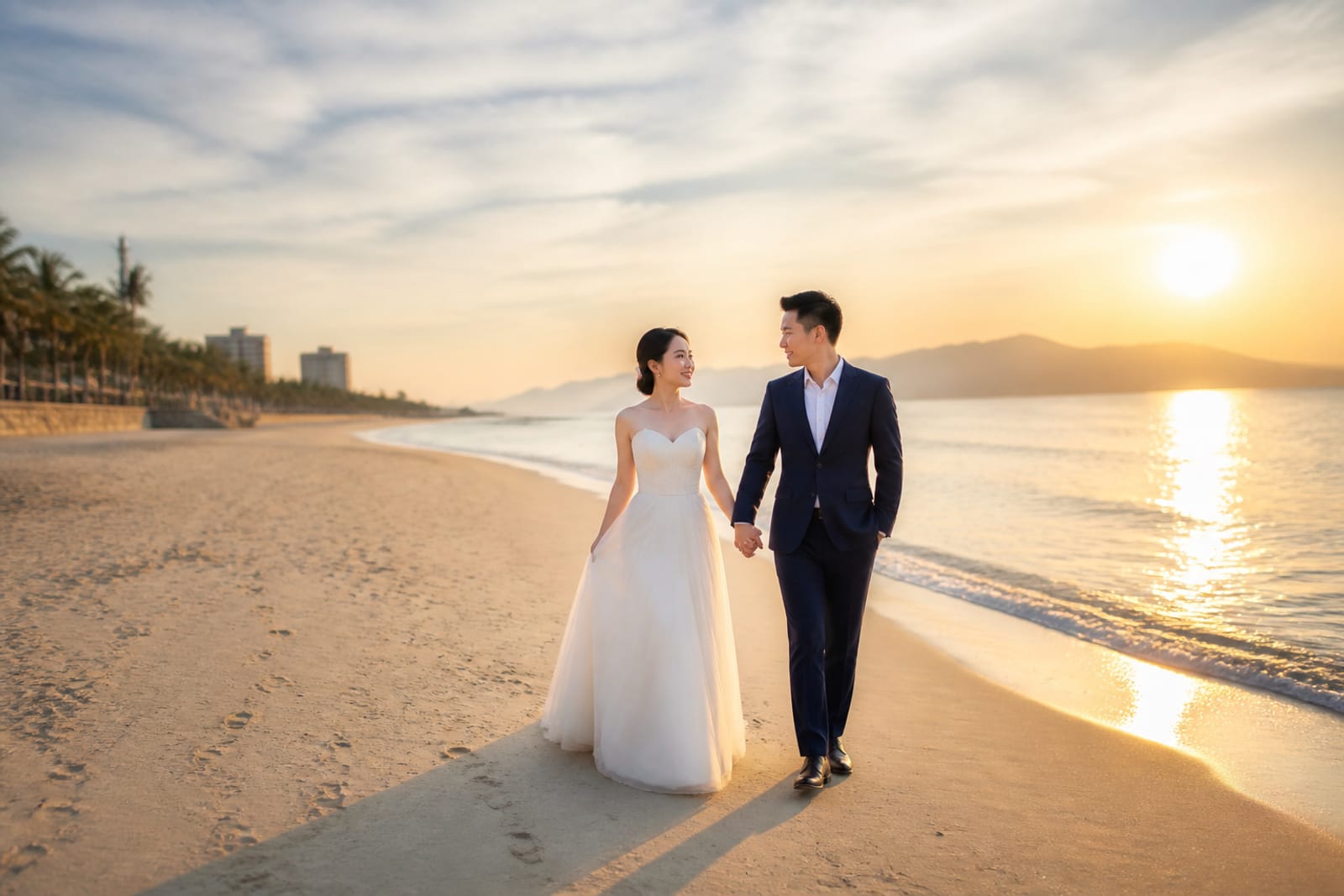
My Khe beach: what time and why sunrise matters
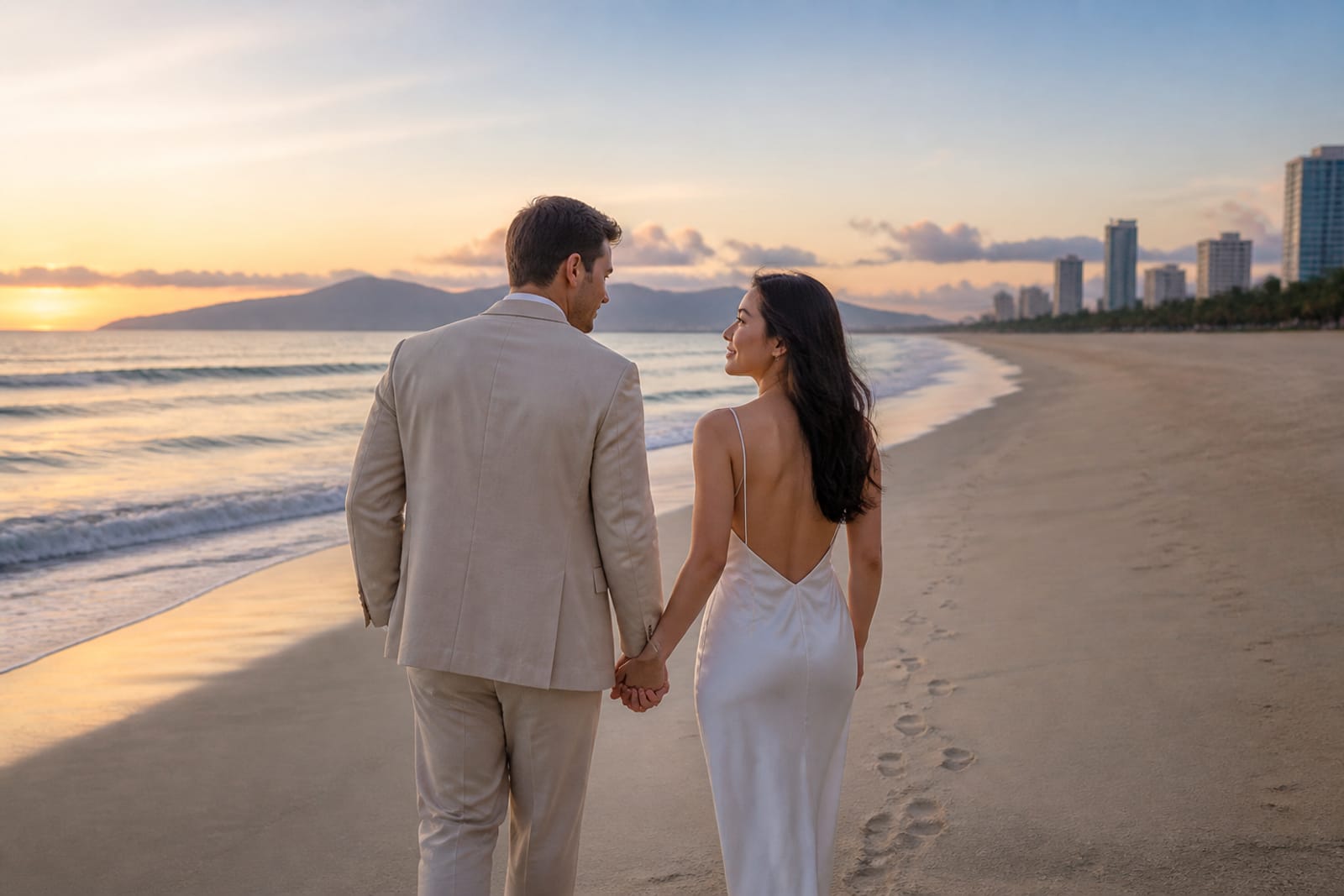
My Khe is Da Nang's flagship: a 30 km crescent with soft sand, calm waters and unobstructed eastern views. Sunrise (6:00–6:30 a.m. in winter; earlier in summer) delivers flat golden light, empty beach and a chance to shoot before tour groups arrive by 8:00 a.m. By 9:00 a.m. the beach fills; midday sun creates harsh shadows unsuitable for couple portraits.
Logistics: arrive 45 minutes early to scout the tide line and negotiate space with local vendors (who may ask for a small courtesy—confirm with your photographer). Shallow water works for wading shots but currents vary; ask locals about safe zones. The beach has changing rooms at the north end but no formal facilities; pack a dry bag and arrive in swimwear under your outfit.
Why it works: uncluttered, romantic, and the only time you'll have it quasi-private is before sunrise traffic. Sunset (5:30–6:00 p.m.) is also popular but busier. Bring a waterproof phone pouch and trust your photographer's experience with sand and saltwater.
📸 Book on WhatsApp — ao dai photoshoot | 💄 Makeup & hair at your hotel
---
Golden Bridge and Ba Na Hills: beat the crowds and clouds
The Golden Bridge on Ba Na Hills (1,400 m elevation) is a global icon—and a photographic gauntlet. Midday crowds (10:00 a.m.–3:00 p.m.) number in hundreds; the site is often shrouded in mist by afternoon. Arrive at the cable-car opening (check the current timetable locally) to shoot before 9:00 a.m., when light is soft and footfall minimal. The bridge itself is photogenic only from 2–3 angles; plan 45 minutes there, then move to the surrounding gardens or Linh Ung Pagoda (nearby, fewer people, elevated views).
Cost factors: cable-car tickets and parking are required for you and your photographer—budget for this in your quote. Check current prices on Ba Na Hills' official site.
Why couples choose it: iconic backdrop, dramatic scale, and the cooler mountain air is welcome relief in May–August. Why it's risky: weather changes fast; mist can erase the bridge entirely within minutes. A photographer familiar with Ba Na's microclimates will know the second-best time to shoot (usually 7:00–8:30 a.m. in summer, 8:00–9:00 a.m. in cooler months).
---
Marble Mountains and Buddhist temples: intimacy and ritual light
Marble Mountains (Ngu Hanh Son) is a cluster of five limestone peaks with caves, pagodas and river views—less crowded than Ba Na and more culturally grounded. Each peak is a 30–45 minute walk; shoot the lower caves and pagoda interiors where light filters through stone openings, creating ethereal silhouettes. The highest peak offers panoramic city views but demands 90 minutes and isn't worth the time cost for a couple session.
Etiquette: temples and pagodas are active worship spaces. Dress modestly (knees and shoulders covered); remove shoes inside shrines; ask the photographer before shooting altar areas or monks. Many allow photography in outer courtyards but restrict it indoors—clarify on arrival.
Why it works: the light inside caves is naturally diffused; pagoda courtyards offer shade and spiritual framing without Ba Na's tourist density. Autumn mornings (February–April) are ideal when the sun rises behind the mountains, backlighting stone and creating depth.
---
Hoi An Ancient Town: lanterns, shophouse corridors and golden hour
Hoi An is 30 km south and worth a half-day or full-day shoot if you're combining it with Da Nang. The lantern-lit streets, French-colonial shophouses and Thu Bon River create cinematic frames impossible to replicate elsewhere. Shoot at golden hour (5:00–6:30 p.m., especially June–August when it peaks later), when lantern light balances daylight and the streets empty of midday foot traffic. Sunrise (6:00–6:30 a.m.) is quieter but the lanterns are off and light is cooler—better for a second-outfit change.
Cost factors: entry tickets to Hoi An Ancient Town are required; check the current price on the official Hoi An website. Parking and your photographer's transport add to the day's cost.
Why it's different: Hoi An reads as "another country"—Japanese bridges, Chinese shopfronts, Vietnamese river life in one frame. The narrow alleys force intimacy; your photographer shoots tighter, more storytelling angles than a beach allows.
---
Choosing between beach, mountains and town: a comparison framework
| Venue | Best season | Light quality | Crowd factor | Effort & time | Best for |
|---|---|---|---|---|---|
| My Khe beach | Feb–Aug | Sunrise golden, midday harsh | Empty 6–8 a.m., busy 9 a.m.+ | 90 min total; low walking | Classic, romantic, minimal outfit changes |
| Ba Na Hills | Feb–May, Aug–Sep | Crisp early morning; misty by noon | Peak 10 a.m.–3 p.m.; open dawn–9 a.m. | 3–4 hours; cable-car + 45 min walk | Iconic landmark; high altitude drama |
| Marble Mountains | Feb–May | Cave interiors softly diffused; outdoor sun sharp | Moderate year-round; caves quieter mornings | 2–3 hours; 30–45 min walks per peak | Cultural, intimate, backlit silhouettes |
| Hoi An Ancient Town | Feb–Aug, avoid Tet | Golden hour (5–6:30 p.m.) ideal; lanterns at dusk | Moderate morning, crowded 10 a.m.–4 p.m. | 4–6 hours; tight alleys, multiple outfits | Narrative, cinematic, second-location depth |
---
How to book a local photographer in Da Nang: what to check before committing
Cáo Studio – Makeup & Photoshoot operates in Hanoi and Ho Chi Minh City; we do not have a Da Nang branch. For a local shoot, book a Da Nang-based photographer 2–3 months ahead. Here's your vetting checklist:
Portfolio & specificity:
- Ask to see 3–5 full pre-wedding sessions (not just "best shots"). Do they show diverse couples, locations, light conditions?
- Do their edits match your style? (Warm vs. cool tones, matte vs. glossy, color vs. B&W?)
- Check for detail: do they shoot the small moments (rings, hands, laughs) alongside posed portraits?
Experience with your needs:
- Have they worked with British or Western couples? Workflows and expectations differ.
- Do they understand beach logistics (tide, vendors, costume changes)?
- Ask for a reference from a couple shot in similar season/weather.
Logistics & backups:
- What's their backup plan if rain cancels your beach slot? Rescheduled date, partial refund, or move to indoor venue?
- Do they provide a full shot list (what you'll get: group shots, details, candids)?
- How many edited photos, in what format (web-res JPEGs, print-res TIFFs, RAW files)?
- Timeline: when will you receive a first preview, the full gallery, final retouches?
Inclusions & hidden costs:
- Is makeup and hair included, or hired separately? (Hiring a local makeup artist adds time and cost.)
- Are multiple locations covered, or does each venue add a surcharge?
- Do they provide any prints, albums or digital deliverables, or is it photos only?
- Confirm parking, cable-car tickets and other on-location fees are your responsibility.
Communication & contract:
- Do they speak English fluently, or will there be a liaison?
- Request a written agreement specifying date, time, locations, deliverables, payment schedule and cancellation terms.
- Ask for their response time (how quickly do they reply to messages?).
Red flags: vague portfolio, no references, unwillingness to discuss weather backups, payment upfront with no terms, or a quoted package that sounds too low (indicates rushed work or hidden costs).
---
Cost factors that shape your Da Nang pre-wedding budget (not prices—decision drivers)
Never ask "how much?" without understanding what moves the needle. Local Da Nang photographers price based on:
- Duration: half-day (4 hours) costs less than full-day (8 hours), which costs less than multi-day (useful if you're combining Da Nang, Hoi An and Marble Mountains).
- Locations: beach-only is simpler than beach + mountains + town (more travel time, outfit changes, lighting complexity).
- Season: dry-season (Feb–Apr) rates may be lower due to higher volume; rainy-season (Oct–Nov) may rise because rescheduling risk increases.
- Team size: solo photographer vs. photographer + assistant + makeup artist.
- Deliverables: edited JPEGs only vs. JPEGs + RAW files vs. printed album, changes the final cost.
- Add-ons: videographer, drone footage, engagement ring close-ups or details shooting add specialist fees.
Compare photographers not by price alone but by what you're getting for the time and location complexity. A cheaper rate on a typhoon-season date is risky; a higher rate from someone with 50+ Da Nang pre-weddings and a weather backup plan may save your day.
---
What to wear and bring for a Da Nang pre-wedding shoot
Outfits:
- Bring 2–3 changes: an ao dai (hire locally or bring your own; renting in Da Nang avoids luggage bulk), a Western wedding dress or formal suit, and a casual–romantic option (linen trousers, silk blouse, or jumpsuit for Hoi An streets).
- Pack a thin shawl for temple visits and cooler mountain mornings.
- Wear soft, neutral shoes you can walk in (flip-flops for beach, flats for town alleys; heels for posed shots only).
Practical kit:
- Waterproof phone pouch and dry bag for beach shots.
- Sunscreen (high SPF; your photographer will note tan lines in retouching).
- Lip balm and mist spray (humidity and salt water dry lips fast).
- Hairpins, bobby clips and a small mirror for touch-ups mid-shoot.
- Hat or cap for sun breaks between locations.
- A light scarf or sarong (useful as a prop, modesty layer or beach wind shield).
Timing your shoot: Book a trial run with your photographer 1–2 days before if possible. Walk the beach at sunrise, check Marble Mountain terrain, and confirm Hoi An's current festival dates (lantern festivals change monthly and attract huge crowds).
---
If you're already booked with Cáo Studio in Hanoi or Ho Chi Minh City
Cáo Studio – Makeup & Photoshoot specializes in pre-wedding, couple and ao dai photoshoots across Hanoi and Ho Chi Minh City, plus Hoi An by appointment. If your wedding is in one of those cities, or you're willing to travel, we handle the full logistics: makeup and hair at your hotel, multiple locations, and direct communication in English. Our team knows north and south Vietnam's light, seasons and venues intimately.
For Da Nang exclusively, a local photographer is your best option—they know the monsoon patterns, the 6:00 a.m. beach rhythm and which pagoda lets you shoot interiors. We recommend booking them, not us, for this location.
📸 Book on WhatsApp — pre-wedding photoshoot | 💄 Makeup & hair at your hotel | 🌸 See the lookbook
---
FAQ
What's the best month for a Da Nang pre-wedding shoot?
March–April offers cool mornings, golden light and low humidity. February is also excellent but busier around Tet. May–August works if you start before 8:00 a.m. Avoid October–November (typhoon risk, unpredictable rain).
How early should I book a Da Nang photographer?
Aim for 2–3 months ahead, especially if your date lands in March–May. Local photographers fill up fast in dry season. Off-season (June–September) offers more flexibility but higher heat and humidity.
Do I need a permit to shoot at Marble Mountains or Hoi An?
Hoi An Ancient Town requires entry tickets for all visitors (check the official website for current prices). Marble Mountains has no formal permit, but ask your photographer about respectful photography in active temples. Always ask locals or monks before shooting inside shrine areas.
Can I shoot pre-wedding photos if it rains?
Yes, but with limits. Light rain works for moody silhouettes and reflections on wet pavement. Heavy rain or typhoon conditions cancel beach and mountain shoots. Confirm your photographer's rescheduling policy and whether indoor venues (Hoi An shophouses, pagoda courtyards) are fallback options.
Should I hire a makeup artist separately, or is it included with the photographer?
Most Da Nang photographers don't include makeup. Hire a local makeup artist (your photographer can recommend one) 3–4 weeks ahead. Build buffer time into your shoot schedule—makeup for multiple outfits takes 45–90 minutes total. Some Western couples bring their own makeup artist from home for consistency; allow this in your travel plans.
What's the difference between a full-day and half-day pre-wedding shoot?
Half-day (4 hours) covers one location well—e.g., beach sunrise + a second outfit at a café. Full-day (8 hours) spans 2–3 locations (beach, mountains, town) with multiple outfits and allows for travel time. Half-day is faster and less exhausting; full-day tells a richer story but requires more planning and endurance.
FAQ
What's the best month for a Da Nang pre-wedding shoot?
March–April offers cool mornings, golden light and low humidity. February is also excellent but busier around Tet. May–August works if you start before 8:00 a.m. Avoid October–November (typhoon risk, unpredictable rain).
How early should I book a Da Nang photographer?
Aim for 2–3 months ahead, especially if your date lands in March–May. Local photographers fill up fast in dry season. Off-season (June–September) offers more flexibility but higher heat and humidity.
Do I need a permit to shoot at Marble Mountains or Hoi An?
Hoi An Ancient Town requires entry tickets for all visitors (check the official website for current prices). Marble Mountains has no formal permit, but ask your photographer about respectful photography in active temples. Always ask locals or monks before shooting inside shrine areas.
Can I shoot pre-wedding photos if it rains?
Yes, but with limits. Light rain works for moody silhouettes and reflections on wet pavement. Heavy rain or typhoon conditions cancel beach and mountain shoots. Confirm your photographer's rescheduling policy and whether indoor venues (Hoi An shophouses, pagoda courtyards) are fallback options.
Should I hire a makeup artist separately, or is it included with the photographer?
Most Da Nang photographers don't include makeup. Hire a local makeup artist (your photographer can recommend one) 3–4 weeks ahead. Build buffer time into your shoot schedule—makeup for multiple outfits takes 45–90 minutes total. Some Western couples bring their own makeup artist from home for consistency; allow this in your travel plans.
What's the difference between a full-day and half-day pre-wedding shoot?
Half-day (4 hours) covers one location well—e.g., beach sunrise + a second outfit at a café. Full-day (8 hours) spans 2–3 locations (beach, mountains, town) with multiple outfits and allows for travel time. Half-day is faster and less exhausting; full-day tells a richer story but requires more planning and endurance.
Ao dai, makeup, hair and a local photographer in Hanoi or Saigon — one WhatsApp message.