/pre-wedding-photoshoot
Pre-wedding photoshoot in Ha Giang October: light, weather and plannin
October is Ha Giang's best month for pre-wedding photography: dry, cool mornings (around 15–18°C) and low humidity make the light stable from 6 am onward. Rice terraces near Hoang Su Phi turn golden in early September through mid-October, providing a living backdrop that changes by the hour as sun moves. Plan a 2–3 day trip to shoot multiple locations (buckwheat fields may still bloom late October; check locally one month before). Avoid midday (11 am–3 pm) when flat overhead light washes out detail. Hire a local Ha Giang photographer familiar with mountain roads, permits for certain scenic spots, and the risk of sudden afternoon clouds—Cáo Studio does not operate in Ha Giang, but this guide covers how to plan and find a vetted local team. 📸 Book on WhatsApp — pre-wedding & elopement ---
Why is October the best month for a Ha Giang pre-wedding shoot?
October sits between summer monsoons (May–Sep, heavy rain and landslide risk on mountain roads) and winter fog (Nov–Feb, grey skies and poor visibility on high passes). Temperatures drop to 15–20°C, so skin looks crisp and sweat is minimal—critical for makeup that lasts 6+ hours outdoors. Rainfall is rare; morning dew evaporates by 7 am. Rice harvest peaks early October; by late October, fields are stubbled but still photogenic. The key: book early (August) because mountain roads close unpredictably if rain is forecast, and your photographer must confirm 48 hours before if a typhoon system is building in the South China Sea.
Conclusion: October offers the only reliable combination of dry weather, cool temperatures and golden light across Ha Giang's 3,000+ meter terrain.
What time of day delivers the best light for pre-wedding frames?
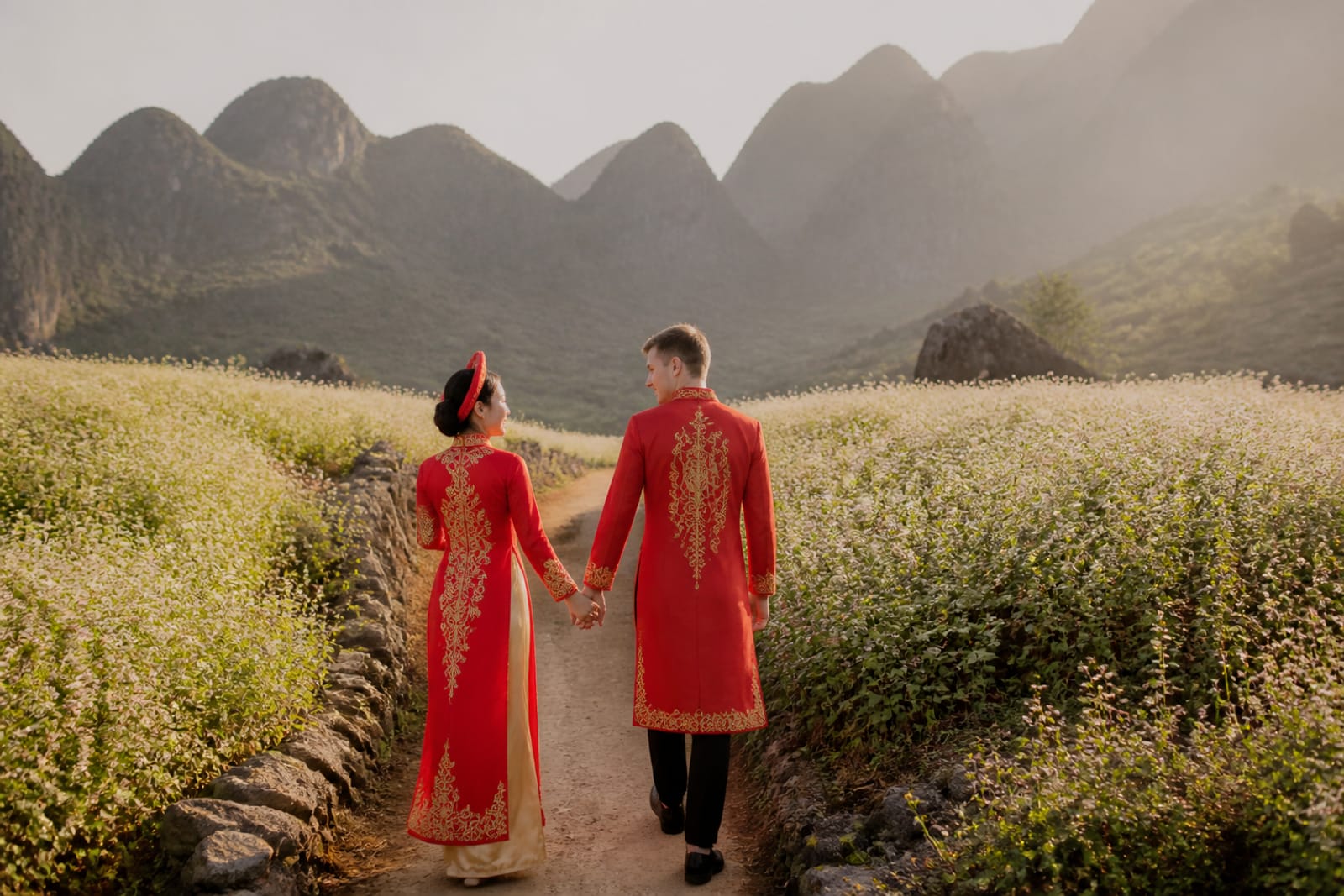
Golden hour in Ha Giang mountains lasts longer than lowland cities because terrain creates soft side light and reflective shadow fill until 7:30 am and again from 4 pm onward. Start at 5:50 am; mist still clings to valleys and softens backgrounds. By 6:45 am, direct light hits rice terraces from the east, creating texture without harshness. Midday (11 am–3 pm) flattens all detail—avoid this window entirely. Afternoon shoots (4:30–6:30 pm) face west; clouds often build, but if clear, you get warm, directional light and long shadows. Sunset occurs around 5:45 pm in October; plan to finish by 6:15 pm as light dies fast and roads are hazardous at dusk.
Conclusion: 5:50–8 am and 4:30–6:15 pm are the only windows; midday is unusable.
Should you schedule a one-day or multi-day pre-wedding shoot?
Shoot format | Best for | Light coverage | Road & crowd factors ---|---|---|--- One-day morning session (5–7 hours) | Couple on tight schedule; central Hanoi base | Single golden hour + one location | Fast; fewer outfit changes; limited story arc; misses afternoon light entirely Two-day trip (split morning and evening) | Full narrative; multiple terraces + village scenes | Two golden hours + midday scout options | Requires overnight stay; more outfit and makeup; afternoon weather risk; 6–8 hour drive each way (landslide or closure possible) Three-day immersion | Couple seeking depth; road trip mood; ao dai + casual wear | All light angles; sunrise mist, noon village life, sunset reflection | Professional guide essential; high cost and fatigue; worth it for albums and films that feel cinematic
One-day shoots work if you choose one terraced valley near the main towns (Yen Minh, Meo Vac) to save drive time. Two-day trips are standard for Ha Giang pre-weddings: shoot Hoang Su Phi terraces morning-of, drive back via different pass for evening frames, explore the second day before departure. Three-day trips require fitness and a experienced mountain driver; they yield the most editorial depth but are rarely booked by international couples on a single vacation.
Conclusion: Two days is the practical middle ground—one morning, one evening, zero wasted midday hours.
What should you wear, and what will makeup endure?
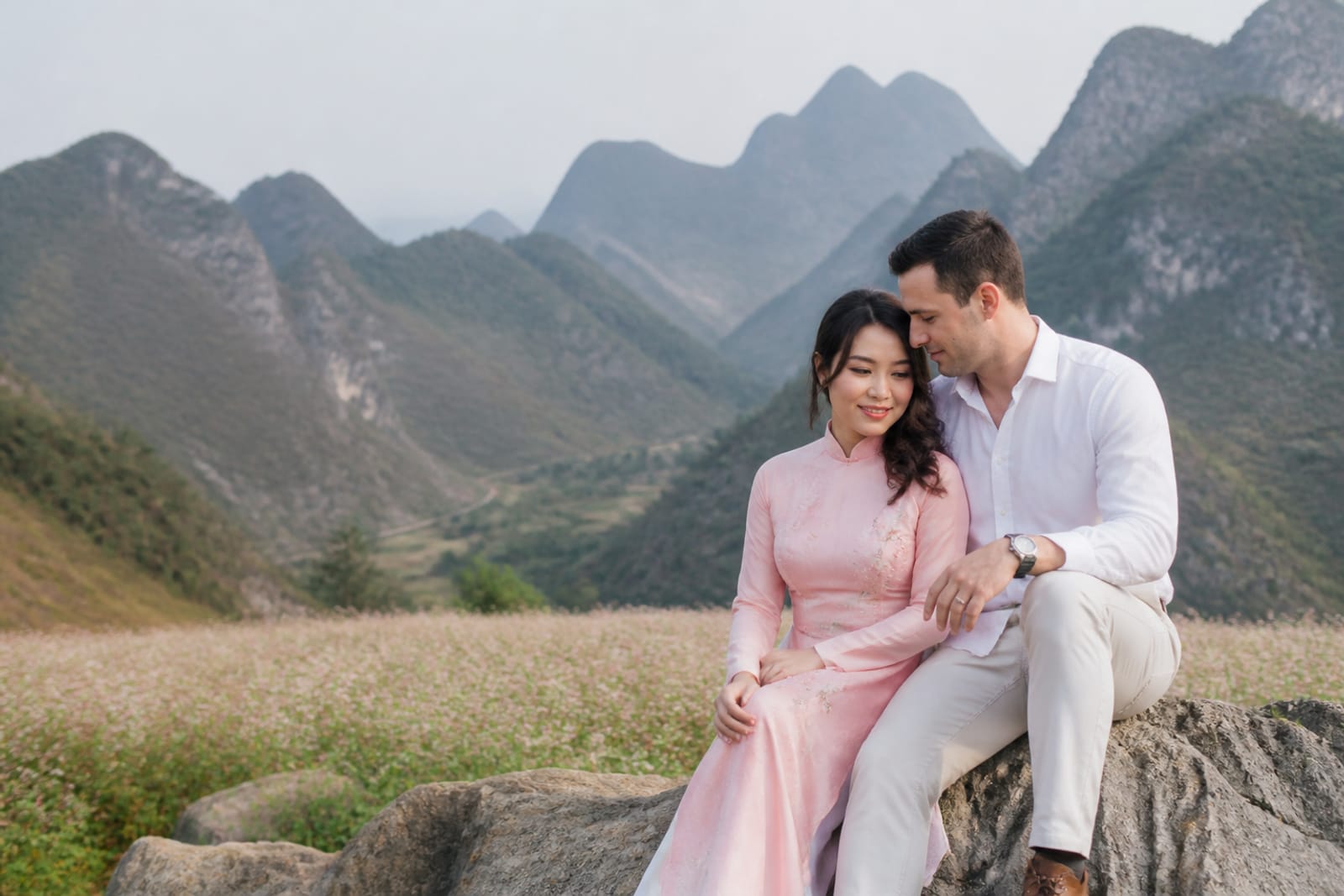
Ao dai in October: choose silk or linen-cotton blend (avoid heavy satin—you'll overheat on walks uphill). Layer underneath with a fitted underdress to move freely; loose fabric catches wind and terracing steps. Cream, ivory, or pale champagne colors photograph best at sunrise (contrast with shadow); jewel tones (emerald, deep blue) hold detail better in afternoon light. Bring a backup casual outfit (linen shirt, dark trousers or skirt) for afternoon village scenes—formal wear reads stiff on narrow footpaths.
Makeup: airbrush or HD foundation withstands 6–8 hours, humidity swings, and sweat from walking. Matte lips hold longer than glossy. Avoid heavy winged eyeliner (mist and sweat dissolve it); opt for waterproof brow powder and mascara. Makeup artist must come to location—no touch-ups at a studio 2+ hours away. Most international couples hire both outfit (ao dai rental) and makeup as a package with their photographer; verify if your photographer coordinates this or if you source independently.
Conclusion: Lightweight natural fiber, neutral or jewel tones, and waterproof makeup are non-negotiable on mountain terrain.
How do you hire and vet a local Ha Giang photographer?
Cáo Studio does not operate in Ha Giang; you'll need a local team. Look for photographers with 5+ years of experience in Ha Giang (not just Hanoi day-trips). Ask for:
- Road knowledge: Can they name the three best terraced valleys and their ideal shooting months? Do they know which passes close in rain?
- Permit awareness: Certain scenic overlooks (near the border with China) require permits or local guide approval. A good photographer knows the rules and avoids hidden fines.
- Sample galleries: Request 10+ full sessions (not just Instagrams highlights). Look at consistency: do all frames look overly filtered or edited? Are backgrounds cluttered or clean?
- Weather contingency: Ask their cancellation policy if rain closes roads. Do they offer a reshoot, or a partial refund?
- Gear and backup: Do they shoot with two camera bodies? What if one fails in remote terrain?
Interview 2–3 photographers. Request a half-day trial (morning session only) to assess communication and rhythm before committing to a two-day shoot. Payment: 50% deposit upon booking, 50% on delivery (within 7 days, ask for timeline in writing).
Conclusion: A Ha Giang specialist costs more but saves days of wasted light and road closures.
---
What to check before you book
- Weather forecast window: Ask your photographer to send a 10-day forecast 10 days before. If rain > 30% chance, discuss rescheduling or moving locations lower in elevation.
- Road status: Mountain passes are closed unpredictably. Confirm with your photographer 48 hours before departure; allow flexibility.
- Outfit fit and comfort: Walk test your ao dai on stairs or uneven ground before the shoot day. Tight underdresses limit mobility uphill.
- Makeup timing: Schedule makeup at your hotel 2 hours before departure (not at a studio). Transport makeup artist with you.
- Backup outfits and footwear: Bring comfortable walking shoes for scout hours. A wet-weather backup outfit (darker, faster-drying fabric) is essential.
- Crew fitness: Be honest about hiking ability. 6–8 hours on mountain terrain is tiring; your photographer should suggest realistic location counts and rest breaks.
- Delivery timeline: Confirm when you'll receive edited photos and film. Most local photographers deliver within 7–14 days; international couriers may delay further.
---
Moving beyond Ha Giang: your next photoshoot
If Ha Giang is part of a longer Vietnam trip, consider adding a pre-wedding session in Hanoi or Hoi An to your timeline. Hanoi couples often pair a mountain shoot with urban frames—temples, lakes, street scenes—for editorial variety. Hoi An offers controlled lighting (ancient town, lantern streets, river) with zero road risk. If you're planning makeup and hair for multiple locations, coordinate with a central team—Cáo Studio in Hanoi can manage beauty for city-based sessions, or you hire independently for mountain work.
Check the pre-wedding & elopement guide for timing, outfit, and narrative structure advice that applies to any Vietnam location. The lookbook shows how couples layer formal and candid frames across multi-day shoots.
---
FAQ
Can I shoot my pre-wedding in Ha Giang if I'm visiting for only one day?
One day is tight—you'll spend 6–8 hours in transit on winding mountain roads. A single morning session is possible if you base in Yen Minh town (closer to lower-elevation terraces), but you lose afternoon light entirely. Most couples extend to 2 days minimum. Confirm road conditions 48 hours before; a closed pass makes the trip impossible.
Should I rent an ao dai in Hanoi or bring my own to Ha Giang?
Rent in Hanoi if you prefer fitted tailoring and backup options (Cáo Studio can recommend rental partners). Bring your own only if it's lightweight linen-cotton and already tested for hill walking. Mountain humidity and sweat degrade delicate fabrics; a rented dress can be returned regardless of condition, reducing stress during the shoot.
What happens if it rains on my pre-wedding shoot day?
Rain in October is rare but possible. Discuss contingencies with your photographer: do they offer a reshoot date at no extra cost, or a partial refund? Afternoon clouds are common; your photographer should pivot to lower valleys or village scenes where overcast light works well. Avoid open terraces in active rain—risk of slips and camera damage.
Do I need a local guide in addition to my photographer?
Not mandatory, but a guide helps if you want cultural context (village histories, terracing techniques) or access to restricted viewing points near the border. Guides cost extra and are arranged separately from the photographer. Most pre-wedding couples skip guides and focus on light and framing alone.
How many outfits should I plan for a two-day Ha Giang pre-wedding?
Typically two: an ao dai for morning Day 1 (terraces in golden light) and a casual outfit (linen shirt, neutral trousers) for afternoon and Day 2 village walks. A third outfit (formal or ao dai in contrasting color) extends the narrative but increases fatigue and makeup touch-up demand. Stick to two for logistics and impact.
FAQ
Can I shoot my pre-wedding in Ha Giang if I'm visiting for only one day?
One day is tight—you'll spend 6–8 hours in transit on winding mountain roads. A single morning session is possible if you base in Yen Minh town (closer to lower-elevation terraces), but you lose afternoon light entirely. Most couples extend to 2 days minimum. Confirm road conditions 48 hours before; a closed pass makes the trip impossible.
Should I rent an ao dai in Hanoi or bring my own to Ha Giang?
Rent in Hanoi if you prefer fitted tailoring and backup options (Cáo Studio can recommend rental partners). Bring your own only if it's lightweight linen-cotton and already tested for hill walking. Mountain humidity and sweat degrade delicate fabrics; a rented dress can be returned regardless of condition, reducing stress during the shoot.
What happens if it rains on my pre-wedding shoot day?
Rain in October is rare but possible. Discuss contingencies with your photographer: do they offer a reshoot date at no extra cost, or a partial refund? Afternoon clouds are common; your photographer should pivot to lower valleys or village scenes where overcast light works well. Avoid open terraces in active rain—risk of slips and camera damage.
Do I need a local guide in addition to my photographer?
Not mandatory, but a guide helps if you want cultural context (village histories, terracing techniques) or access to restricted viewing points near the border. Guides cost extra and are arranged separately from the photographer. Most pre-wedding couples skip guides and focus on light and framing alone.
How many outfits should I plan for a two-day Ha Giang pre-wedding?
Typically two: an ao dai for morning Day 1 (terraces in golden light) and a casual outfit (linen shirt, neutral trousers) for afternoon and Day 2 village walks. A third outfit (formal or ao dai in contrasting color) extends the narrative but increases fatigue and makeup touch-up demand. Stick to two for logistics and impact.
Ao dai, makeup, hair and a local photographer in Hanoi or Saigon — one WhatsApp message.