/pre-wedding-photoshoot
Pre-wedding photoshoot in hot-season Mai Chau and Pu Luong
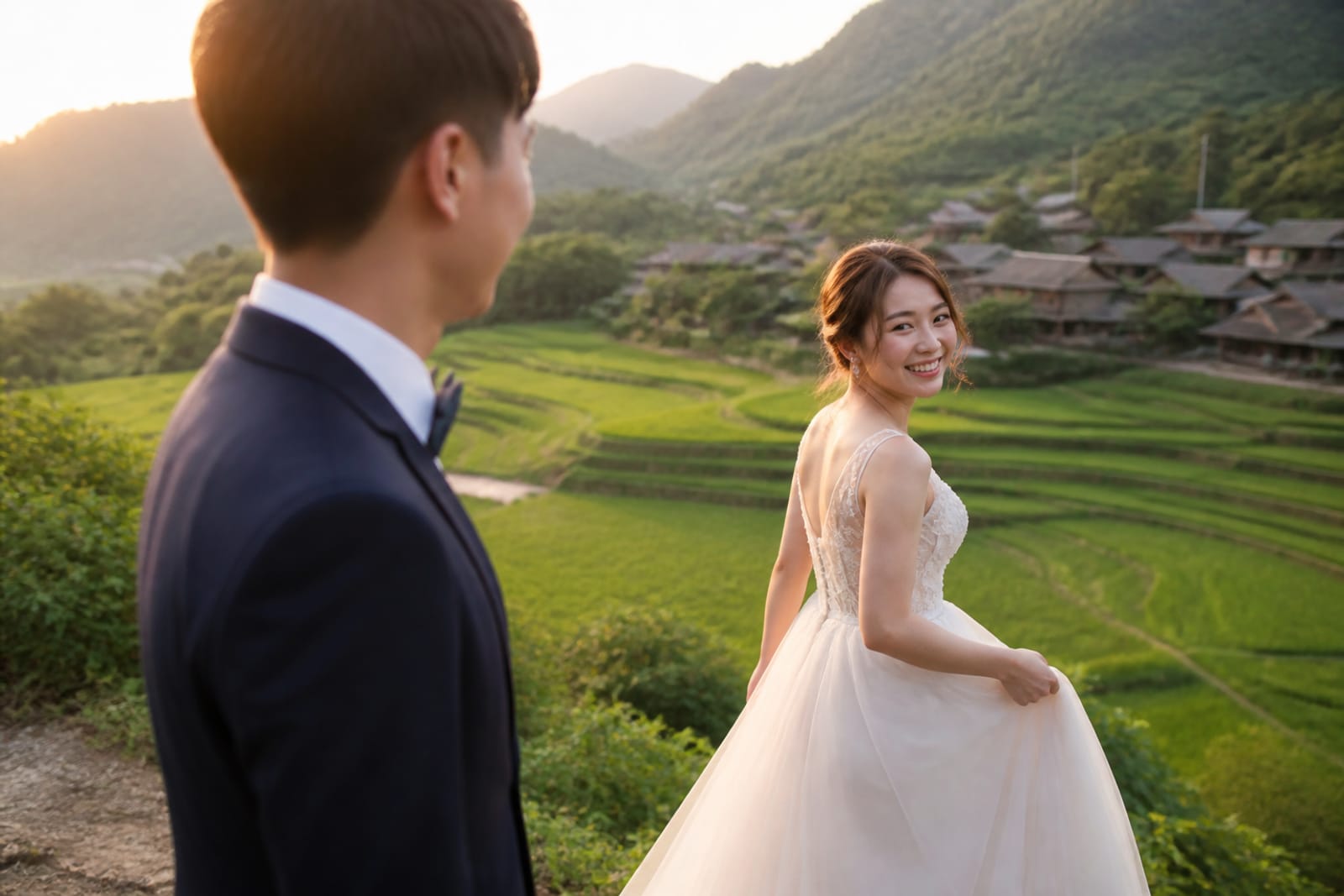
Pre-wedding shoots in Mai Chau and Pu Luong during May–October (hot season) demand early morning or late afternoon light to avoid harsh midday sun and manage heat on camera. Rice paddies golden in late May–June and again September–October—your main visual asset. Plan a 3–4 hour session starting before 6 am or after 4 pm; bring a makeup artist experienced in sweat control, lightweight fabrics for outfit changes, and a photographer skilled in real-light direction (not posed setups). Humidity peaks 70–90% and afternoon thunderstorms are common, so have a weather backup plan. If you're based outside Hanoi or Saigon, hire a vetted local photographer who has shot in these valleys; Cáo Studio offers pre-wedding shoots in Hanoi and Saigon and can advise on local team vetting via WhatsApp.
Why are early morning and late afternoon the only realistic windows in Mai Chau and Pu Luong during hot season?
Between May and October, the sun climbs high and harsh by 8 am. Direct overhead light flattens faces, casts dark eye shadows, and bakes exposed skin—making makeup melt and sweat visible in frames within 20 minutes. Early morning (5:30–7 am) and late afternoon (4:30–6 pm) offer soft, directional light that sculpts cheekbones and doesn't fight your skin tone.
Starting before dawn means cooler air (still 20–24°C), lower humidity, and paddies often misty—a natural softbox. By 6:30 am, side light rakes across the landscape without glare. Late afternoon works similarly but adds golden tones; downside is afternoon storms can roll in by 5 pm, especially September–November. Most local photographers and couples pick early morning to avoid weather risk and heat buildup. This timing choice alone determines whether you look refreshed or exhausted in your final frames.
📸 Book on WhatsApp — pre-wedding photoshoot
How does humidity affect makeup and skin in Mai Chau and Pu Luong?
Humidity in these valleys sits at 70–90% May–October, with afternoon peaks near saturation. Sweat begins within 10 minutes of walking. Standard makeup (powder, matte finishes, heavy foundations) separates and slides; primer alone won't hold. Oil skin appears shinier under side light, and dark circles become more pronounced as heat triggers blood vessel dilation. Professional makeup for this region requires waterproof products, hydrating (not matte) primers, and frequent touch-ups every 20–30 minutes during a session.
A makeup artist experienced in tropical humidity knows to use long-wearing base, cream blush (which blends with sweat better than powder), and setting spray formulated for moisture (not silicone-heavy, which traps heat). Concealer under the eyes should be applied last so it doesn't crease as your face warms. Lip color matters: matte lipstick dries and cracks in heat; tinted lip balms hold better. If you're hiring a local makeup artist, confirm they've worked in paddy shoots during hot season and ask to see a portfolio from May–September; this is non-negotiable for staying camera-ready for 3+ hours. Cáo Studio's makeup and hair service at your hotel is Hanoi and Saigon–based, but the principles (waterproof, hydrating, frequent touch-ups) apply wherever you book.
What outfit strategy keeps you comfortable and photogenic in heat and humidity?
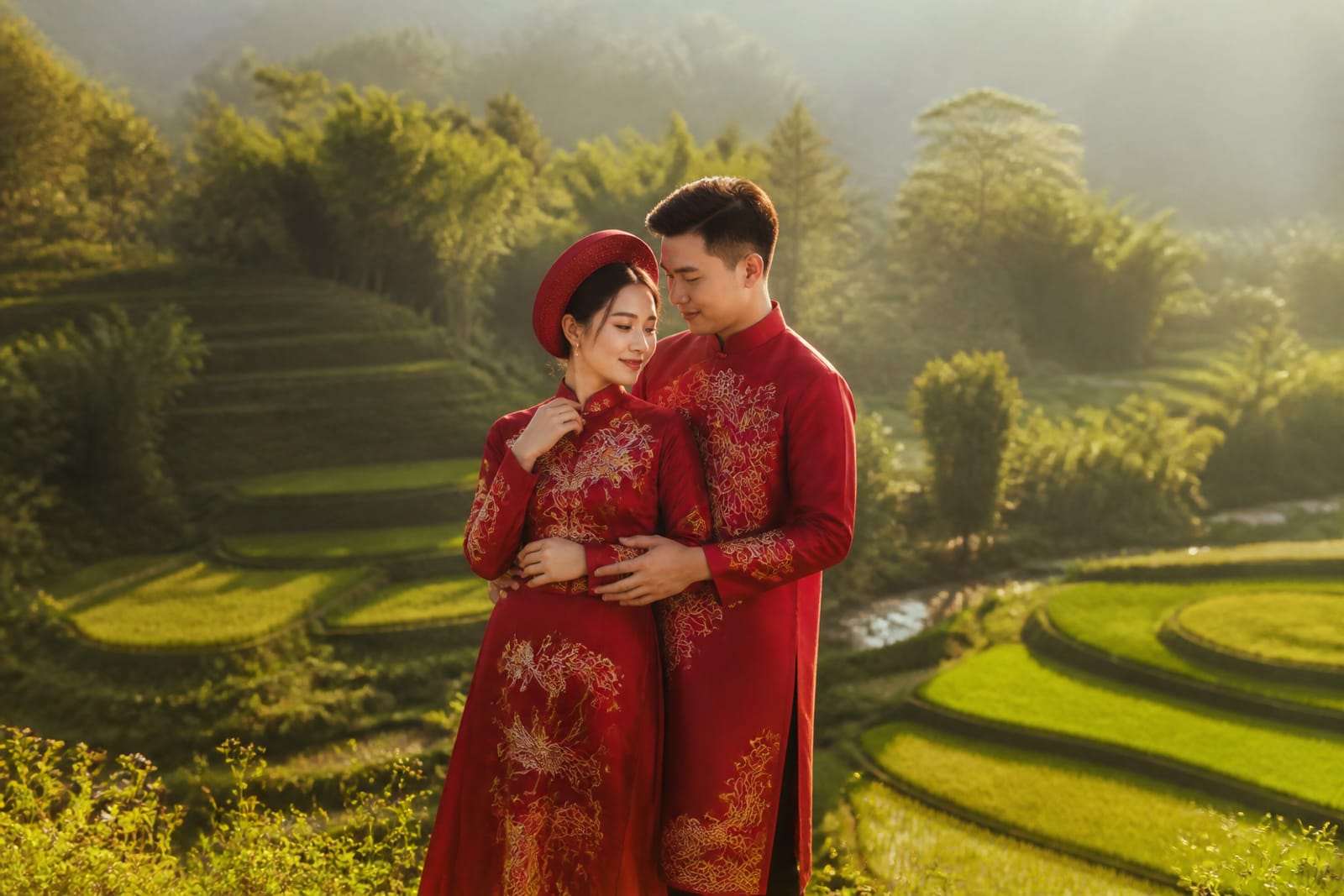
Outfit choices dictate whether you feel trapped or free on camera. Heavy silk ao dai (traditional Vietnamese dress) absorbs sweat, wrinkles visibly, and clings when wet—bad for movement and close-ups. Lightweight ao dai (cotton or linen blends) breathe better and drape cleanly even when damp. If you're wearing Western wedding attire, linen or cotton blends over synthetic fabrics; long sleeves in lightweight cotton stay cooler than bare arms because they block direct sun.
A practical strategy: shoot first outfit (ao dai or traditional dress) during the coolest, earliest light (5:30–6:30 am), when humidity is lowest and clothes are unwrinkled. Change into a second outfit (lighter fabric, fewer layers) by 6:45 am if the schedule allows. Avoid heavy beading, long trains, or tight corsetry—these trap heat and limit walking naturally through light. Bring a cotton robe or loose shirt to wear between setups; your photographer should work in movement (walking, looking at each other, pausing in good light) rather than static poses, which multiply sweat visibility.
For pre-wedding couples, the outfit sequence matters: many local photographers shoot outfit 1 in the paddies (early, cool, golden light), then pivot to a secondary location (village path, water buffalo crossing) in outfit 2 as light softens (6:30–7 am). This pacing keeps energy and freshness visible frame-to-frame.
| Outfit type | Best light window | Heat/sweat factor | Movement-friendly | Why it works |
|---|---|---|---|---|
| Lightweight ao dai (cotton/linen) | 5:30–6:30 am | Low sweat show | Yes | Breathes, doesn't cling, wrinkles less visible |
| Heavy silk ao dai | 5:30–6:00 am (shortest window) | High sweat/wrinkles | Limited | Tradition, but absorbs moisture fast |
| Linen Western wedding dress | 6:00–7:00 am | Low sweat show | Yes | Breathes, natural movement, washes light |
| Cotton suit (groom) | 5:30–7:00 am | Moderate | Yes | Allows arm movement, cools better than wool |
How do afternoon storms affect pre-wedding shoots, and what's a backup plan?
Mai Chau and Pu Luong see afternoon thunderstorms (May–October) almost daily around 2–5 pm. A morning session (5:30–7:30 am) finishes before weather shifts. An afternoon session (4:30–6:30 pm) carries 40–60% risk of rain, especially September–November. Rain itself isn't always bad—wet paddies, clouds, and soft grey light can be cinematic if your photographer knows how to expose and move quickly. The risk is lightning (unsafe for outdoor work) and wind (ruins makeup and outfit continuity).
Before booking, ask your local photographer: Do you have a dry-location backup? (A covered market, village hall, indoor temple, or homestay common area.) Have you shot in rain, and do you know how to edit wet skin and clothes? Professional teams working this region year-round have contingency routes and know which locations don't flood. Many couples plan a dual-session: 2–3 hours outdoors in early morning, then 1 hour in a covered or indoor secondary spot (hired room with natural window light, or a temple interior) so the full pre-wedding narrative has both landscape and intimate frames.
How do you find and vet a local photographer for Mai Chau or Pu Luong?
Cáo Studio operates in Hanoi and Saigon; pre-wedding shoots in Mai Chau (2 hours from Hanoi) and Pu Luong (3 hours from Hanoi) are typically booked with local photographers based in those valleys or in nearby towns (Hoa Binh for Mai Chau, Thai Nguyen or Thanh Hoa for Pu Luong). Here's a vetting checklist:
- Portfolio proof: Ask for 5–10 frames from May–October shoots (not cherry-picked). Look for: sharp focus in early morning light, realistic skin tones (not over-brightened), visible movement and genuine moments (not stiff poses), and makeup/outfit freshness across the timeline. If they show only December–February shots, they may not understand heat humidity challenges.
- Experience claim: Ask—How many paddy shoots have you done in May–October? and What's your weather contingency? A local photographer with 20+ hot-season sessions has systems (backup locations, rapid-setup gear, sweat-control knowledge). Someone with 2–3 is learning.
- Team structure: Who does makeup? Is makeup included, or do you hire separately? A one-person photographer + external makeup artist means slower transitions and less coordinated timing. A team (photographer + makeup artist) that've worked together moves faster and adapts better when heat requires touch-ups.
- Editing timeline: Ask when you'll receive edited photos. "48 hours" is industry-standard; "2–3 weeks" suggests lower volume or less efficient workflow. For a pre-wedding, fast turnaround matters if you're planning a wedding-day video or a printed preview.
- Equipment resilience: Do they have backup cameras, lenses, and batteries? Mai Chau and Pu Luong are remote—a broken lens at 6 am means no backup shop nearby. Professional teams carry redundancy.
- Reference: Ask for a couple's contact (anyone who shot pre-wedding there in the past year) and message them: Did the team stay on schedule? Was makeup fresh in the final frames? How was communication?
If you're based internationally or uncomfortable vetting alone, contact Cáo Studio on WhatsApp—we can advise on local team red flags and provide a remote direction brief (lighting goals, movement cues, outfit pacing) for a photographer you hire locally. This costs less than flying a Hanoi team to a remote location and bridges the gap.
---
What should you check before booking a pre-wedding shoot in Mai Chau or Pu Luong?
Photographer experience: 5+ paddy shoots May–October, portfolio proof, team structure (makeup included or separate?), weather backup plan written down.
Outfit readiness: Fabrics tested in humidity (bring samples to try on indoors with a humidifier running, if possible). Lightweight ao dai or linen Western dress. Backup outfit plan if primary gets damp.
Makeup plan: Artist confirms waterproof products, hydrating primers, frequent touch-ups (every 20–30 min). Ask for sweat-control references.
Weather contingency: Backup indoor location identified before the shoot date. Photographer has shot there in similar light. Rain reschedule terms in writing.
Timing lock: Confirm start time (pre-dawn or late afternoon), session length (usually 3–4 hours), and light windows for each outfit. Written schedule reduces stress and confusion on the day.
Edited delivery: Timeline (e.g., 48 hours, 1 week), number of edited final frames, format (digital files, prints, or both).
Post-production: Will the photographer edit for skin texture (softening sweat shine without losing detail)? Ask to see before/after samples from a hot-season shoot.
---
FAQ
Can I shoot pre-wedding in Mai Chau or Pu Luong with Cáo Studio?
Cáo Studio operates in Hanoi and Saigon. For Mai Chau or Pu Luong, we advise on vetting local photographers via WhatsApp. We can brief a local team on our directing style (real light, movement, one-message framing) to ensure alignment with your vision.
What's the best month to shoot in Mai Chau or Pu Luong for pre-wedding?
Late May–June and September–October offer golden rice paddies and slightly cooler mornings than July–August. All months in this season require early morning (before 7 am) to manage heat. December–February is cooler but paddies are dry and brown—a different aesthetic.
How long does a pre-wedding session typically run in these locations?
3–4 hours total, usually starting 5:30 am and ending by 8:30–9 am. This covers one outfit in paddies, a location change, and a secondary outfit in softer light. Afternoon sessions (4:30–6:30 pm) carry storm risk but are possible if weather is clear.
Do I need two outfits, or can I shoot one pre-wedding outfit for the whole session?
One outfit is fine and is often the stronger creative choice. Two outfits let you show variety (ao dai in paddies, Western dress in a temple or village) but increase sweat management complexity. Discuss outfit strategy with your photographer before the shoot.
What happens if it rains on the scheduled pre-wedding shoot day?
A professional photographer has a dry backup location (covered market, temple interior, homestay room with window light). Confirm this plan in writing before booking. Rain itself can be cinematic if your photographer knows how to expose and move safely—but lightning stops outdoor work.
Should I hire a makeup artist from Hanoi or find one locally in Mai Chau?
Local artists reduce logistics (no travel fees) but may lack pre-wedding / hot-season experience. Ask any local candidate for a hot-season paddy portfolio. If unavailable, consider hiring a Hanoi-based makeup artist to travel (cost factor: fuel, accommodation, time). Vet them the same way.
FAQ
Can I shoot pre-wedding in Mai Chau or Pu Luong with Cáo Studio?
Cáo Studio operates in Hanoi and Saigon. For Mai Chau or Pu Luong, we advise on vetting local photographers via WhatsApp. We can brief a local team on our directing style (real light, movement, one-message framing) to ensure alignment with your vision.
What's the best month to shoot in Mai Chau or Pu Luong for pre-wedding?
Late May–June and September–October offer golden rice paddies and slightly cooler mornings than July–August. All months in this season require early morning (before 7 am) to manage heat. December–February is cooler but paddies are dry and brown—a different aesthetic.
How long does a pre-wedding session typically run in these locations?
3–4 hours total, usually starting 5:30 am and ending by 8:30–9 am. This covers one outfit in paddies, a location change, and a secondary outfit in softer light. Afternoon sessions (4:30–6:30 pm) carry storm risk but are possible if weather is clear.
Do I need two outfits, or can I shoot one pre-wedding outfit for the whole session?
One outfit is fine and is often the stronger creative choice. Two outfits let you show variety (ao dai in paddies, Western dress in a temple or village) but increase sweat management complexity. Discuss outfit strategy with your photographer before the shoot.
What happens if it rains on the scheduled pre-wedding shoot day?
A professional photographer has a dry backup location (covered market, temple interior, homestay room with window light). Confirm this plan in writing before booking. Rain itself can be cinematic if your photographer knows how to expose and move safely—but lightning stops outdoor work.
Should I hire a makeup artist from Hanoi or find one locally in Mai Chau?
Local artists reduce logistics (no travel fees) but may lack pre-wedding / hot-season experience. Ask any local candidate for a hot-season paddy portfolio. If unavailable, consider hiring a Hanoi-based makeup artist to travel (cost factor: fuel, accommodation, time). Vet them the same way.
Ao dai, makeup, hair and a local photographer in Hanoi or Saigon — one WhatsApp message.