/pre-wedding-photoshoot
Pre-wedding photoshoot in Mu Cang Chai: January light, crowds and plan
Pre-wedding shoots in Mu Cang Chai in January mean cool, clear light (ideal for skin tones and fabric drape) and sparse crowds at the terraces—but the trade-off is steep. The destination sits 150 km northwest of Hanoi; a full team (photographer, makeup artist, stylist) needs a 5-hour mountain drive each way, which limits flexibility and adds fatigue. January weather hovers 10–15°C on the terraces (higher altitude) and requires thermal layers under your wedding dress. The golden window for light lasts 6:30–8 am and 4:30–5:30 pm, so a full shoot requires an overnight stay. Cáo Studio operates in Hanoi, Ho Chi Minh City, and Hoi An; for Mu Cang Chai, ask on WhatsApp about custom expeditions and whether your chosen date works for the team's mountain schedule. 📸 Book on WhatsApp — pre-wedding photoshoot ---
Is Mu Cang Chai worth the 10-hour round trip in January?
Mu Cang Chai's stacked terraces create a cinematic depth that flat rice paddies cannot match. January is the driest month in northern Vietnam, with stable light and minimal rain—the opposite of May–June when water fills the terraces but clouds hide the sun. The trade-off: the terraces are fallow (brown earth and stubble) rather than flooded or golden. A couple committed to one location and willing to arrive the evening before can shoot two golden hours the next morning, rest at midday, and capture the late-afternoon light. If you need flexibility, multiple locations in one day, or a same-day turnaround, Mu Cang Chai becomes logistically punishing and may waste your budget on travel time rather than frames.
When to choose Mu Cang Chai: you've built a 2–3 day trip around one powerful visual (the valley itself); you value isolation over variety.
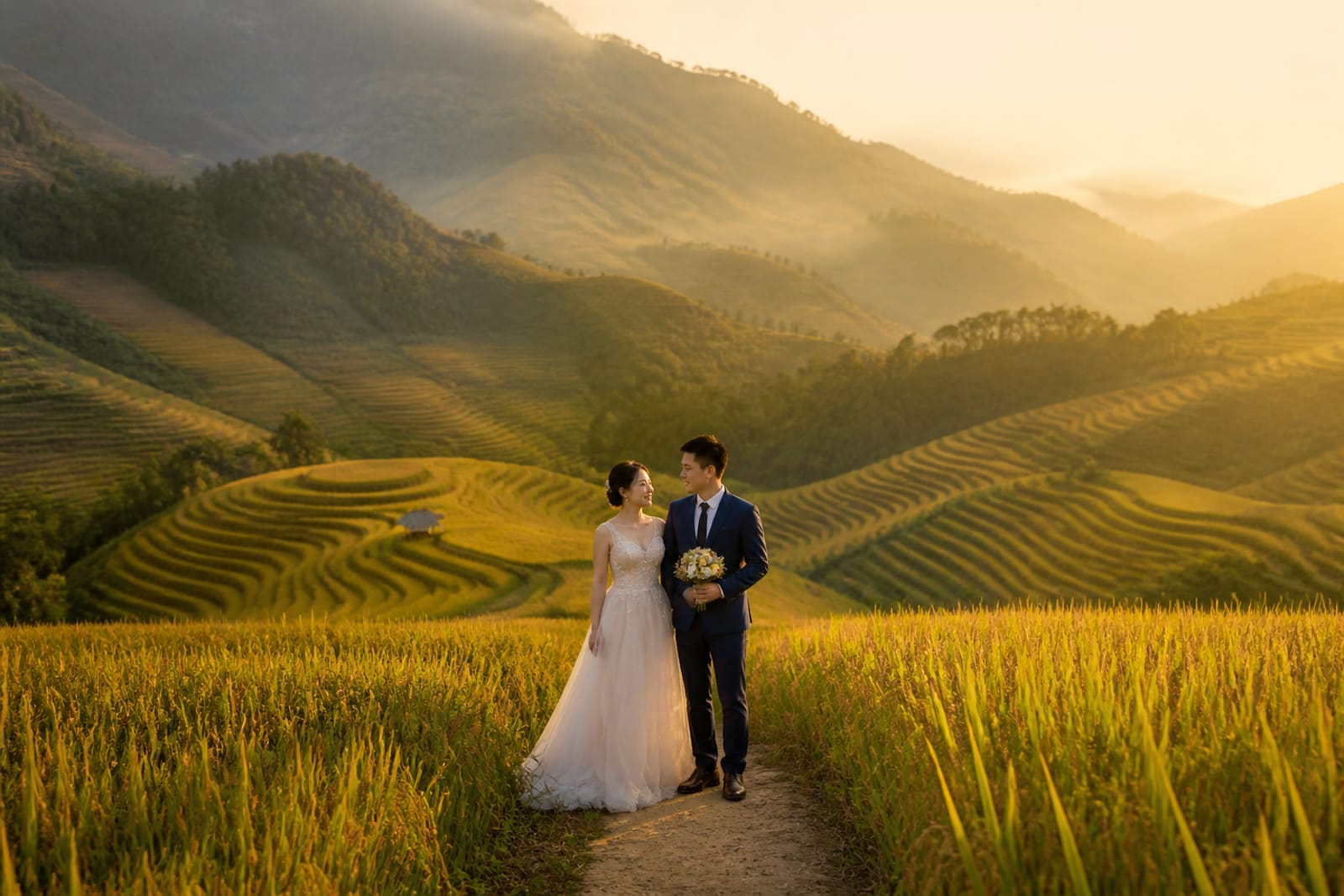
What does January light actually look like in the mountains?
January's light in Mu Cang Chai is direct, cool-toned, and low on the horizon—soft golden hour lasts longer than at sea level because the sun dips behind peaks earlier. At 6:30 am, sidelighting skims the terrace walls, deepening texture; by 7:30 am, the sun has climbed enough to frontlight faces without harsh shadows. Clouds form mid-morning (the valley's microclimate tends toward mist between 9 am and 3 pm), and light fragments into patches—unusable for clean shots. By 4:30 pm, the sun angles steeply again, and you have 45 minutes of usable backlight before the valley fills with shadow. Wind is minimal in January, so fabric moves predictably. The risk: if cloud cover hits early, the entire shoot flattens into grey, and no editing recovers contrast. This is why overnight stays are non-negotiable; you cannot rely on a single golden hour.
How cold does it get, and what wedding dress fabrics work?
At 1000 m elevation, January temperatures drop to 8–12°C at dawn and climb to 15–18°C by midday—below the threshold where most couples feel comfortable. Silk and thin chiffon drape beautifully but offer no insulation; cotton and linen hold warmth slightly better. Layering is essential: a thermal or silk slip under the dress, a structured shawl or cape that sits on the shoulders without bunching the train, and custom-dyed gloves if the dress has long sleeves. If the dress is strapless, bare arms become a risk—not just for comfort but for photos, where tension in the shoulders reads as discomfort. Many couples at mountain shoots wear oversized cardigans between takes and remove them for frames. Ask a local dressmaker in Hanoi to reinforce the waistband with a hidden elastic if the dress fits loosely; the cold makes you move less, and an ill-fitting dress amplifies fatigue.
| Fabric | Warmth | Drape | January fit | Best for |
|---|---|---|---|---|
| Silk | Low | Excellent | With layers | Backlit frames, movement |
| Chiffon | Very low | Excellent | Risky alone | Detail close-ups only |
| Cotton blend | Medium | Good | Comfortable | All-day shoots |
| Linen | Medium | Moderate | Works well | Informal, daytime looks |
| Satin | Low | Stiff | Needs layers | Formal morning light |
Conclusion: Cotton-silk blends and layerable designs work best for mountain shoots in January; plan extra pieces, not just one dress.
How do crowds and permits affect your shoot timeline?
Mu Cang Chai has no entrance gates or official permits for photography—it's an open valley where locals farm and tourists walk. In January, visitor traffic is low (main season is Sep–Oct for golden terraces and Apr–May for water), so you'll rarely compete with tour groups at 6:30 am. By 8:30 am, a handful of early hikers appear; by 10 am, the valley is quiet again. The risk is bureaucratic, not social: local authorities occasionally ask why a large crew (photographer, makeup artist, stylist, couple, sometimes an assistant) is setting up tripods on farming land. Some villagers object to commercial shoots near their homes. Hiring a local guide (ask in Hanoi) smooths this friction and often yields better locations—spots outsiders miss. Never shoot near active farming or block paths; always ask permission before approaching a home for a background frame.
Practical step: Arrive with a guide who knows the village hierarchy; a 15-minute conversation and small gift (local tea, fruit) often opens doors to private terraces with better framing.
What logistics kill pre-wedding shoots in Mu Cang Chai, and how do you avoid them?
The route from Hanoi to Mu Cang Chai is 85% mountain road—winding, narrow, and slow. A full team (4 people in a car) plus a driver takes 5 hours; weather can add 1–2 hours. Makeup and hair work best in daylight or good mirror-light, so either you arrive the evening before (dinner, overnight, 6 am wake-up for makeup), or you do makeup in a hotel 2 hours before departure and risk touch-ups during travel. Many couples choose the overnight option: leave Hanoi at 3 pm, reach a guesthouse in Mu Cang Chai by 8 pm, sleep, then execute the full shoot 6:30–7:30 am and again 4:30–5:30 pm, sleep another night, and return to Hanoi the next day. This adds two hotel nights and a full day lost to logistics. If you're also shooting in an ao dai, that's a second outfit and a second makeup call—feasible in a 2-day trip but exhausting. Couples who try to "squeeze" a Mu Cang Chai shoot into a Hanoi day trip (leave 6 am, shoot 11 am–3 pm, return by 7 pm) report flat light, rushed makeup, and frames that feel rushed. The mountain doesn't compress into an afternoon.
Checklist to avoid blown timelines:
- Book the guesthouse 60 days ahead (limited rooms in the village; January fills fast).
- Confirm the driver can handle 10 hours round-trip mountain driving—not all Hanoi taxi services do.
- Schedule makeup 90 minutes before the first golden hour (so 5 am makeup for a 6:30 am shoot).
- Pack a hand mirror and lip color; wind and cold evaporate lipstick within an hour.
- Bring a phone charger; no reliable power in many guesthouses above 1000 m.
- Plan outfit changes only if the first dress is dry-clean-able; wet hems and mud are real risks.
---
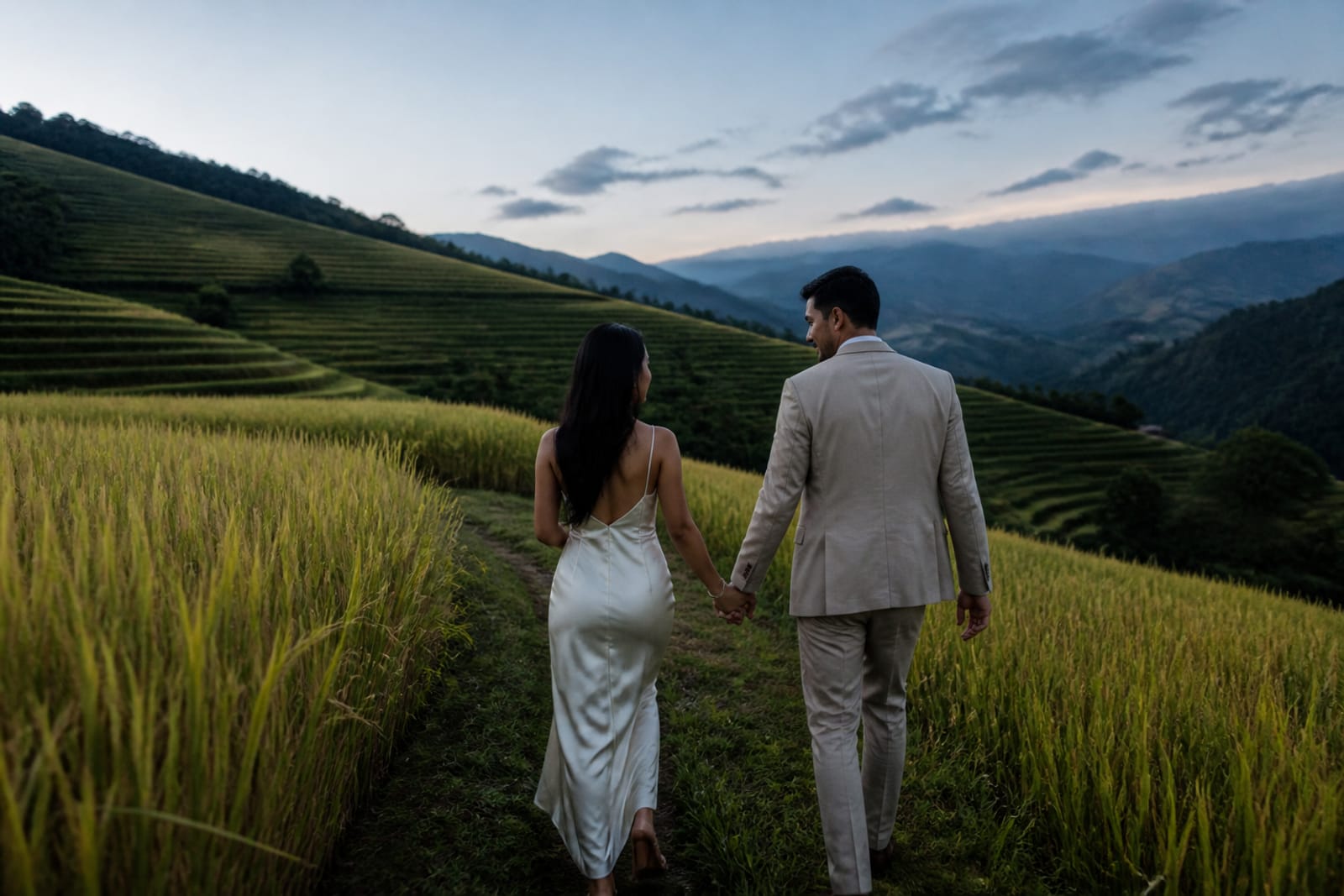
How does a Mu Cang Chai shoot differ from pre-wedding photoshoots in Hanoi or Hoi An?
Hanoi shoots use urban light (alleyways, French colonial architecture, riverside parks) and fit into a single day; Mu Cang Chai demands overnight travel and a 2–3 day commitment. Hoi An shoots work year-round but require managing lantern-lit crowds and ancient-town permits. Mu Cang Chai isolates the couple in landscape, which works if your story is "just us and the valley"; Hanoi and Hoi An embed couples in cultural context, which works if your story includes the place's history. Mu Cang Chai light is predictable but weather-sensitive (clouds ruin a day); urban shoots offer fallback locations if light fails one spot. For couples choosing between destinations, Mu Cang Chai wins on visual singularity; Hanoi and Hoi An win on efficiency and weather resilience.
---
What to check before you plan a Mu Cang Chai pre-wedding shoot
- Arrival dates: Ask Cáo Studio on WhatsApp if the team can accommodate your January dates; mountain expeditions require advance notice, and slots may be limited.
- Guesthouse availability: Book your overnight accommodation 60 days ahead; rural guesthouses fill quickly during the dry season.
- Weather forecasts: Check a 7-day forecast 2 weeks before your shoot; if clouds are forecast for your entire window, postpone or pivot to Hanoi/Hoi An.
- Dress code: Confirm your dress fits over thermal layers and that your stylist has packed a shawl or cape that coordinates.
- Fitness: The shoot involves walking uphill on uneven terrace paths; ensure both partners can manage 2–3 hours of movement per session.
- Guide: Plan to hire a local guide in Mu Cang Chai; costs and availability are confirmed via the WhatsApp conversation with Cáo Studio.
---
Is Mu Cang Chai suitable for an ao dai photoshoot or should I book an urban couple photoshoot?
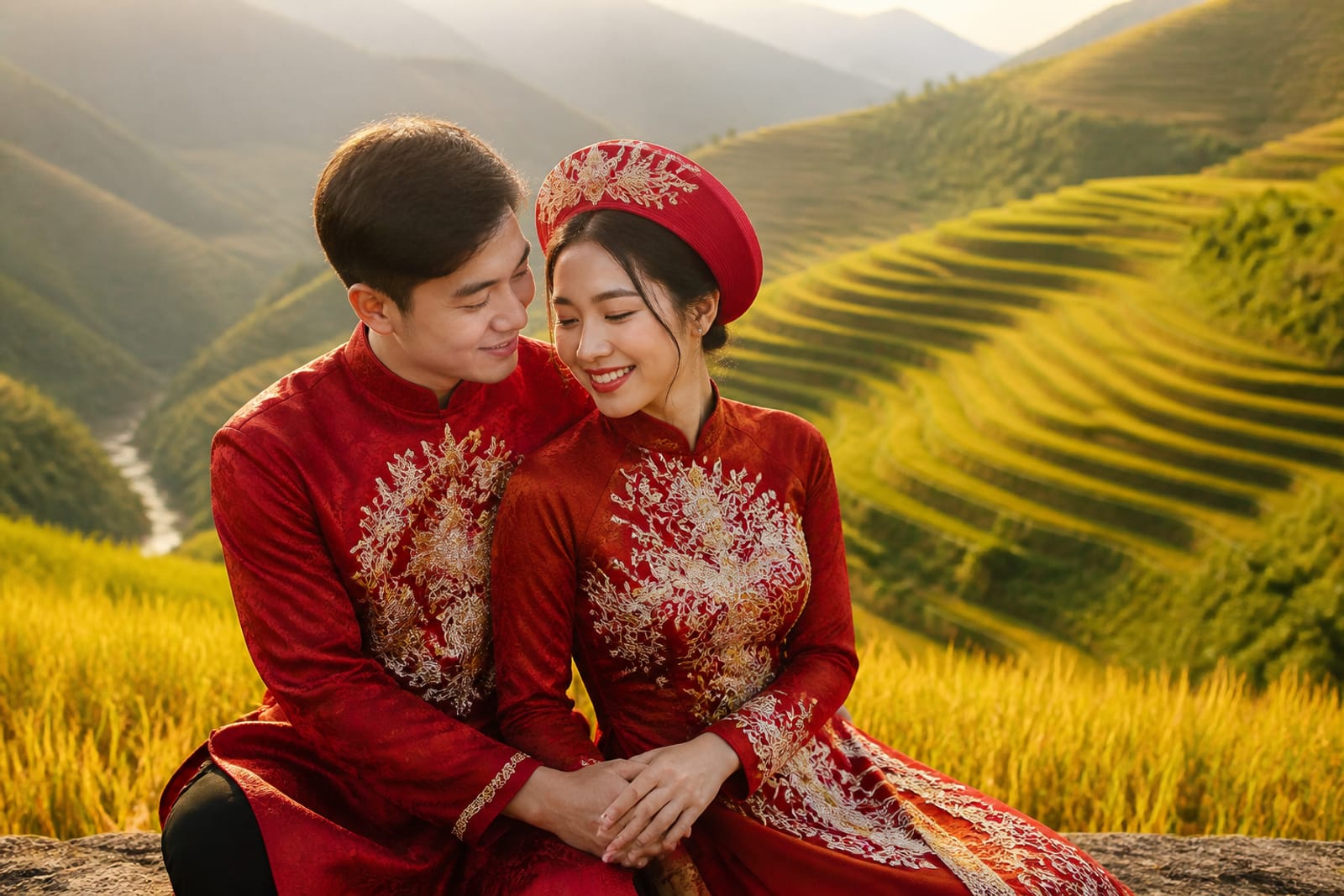
Mu Cang Chai works beautifully for ao dai because the fabric drapes against the valley backdrop with minimal wind interference in January. But ao dai requires a precise stylist and makeup artist; the 5-hour drive risks hair and makeup breakdown. Urban couple photoshoots in Hanoi handle makeup touch-ups and wardrobe changes more easily because the team works blocks of 1–2 hours in one neighborhood, not spread across a day of travel. If you want ao dai and mountain isolation, ask Cáo Studio on WhatsApp about a Hanoi-based ao dai morning shoot, then a separate Mu Cang Chai expedition for a Western wedding dress—two sessions, two visions, no rushed logistics.
For makeup and hair services tailored to a long travel day, discuss with the team during booking.
---
Can I combine Mu Cang Chai with other northern Vietnam locations?
Mu Cang Chai sits 1–2 hours from Moc Chau (limestone plateau, tea plantations) and 3 hours from Sapa (mountain terraces, minority villages). Couples sometimes build a 4–5 day northern Vietnam journey: Hanoi urban shoot, overnight to Mu Cang Chai, then Moc Chau or Sapa as a second day. This compounds logistics (multiple overnight stays, multiple makeup calls, weather risks multiply). Cáo Studio's strength is managing one location deeply—one team, one message, directed light—rather than juggling three valleys and three weather systems. If you're drawn to multiple northern landscapes, ask the studio on WhatsApp about a phased approach: shoot Hanoi in January (when it's clearer), then return in April for Mu Cang Chai when the landscape has greened slightly and the risks of cloud cover lower.
---
What editing and turnaround can you expect from a Mu Cang Chai pre-wedding session?
Cáo Studio delivers edited photos and a short vertical film within 48 hours of the shoot. For a Mu Cang Chai session, the team uploads files remotely (cell signal is inconsistent in the village, so uploads happen once they return to Hanoi). You'll receive a digital gallery and a 1–2 minute film suitable for wedding websites, social sharing, or save-the-date videos. If you need printed keepsakes (a photo album, prints or frames) for your actual wedding day, plan 2–3 weeks for production; that ordering happens after you review the digital gallery.
---
FAQ
Is January actually the best month for a Mu Cang Chai pre-wedding shoot?
January offers clear, stable light and low crowds—ideal for sharp frames and intimate moments. But the brown, fallow terraces lack the drama of May's green or September's gold. Choose January if you value light over landscape aesthetics; pick Sep–Oct or Apr–May if the terrace color matters more than weather certainty.
How much does a Mu Cang Chai expedition cost compared to a Hanoi shoot?
Costs depend on team size, overnight accommodation, and whether a guide is hired. Contact Cáo Studio on WhatsApp for a custom quote; the team discusses what the 10-hour round trip adds to a standard pre-wedding package.
Can I wear a Western wedding dress in January at 1000 m elevation?
Yes, but layer it. Pair the dress with a thermal slip, a structured shawl, and custom gloves if needed. Avoid strapless or sleeveless designs unless you're comfortable in 12°C with bare shoulders. Pack a cardigan for between-shot comfort.
What if clouds ruin my entire shoot window?
Cloud cover in Mu Cang Chai is unpredictable and cannot be edited away. Most couples book a contingency day (arrive two days, shoot only if light is clear on day one, pivot to Hanoi shoot if day one is grey). Ask Cáo Studio about rescheduling options and cancellation policies during the WhatsApp booking conversation.
Should I combine a Western wedding dress shoot with an ao dai shoot in Mu Cang Chai?
Logistically difficult in one day. The 5-hour drive, mountain altitude, and two makeup calls compress an already tight timeline. Consider a pre-wedding Hanoi shoot in Western dress, then a separate ao dai photoshoot at a closer, more controlled urban location—or ask the studio about a 2-day expedition with both outfits.
Do I need a permit to shoot in Mu Cang Chai?
No official government permit, but the valley is farmland. Hire a local guide to navigate permissions with villagers; conflicts arise when crews block paths or shoot near homes without asking. The guide typically costs less than the friction it prevents.
How far in advance should I book a Mu Cang Chai pre-wedding shoot?
Book guesthouse accommodation 60 days ahead (limited rooms). Coordinate with Cáo Studio 30–45 days before your date; the team needs to confirm the date fits their Hanoi, Saigon, or Hoi An schedule. Mountain expeditions require early planning because bad weather may force rescheduling.
FAQ
Is January actually the best month for a Mu Cang Chai pre-wedding shoot?
January offers clear, stable light and low crowds—ideal for sharp frames and intimate moments. But the brown, fallow terraces lack the drama of May's green or September's gold. Choose January if you value light over landscape aesthetics; pick Sep–Oct or Apr–May if the terrace color matters more than weather certainty.
How much does a Mu Cang Chai expedition cost compared to a Hanoi shoot?
Costs depend on team size, overnight accommodation, and whether a guide is hired. Contact Cáo Studio on WhatsApp for a custom quote; the team discusses what the 10-hour round trip adds to a standard [pre-wedding package](/pre-wedding-photoshoot).
Can I wear a Western wedding dress in January at 1000 m elevation?
Yes, but layer it. Pair the dress with a thermal slip, a structured shawl, and custom gloves if needed. Avoid strapless or sleeveless designs unless you're comfortable in 12°C with bare shoulders. Pack a cardigan for between-shot comfort.
What if clouds ruin my entire shoot window?
Cloud cover in Mu Cang Chai is unpredictable and cannot be edited away. Most couples book a contingency day (arrive two days, shoot only if light is clear on day one, pivot to Hanoi shoot if day one is grey). Ask Cáo Studio about rescheduling options and cancellation policies during the WhatsApp booking conversation.
Should I combine a Western wedding dress shoot with an ao dai shoot in Mu Cang Chai?
Logistically difficult in one day. The 5-hour drive, mountain altitude, and two makeup calls compress an already tight timeline. Consider a [pre-wedding Hanoi shoot](/pre-wedding-photoshoot) in Western dress, then a separate [ao dai photoshoot](/ao-dai-photoshoot) at a closer, more controlled urban location—or ask the studio about a 2-day expedition with both outfits.
Do I need a permit to shoot in Mu Cang Chai?
No official government permit, but the valley is farmland. Hire a local guide to navigate permissions with villagers; conflicts arise when crews block paths or shoot near homes without asking. The guide typically costs less than the friction it prevents.
How far in advance should I book a Mu Cang Chai pre-wedding shoot?
Book guesthouse accommodation 60 days ahead (limited rooms). Coordinate with Cáo Studio 30–45 days before your date; the team needs to confirm the date fits their Hanoi, Saigon, or [Hoi An schedule](/hoi-an). Mountain expeditions require early planning because bad weather may force rescheduling.
Ao dai, makeup, hair and a local photographer in Hanoi or Saigon — one WhatsApp message.