/pre-wedding-photoshoot
Pre-wedding photoshoot in Mu Cang Chai: summer heat guide
A pre-wedding photoshoot in Mu Cang Chai during the hot season (May–June terraces water-filled; September–October golden and dry) means shooting in mountain heat at 1,000+ metres elevation. You'll spend 2–4 hours walking terraces in direct sun or early-morning mist—exertion plus humidity equals sweat, flushed skin, and makeup breakdown within the first hour. Cáo Studio's approach here: arrive at dawn (before 7 am) to capture soft side light and cooler air, dress the couple in lightweight ao dai or linen, station a makeup artist on location for real-time touch-ups, and build in shade breaks with water and electrolyte drinks. The terrain is uneven, muddy after rain, and far from Hanoi (3.5–4 hours drive), so heat isn't just comfort—it's a logistics challenge. Choose a team (not separate vendors) that pre-scouts the terrain, understands mountain light shifts, and carries cooling supplies; otherwise, you'll arrive fresh and leave crispy.
Why does heat change how pre-wedding shoots work in Mu Cang Chai?
Mu Cang Chai sits at high elevation in Yen Bai province, north-central Vietnam. In hot season (May–June and September–October), afternoon temperatures climb into the low 30s°C, but elevation and humidity make it feel hotter when you're moving uphill. Sweat isn't just a comfort issue—it breaks down makeup in under an hour, causes skin shine that photographs flat, and forces repeated retakes. A pre-wedding photoshoot here demands a different rhythm than city shoots: dawn timing, frequent breaks, on-location makeup support, and a team that knows the mountain light shifts hour by hour. Standard urban pre-wedding schedules (arrive 10 am, shoot until noon, edit for next week) won't translate; the terrain and climate demand a custom plan built around sun angle and crew stamina.
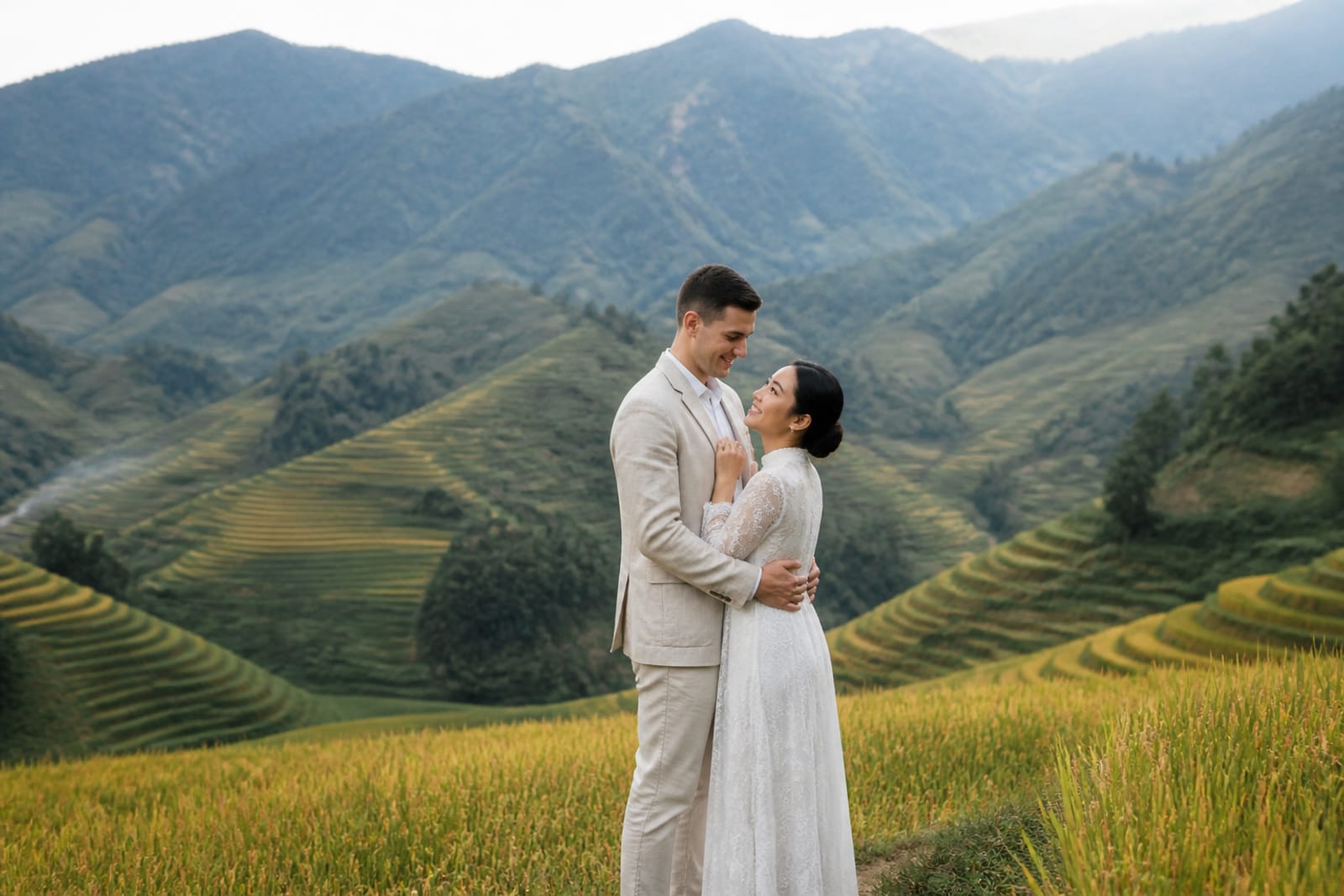
When in the day should you actually shoot Mu Cang Chai in hot season?
The window is tight: 5:30–7:30 am, before direct sun hits the terraces and before foot traffic builds. After 8 am, light turns harsh, terraces flood with other visitors, and you're shooting into sweat and flushed skin. Late afternoon (4–5:30 pm) works if clouds roll in; otherwise, the sun sits behind the western ridge and casts the fields in flat shadow. Many couples assume "golden hour" applies here—it does, but only before sunrise or at dusk, which requires an overnight stay in a nearby village (most shoots base in Mu Cang Chai town, 30 minutes down the valley). Expect to wake at 4:30 am, travel to the best terrace access by 5:15 am, and wrap by 7:30–8 am. Staying fresh means shooting early; shooting after 10 am in May–June is fighting physics.
📸 Book on WhatsApp — ao dai photoshoot
Should you wear an ao dai or lightweight clothes on mountain terrain?
| Outfit choice | Best for | Heat/moisture reality | Terrain fit |
|---|---|---|---|
| Silk ao dai (traditional) | couples wanting formal heritage frames | absorbs sweat, clings after 1 hour, shows every bead | uneven ground catches hems; muddy after rain |
| Linen ao dai (custom lightweight) | heat season + formal look | breathes, dries faster, won't wrinkle as visibly | same hem risk, but lighter to move in |
| Linen pants + fitted shirt | pairs wanting casual sophistication | most forgiving for sweat; easy movement | safest for steep, muddy paths |
| Dress + groom shirt only | minimalist modern aesthetic | dress absorbs less sweat if sleeveless; groom sweats through cotton | dress hems vulnerable; requires careful stepping |
Silk absorbs moisture and clings; by the second outfit change, you've lost 30 minutes to drying and touch-ups. Linen breathes and dries faster, but both fabrics show sweat stains under direct sun in close-ups. A lightweight custom ao dai—commissioned from a tailor in Hanoi before the shoot—costs more upfront but photographs better in heat than tourist-market silk. The real decision: do you want heritage formality (ao dai) or comfort that reads as intentional casualness (linen separates)? Cáo Studio's couples often choose one ao dai (shot at dawn on the best terrace) and change into linen for the second location as heat builds. Ask your photographer what they'll provide and what you need to bring.
How do makeup and hair hold up on a hot-season mountain shoot?
Makeup designed for city humidity will melt and slide downhill within 90 minutes in Mu Cang Chai's heat. Sweat runs from the forehead; foundation separates at the jawline; lip colour fades into the terrain. The solution isn't thicker makeup—it's staging and on-location support. A makeup artist on set (not dropped off at 8 am and gone) reapplies powder, fixes mascara runs, and adjusts lip colour between outfit changes. Hair in an updo or braid stays intact longer than loose; braids also withstand the 3.5-hour drive and uneven terrain without restyling en route. Waterproof mascara and long-wear foundation designed for humidity (not silicone-based formulas that slide) make a visible difference. Many couples don't realize makeup needs refreshing during a shoot, not just before; standard city makeup artists often haven't worked mountain heat and arrive unprepared with small touch-up kits. Cáo Studio brings makeup and hair support to your hotel the morning of, travels to Mu Cang Chai with you, and carries full supplies for mid-shoot refresh. If you're booking a local photographer without an embedded makeup artist, confirm they've worked high-elevation terrain and have heat-tested products on hand.
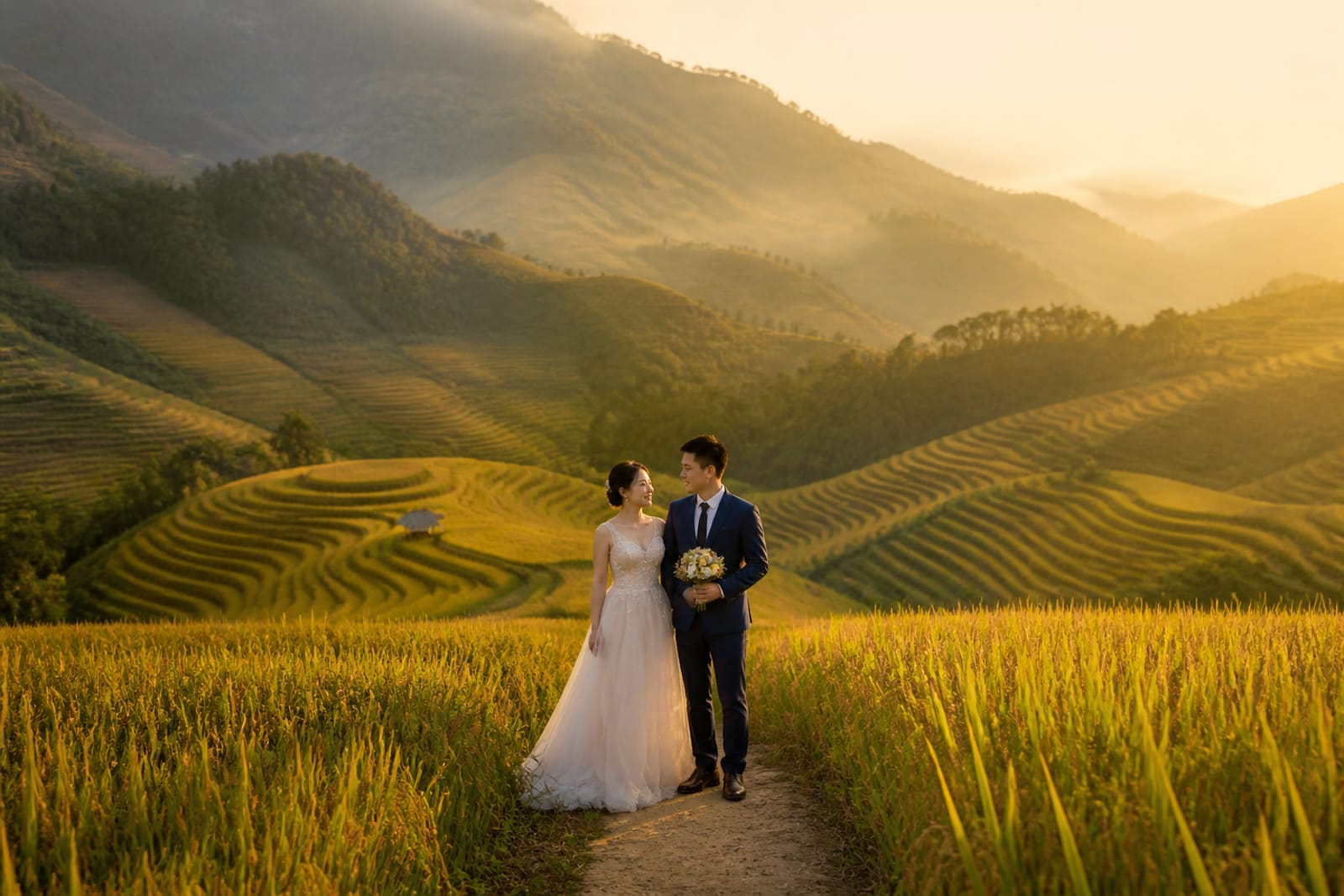
What's the real cost of a Mu Cang Chai shoot versus a Hanoi city shoot?
Travel time inflates logistics: a 3.5–4 hour drive from Hanoi means the team departs before dawn, returns after 10 am, and loses a full day to location work. Accommodation, vehicle hire, and guide fees for terrain navigation add up. A city shoot in Hanoi keeps overhead low; a mountain shoot requires crew stamina, cooling supplies, on-location makeup refresh, and contingency time for terrain delays. Many couples assume "mountain shoot" costs less because there's no monument entry fees or permit processing. In practice, travel, time-on-location, and support staffing often make Mu Cang Chai equal to or pricier than a Hanoi/Saigon session—but the landscape value and unique framing justify it for couples who prioritize terraces over urban backdrops. Before booking, ask: Does the fee include travel and accommodation? Who covers weather delays (if rain floods the terraces, do you reschedule or shoot altered frames)? Is on-location makeup included, or do you hire separately? What time does the team arrive and depart? These factors shape real cost; ask on WhatsApp for a detailed quote that names them.
What should you check before booking a Mu Cang Chai pre-wedding shoot?
Before you commit, confirm these with your photographer:
- Terrain scout report. Have they shot Mu Cang Chai in the same season and month? Ask to see frames from that exact time—light, crowds, and terrace state shift week to week.
- Team size and roles. Will a makeup artist travel with the photographer, or will you hire one locally? How many people are on set (to manage terrain liability and logistics)?
- Heat contingencies. What if you feel unwell or makeup breaks down faster than expected? Do they have cooling supplies, shaded rest spots, or a schedule to pivot?
- Outfit and accessory plan. Will they provide ao dai or do you source it? If you rent, can they work with your timeline and fabric choice?
- Delivery and edits. How many edited frames will you receive, and in what format? When? Mu Cang Chai shoots often take longer to edit due to challenging light and terrain.
- Weather and reschedule policy. If morning clouds block the sunrise or rain makes terrain unsafe, can you rebook at no extra cost?
- Transport and timeline. What time does the vehicle arrive at your hotel, and when will you return? Factor in energy—dawn starts are exhausting.
Write these questions down and send them on WhatsApp before you book. A photographer who answers specifically (names dates, shows prior work, outlines supplies) is more likely to deliver frames you'll keep than one offering vague promises.
Why shoot pre-wedding in Mu Cang Chai at all if heat is this much work?
The terraces photograph like few other places in Vietnam: layered, human-scaled, and alive with water or gold depending on season. A couple photoshoot here captures narrative—you're not posing in front of a monument, you're walking through the landscape, and the frames tell a story of place and season. May–June terraces are water-filled mirror-like; September–October fields glow amber. City backdrops (Hanoi's French architecture, Saigon's riverside) are polished and competitive. Mu Cang Chai is labour-intensive, which often means fewer couples attempt it—your frames stand apart. For couples who value landscape and are willing to start at 5 am, the investment pays off in frames they show for years. Cáo Studio coordinates Mu Cang Chai shoots as pre-wedding sessions from our Hanoi base; it's a full-day mountain commitment, not a quick city session. If you're considering it, you already value the terraces enough to tolerate early mornings and heat logistics. The question isn't whether to shoot there, but whether to hire a team experienced in mountain heat or risk a city photographer learning on your shoot day.
---
What to check before you book
- Photographer's prior Mu Cang Chai work. Do they have edited frames from the same season and month? Ask to see close-ups (makeup, skin texture, sweat detail).
- Makeup artist experience. Will they travel, and have they worked high-altitude heat shoots? Request their heat-tested product list.
- Vehicle and guide included. Does the quoted fee cover the 3.5-hour drive, or is it extra? Is a local guide hired to scout terrain and manage access?
- On-location support. Will there be a shade tent, cooling towels, water, and electrolyte supplies for the couple and crew?
- Outfit sourcing and fitting. If you're wearing ao dai, who provides it, when is the fitting, and what happens if it needs alteration 2 days before the shoot?
- Edited timeline. Mountain light is complex; ask when you'll receive the first edited frame batch and the full gallery.
- Weather reschedule policy. If morning clouds or rain appear, can you reschedule within 7 days at no extra cost?
FAQ
What time should we wake up for a Mu Cang Chai pre-wedding shoot in hot season?
Plan to leave your hotel by 4:30 am for a 5 am vehicle pickup. You'll arrive at the terrace access by 5:45–6 am, beginning the shoot by 6:15 am. Most couples find this manageable once and report the dawn light makes it worth the early wake.
Can we shoot Mu Cang Chai in the afternoon if we can't wake up early?
Afternoon light (2–4 pm) is harsh and unforgiving on skin texture; sweat and heat are at their peak. Terraces are crowded by midday. Most photographers will discourage this unless heavy cloud cover is forecast. Ask about late afternoon (4:30–5:30 pm) only if cloud patterns are typical for your shoot date.
Should I bring my own ao dai or rent one in Hanoi before the shoot?
Rent or commission one 2–3 weeks before, so the photographer can assess the fabric in mountain light and you can be fitted properly. Buying tourist-market silk days before often results in poor fit and heat absorption. Cáo Studio can advise on tailors; confirm this when you request a quote on WhatsApp.
How much water should we drink, and will the team bring supplies?
Drink 500 ml before you depart the hotel and 250 ml every 45 minutes during the shoot. A professional team brings water, electrolyte drinks, and cooling towels. Ask your photographer explicitly: "Will you bring hydration supplies?" If not, pack your own and factor it into comfort planning.
What if rain hits during the shoot and the terraces flood?
Morning rain often clears by 7 am; mist can add mood but limits visibility. Ask your photographer's reschedule policy before booking. Some offer a free reschedule within 7 days; others require a rescheduling fee if weather cancels the session. Confirm this in writing on WhatsApp.
Can we do a pre-wedding shoot in Mu Cang Chai without changing outfits?
Yes, but one outfit limits narrative. Most couples shoot one ao dai on the best terrace at dawn, then change to linen for a second location as light shifts and heat builds. Single-outfit shoots work if you prioritize one location over variety.
FAQ
What time should we wake up for a Mu Cang Chai pre-wedding shoot in hot season?
Plan to leave your hotel by 4:30 am for a 5 am vehicle pickup. You'll arrive at the terrace access by 5:45–6 am, beginning the shoot by 6:15 am. Most couples find this manageable once and report the dawn light makes it worth the early wake.
Can we shoot Mu Cang Chai in the afternoon if we can't wake up early?
Afternoon light (2–4 pm) is harsh and unforgiving on skin texture; sweat and heat are at their peak. Terraces are crowded by midday. Most photographers will discourage this unless heavy cloud cover is forecast. Ask about late afternoon (4:30–5:30 pm) only if cloud patterns are typical for your shoot date.
Should I bring my own ao dai or rent one in Hanoi before the shoot?
Rent or commission one 2–3 weeks before, so the photographer can assess the fabric in mountain light and you can be fitted properly. Buying tourist-market silk days before often results in poor fit and heat absorption. Cáo Studio can advise on tailors; confirm this when you request a quote on WhatsApp.
How much water should we drink, and will the team bring supplies?
Drink 500 ml before you depart the hotel and 250 ml every 45 minutes during the shoot. A professional team brings water, electrolyte drinks, and cooling towels. Ask your photographer explicitly: "Will you bring hydration supplies?" If not, pack your own and factor it into comfort planning.
What if rain hits during the shoot and the terraces flood?
Morning rain often clears by 7 am; mist can add mood but limits visibility. Ask your photographer's reschedule policy before booking. Some offer a free reschedule within 7 days; others require a rescheduling fee if weather cancels the session. Confirm this in writing on WhatsApp.
Can we do a pre-wedding shoot in Mu Cang Chai without changing outfits?
Yes, but one outfit limits narrative. Most couples shoot one ao dai on the best terrace at dawn, then change to linen for a second location as light shifts and heat builds. Single-outfit shoots work if you prioritize one location over variety.
Ao dai, makeup, hair and a local photographer in Hanoi or Saigon — one WhatsApp message.