/pre-wedding-photoshoot
Pre-wedding photoshoot in Mui Ne in February: weather, light, crowds
February in Mui Ne is reliable for pre-wedding shoots: dry season, morning light soft until 7:30 am, afternoon winds kick up sand (10 am onward). Crowds are lighter than peak January holidays but still present on weekends. Plan early sunrise at the dunes (5:30–6:30 am, before heat and footprints); shoot in town or by the fish sauce warehouses mid-morning when light turns warm and directional; save beach at 4 pm if winds drop. Bring two outfits minimum—one delicate (ao dai or white dress), one movement-friendly for sand and wind. A team that handles makeup, hair and shooting in one session avoids vendor delays and keeps you sharp through a long day. Cáo Studio coordinates pre-wedding shoots in Hanoi and Ho Chi Minh City; for Mui Ne, ask on WhatsApp for a planning guide or a local photographer recommendation. 📸 Book on WhatsApp — pre-wedding & elopement ---
What makes February the right month for Mui Ne pre-wedding shoots?
February sits in Mui Ne's dry season (Nov–Apr), with afternoon winds and morning light that won't disappoint. Rain is rare; humidity drops; the sand dunes are walkable without the afternoon heat blast of March and April. Tet holidays (late January–early February) mean crowds spike just before Feb 1, then thin out by mid-month. If your wedding is February 14–28, you'll dodge peak tourism and keep photo spots clearer. Wind averages 12–16 km/h by noon—manageable if you start early, before 9 am, when the air is calm.
Compare this to: November–January (cool mornings, thicker crowds post-Tet); March–April (wind strengthens, sand shifts visibility, heat rises by 10 am).
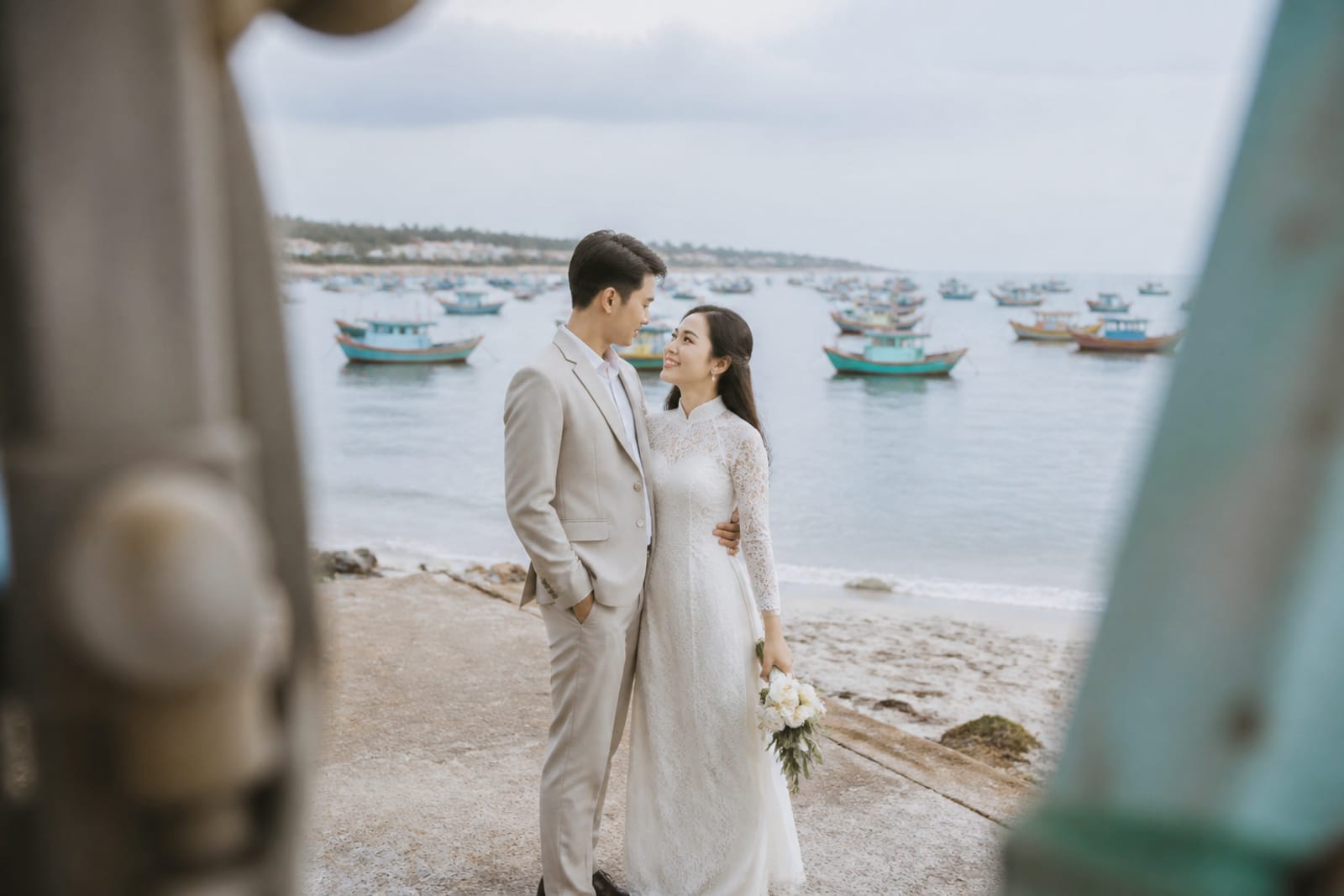
Why does Mui Ne light shift so fast in a single shoot day?
Mui Ne faces the ocean southeast; the dunes sit on the southwest edge. At 5:45 am, light is soft and blue-grey on the dunes' ridge; by 6:30 am it turns golden on the crests. From 7:30 am onward, shadows flatten fast and heat haze rises off the sand. By 9 am, light is harsh overhead; by noon, the sea-breeze pushes sand into the air, reducing visibility. A shoot that starts at 6 am can capture three different light moods in two hours—but only if the team is mobile and knows the timing. This is why one coordinated shoot (makeup, hair, camera all moving as a unit) beats booking three separate vendors who might arrive late or lose light waiting.
How should you dress for sand, wind and changing light?
Wind is constant in February; sand adheres to everything wet or loose. Avoid heavy fabrics that catch wind (wedding dress trains need weights or clips). An ao dai works beautifully in the dunes if the inner layer is silk-smooth and the outer is fitted; loose fabrics will billow and distract from the frame. Second outfit: consider a simple silk or linen shift (knee-length, untucked) and neutral sandals, or tailored shorts and a fitted shirt—something you can move and sit in without sand filling seams.
Undergarments matter: strapless or adhesive bra (no straps visible under ao dai silk); minimal jewelry (salt spray corrodes; wind catches dangles). Hair needs hold: gel and pins, not loose waves. A makeup artist working in-studio (not on-location) has humidity control and can set products properly; if done on-site in a hotel room, ensure air-con is running and allow 15 extra minutes for powder setting in coastal damp.
| Factor | Ao dai + silk slip | Linen shift + sandals | Why choose |
|---|---|---|---|
| Light (dawn golden) | Catches every beam; flows in still air | Drapes simply; shadow-reads calmly | Ao dai = ceremony feel; linen = movement/ease |
| Wind (9 am+) | Needs clips; hemline catches sand | Sits close; easier to manage | Linen wins in gusts; ao dai needs early shoot |
| Sand texture | Silk repels better than cotton; slip protects | Linen traps; needs careful cleaning | Ao dai layer separates skin; linen shows texture |
| Emotional read | Formal, cultural, romantic | Relaxed, intimate, narrative | Ao dai = tradition; linen = story |
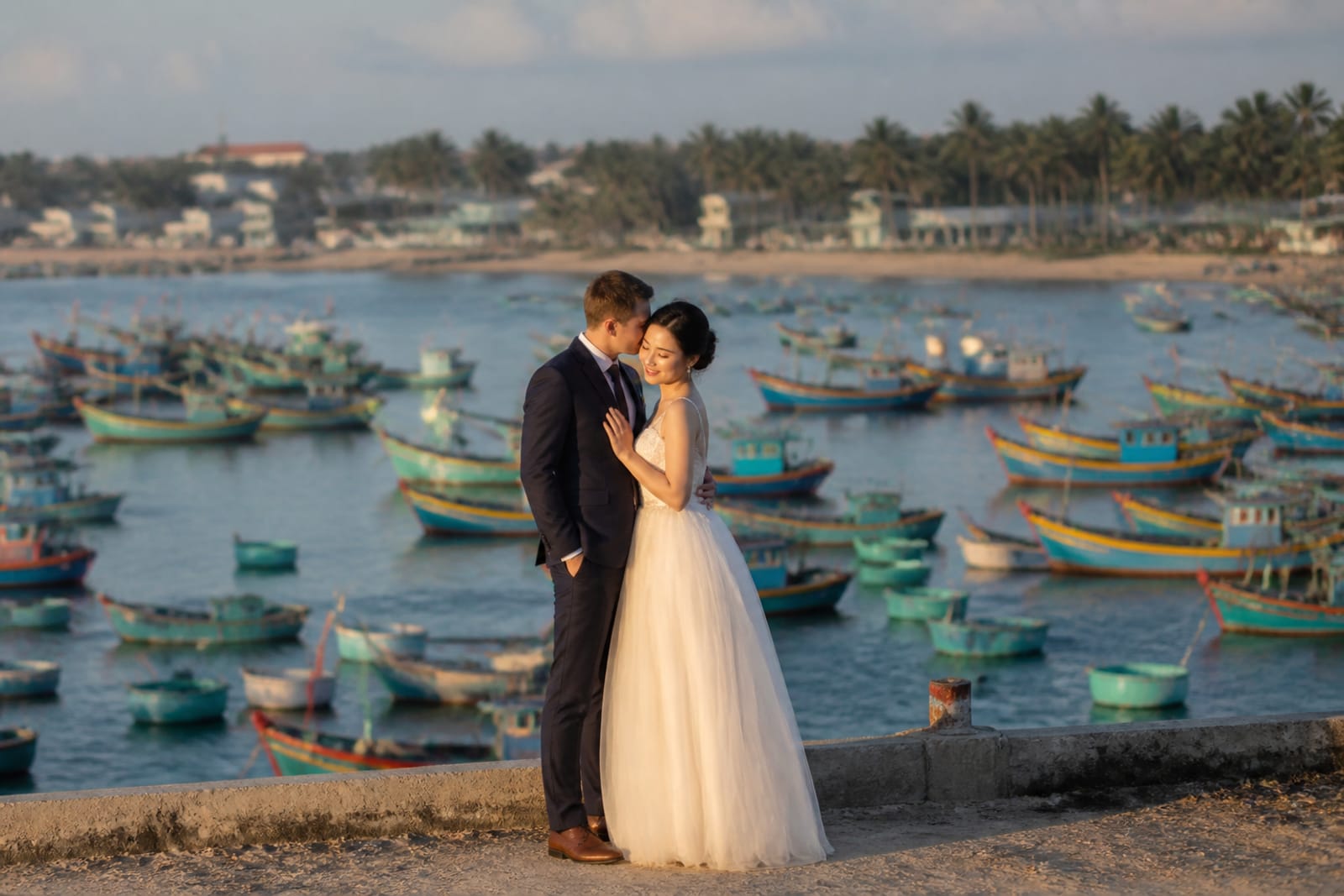
What spots in Mui Ne work best in February morning light?
Dunes (5:30–7:00 am): Soft light hits the ridge from the east. Walk the crest for silhouettes and long shadows. By 7:30 am, light is too bright; wind picks up and lifts sand. Start here, then move. One good sequence: wide shot of you two walking the ridge; medium of one reaching toward the other; close detail of hands or feet in sand. Three frames, one message.
Fish sauce warehouses (7:30–9:00 am): South of town, wooden buildings sit near the beach. Morning light hits their weathered walls at a low angle (6:45–8:00 am is peak). The warehouses create leading lines; their texture reads raw and honest—ideal for a couple's frame that says "real, not pristine." Wind is gentle here because the buildings block it. Shoot the two of you walking past; framed by doorways; sitting on a bench in front. By 9:30 am, light hardens; move on.
Beach, concrete jetty (4:00–5:30 pm): If morning shoots are overbooked, an afternoon session works only if wind has dropped (check daily). Wet sand reflects light beautifully at 4:15–5:00 pm. The tide determines access; check it before choosing this time. Sunset arrives around 5:45 pm in February, so you have 90 minutes max. Bring a light, neutral wrap for wind-chill as light fades.
Town market and streets (8:00–10:00 am): If you want color and life (vendors, locals, lanterns), shoot by 8:30 am. Light is warm but not yet harsh. Markets open early (5 am) and quietest by 9 am. This works for a second outfit or a tonal shift in the sequence.
Should you hire a local or book a team from Hanoi/Saigon?
A local photographer knows Mui Ne's light and season; they don't travel cost and aren't learning the tides in real time. But a pre-wedding shoot requires makeup, hair, outfit coordination and directing all at once. Hiring a photographer, a makeup artist and a stylist separately means: three vendors arrive at different times, one might be late or unprepared, makeup might not hold in salt air, the photographer shoots you "as you appear"—not as a directed team with a single vision.
Cáo Studio pre-wedding shoots are built on one team (photographer, makeup artist, stylist, director) in one booking. For Hanoi and Ho Chi Minh City, we control every variable. For Mui Ne, a destination outside our bases, the honest choice is to ask us on WhatsApp for a local photographer recommendation—someone vetted, or a step-by-step planning guide so you can hire locally and avoid common timing and coordination pitfalls.
---
What to check before you book a pre-wedding shoot in Mui Ne
- Wind forecast: Check 3 days before; gusts over 20 km/h mean moving shots are difficult and makeup dries fast. Reschedule if possible.
- Tide table: If you want beach jetty or shallow water, confirm tide timing the morning of your shoot.
- Makeup + heat test: If your artist hasn't worked in Mui Ne, do a 30-minute test in a warm room with a fan. Salt air and sun exposure are harsher than studio.
- Outfit fit in sand: Walk in your dune outfit at home or a beach; sand in seams and under hemlines distracts during framing. Bring a lint brush and damp cloth.
- Sunrise access: Some dune areas require walking across private land or paying a small access fee (ask locally or ask us on WhatsApp for current info). Confirm the route and parking 2 days ahead.
- Communication with your team: If you hire separately, send everyone the meeting spot, start time and backup time (wind delay) 24 hours prior.
For a couple photoshoot or pre-wedding session in Hanoi or Saigon, Cáo Studio handles all coordination. For Mui Ne, we'll point you to trusted local partners or walk you through the planning. Ask on WhatsApp.
📸 Book on WhatsApp — pre-wedding & elopement
---
FAQ
Can we shoot a pre-wedding in Mui Ne in the middle of February without reshuffling?
Yes—February is dry and predictable. Plan the shoot at least 3 weeks ahead so the team can secure early-morning slots and coordinate makeup/hair. Wind and crowds are manageable if you start by 5:45 am. Avoid weekends (Jan 31–Feb 2, Feb 8–9, Feb 15–16) when day-trippers arrive.
Will sand and salt damage our outfits?
Salt air doesn't corrode fabrics instantly, but it weakens elastic and metal hardware over weeks. For a one-day shoot, damage is cosmetic (sand in seams, salt stains). Silk and linen dry-clean easily; bring two outfits so you can rotate and let the first one air between locations. Avoid ornate jewelry and heavy beading—they tangle in sand and catch wind.
What happens if wind is too strong on shoot day?
Shoots at 5:45 am are usually calm (wind picks up after 9 am). If gusts exceed 16 km/h, moving shots (walking, twirling) become chaotic. Reschedule for the next calm morning or shift to sheltered spots (fish sauce warehouses, town streets). Ask the team to check the forecast 3 days before and offer a backup date.
Is it worth doing two outfits in one Mui Ne session?
Yes—the light and location change dramatically in 2–3 hours. First outfit (ao dai or formal white) at the dunes 5:45–7:00 am; second outfit (relaxed linen) at 7:30–9:00 am in town or by warehouses. This gives you ceremony-feel frames and narrative-feel frames, and fills a full day efficiently.
Should we hire Cáo Studio or a local photographer for Mui Ne?
Cáo Studio is based in Hanoi and Ho Chi Minh City and doesn't operate a Mui Ne team. For a pre-wedding shoot in our bases, we coordinate everything. For Mui Ne, message us on WhatsApp for a vetted local recommendation and a planning checklist so you hire confidently and avoid vendor coordination delays.
FAQ
Can we shoot a pre-wedding in Mui Ne in the middle of February without reshuffling?
Yes—February is dry and predictable. Plan the shoot at least 3 weeks ahead so the team can secure early-morning slots and coordinate makeup/hair. Wind and crowds are manageable if you start by 5:45 am. Avoid weekends (Jan 31–Feb 2, Feb 8–9, Feb 15–16) when day-trippers arrive.
Will sand and salt damage our outfits?
Salt air doesn't corrode fabrics instantly, but it weakens elastic and metal hardware over weeks. For a one-day shoot, damage is cosmetic (sand in seams, salt stains). Silk and linen dry-clean easily; bring two outfits so you can rotate and let the first one air between locations. Avoid ornate jewelry and heavy beading—they tangle in sand and catch wind.
What happens if wind is too strong on shoot day?
Shoots at 5:45 am are usually calm (wind picks up after 9 am). If gusts exceed 16 km/h, moving shots (walking, twirling) become chaotic. Reschedule for the next calm morning or shift to sheltered spots (fish sauce warehouses, town streets). Ask the team to check the forecast 3 days before and offer a backup date.
Is it worth doing two outfits in one Mui Ne session?
Yes—the light and location change dramatically in 2–3 hours. First outfit (ao dai or formal white) at the dunes 5:45–7:00 am; second outfit (relaxed linen) at 7:30–9:00 am in town or by warehouses. This gives you ceremony-feel frames and narrative-feel frames, and fills a full day efficiently.
Should we hire Cáo Studio or a local photographer for Mui Ne?
Cáo Studio is based in Hanoi and Ho Chi Minh City and doesn't operate a Mui Ne team. For a [pre-wedding shoot](/pre-wedding-photoshoot) in our bases, we coordinate everything. For Mui Ne, message us on WhatsApp for a vetted local recommendation and a planning checklist so you hire confidently and avoid vendor coordination delays.
Ao dai, makeup, hair and a local photographer in Hanoi or Saigon — one WhatsApp message.