/pre-wedding-photoshoot
Pre-wedding photoshoot in Sapa in April: weather, light and crowds
April in Sapa delivers the best weather window for pre-wedding shoots—mild 18–24°C days, minimal rain, and rice terraces transitioning to green. Light is soft until 7:30 am and after 5 pm; midday is harsh. Sessions run 3–4 hours, split between high-altitude terraces (require early starts, cool mornings, sturdy footwear under your ao dai or wedding dress), Sapa town (colonial architecture, trekking trails), and homestays. Cáo Studio does not operate in Sapa—you'll need a local photographer—but we shoot pre-wedding sessions in Hanoi, Ho Chi Minh City, and Hoi An. Plan for uneven terrain, potential mud patches even in dry season, and weather shifts fast at altitude; bring layers and waterproof bags for gear. ---
Is April truly the best month for a Sapa pre-wedding shoot?
Yes, strategically. April straddles the cool season (ending) and monsoon (starting), with the lowest rain and most stable light of any month. Water fills rice paddies from May onward; terraces in April are bare-to-green depending on planting cycles, giving you variety—not the lush monochrome of June or the golden of September harvest. No typhoon threat (unlike October). Temperature hovers 18–24°C during the day, dropping near 10°C before dawn—manageable with layering. The downside: terraces are least photogenic visually compared to water-filled May or golden Sep–early Oct, but weather reliability and light quality outweigh that trade-off for pre-wedding timings.
Decision framework: choose April for certainty over aesthetic drama; choose May if you want water reflections and accept higher rain risk; choose Sep–early Oct if you can gamble on typhoon-season showers for the harvest look.
What time of day gives the best light in Sapa for portraits?
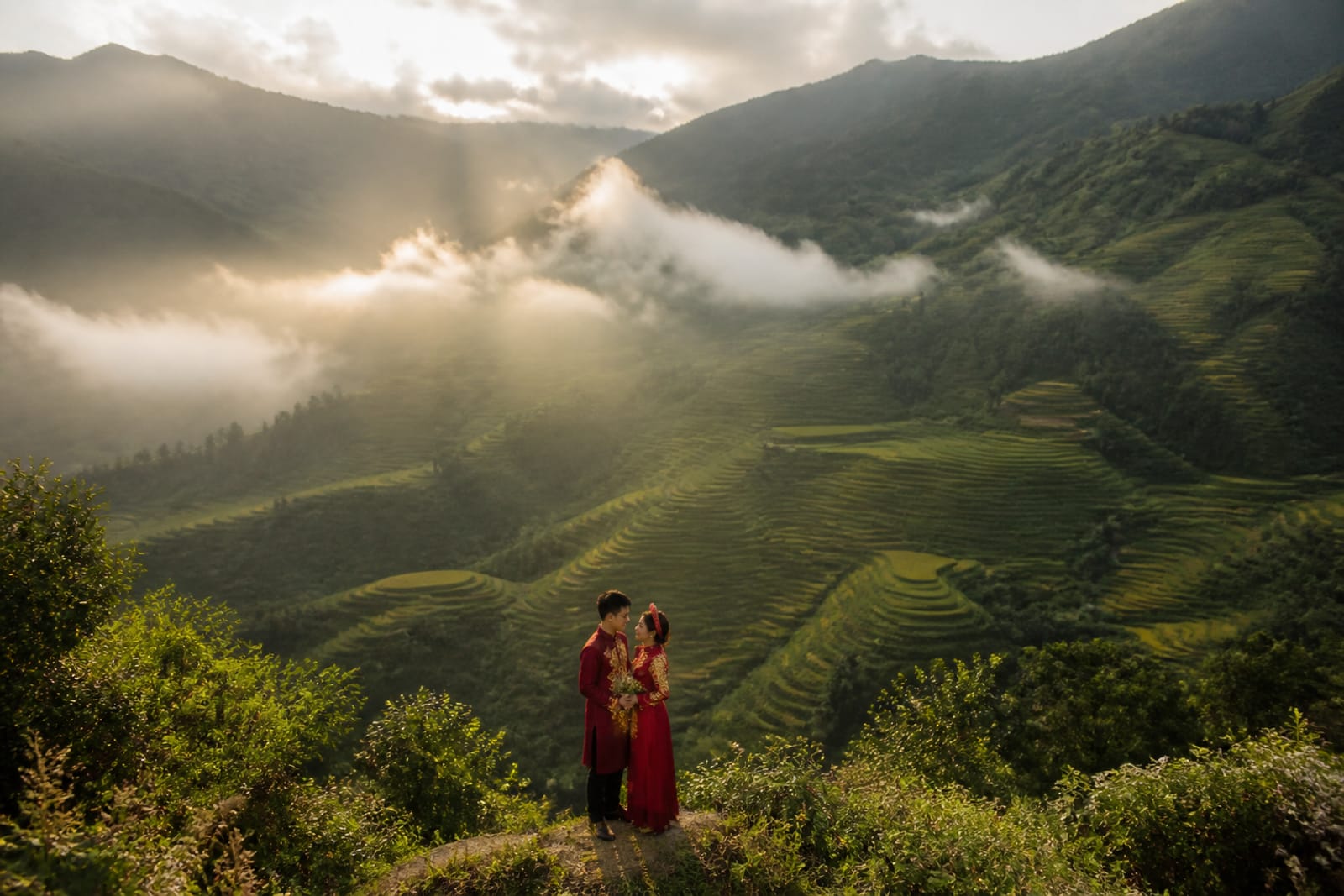
Pre-dawn (5:30–7:30 am) and post-4:30 pm are non-negotiable. Sapa's altitude (1,600 m) and valley position mean midday sun (9 am–4 pm) is harsh, creating shadows under eyes and washing out skin tone on terraces with no natural diffusion. Early morning light is soft, directional, and golden without glare—ideal for close-ups and couple framing. Afternoon light turns golden-orange 30 minutes before sunset, but mist often rolls in after 5:30 pm, reducing visibility. A typical shoot starts before 6 am, captures terraces and wide landscapes until 8 am (light hardens), breaks for breakfast or rest, then resumes 4–6 pm for intimate couple shots near town or homestays. This rhythm also avoids peak trekker traffic (9 am–3 pm).
How do outfits and layers work in April's Sapa weather?
April mornings are cold (near 10°C) and humid; mid-afternoon warms to 20°C. If shooting in an ao dai or wedding dress, you'll need strategic layering underneath—a fitted thermal or silk base layer under the dress itself, plus a lightweight cardigan or shawl you remove once light warms up. Groom suits work if tailored fitted (Sapa wind is real); loose fabric looks chaotic in movement on uneven ground. Footwear is critical: the terrain is muddy stone steps, red-earth paths, and slippery grass after rare rain patches. Wear trail-appropriate shoes or boots (not heels) under your outfit or change on-site. Many couples bring a second pair of shoes for ceremony-style portraits near town, then switch to trekking boots for terraces. Avoid long hems that drag in mud; cropped or high-hemmed ao dai or dresses work better. Bring a waterproof bag for phone and makeup touch-ups—early mist can be dewy, and sweat happens on steep walks.
| Outfit choice | Best for | Light condition | Why it works |
|---|---|---|---|
| Ao dai + thermal layers + cardigan | Traditional aesthetic, outdoor terraces | Early morning, golden hour | Layering adapts to cold–warm swing; ao dai moves well on steps; easy removal maintains silhouette in warm light |
| Wedding dress + boots + shawl | Western formal, homestead/town portraits | Late afternoon, near settlements | Dress photographs well in golden hour; boots stay hidden; shawl preserves warmth without bulking silhouette |
| Casual couple outfit (linen, lightweight jacket) | Candid, natural aesthetic | Midday (second shift), avoid harsh 12–3 pm | Practical for terrain; wind-resistant; less heat stress; works with natural mist atmosphere |
| Traditional groom suit + ao dai | Symmetrical formal, symbolic pairing | Post-4 pm, clear sky sections | Impact in soft light; less physical stress than morning; mist adds drama without harsh glare |
How do crowds and logistics affect your shoot schedule?
Sapa is heavily trekked (peak hours 9 am–3 pm). Early shoots (before 6:30 am) mean you have terraces near-empty and soft light—the trade is a 4 am wake-up and cold hands for the photographer. Afternoon reshoots (4–6 pm) avoid crowds but risk incoming mist and shorter light window (30–45 minutes usable). Access roads can be muddy and slow; getting a vehicle to high-altitude terraces takes 20–40 minutes from town depending on condition. Homestay access (family homes in villages used as backdrop) requires local guides and permission—timing can slip. Weather shifts fast; a clear 5 am can be foggy by 6:30 am. A professional local photographer knows which terraces are accessible in April (some are harvested and replanted, others muddy after rare rains) and builds a flexible itinerary. Plan for 1–2 hour photo sessions split across two time windows rather than one long 4-hour shoot; the physical and weather demand is high.
Why Sapa pre-wedding shoots need a local photographer, not a remote planner.
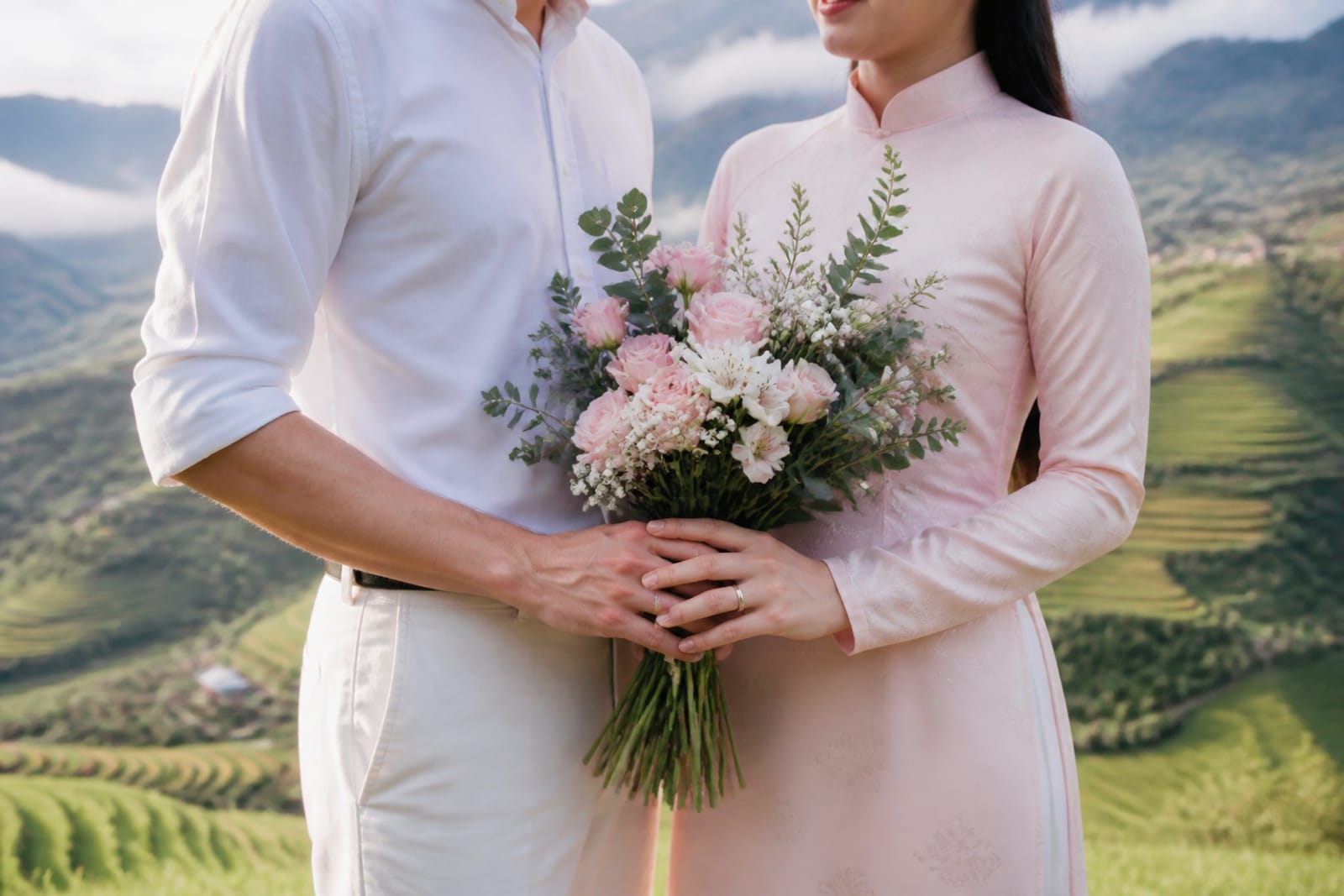
Sapa's geography demands real-time decisions: terrain hazards, weather windows, light angles that depend on cloud position and time within a 30-minute window. A photographer who's worked Sapa in April knows which homestays have the best backlight (north-facing, mid-morning), which terraces photograph greener this year (depends on planting week), and which paths are passable. Cáo Studio operates in Hanoi, Ho Chi Minh City, and Hoi An—for Sapa, you'll need a vetted local team. Find one through Sapa tourism boards, Instagram portfolio searches (filter by "Sapa pre-wedding" or "Sapa couple"), or ask your accommodation for referrals. Check their April portfolio specifically (light, outfit fit, terrain), ask about weather contingencies, and confirm they scout locations 2–3 days before your shoot. Cost factors: season (April is mid-range), distance from town, number of locations, and session length. Expect local rates and logistics to differ from Hanoi studio shoots.
📸 Book on WhatsApp — pre-wedding photoshoot | 💄 Makeup & hair at your hotel | 🌸 See the lookbook
What to check before booking a Sapa pre-wedding shoot.
Ask your prospective photographer:
- Portfolio scope: Do they have 10+ April shoots in their gallery (not just one-off shots)?
- Weather backup: What happens if mist rolls in at 6:15 am? Do they reschedule, shoot anyway, or pivot to town backups?
- Terrain experience: Can they safely guide you on steep, wet paths while shooting? Do they carry insurance?
- Outfit knowledge: Have they shot in ao dai on mountains? Do they advise on layers and footwear?
- Local access: Do they have permissions for homestays and private terraces, or do you trek public paths only?
- Delivery timeline: When are edited files ready? Digital only, or do they offer prints?
- Group size: How many crew (photographer + assistant, makeup artist, guide)? Smaller teams move faster; larger ones support outfit changes and logistics.
---
Alternative Sapa pre-wedding option: combine with Hanoi.
If April Sapa feels logistically complex, consider a split shoot: a studio or urban pre-wedding session in Hanoi on a flexible indoor/outdoor day, then a shorter Sapa morning shoot (4–6 hours) focused on one or two iconic locations. This reduces Sapa weather risk and lets you work with Cáo Studio's Hanoi team for makeup, outfit rental, and part of the shoot. Discuss hybrid plans on WhatsApp.
📸 Book on WhatsApp — couple photoshoot | 💄 Makeup & hair at your hotel | 🌸 See the lookbook
---
FAQ
Is April more crowded than other months in Sapa?
April sees moderate foot traffic—not peak summer (July–Aug) or autumn festival season (Sep–Oct), but still trekked 9 am–3 pm. Pre-dawn shoots bypass crowds entirely. Local guides can route you to less-posted terraces.
Will my ao dai or dress get muddy in April?
Rare, if you plan route carefully. Terraces are drying after any winter rain; red-earth paths have dry patches April–May. Wear trail shoes under your outfit, change into ceremonial footwear for still portraits near town. Bring a waterproof bag for touch-ups and shoe change.
How much altitude should I expect, and will it affect the shoot?
Sapa town is 1,600 m; terraces nearby reach 1,400–1,700 m. Most people acclimate within 2–3 hours. Exertion on steep paths can affect stamina in thin air—plan shorter active segments (45 min walk, 15 min portrait rest) rather than 3-hour hikes. Start early when air is coolest.
Can I wear Western wedding dress in Sapa, or should I choose ao dai?
Both work, but ao dai adapts better to terrain and cold. If you wear a Western dress, choose a shorter or cropped silhouette, bring sturdy boots to wear under it, and plan most of that shoot for afternoon near homesteads (easier terrain than steep terraces). Consider renting a backup ao dai for terraces.
Should I book a local Sapa photographer or coordinate with a Hanoi studio?
Book local for Sapa shoots. A photographer based in or familiar with Sapa knows April conditions, terrain, and weather patterns intimately. Remote coordination from Hanoi is difficult because weather and access change daily. Cáo Studio shoots in Hanoi, Ho Chi Minh City, and Hoi An; for Sapa, find a vetted local team through tourism boards, portfolio reviews, and accommodation referrals.
FAQ
Is April more crowded than other months in Sapa?
April sees moderate foot traffic—not peak summer (July–Aug) or autumn festival season (Sep–Oct), but still trekked 9 am–3 pm. Pre-dawn shoots bypass crowds entirely. Local guides can route you to less-posted terraces.
Will my ao dai or dress get muddy in April?
Rare, if you plan route carefully. Terraces are drying after any winter rain; red-earth paths have dry patches April–May. Wear trail shoes under your outfit, change into ceremonial footwear for still portraits near town. Bring a waterproof bag for touch-ups and shoe change.
How much altitude should I expect, and will it affect the shoot?
Sapa town is 1,600 m; terraces nearby reach 1,400–1,700 m. Most people acclimate within 2–3 hours. Exertion on steep paths can affect stamina in thin air—plan shorter active segments (45 min walk, 15 min portrait rest) rather than 3-hour hikes. Start early when air is coolest.
Can I wear Western wedding dress in Sapa, or should I choose ao dai?
Both work, but ao dai adapts better to terrain and cold. If you wear a Western dress, choose a shorter or cropped silhouette, bring sturdy boots to wear under it, and plan most of that shoot for afternoon near homesteads (easier terrain than steep terraces). Consider renting a backup ao dai for terraces.
Should I book a local Sapa photographer or coordinate with a Hanoi studio?
Book local for Sapa shoots. A photographer based in or familiar with Sapa knows April conditions, terrain, and weather patterns intimately. Remote coordination from Hanoi is difficult because weather and access change daily. Cáo Studio shoots in Hanoi, Ho Chi Minh City, and Hoi An; for Sapa, find a vetted local team through tourism boards, portfolio reviews, and accommodation referrals.
Ao dai, makeup, hair and a local photographer in Hanoi or Saigon — one WhatsApp message.