/pre-wedding-photoshoot
Pre-wedding photoshoot Mui Ne April: weather, light and timing
Mui Ne in April delivers the conditions pre-wedding couples want: dry weather, warm light, and minimal rain. The dry season runs November to April, so April sits near its end—still reliable but hotter than March. Expect midday temperatures around 30–32°C; light is strong and direct, demanding early dawn or late-afternoon shoots (5:30–7:00 am or 5:00–6:30 pm) to avoid harsh shadows. Crowds are thinner than peak season, especially weekdays. The main challenge: wind picks up in late afternoon, blowing sand on the dunes (worst November–March, but still present in April). Cáo Studio shoots in Hanoi, Ho Chi Minh City, and Hoi An; if Mui Ne is your chosen location, this guide will help you plan with a local photographer or understand what to book from our Saigon base if you can shoot part of your session in Ho Chi Minh City instead.
Why does April work better for Mui Ne pre-wedding shoots than other months?
April falls in Mui Ne's dry season (November–April), when rain is rare and light is consistent. By late April, afternoon wind and heat intensify, but mornings remain calm and golden until 7:00 am. Compare this to May onward: the wet season brings afternoon downpours, overcast skies, and humidity that dulls light. October–November are wetter and windier. April's advantage is predictability—you can plan a 5:30 am dune session confident the light will be soft and the sky clear. Pack layers for the cool pre-dawn air; you'll shed them by 7:00 am.
📸 Book on WhatsApp — pre-wedding photoshoot | 🌸 See the lookbook
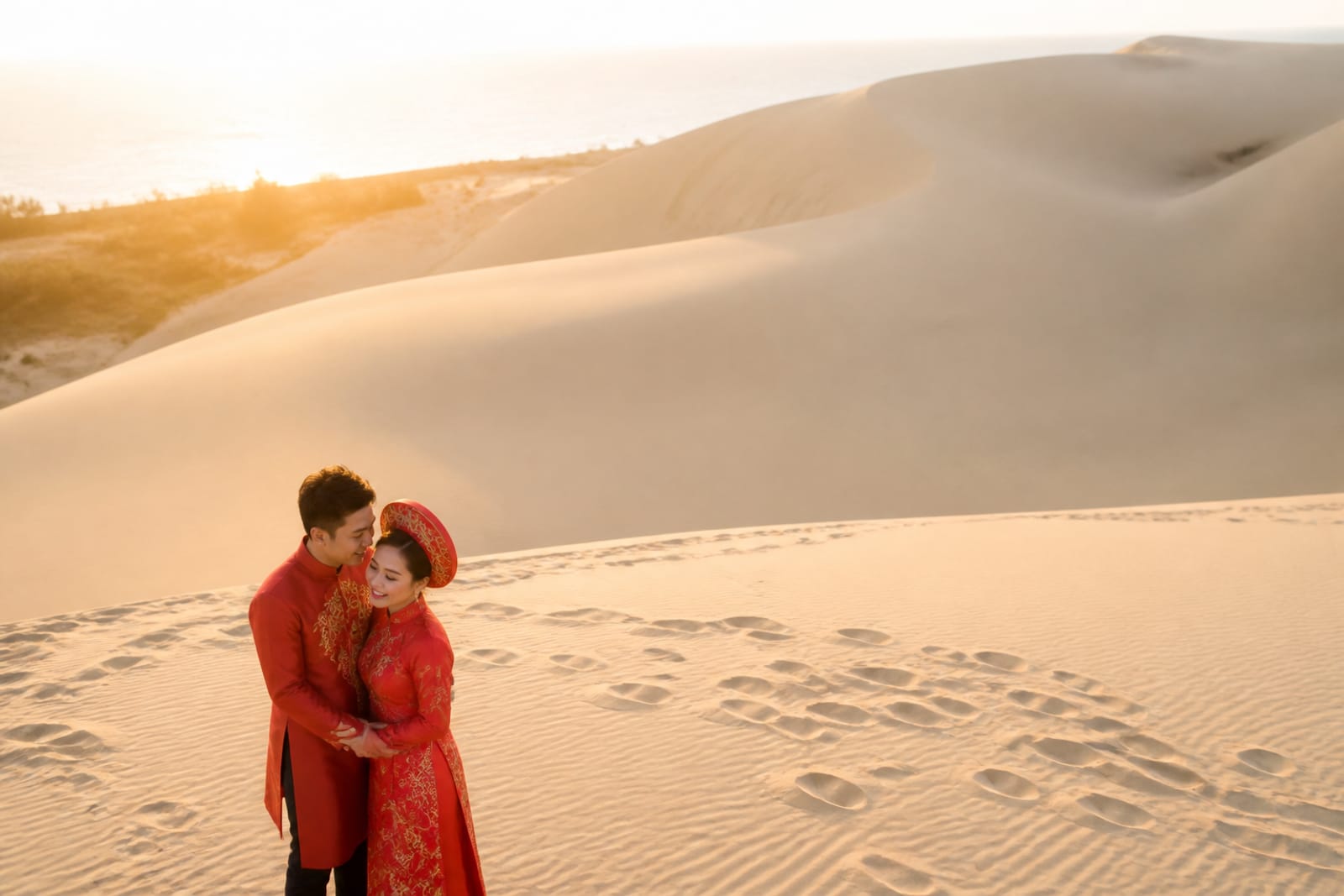
What time of day gives you the best light in Mui Ne for couple portraits?
Golden hour—the hour after sunrise and the hour before sunset—is non-negotiable in Mui Ne. Sunrise (around 5:40–5:50 am) offers soft, directional light without heat; you shoot comfortably on the dunes until 6:30–7:00 am, when the sun climbs and light flattens. Sunset (6:00–6:30 pm) works similarly but invites afternoon wind and sand drift. If your session spans both, start on the dunes at dawn (wide, walking shots, natural poses), move to fishermen or the town for detail frames mid-morning (shade, texture, candid moments), then return to the coast for the last 20 minutes of warm light. Midday (10:00 am–4:00 pm) produces harsh shadows under eyes and chins—avoid scheduling portraits then, though wide establishing shots of the landscape still read well in strong sun.
How does wind affect your clothing choices and shot planning?
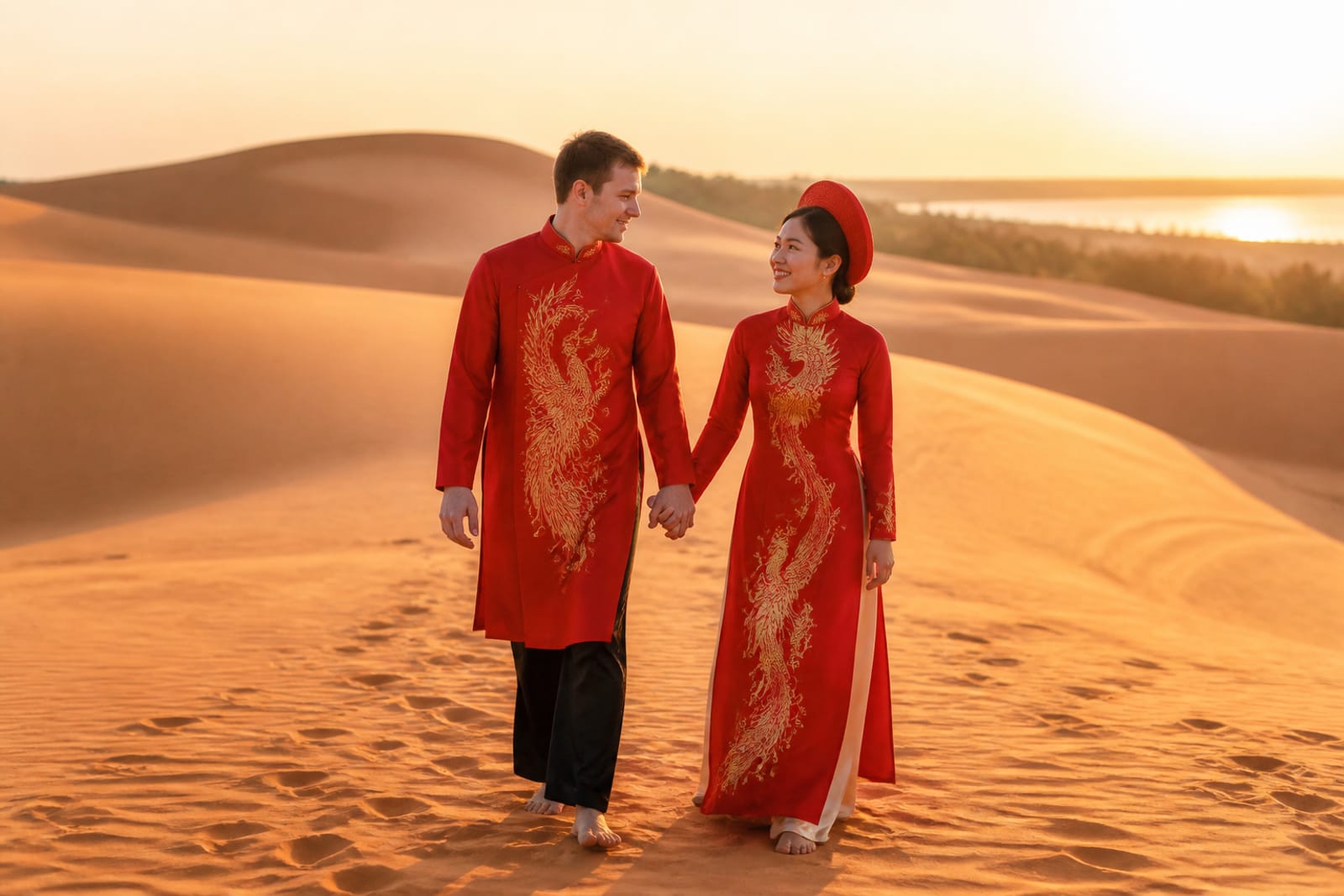
Wind in Mui Ne runs strongest from November to March but persists through April, especially after 3:00 pm. It lifts sand onto skin and clothes, blurs long hair, and fills the air with grit that damages camera sensors if you're not careful. For your outfit: lightweight, tailored ao dai or wedding dress holds shape better than gauze or silk chiffon; consider a shorter hemline (tea-length ao dai or midi dress) to prevent fabric catching sand and blowing in your face. If you wear a long train or veil, plan dawn-only shots and ask your photographer to brief you on safe angles and when to hold fabric close. Practically, bring a makeup artist or plan a touch-up kit—sand sticks to lips and foundation, and wind dries skin fast. A local guide is essential: they'll know which dunes are sheltered and which time slots have the calmest air. Ask your photographer to check wind reports the morning of the shoot and adapt the schedule if needed.

What's the realistic guest experience: crowds, heat, and logistical prep?
April weekdays in Mui Ne are quiet—you'll see tourists at the dunes, but the density is nothing like January or March. Weekends draw more visitors, especially Saturday evenings. The town itself (Mui Ne town proper, not the dunes) has cafés, street-food stalls, and markets; restaurants are open, but expect a post-Tet slowdown in early April. Heat builds fast: by 8:00 am, it's warm; by 10:00 am, it's hot enough that couples in heavy fabrics need shade and water. Logistically: the nearest airport is Phan Thiet (about 30 minutes from Mui Ne town). Most couples base themselves at a beachfront resort; check-in the day before to rest and prep. Your photographer and makeup artist should arrive the evening before or early morning (by 5:00 am) to allow setup time. One-hour commute from Phan Thiet airport to your hotel is normal; factor it into your arrival plan. Facilities at the dunes are minimal (no bathrooms, no shaded shelters), so use your hotel room for final touch-ups before heading out. Bring sunscreen, water, wet wipes, and a small cooler. Sand gets into everything—camera gear, hair, clothes—so a waterproof bag and a change of clothes back at the hotel are smart.
How do you choose between a dawn dune session, a beach walk, or a town / fisher-village frame story?
Each location offers different light and narrative texture. The dunes (Mui Ne's signature) deliver wide, saturated color at dawn—sand turns gold, shadows are long—ideal for full-length couple portraits and movement shots (walking away, looking back). Risk: wind and sand. The beach proper (directly in front of hotels) is accessible and peaceful in early morning but less visually distinctive—soft waves, wet sand, but the backdrop lacks Mui Ne's visual signature. Use it for detail shots (shoes, rings, embracing close-ups) or mid-morning candids while you wait for light to return. The fishing village (Mui Ne town's harbor, with colorful boats and nets) reads best between 5:00–7:00 am, when light is soft and fishermen are working—it's photojournalistic, not posed, but crowded with real activity that can feel authentic. Late afternoon brings golden light but chaos and afternoon wind. A one-day itinerary often looks like: dunes at dawn (6:00–7:00 am), hotel breakfast and rest (7:00–9:00 am), village or market detail walk (9:30–11:00 am in available light and shade), hotel lunch, nap, and a final short beach walk (5:15–6:00 pm if the couple has energy and the wind is calm). Most couples shoot three outfits across those windows.
| Location | Best for | Light window | Why it works |
|---|---|---|---|
| Dunes | Couple portraits, movement, signature scale | 5:40–7:00 am | Soft directional light, colour saturation, emotional landscape |
| Beach | Detail shots, rings, tender moments | 6:30–10:00 am (any weather) | Intimate scale, water texture, forgiving light |
| Fishing village / harbour | Narrative, candid moments, cultural frame | 5:00–7:00 am (fishermen active) | Authentic activity, warm light, story-driven frames |
| Town market / café | Candid, transition frames, daily life | 9:00–11:00 am (shade preferred) | Natural interaction, relaxed posture, morning energy |
| Beach at sunset | Warm finale, silhouettes | 5:30–6:15 pm | Romantic light, but wind; not ideal for sharp couple portraits |
What should you pack, wear underneath, and check before you book a photographer?
What to wear: An ao dai (rent locally or from Cáo Studio; check ao dai rental) photographs beautifully in Mui Ne's light and speaks culturally. A Western wedding dress works too, but consider a shorter version or a rehearsal dinner style to avoid sand and heat struggle. Bring a second outfit—a casual linen shirt and tailored trousers, or a light rehearsal dress—for the village or beach walk. Flat sandals or embroidered slippers for the dunes (shoes sink in sand); bring them in your bag, shoot barefoot for texture, then slip them on for comfort.
Underneath: Wear seamless, moisture-wicking undergarments (sand and sweat stick to cotton). Skip heavy shapewear in April heat; a light slip under your dress is enough. Bring a soft towel and baby wipes to remove sand between outfits.
Before you book: If you're hiring a local photographer (Cáo Studio does not operate in Mui Ne; we coordinate pre-wedding shoots in Hanoi, Ho Chi Minh City, and Hoi An), ask these questions:
- Have they shot Mui Ne dunes in April? What time do they arrive and how long do they stay?
- Do they work with a makeup artist and can they coordinate timing?
- What's the edit turnaround (48 hours is industry standard, but confirm)?
- Do they scout the location the day before or rely on day-of instinct?
- How many outfits and locations are covered in your session time?
- What's their backup plan if wind becomes unworkable?
Ask to see their Mui Ne portfolio—not generic Mui Ne images, but their own work shot there in April. If you're considering a shoot in Ho Chi Minh City as part of your pre-wedding prep, Cáo Studio's Saigon team can guide you on outfit, hair, and timing, then advise you on finding a reliable local photographer for Mui Ne if that's your chosen location.
FAQ
Is April considered peak season in Mui Ne, and will I see crowds?
April is shoulder season—less crowded than January–March, but busier than May onward. Weekday dune sessions are quiet; weekends and late April afternoons see more tourists. Early-morning shoots (before 7:00 am) virtually guarantee solitude on the dunes.
Can I shoot a pre-wedding session in Mui Ne through Cáo Studio, or do I need to hire a local photographer?
Cáo Studio operates in Hanoi, Ho Chi Minh City, and Hoi An. Mui Ne is outside our service area. Our Saigon team can brief you on outfit, makeup, and light timing, but you'll need to hire a local Mui Ne photographer. We're happy to advise on vetting one via WhatsApp.
What should I do if the wind is too strong on the morning of my shoot?
Check wind forecasts 24 hours before and the morning-of. Your photographer should have a backup plan: shift focus to the beach (more sheltered) or the village. Sand-heavy wind usually dies by 7:00–7:30 am; consider a later start if the 5:30 am slot is unusable.
Can I wear my wedding dress on the Mui Ne dunes, or is an ao dai better?
Both work. An ao dai photographs beautifully and feels culturally rooted; a wedding dress stands out against the landscape. Consider the dress weight and hem length: a heavy, floor-length gown on sand requires patience and a makeup artist on standby. A tea-length ao dai or a lighter rehearsal-style dress is more practical in April heat and wind.
How many hours should I book for a pre-wedding shoot in Mui Ne, and what locations can I fit?
Most couples book 4–6 hours (dawn through mid-morning, or late afternoon into sunset). You can realistically shoot two locations well (dunes + village, or dunes + beach) and one outfit change without feeling rushed. A third outfit requires a longer session and a committed midday break.
What's the best way to protect my photographer's camera and my own belongings from sand in Mui Ne?
Use waterproof camera bags and lens caps; don't change lenses on the dunes. Keep phones, jewelry, and valuables in a sealed beach bag in the car. Bring a small gazebo or beach umbrella as a shade and sand-barrier base camp. After the shoot, rinse equipment gently with fresh water at your hotel.
FAQ
Is April considered peak season in Mui Ne, and will I see crowds?
April is shoulder season—less crowded than January–March, but busier than May onward. Weekday dune sessions are quiet; weekends and late April afternoons see more tourists. Early-morning shoots (before 7:00 am) virtually guarantee solitude on the dunes.
Can I shoot a pre-wedding session in Mui Ne through Cáo Studio, or do I need to hire a local photographer?
Cáo Studio operates in Hanoi, Ho Chi Minh City, and Hoi An. Mui Ne is outside our service area. Our [Saigon team](/saigon) can brief you on outfit, makeup, and light timing, but you'll need to hire a local Mui Ne photographer. We're happy to advise on vetting one via WhatsApp.
What should I do if the wind is too strong on the morning of my shoot?
Check wind forecasts 24 hours before and the morning-of. Your photographer should have a backup plan: shift focus to the beach (more sheltered) or the village. Sand-heavy wind usually dies by 7:00–7:30 am; consider a later start if the 5:30 am slot is unusable.
Can I wear my wedding dress on the Mui Ne dunes, or is an ao dai better?
Both work. An ao dai photographs beautifully and feels culturally rooted; a wedding dress stands out against the landscape. Consider the dress weight and hem length: a heavy, floor-length gown on sand requires patience and a makeup artist on standby. A tea-length ao dai or a lighter rehearsal-style dress is more practical in April heat and wind.
How many hours should I book for a pre-wedding shoot in Mui Ne, and what locations can I fit?
Most couples book 4–6 hours (dawn through mid-morning, or late afternoon into sunset). You can realistically shoot two locations well (dunes + village, or dunes + beach) and one outfit change without feeling rushed. A third outfit requires a longer session and a committed midday break.
What's the best way to protect my photographer's camera and my own belongings from sand in Mui Ne?
Use waterproof camera bags and lens caps; don't change lenses on the dunes. Keep phones, jewelry, and valuables in a sealed beach bag in the car. Bring a small gazebo or beach umbrella as a shade and sand-barrier base camp. After the shoot, rinse equipment gently with fresh water at your hotel.
Ao dai, makeup, hair and a local photographer in Hanoi or Saigon — one WhatsApp message.