/pre-wedding-photoshoot
Rainy Day Backup Plan for Hoang Su Phi Rice Terraces Wedding Photo
Hoang Su Phi rice terraces' best light (Sep–Nov) overlaps monsoon risk—downpours arrive fast and strand crews on muddy roads. A solid backup plan has two layers: on-location pivots (shoot the mist, the stone-walled villages, intimate details under shelter) and off-site secondaries (move the shoot to Hanoi or a nearby town with weather shelter). Cáo Studio builds rainy-day logistics into every Hoang Su Phi booking: scouts backup light 48 hours before, secures covered spots in local villages, and keeps a flexible two-day window so one weather window is liveable. The key is committing early—rainy shoots cost more (longer drive times, fewer locations per hour) and must be discussed before you book, not discovered on the day.
Hoang Su Phi sits three hours northwest of Hanoi, cradled in valleys where September terraces glow gold and November buckwheat paints hills white. Between those peaks lies a trap: the tail end of Vietnam's northern monsoon season. Rain doesn't cancel a shoot here—it reshapes it. You either plan that reshaping or you improvise on a mountainside in the dark.
Why rain hits Hoang Su Phi harder than Hanoi
Hoang Su Phi sits at 1,000–1,500 metres elevation, where clouds form faster than in the lowlands. Afternoon showers that Hanoi might escape become hour-long downpours in the hills. Roads narrow to switchbacks—a rain delay is a stranded delay, not a "wait it out in a café" delay. Many couples choose Hoang Su Phi for its remoteness; that same remoteness means a backup studio or indoor venue doesn't exist five kilometres away. The solution: anchor your backup plan to real geography, not wishful thinking.
Should you shoot in the rain or move the session?
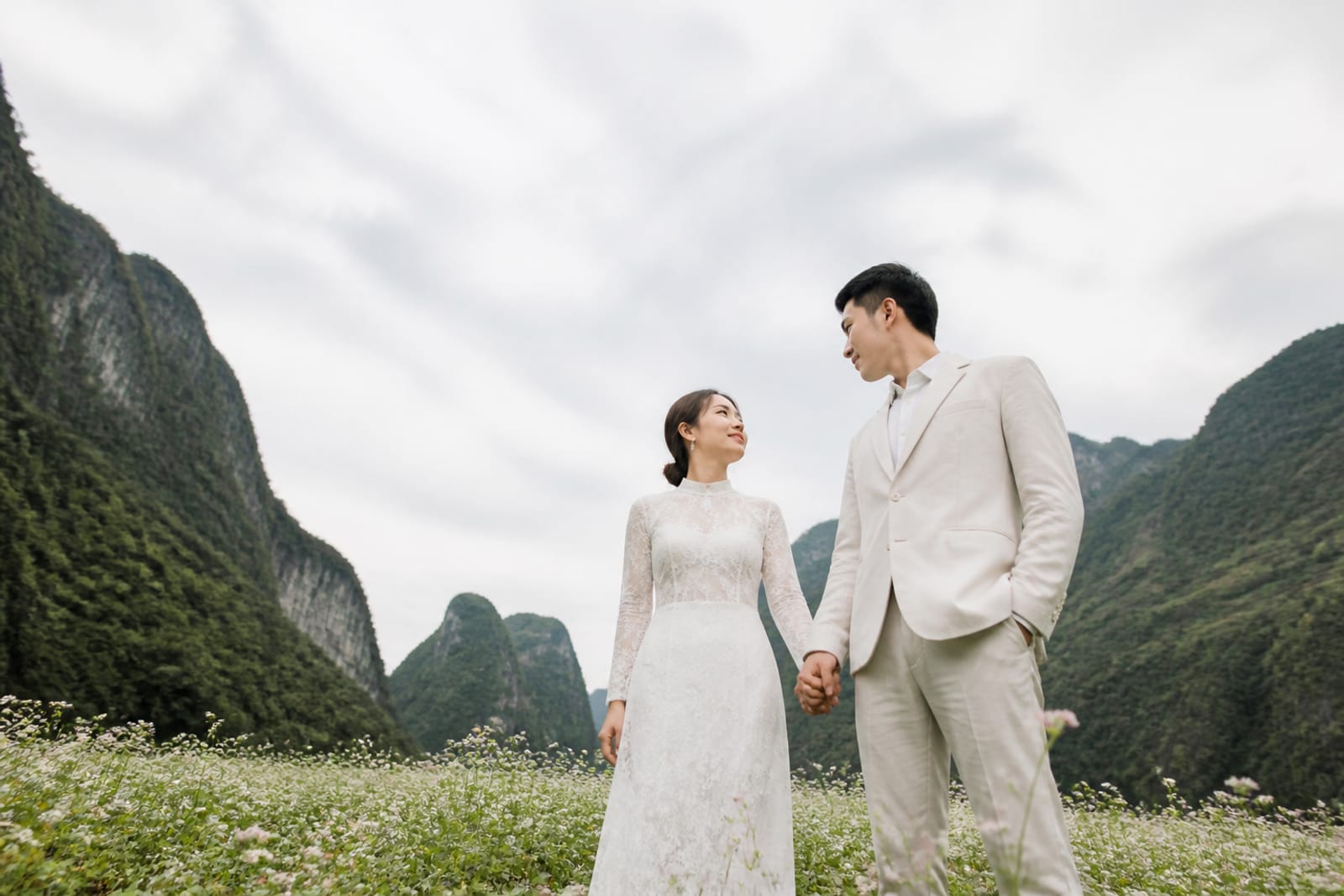
Shooting in the rain is cinematic if you've prepared for it—mist wrapping terraces, grey light flattening detail into mood, stone paths shining. Wet ao dai photographs beautifully; couples often say a rainy frame feels more intimate than golden-hour ones. But it demands:
- Waterproof gear for hair and makeup (a full reset takes an hour in a van)
- Shorter location hops (muddy tracks become slippery and slow)
- A shelter base (a local homestay or village hall to retreat between shoots)
- One full extra day (rain reshuffles timing, and second-day light is rarely perfect)
Moving the session—to Hanoi for an urban pivot, or to a lower-elevation town like Tam Coc—trades the terraces for guaranteed light and shelter but loses the destination reason couples chose Hoang Su Phi. The real call: partial pivot. Shoot one day in the rain for mood, one day elsewhere for variety. This needs a three-day window and honest pre-booking conversation.
| Backup Plan | Best for | Light & Season | Why it works |
|---|---|---|---|
| Shoot in rain (mist, villages, details) | Couples ready for cinematic mood; willing to reschedule a day | Overcast; Sep–Nov monsoon; intimate frames | Mist romanticizes; fewer tourists; wet stone and terraces read as moody, not ruined |
| Move to Tam Coc or nearby town | Couples needing guaranteed sun; prefer limestone karst backup | Feb–Aug dry season; morning sun on river/rocks | 45 min away; sheltered valleys; still rural; better weather odds |
| Pivot to Hanoi ancillary shoot | Couples wanting cultural contrast; urban detail after rural landscape | Any season; studio light available | Guarantees polished frames; ao dai in street markets reads fresh; no weather gamble |
| Extend to two-weather window | Couples committed to Hoang Su Phi; budget flexibility | Flexible dates; book Sep–Oct or Oct–Nov, not peak Dec–Feb | Rainy first day, clear second; terraces in both light; no location loss |
The industry standard is one day in one location; Cáo Studio treats Hoang Su Phi differently because isolation demands it.
What to check before booking a Hoang Su Phi rainy-day shoot
Before you send a WhatsApp, settle these four points:
Weather window flexibility. Booking a fixed date in October almost guarantees rain contact. Booking a "first two weeks of October" window (rather than "October 10") buys the crew one clear day. Moving your dates by three days often buys a whole season's-worth of weather luck. Ask the photographer: "What do you do if rain hits on my chosen date?"—vague answers (like "we'll work around it") are a yellow flag.
Backup location clarity. Before money changes hands, ask: "If the terraces are unsafe or too flooded, where do we shoot instead?" A real answer names a place, describes the light at that place, and explains why it won't feel like a consolation. Answers like "somewhere nearby" or "we'll figure it out" mean the crew hasn't scouted. Cáo Studio names specific homestays with covered courtyards and identifies three village backroad options by GPS before confirming a booking.
Crew experience in monsoon logistics. One-person freelance photographers struggle in rain—no makeup reset support, no gear drying, no backup gear. A team approach (photographer, director, makeup and hair in one booking) means rain pivots are rehearsed, not improvised. Ask if the crew has shot this location in rain before and what went wrong; honest answers build trust.
Cost realities. Rainy shoots cost more: extra driving, slower location changes, longer days. Pivoting to a second location (Tam Coc, a nearby town) adds travel time that the couple often covers. A backup urban shoot in Hanoi may need a separate date. None of these are hidden fees—they're season realities. Discuss them before booking so rain doesn't also bring sticker shock.
📸 Book on WhatsApp — ao dai photoshoot | 💄 Makeup & hair at your hotel | 🌸 See the lookbook
Real rainy-day Hoang Su Phi shoots: what actually happens
Last October, a couple photoshoot arrived on a day mist sat at 800 metres, swallowing the upper terraces. The plan pivoted in two hours: a homestay courtyard framed by dry-stone walls (warm side light through the mist), a walk along a village path with steps and iron handrails, a close-up of wet ao dai sleeves against green leaves, and a wider shot of the couple walking out of frame toward clouds. Edited in 48 hours. The couple said the mist frames were keepers; golden-hour shots would've been prettier but less them.
This works because:
- The crew had scouted the homestay weeks before as a Plan B.
- Makeup was light (water-resistant, resettable in minutes if needed).
- The director framed shots for mist mood, not despite mist—wide to establish haze, then medium, then detail.
- One day was spent this way; a second clear day allowed the terraces-and-light shots the couple still wanted.
Another booking in November buckwheat season arrived on forecast rain. The crew arrived 48 hours early (the flexibility they'd built into the contract), scouted in actual rain, and discovered the buckwheat blooms looked sharper in overcast light—no glare washing the white. The shoot went ahead; the couple's photo album opens with five rainy-day frames.
How to prepare your ao dai and outfit for rain
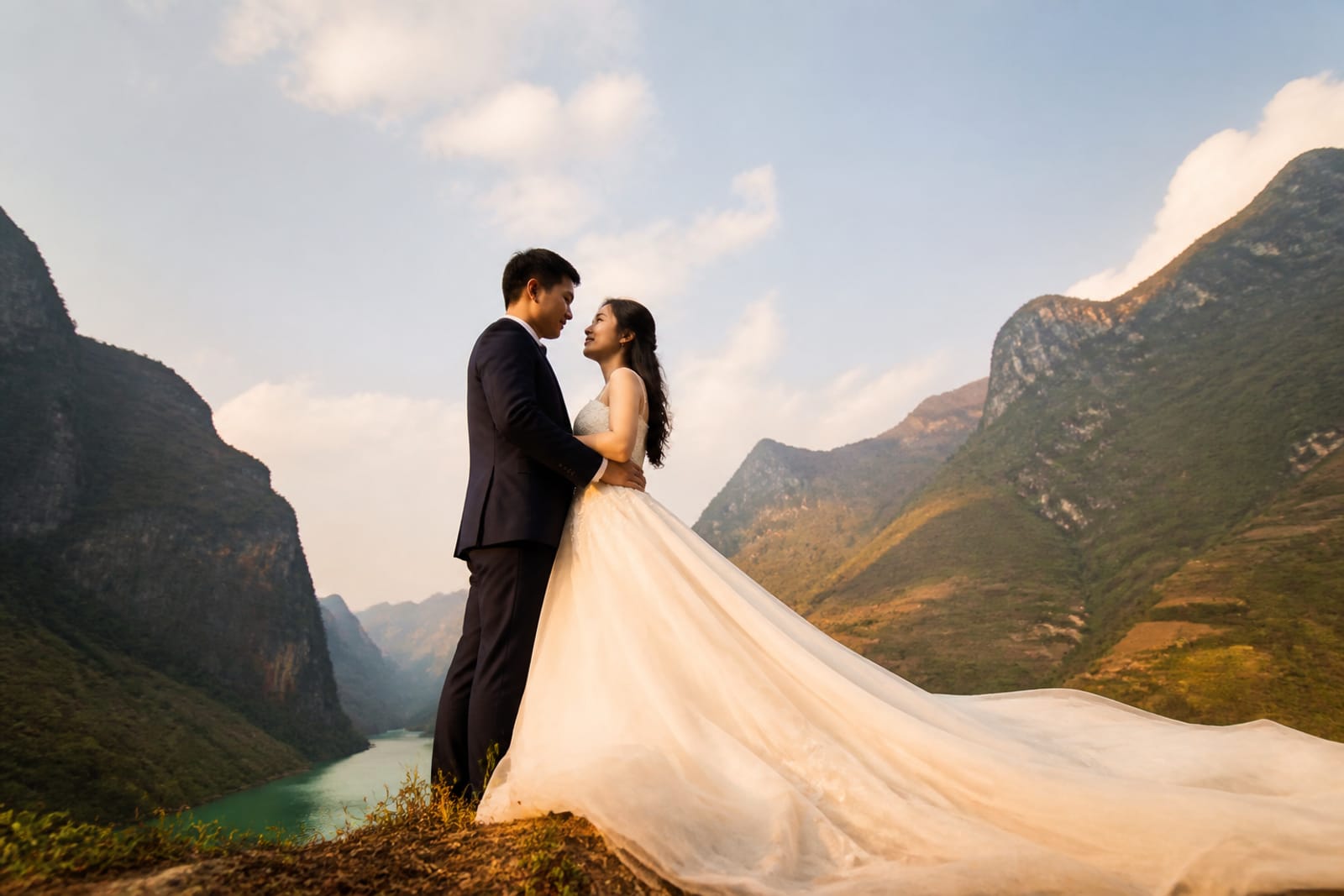
Wet ao dai photographs; it's not ruined by rain. But:
Silk ao dai (most bridal wear) can stain if hemmed water sits for hours—have the crew dry the hem every 20 minutes with a microfiber cloth if rain falls. Synthetic ao dai dries faster. Ask your rental shop (or check your ao dai rental agreement) if water damage is a concern; most cover it.
Layering matters. Underneath a wet ao dai, moisture clings; bring a dry undershirt or bra so makeup and hair don't slide. Waterproof hairspray (not the fancy kind, the cheap sticky kind) holds wet-weather curls far better than standard spray.
Footwear. Stone steps and mud require grip, not slides. Closed-toe shoes that photograph well in wet conditions are rare; the crew will likely shoot tighter (medium and detail frames) to avoid showing feet, or suggest bare feet on dry ground under shelter. Discuss this before the shoot date.
Backup outfit planning (if pivoting to Hanoi or a town shoot) should be settled weeks before, not on the rain day itself. Cáo Studio's makeup & hair at your hotel service means a reset is possible without losing hours—the team travels to your location and restyles you for a second location's light and mood.
📸 Book on WhatsApp — ao dai photoshoot | 💄 Makeup & hair at your hotel | 🌸 See the lookbook
Comparing Hoang Su Phi to other northern high-altitude shoots
Hoang Su Phi isn't the only mountain destination. Sapa, Ha Giang, and Ninh Binh each have their own rain profile:
- Sapa (1,600 m) faces harsher winter cold (Dec–Feb); monsoon rain is similar to Hoang Su Phi but temperature swings are sharper. A rainy Sapa shoot demands heavier clothing layers.
- Ha Giang (buckwheat Oct–Nov) is even more remote; roads are narrower and washouts are riskier. Rainy-day pivots are harder. Only book Ha Giang with a crew that names a second-location plan.
- Ninh Binh (Tam Coc, Trang An) sits lower (100–200 m); rain clears faster, limestone karst is photogenic even wet, and shelter is closer. A Ninh Binh rainy-day backup feels less logistically fraught.
If you're nervous about rain, Ninh Binh's easier pivots may suit you better. If the terraces' isolation is the draw, commit to the rain plan and let it be part of the story.
What to check before you book
Do you have a named rainy-day location, scouted and photographed? Not a vague "nearby" spot. Specificity builds trust.
Does the crew have a drying and reset protocol? Makeup and hair reset in rain takes an hour if unplanned, 15 minutes if prepared.
Is a second date (or a second location on the same trip) part of the booking, or added later at extra cost? Clarify now.
Can you stay flexible on dates, or is your trip fixed? Flexible = better weather odds. Fixed dates = higher rain risk.
Who covers the cost of a location pivot (travel, extra guides, second-location permit)? Discuss before signing.
Cáo Studio addresses all of these in the WhatsApp consultation before you book. A pre-wedding photoshoot at this elevation isn't a standard package; it's a custom plan built around weather realities.
📸 Book on WhatsApp — ao dai photoshoot | 💄 Makeup & hair at your hotel | 🌸 See the lookbook
FAQ
What months have the lowest rain risk for Hoang Su Phi?
February–April and September (early) have clearer odds. October–November are golden for light but rainier. December–January are cold and grey but often drier. Book a flexible window within your preferred light season if possible.
If it rains, can we shoot the same day or must we reschedule?
You can shoot in rain—mist and wet stone are cinematic. But heavy downpour and flooded roads stop shoots; safety comes first. The backup plan decides: pivot to a village shoot, a second location, or postpone. This is confirmed before booking.
Does rainy-day shooting cost more?
Yes, typically. Slower location changes, extra drying time for makeup, longer crew hours, and potential second-location travel add cost factors. Discuss this on the WhatsApp consultation before booking.
What if I'm stuck between Hoang Su Phi and a safer backup like Ninh Binh?
Ninh Binh (Tam Coc, Trang An) has faster weather recovery and easier shelter, so rain is less risky. Hoang Su Phi is more isolated and requires genuine commitment to a rainy-day plan. Choose based on whether the terraces' story is non-negotiable or flexible.
Can I book Hoang Su Phi and a Hanoi urban shoot as a two-location package?
Yes. This is a pre-wedding photoshoot with a mobile team and multiple locations. Discuss the scope (days, locations, outfit changes) on WhatsApp so Cáo Studio can quote and schedule the team accordingly.
What happens to my ao dai and makeup if we pivot locations mid-trip?
Cáo Studio's makeup & hair at your hotel service means restyling for a new location and light is possible without losing a full day. Ao dai dries and is refit. Plan a 30–45 minute reset window between locations.
FAQ
What months have the lowest rain risk for Hoang Su Phi?
February–April and September (early) have clearer odds. October–November are golden for light but rainier. December–January are cold and grey but often drier. Book a flexible window within your preferred light season if possible.
If it rains, can we shoot the same day or must we reschedule?
You can shoot in rain—mist and wet stone are cinematic. But heavy downpour and flooded roads stop shoots; safety comes first. The backup plan decides: pivot to a village shoot, a second location, or postpone. This is confirmed before booking.
Does rainy-day shooting cost more?
Yes, typically. Slower location changes, extra drying time for makeup, longer crew hours, and potential second-location travel add cost factors. Discuss this on the WhatsApp consultation before booking.
What if I'm stuck between Hoang Su Phi and a safer backup like Ninh Binh?
Ninh Binh (Tam Coc, Trang An) has faster weather recovery and easier shelter, so rain is less risky. Hoang Su Phi is more isolated and requires genuine commitment to a rainy-day plan. Choose based on whether the terraces' story is non-negotiable or flexible.
Can I book Hoang Su Phi and a Hanoi urban shoot as a two-location package?
Yes. This is a [pre-wedding photoshoot](/pre-wedding-photoshoot) with a mobile team and multiple locations. Discuss the scope (days, locations, outfit changes) on WhatsApp so Cáo Studio can quote and schedule the team accordingly.
What happens to my ao dai and makeup if we pivot locations mid-trip?
Cáo Studio's [makeup & hair at your hotel](/makeup-and-hair) service means restyling for a new location and light is possible without losing a full day. Ao dai dries and is refit. Plan a 30–45 minute reset window between locations.
Ao dai, makeup, hair and a local photographer in Hanoi or Saigon — one WhatsApp message.