/pre-wedding-photoshoot
Sunset Town and Kiss Bridge wedding photos: best time and light
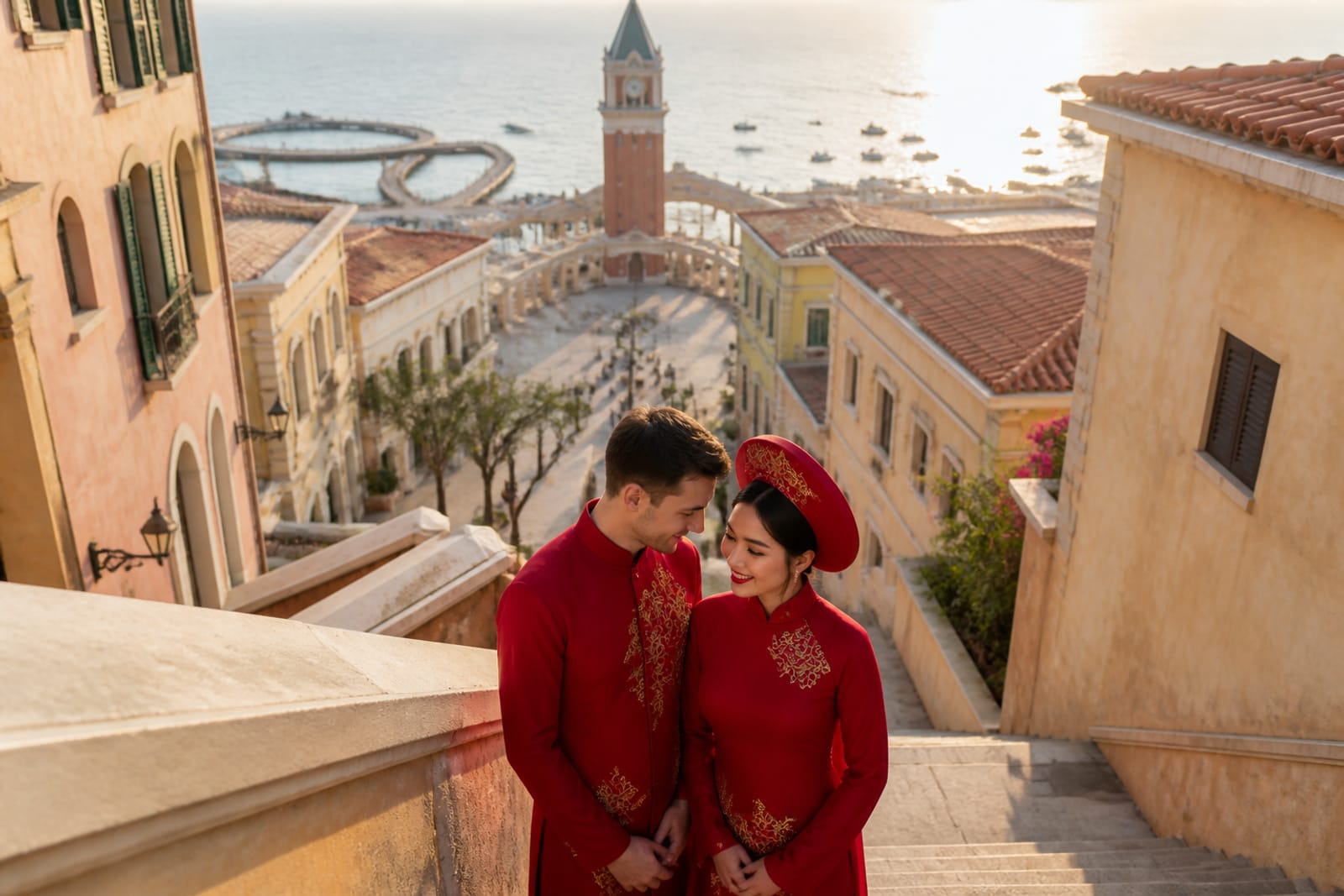
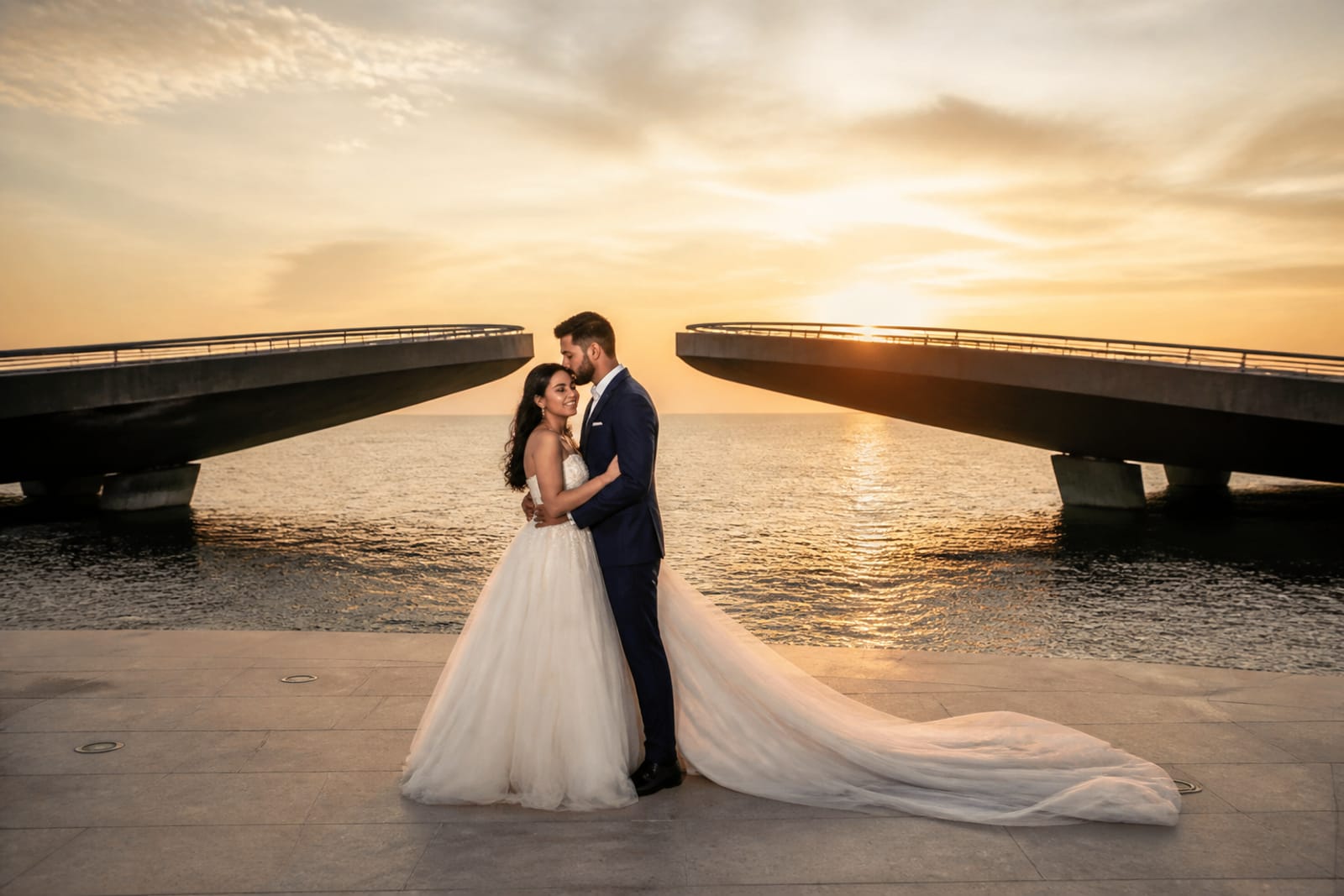
The best light at Sunset Town and Kiss Bridge arrives 30–50 minutes before sunset during Phu Quoc's dry season (Nov–Apr), when skies are clear and the sea stays calm. Golden-hour sidelight sculpts faces and fabric without blown highlights; long shadows add depth to wide frames. Solo photographers risk missed details and costume changes; one integrated team (photographer, makeup, stylist) adjusts light angles in real time and reshoot if clouds shift. Crowds peak near sunset itself, so arriving early and shooting as light tilts rewards patient framing. Cáo Studio shoots pre-wedding sessions in Hanoi, Ho Chi Minh City and by appointment in Hoi An—ask on WhatsApp for Phu Quoc logistics and local photographer referrals.
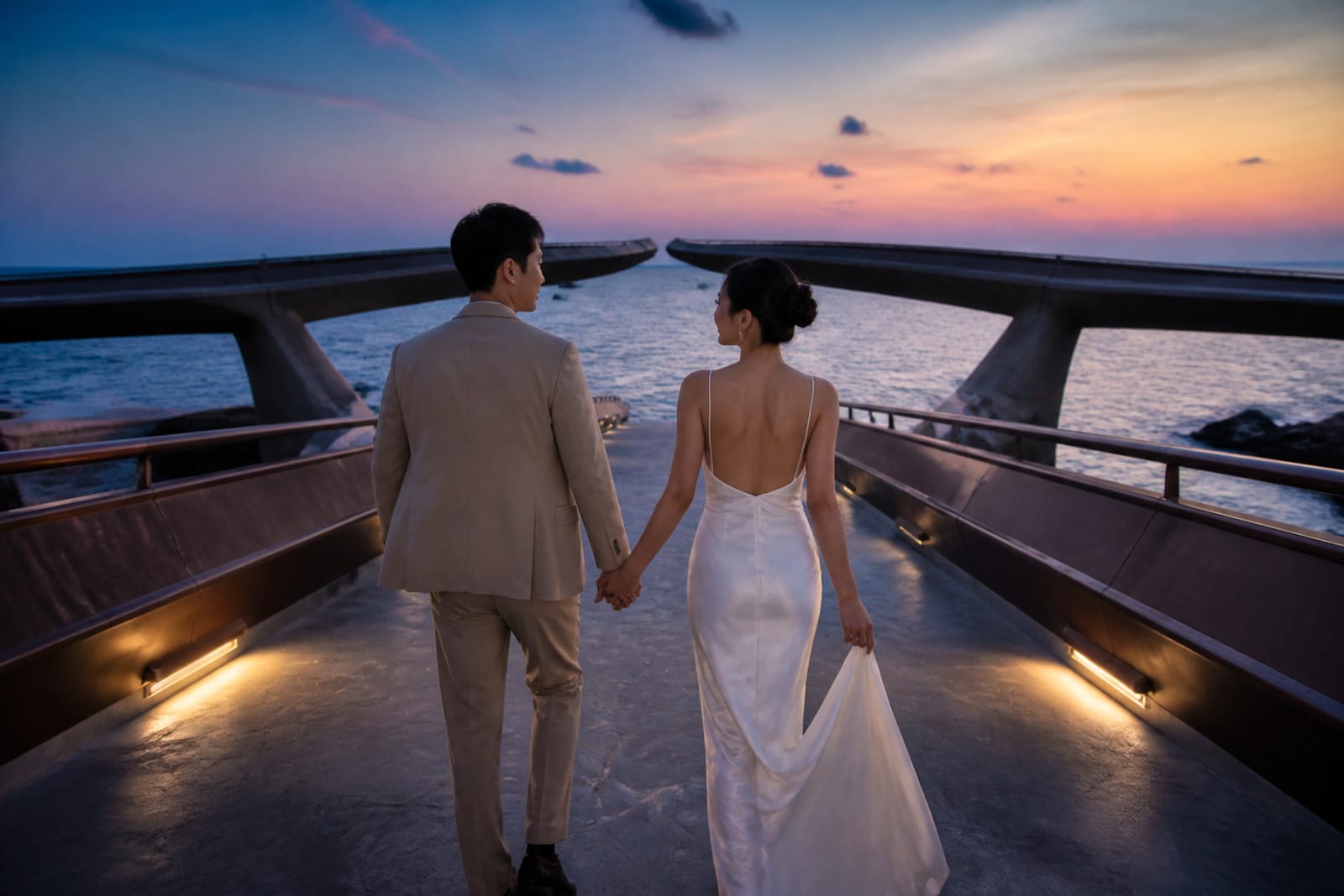
Sunset Town's pastel pavilion and the Kiss Bridge's gentle curve are framed for west-facing light. That facing angle locks your timing: you cannot chase the sun; the sun must hit the landmarks at the angle that reads. Most couples book based on Instagram alone, then arrive to flat midday light or silhouettes. The difference between a keeper and a cliché is 20 minutes and a crew that moves faster than clouds.
Why do light and time matter more than you think?
Golden hour—the 30–50 minutes before sunset—isn't magic; it's geometry. Sun angle at Sunset Town and Kiss Bridge is lowest and warmest on the western horizon, grazing across water and skin without overhead harshness. Sidelight flatters ao dai drape, catches embroidery texture, and separates you from the background. Flat midday light (10 am–3 pm) drowns color and flattens fabric. Blue hour (10–20 minutes after sunset) deepens sky tone but requires faster film or steady hands—not all editing recovers it cleanly. Arrival time and shot sequence are the real tools; light doesn't wait.
📸 Book on WhatsApp — pre-wedding photoshoot
When is the dry season, and does weather really block the shoot?
Phu Quoc's dry season runs Nov–Apr: calm seas, clear skies, predictable afternoon light. Rainy season (May–Oct) brings daily downpours, usually short and afternoon-timed, but cloud cover is heavy. Overcast light is soft and even—it flattens shadow and dulls gold—so midday feels bearable, but golden hour loses punch. Humidity is high year-round; sweat and humidity affect makeup durability, so factor in touch-ups. If you're flexible, book Nov–Feb for clearest skies and the coolest air. Tet (late Jan–mid Feb) closes services and crowds landmarks, so avoid that window.
What outfit choice shapes how light reads on camera?
An ao dai's silk or cotton sheen bounces light differently than a wedding dress's structured tulle. White ao dai glows in golden hour but clips (burns white) if sun directly hits the front—sidelight and backlight work better. Jewel tones (emerald, burgundy, navy) hold detail in shadow; pastels (cream, pale pink) brighten but risk overexposure. Layer with a shawl or jacket for texture and shadow variety. Groom suits in grey or cream reflect warmth; black absorbs it and can read as a silhouette. Hair loose catches backlight and rim-light; pinned hair shows facial side-light better. Makeup must account for warm golden tone—cool foundations can photograph muddy in sunset light. Chat with your team (hair, makeup, photographer) about outfit before the shoot; light and fabric are one decision.
| Outfit type | Best light window | Why it works | What to watch |
|---|---|---|---|
| White ao dai | Sidelight, 30–40 min before sunset | Glows without clipping | Avoid direct front light; test backlight |
| Jewel-tone ao dai | Anytime golden hour | Holds shadow detail, reads rich | Needs less reflector bounce |
| Grey/cream suit | 30–50 min before sunset | Warm tone flatters skin, holds texture | Darker suit reads flat; test in-person |
| Layered shawl/jacket | Golden hour sidelight | Adds depth, breaks up large shapes | Weight and drape affect movement |
Should you hire one team or book a photographer separately?
A solo photographer arrives, shoots, and leaves—no assistant to reset outfit, check light angle while you're in frame, or catch emotion in a second camera angle. Hair and makeup vendors work from a phone call; timing is loose; if light shifts, one person cannot reframe and relight fast enough. Cáo Studio's integrated approach means the photographer, hair artist, makeup artist and stylist move as one unit. While you're being touched up for a dress change, the photographer scouts the next frame and tests light. If clouds roll in, the team pivots to a backlit angle or a different backdrop within minutes. You do not wait for three vendors to coordinate or find yourself with a rushed makeup touch-up while light is golden. A single booking also means one message: the outfit, hair, makeup and camera all support the same story, not three separate aesthetics.
Booking a solo local photographer on Phu Quoc can work if you research portfolio and ask specific questions: Does the photographer shoot in golden hour regularly? Can they move fast if light changes? Do they have a second card or backup battery? (Dust and humidity degrade electronics fast.) Will they adjust your pose or just direct you to smile? A pre-wedding pre-wedding photoshoot deserves someone you've reviewed in person or via trusted referral, not a Fiverr review.
How do crowds affect the shoot, and can you avoid peak times?
Sunset Town and Kiss Bridge see heaviest foot traffic 4:45 pm–6 pm, when tour groups and day-trippers arrive to catch sunset. You will share frames with strangers, phone cameras, and selfie sticks. Arriving at 3 pm gives you calm light, fewer people, and time to scout angles—but light is still flat and overhead. Shooting 5:30 pm–6:15 pm (30–50 minutes before actual sunset) hits golden hour and lighter crowds because tourists are already at the pavilion steps, not walking the bridge. You work in the foreground while they're in the background. The trade-off: you're rushing (sun drops fast), so the team must know the location and be set up before you arrive. No scouting; no second chances. Cáo Studio arrives on-location early, marks the light, and briefs you in the car.
What should you check before booking a pre-wedding shoot here?
Ask the photographer or studio:
- Light timing. Do they commit to a specific start time, or just "sunset"? (Sunset itself is too late.)
- Backup plan. If clouds block golden hour, do they have an alternate location or shoot in blue hour? What's included?
- Team size. Is it one photographer or a crew? If one, who handles outfit/hair changes while shooting?
- Outfit changes. How many outfits can fit in the time? Does the team bring styling, or do you?
- Editing timeline. When do you get the gallery? Rushed edits look flat; ask for the delivery date in writing.
- Local knowledge. Have they shot Sunset Town in the last six months? Light changes season to season; old portfolios mislead.
- Backup gear. Humidity and salt air corrode cameras. Ask if they bring backup bodies and lenses.
- Weather clause. What happens if rain or typhoon warning closes the coast that day?
Most pre-wedding sessions here run 2–3 hours (one sunset cycle). Cáo Studio coordinates makeup & hair at your hotel before the shoot, so you arrive at Sunset Town ready and the team is not managing hairspray and brushes on location. That's how the real light gets saved.
FAQ
What time should I actually arrive at Sunset Town and Kiss Bridge?
Arrive 60 minutes before your target sunset time. This lets the team scout light angles, test exposure, and reset outfit while tourists are still at the pavilion. Shooting begins 30–50 minutes before sunset when golden hour peaks.
Can I shoot at Sunset Town if it's cloudy or rainy?
Cloud cover kills golden-hour punch; colors flatten and skin tones gray out. Rainy season (May–Oct) is high-humidity and overcast. If weather is unpredictable, book during Phu Quoc's dry season (Nov–Apr) and ask your team about backup locations.
Do I need an ao dai, or can I wear a wedding dress?
Either works. Ao dai silks glow in golden sidelight; wedding dresses read formal and large. White fabric clips easily in direct sun, so your photographer must know to use backlight or sidelight angles. Discuss outfit choice with your team before the shoot.
How many outfit changes fit in one session?
1–2 outfits realistically, if the team is fast and light holds. Each change eats 10–15 minutes (touch-ups, walking to frame, resetting). Three outfits requires more time or shorter light windows per outfit. Cáo Studio discusses outfit count when you book.
Should I hire a photographer in Ho Chi Minh City and book him to travel to Phu Quoc?
Travel photographers exist, but ask: Do they know Phu Quoc's light and tide? Will they stay overnight? Do they charge travel time? Cáo Studio shoots pre-wedding sessions in Hanoi and Ho Chi Minh City, and can advise on Phu Quoc logistics via WhatsApp. Ask us about referrals to local photographers who know the islands.
How quickly will I get the photos back after the session?
Turnaround varies by team. Cáo Studio delivers edited photos and a short vertical film within 48 hours; confirm exact timeline when you book. Solo photographers often take 1–2 weeks. Ask for the delivery date in writing before you sign.
FAQ
What time should I actually arrive at Sunset Town and Kiss Bridge?
Arrive 60 minutes before your target sunset time. This lets the team scout light angles, test exposure, and reset outfit while tourists are still at the pavilion. Shooting begins 30–50 minutes before sunset when golden hour peaks.
Can I shoot at Sunset Town if it's cloudy or rainy?
Cloud cover kills golden-hour punch; colors flatten and skin tones gray out. Rainy season (May–Oct) is high-humidity and overcast. If weather is unpredictable, book during Phu Quoc's dry season (Nov–Apr) and ask your team about backup locations.
Do I need an ao dai, or can I wear a wedding dress?
Either works. Ao dai silks glow in golden sidelight; wedding dresses read formal and large. White fabric clips easily in direct sun, so your photographer must know to use backlight or sidelight angles. Discuss outfit choice with your team before the shoot.
How many outfit changes fit in one session?
1–2 outfits realistically, if the team is fast and light holds. Each change eats 10–15 minutes (touch-ups, walking to frame, resetting). Three outfits requires more time or shorter light windows per outfit. Cáo Studio discusses outfit count when you book.
Should I hire a photographer in Ho Chi Minh City and book him to travel to Phu Quoc?
Travel photographers exist, but ask: Do they know Phu Quoc's light and tide? Will they stay overnight? Do they charge travel time? Cáo Studio shoots [pre-wedding sessions](/pre-wedding-photoshoot) in [Hanoi](/hanoi) and [Ho Chi Minh City](/saigon), and can advise on Phu Quoc logistics via WhatsApp. Ask us about referrals to local photographers who know the islands.
How quickly will I get the photos back after the session?
Turnaround varies by team. Cáo Studio delivers edited photos and a short vertical film within 48 hours; confirm exact timeline when you book. Solo photographers often take 1–2 weeks. Ask for the delivery date in writing before you sign.
Ao dai, makeup, hair and a local photographer in Hanoi or Saigon — one WhatsApp message.