/pre-wedding-photoshoot
Ta Phin Village wedding photos: best time of day and light
Ta Phin village, 12 km from Sapa town in northwest Vietnam's Lao Cai province, is a working community with terraced rice and stone houses—not a staged set. Best light arrives early morning (6–7 am, side light on fields, no crowds) or late afternoon (5–6 pm, warm tones, walking paths clear). Midday (11 am–3 pm) produces harsh overhead shadows that flatten terraces and require careful framing. Cáo Studio does not operate in Sapa, so work with a vetted local photographer who knows the village footpaths, village access rules and how season (May green, Sep–Oct golden, Dec–Feb misty) changes composition. Avoid Tet (late January–mid February) when many services close and paths are crowded. Confirm permits, parking and whether villagers permit photography in advance. ---
Why is early morning the most reliable time at Ta Phin?
6–7 am offers side light that models the terraced landscape without flattening it—the sun sits low enough to catch field edges and stone walls in shadow and highlight. Morning air is usually clear (mist burns off by 7:30 am in dry season), crowds haven't arrived, and couples can walk freely without tourists in frame. The trade-off: you must start before dawn to reach the village, which means a 4:30 am pickup from Sapa town and a bumpy 45-minute drive on a single-lane mountain road. If your couple is jet-lagged or prefers a gentler pace, this timing can feel rushed. Best suited for couples willing to wake early for calm, intimate light and who travel with a photographer experienced in mountain terrain and quick setup.
When does late afternoon light work better than sunrise?
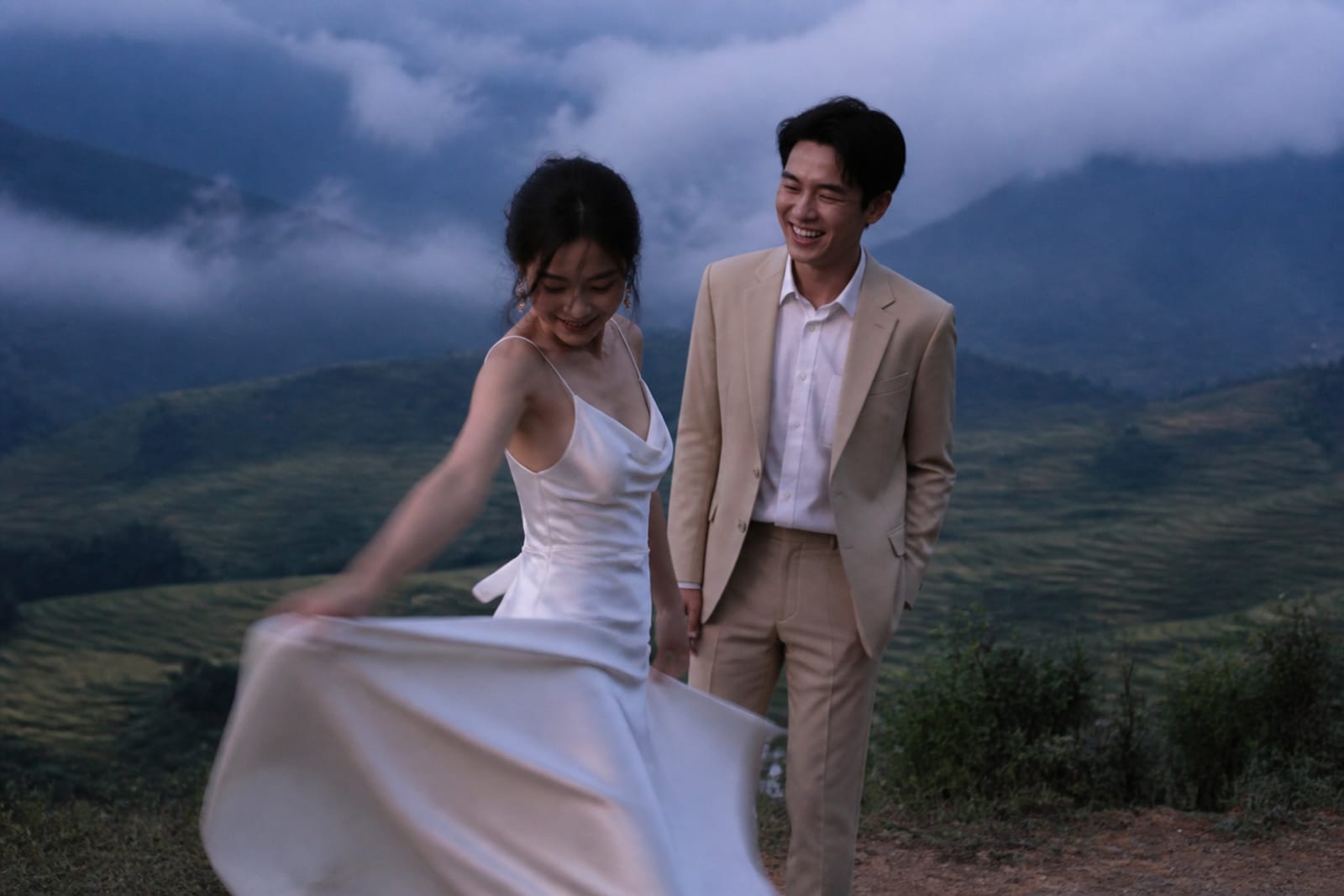
5–6 pm delivers warm, directional light across terraced faces without the pre-dawn logistics. The sun angles from the west, casting long shadows that emphasize field contours; golden tones suit fabric textures (ao dai silk, linen trousers, woven scarves). Paths are quieter than midday but not empty—some villagers and occasional trekkers are still moving, which can add authenticity to walking shots but requires a photographer quick enough to frame between passersby. Daylight lasts until roughly 6:30 pm in dry season (Dec–Apr), giving a 90-minute window. Sunset itself (6:15–6:45 pm) produces rim-lit silhouettes that work well for couples walking away from camera or standing against the landscape. The risk: if clouds roll in or mist rises—common in wet season (May–Sep)—the light can dim fast. Plan for a second location nearby in case the first spot loses light early.
Light, season and framing: what works where?
| Season & Light | Best for | Terraces | Why it works | What to watch |
|---|---|---|---|---|
| May–Aug (wet, green) | Lush, moody shots | Waterlogged, deep green | Rich colour contrast, mist adds mystery | Afternoon clouds cut light; rain common; paths muddy |
| Sep–Oct (harvest, golden) | Warm tones, clear air | Golden-brown, dry edges | Bright morning and evening, sharp detail | Midday glare intense; early season still wet |
| Nov–Mar (cool, mist) | Minimalist, atmospheric | Layered grey-on-grey | Soft, diffused light all day; no harsh shadows | Heavy mist blocks detail; fewer colours; cold wind |
| Dec–Feb (Tet closure) | Avoid if possible | Variable | Many guides/homestays closed; crowds before Tet | Roads congested; services reduced |
---
How do you choose a local photographer for Ta Phin?
Cáo Studio works in Hanoi and Ho Chi Minh City, but Sapa requires a local team. Vet by asking: (1) How many Ta Phin shoots have they led? (2) Do they have a village guide or local contact? (3) Can they show a portfolio sorted by season and time of day—not just curated highlight reels? (4) Do they know the village access protocol (whether homestays permit photography, if paths require a guide)? (5) What's their backup plan if mist blocks the primary location? Ask for a breakdown of their shoot timeline: travel time from Sapa town, setup duration, walking routes, and buffer time before sunset. A photographer who hasn't scouted Ta Phin recently may not know current path conditions or village sentiment about couples' shoots. Request a planning call 2–3 weeks before your date to confirm logistics, discuss outfit fit on rough terrain (ao dai trains catch brambles; consider a short version or a second outfit), and lock in a weather contingency.
What outfit and styling works best at Ta Phin?
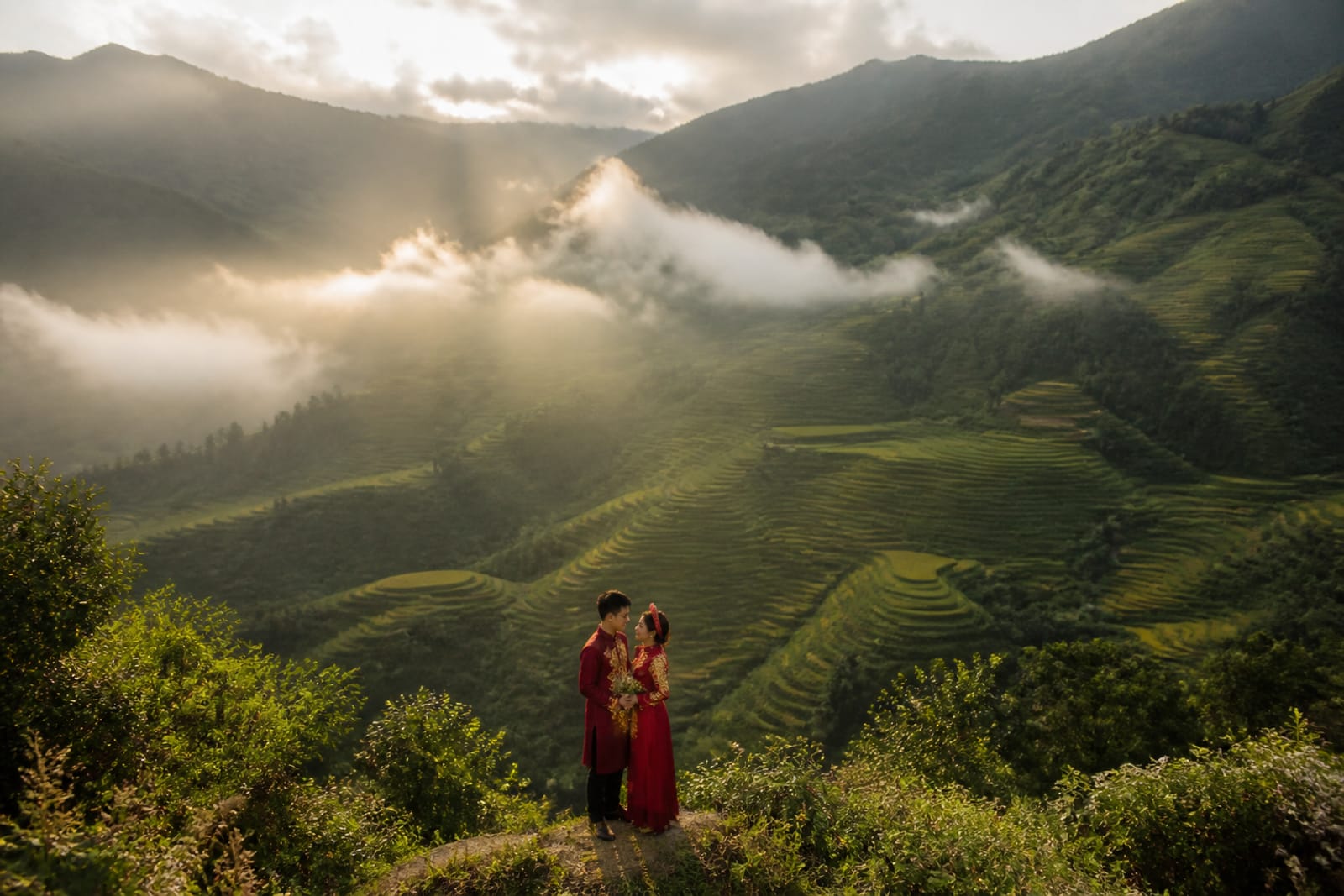
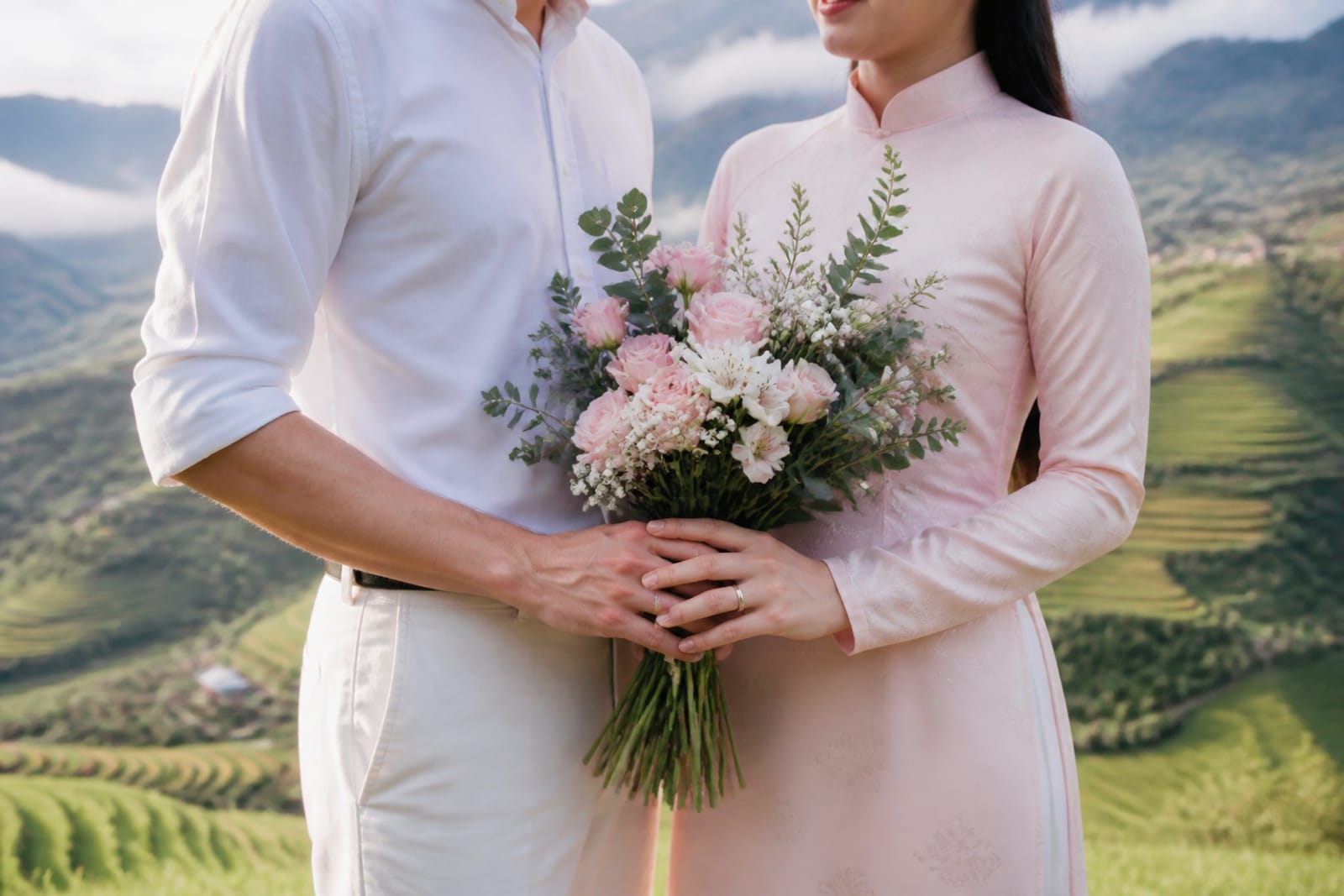
Ao dai is the obvious choice—the textile and silhouette suit landscape photography—but terrain matters. Full trains (traditional ao dai) snag on field edges and stone; opt for a cropped or split version, or bring two versions (formal for standing frames, practical for walking shots). Groom in a matching fabric tone (cream, grey, rust) or a neutral suit keeps the frame cohesive without fussy detail. Accessories (hats, scarves, umbrellas) add local authenticity if worn naturally—not as props. Hair and makeup should withstand wind and humidity; loose waves photograph better than tight styles under harsh midday light, and matte finish suits earthy tones better than shine. If shooting in wet season, avoid white or pale fabrics (mud splashes show; colours read muddier in overcast light). Test shoes on the drive up—Sapa's mountain air is cold and paths slope; slip-on heels or slippers won't work. A lightweight shawl handles wind and provides a coverage option if afternoon clouds bring drizzle.
📸 Book on WhatsApp — pre-wedding photoshoot
What to check before you book a Ta Phin shoot.
- Photographer experience: Ask for 3–5 Ta Phin shoots by season (not just Sapa generic shots). Request raw light and composition notes, not just edited finals.
- Travel time and logistics: Confirm travel pickup, drive duration, parking, and whether a village guide is included or costs extra.
- Weather backup: Is a second location pre-scouted? What happens if mist doesn't clear by 7:30 am? Do you reschedule, move downhill, or shoot anyway?
- Permit and access: Clarify whether homestays or the village formally permit couple shoots. Some homestays charge a small access fee; confirm upfront.
- Outfit fit: If wearing ao dai, will the photographer advise on train length and fabric weight for walking? Do they provide a changing space?
- Delivery timeline: How many edited images, by when? Do you get RAW files? Is a short video included or quoted separately?
- Cost factors (not amounts—ask for a WhatsApp quote): Season (May–Aug costs more due to rain logistics), travel distance from Sapa town, number of outfits, video, and delivery speed all affect pricing. Peak travel months (Sep–Oct, Dec–Jan) see higher photographer rates.
---
Why should couples consider Ta Phin over other Sapa options?
Ta Phin offers working landscape and human presence—terraces are actively farmed, not museum pieces. Other popular Sapa spots (Cat Cat, Sin Chai) are flatter, more touristy, and have harsher midday light. Ta Phin's contoured fields and stone architecture demand specific timing and framing, which means fewer cookie-cutter images and more storytelling potential. The trade-off: logistics are harder (longer drive, rougher paths, fewer backup cafés). Best suited for couples who prioritize authentic landscape over convenience, who can wake early or stay late, and who work with a photographer who scouts ahead rather than improvise on the day. For a full destination pre-wedding experience in a more service-ready location, consider Hanoi's Old Quarter or Hoi An—both have better infrastructure and easier light windows.
---
When is the worst time to shoot at Ta Phin?
11 am–3 pm produces overhead sun, harsh shadows under the chin and across terraces, and washed-out colours in midday glare. If you're committed to midday, choose wide landscape shots (terraces recede and shadow detail is less visible) or move to shaded stone paths. October to November midday glare is worst. November to March, midday is actually softer due to lower sun angle and frequent mist, so the constraint is less severe—but you gain the aesthetic trade-off of cooler tones and reduced colour saturation.
FAQ
Do we need a special permit to shoot in Ta Phin village?
No formal permit is required for casual visiting, but couples' shoots—especially with outfit changes or professional equipment—benefit from notifying a local homestay or guide beforehand. Some homestays appreciate a small courtesy donation. Ask your photographer to confirm current village protocols; practices vary.
Can we do an ao dai shoot at Ta Phin if neither of us is Vietnamese?
Yes. Ao dai is worn by guests at Sapa photoshoots regardless of background. The silhouette suits terraced landscape framing. Wear it respectfully—it's a cultural textile, not a costume. Hire a local photographer who understands how to frame couples in that context, and consider pairing it with a second outfit (Western formalwear) for variety.
What's the difference between early morning and golden hour for light quality?
Early morning (6–7 am) is cooler-toned, softer, and side-lit from the east; shadows are long and define landscape contours. Golden hour (5–6 pm) is warm-toned, also side-lit but from the west, and suits skin tones and fabric texture better. Morning favours landscape drama; evening favours couple intimacy. Both require a professional who knows how to expose for the couple without blowing out the sky.
Is Ta Phin walkable in an ao dai during the rainy season?
Paths are muddy and steep May–September. A practical ao dai (cropped or split) is more manageable than a full train. Wear flat, grippy shoes off-camera, then change for seated or standing frames. Ask your photographer if they've scouted alternate, drier routes or if a second (non-ao dai) outfit suits the conditions better.
How much time should we budget for a Ta Phin pre-wedding shoot?
Ask your photographer for a detailed itinerary. Typical: 4:30 am pickup from Sapa, 45-min drive, 2–3 hours shooting, 45-min return. A full-day shoot may include breakfast at a homestay or a second location. Half-day golden-hour shoots (1–2 hours) need less logistical overhead. Confirm whether travel time is included in the quoted rate or separate.
Can we shoot Ta Phin in December if it's cold and misty?
Yes, mist and cool light suit moody, minimalist frames. Layers and a shawl work well visually. The risk: thick mist obscures terraces entirely, reducing landscape definition. Ask your photographer if they have a lower-elevation or less-misty backup location within 30 minutes' drive. Morning December mist often clears by 8–9 am. ===INTERNAL LINKS (MARKDOWN FORMAT SAMPLE) - ao dai photoshoot - couple photoshoot - pre-wedding photoshoot - Cáo Studio Hanoi - Cáo Studio Saigon - makeup & hair - lookbook
FAQ
Do we need a special permit to shoot in Ta Phin village?
No formal permit is required for casual visiting, but couples' shoots—especially with outfit changes or professional equipment—benefit from notifying a local homestay or guide beforehand. Some homestays appreciate a small courtesy donation. Ask your photographer to confirm current village protocols; practices vary.
Can we do an ao dai shoot at Ta Phin if neither of us is Vietnamese?
Yes. Ao dai is worn by guests at Sapa photoshoots regardless of background. The silhouette suits terraced landscape framing. Wear it respectfully—it's a cultural textile, not a costume. Hire a local photographer who understands how to frame couples in that context, and consider pairing it with a second outfit (Western formalwear) for variety.
What's the difference between early morning and golden hour for light quality?
Early morning (6–7 am) is cooler-toned, softer, and side-lit from the east; shadows are long and define landscape contours. Golden hour (5–6 pm) is warm-toned, also side-lit but from the west, and suits skin tones and fabric texture better. Morning favours landscape drama; evening favours couple intimacy. Both require a professional who knows how to expose for the couple without blowing out the sky.
Is Ta Phin walkable in an ao dai during the rainy season?
Paths are muddy and steep May–September. A practical ao dai (cropped or split) is more manageable than a full train. Wear flat, grippy shoes off-camera, then change for seated or standing frames. Ask your photographer if they've scouted alternate, drier routes or if a second (non-ao dai) outfit suits the conditions better.
How much time should we budget for a Ta Phin pre-wedding shoot?
Ask your photographer for a detailed itinerary. Typical: 4:30 am pickup from Sapa, 45-min drive, 2–3 hours shooting, 45-min return. A full-day shoot may include breakfast at a homestay or a second location. Half-day golden-hour shoots (1–2 hours) need less logistical overhead. Confirm whether travel time is included in the quoted rate or separate.
Can we shoot Ta Phin in December if it's cold and misty?
Yes, mist and cool light suit moody, minimalist frames. Layers and a shawl work well visually. The risk: thick mist obscures terraces entirely, reducing landscape definition. Ask your photographer if they have a lower-elevation or less-misty backup location within 30 minutes' drive. Morning December mist often clears by 8–9 am. ===INTERNAL LINKS (MARKDOWN FORMAT SAMPLE) - [ao dai photoshoot](/ao-dai-photoshoot) - [couple photoshoot](/couple-photoshoot) - [pre-wedding photoshoot](/pre-wedding-photoshoot) - [Cáo Studio Hanoi](/hanoi) - [Cáo Studio Saigon](/saigon) - [makeup & hair](/makeup-and-hair) - [lookbook](/lookbook)
Ao dai, makeup, hair and a local photographer in Hanoi or Saigon — one WhatsApp message.