/pre-wedding-photoshoot
Timeline of a pre-wedding photoshoot day in Mekong Delta
A pre-wedding shoot day in the Mekong Delta typically runs 6–8 hours, from before sunrise through mid-afternoon when light flattens and humidity peaks. Sunrise (5:50–6:30 am) delivers the softest, most directional light at floating markets or along canal banks; mid-morning (8:30–10:30 am) works for fields and orchard backdrops; by noon, overhead sun creates harsh shadows unless you're near water that bounces diffuse light. The dry season (December–April) guarantees clear water and manageable heat; May–November brings afternoon downpours and flooding that can cancel or relocate shoots. A local Mekong photographer works better than shipping a team from Hanoi or Ho Chi Minh City because they know exact tide times, market schedules and which narrow paths dry out fastest after rain. Cáo Studio does not operate in the Mekong Delta, but this guide shows you what to look for when vetting a local photographer and structuring your day.
Why does sunrise timing matter more in the Mekong than in cities?
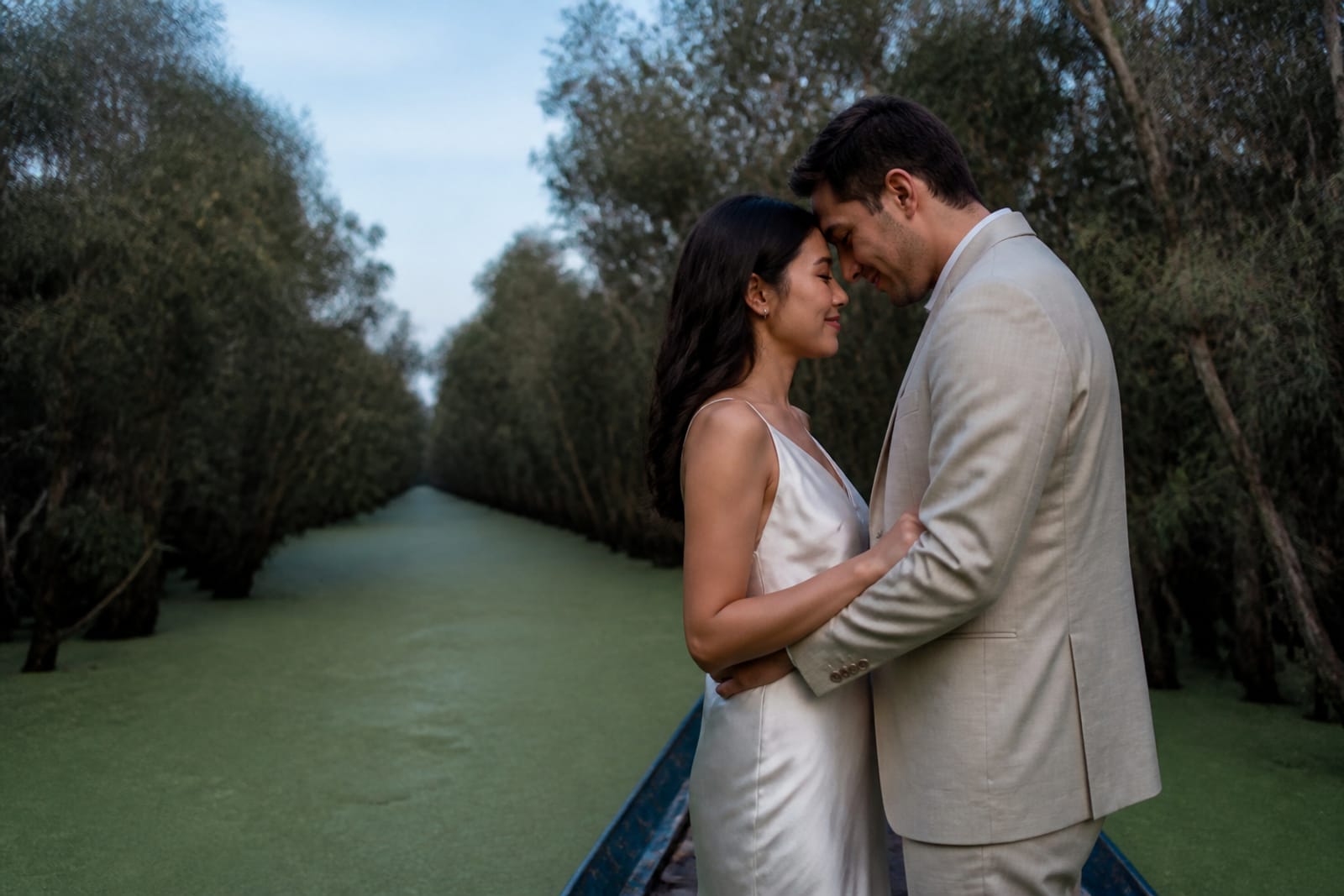
Sunrise in the Mekong Delta (roughly 5:50–6:30 am from December to April) happens over water that reflects light back onto your face and ao dai. In cities, buildings and street canyons trap and scatter that early light; at the river, water acts as a natural reflector, softening shadows and extending the "golden window" by 20–30 minutes. Markets fill fast—by 7:00 am, vendors block narrow paths and boat traffic thickens—so arriving at 5:45 am means you shoot before crowds, when water is mirror-still and mist hangs over coconut groves. By 8:00 am, the scene is loud and busy. A local photographer knows which floating market opens earliest and which canal paths stay empty longest; that knowledge is worth more than a beautiful portfolio alone.
📸 Book on WhatsApp — ao dai photoshoot
What outfit changes work best across a full Mekong day?
Sunrise calls for a lightweight ao dai (silk or linen blend) in jewel tones—burgundy, emerald, navy—that read clearly against pale sky and water. By 9:30 am, when sun climbs higher, a pale or white ao dai reflects heat better and photographs cleaner in brighter conditions. Avoid heavy beading or metallic thread that flares in direct sun; keep jewelry minimal so light doesn't bounce off shoulders and distract from your face. Bring a shawl or cardigan for the 6:00–7:00 am chill (mornings are cooler than you expect, especially December–February). A second outfit—a casual silk shirt and trousers, or a light dress—works for mid-afternoon scenes in orchards or village homes when you've moved past water light. Changing outfits takes 15–20 minutes including hair and makeup touch-up; factor that into your timeline with the photographer so you don't lose the best light waiting for wardrobe shifts.
How does season affect the entire shoot day?
| Season | Best light window | Water condition | Heat & humidity | Rain risk | Why it matters |
|---|---|---|---|---|---|
| Dec–Feb (cool dry) | 6:00–11:00 am | Calm, clear | Mild mornings, warm by noon | Rare | Longest usable light window; mist adds mood |
| Mar–Apr (hot dry) | 5:45–10:00 am | Calm, clear | Intense by 8:30 am; plan shade breaks | Very rare | Heat peaks faster; shoot earlier, wrap by 11:00 am |
| May–Sep (wet season) | 5:30–8:00 am only | High, turbid, fast-moving | Oppressive; mist + humidity | Daily afternoon storms | Very short window; one rain cancels the shoot |
| Oct–Nov (typhoon risk) | Unpredictable | Flooding, debris | Humid, erratic | Frequent, severe | Avoid if possible; check weather 7 days prior |
December–April is the only reliable window for a full day shoot. February is peak season (mild mornings, clear water, manageable afternoon heat) but also busiest—book at least 8–10 weeks ahead. March–April light is harsher and the day compresses to 5–6 usable hours because heat forces an earlier wrap. May–September shoots must start before 6:00 am and finish by 10:00 am, leaving only three hours for multiple locations and outfit changes; every shoot risks afternoon downpours. A local photographer will tell you honestly if a May booking is viable; an outsider may oversell it.
What should a Mekong pre-wedding timeline look like hour by hour?
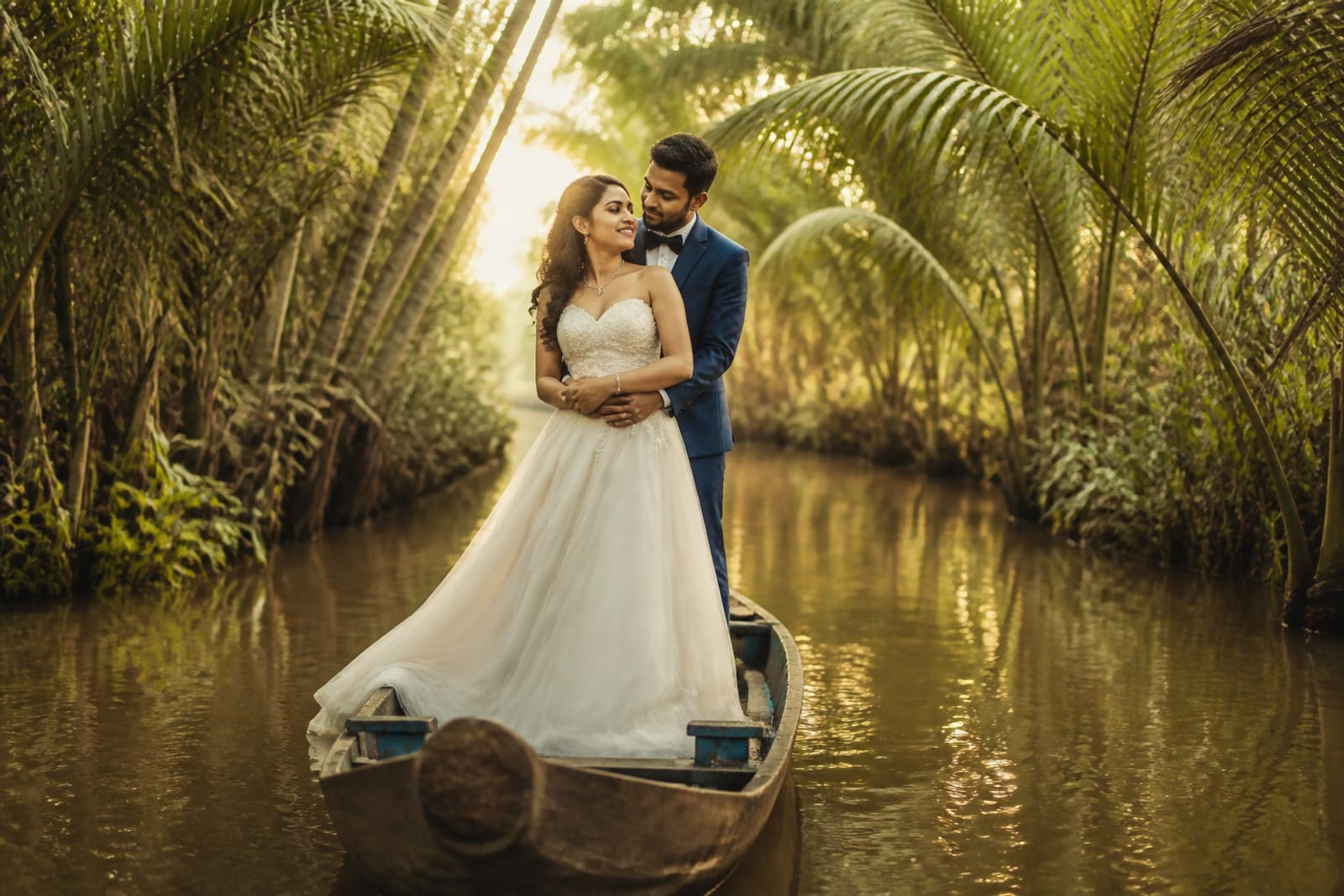
5:15 am: Meet at a cafe or hotel near your first location (a floating market or canal path). Hair and makeup final touch (20 minutes).
5:45–6:45 am: Sunrise shoot at floating market or water's edge. Soft light, water reflections, minimal crowds. Change outfit if planned.
7:00–8:30 am: Move to second location (orchard, village path, wooden house backdrop). Light is still directional and cool; heat is manageable.
8:45–10:00 am: Third location or detail shots (hands, jewelry, walking through fields). By 9:30 am, sun is overhead; look for shade or water reflection to soften shadows.
10:15–11:00 am: Wrap or move to an indoor/shaded location (covered market, family home, temple grounds) if you booked a full-day session. Heat and overhead sun make outdoors unflattering after 11:00 am.
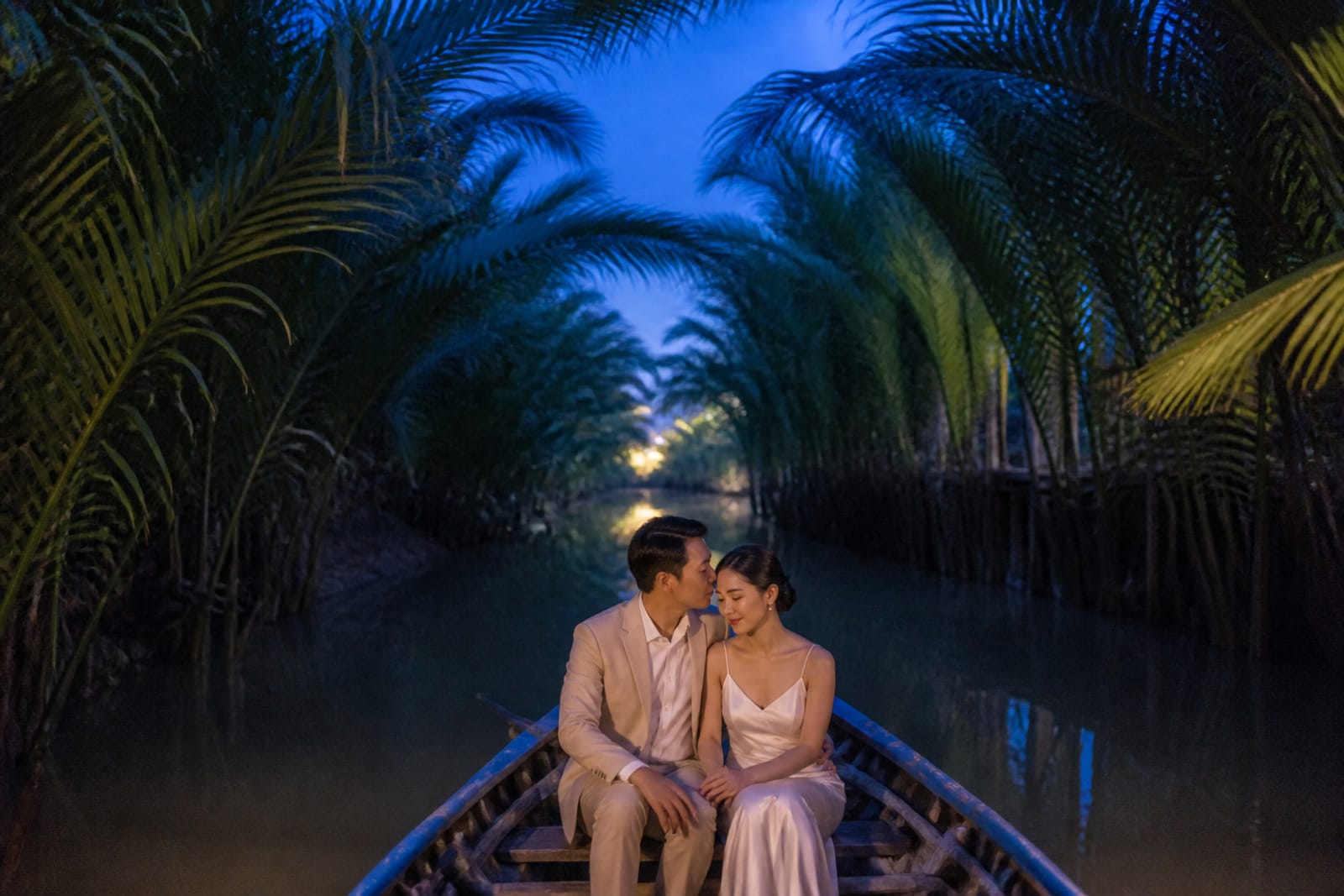
Afternoon (optional, not recommended): If you must shoot past 11:00 am, choose water-adjacent locations (boats, riverside pavilions) where light bounces off the surface. Rest at midday; heat peaks 12:00–3:00 pm.
A tight morning schedule (5:45–10:30 am) delivers the best light and avoids heat; a full-day shoot (5:45 am–1:00 pm) requires careful pacing and shade planning. Fewer locations with longer time at each beats rushing between five spots in harsh light.
How do you choose between a Mekong local photographer and hiring from outside?
A local Mekong photographer (based in Can Tho, My Tho, Vinh Long or Ben Tre) knows tide tables, market schedules, weather patterns and which paths are passable on your exact shoot date. They've shot the same locations 100+ times and know which angles avoid midday tourists, where light reflects off water, and how to move fast in tight spaces. Shipping a photographer from Hanoi or Ho Chi Minh City adds travel cost (a factor, though not stated as a figure), means they arrive unfamiliar with local conditions, and they may not know which floating market stays uncrowded past 7:00 am. For a pre-wedding shoot in the Mekong, a local photographer produces sharper, faster work because logistics don't slow them down.
How to vet one: ask for 3–5 full pre-wedding day galleries (not individual shots); check if they've shot the exact location you want on the same month; confirm they know current water levels and market hours. Ask what happens if it rains (do they reschedule, move indoors, or shoot anyway?). A photographer who answers in vague language ("we'll find beautiful light") rather than specifics ("if water is high, we'll use the Vinh Long temple grounds, which has 30-minute morning light between 6:15–6:45 am") is less reliable. Request a written timeline and shot list before you book, and confirm they have backup locations for rain.
What to check before you book a Mekong pre-wedding shoot
Season and weather: Confirm the photographer has shot your intended month and can show you weather-dependent rescheduling terms. December–February is safest; avoid May–November unless you're flexible on dates.
Exact locations and light times: Ask them to specify the order of locations and the light window at each. "Floating market sunrise" is vague; "Cai Rang floating market, 6:00–7:00 am, wide shots from a boat, then shore paths for detail" is concrete.
Outfit and hair logistics: Confirm whether they arrange hair and makeup or if you hire separately. In the Mekong, finding a makeup artist who works before 6:00 am is difficult—many local studios open at 9:00 am. Ask if they partner with anyone or if you need to hire someone from Can Tho or Saigon and bring them with you.
Backup and contingency: What happens if it rains? Are rescheduling dates included or charged separately? Can they pivot to indoor locations (temples, wooden houses, covered markets) with the same quality? A written contract covering this is essential, especially in rainy season.
Editing timeline and file delivery: How long until you receive edited photos? How many edited files are included? What format (digital only, prints, album)? When the Mekong shoot wraps, you still wait days or weeks for the final edit—confirm that timeline matches your engagement announcement or wedding date.
Payment and cancellation: What percentage is non-refundable if you cancel? What if the photographer cancels due to weather or illness? Get this in writing before you hand over any deposit.
For shoots in Hanoi, Ho Chi Minh City or Hoi An, Cáo Studio handles all logistics—wardrobe, hair, makeup and photography as one team—so you skip the vendor coordination. Outside those bases, you're assembling a local team yourself; that clarity protects both you and the photographer.
FAQ
What time of year has the clearest water for reflection shots?
December–February offers the clearest water and calmest conditions. March–April water is still clear but heat forces an earlier wrap. May–November water is turbid and flood risk peaks October–November; avoid that window if reflection light matters.
Can I do a half-day Mekong shoot instead of a full day?
Yes. A 4–5 hour morning session (5:45–10:00 am) captures the best light, fits two locations and one outfit change, and avoids paying for midday rest time when heat peaks. Full-day bookings suit couples who want three outfits or a relaxed pace; confirm with your photographer which duration they offer.
What happens if it rains the morning of my shoot?
Ask the photographer before you book: do they reschedule to the next clear day, move to indoor/covered locations, or refund? Dry season (Dec–Apr) rain is rare; wet season (May–Nov) afternoon rain is nearly daily. Most photographers won't shoot in active rain (water images blur, gear risks damage). Written cancellation and reschedule terms are essential.
Do I need a local makeup artist or can I do my own?
Professional makeup reads better in soft dawn light and withstands 8 hours of humidity and water spray. Hiring a local makeup artist (ask your photographer for a recommendation) avoids shipping one from the city and ensures they know pre-dawn timing. Budget time for makeup at your hotel or a nearby salon; they rarely open before 7:00 am.
Can the photographer edit and deliver photos in 48 hours?
A local photographer may take 3–7 days to edit a full shoot because they often juggle multiple bookings. Cáo Studio (based in Hanoi and Ho Chi Minh City) returns edited photos and a short film within 48 hours, but Cáo Studio does not operate in the Mekong Delta. For a Mekong shoot, confirm turnaround time in the contract; if you need photos fast (announcement within a week), discuss expedited editing with the photographer.
FAQ
What time of year has the clearest water for reflection shots?
December–February offers the clearest water and calmest conditions. March–April water is still clear but heat forces an earlier wrap. May–November water is turbid and flood risk peaks October–November; avoid that window if reflection light matters.
Can I do a half-day Mekong shoot instead of a full day?
Yes. A 4–5 hour morning session (5:45–10:00 am) captures the best light, fits two locations and one outfit change, and avoids paying for midday rest time when heat peaks. Full-day bookings suit couples who want three outfits or a relaxed pace; confirm with your photographer which duration they offer.
What happens if it rains the morning of my shoot?
Ask the photographer before you book: do they reschedule to the next clear day, move to indoor/covered locations, or refund? Dry season (Dec–Apr) rain is rare; wet season (May–Nov) afternoon rain is nearly daily. Most photographers won't shoot in active rain (water images blur, gear risks damage). Written cancellation and reschedule terms are essential.
Do I need a local makeup artist or can I do my own?
Professional makeup reads better in soft dawn light and withstands 8 hours of humidity and water spray. Hiring a local makeup artist (ask your photographer for a recommendation) avoids shipping one from the city and ensures they know pre-dawn timing. Budget time for makeup at your hotel or a nearby salon; they rarely open before 7:00 am.
Can the photographer edit and deliver photos in 48 hours?
A local photographer may take 3–7 days to edit a full shoot because they often juggle multiple bookings. Cáo Studio (based in Hanoi and Ho Chi Minh City) returns edited photos and a short film within 48 hours, but Cáo Studio does not operate in the Mekong Delta. For a Mekong shoot, confirm turnaround time in the contract; if you need photos fast (announcement within a week), discuss expedited editing with the photographer.
Ao dai, makeup, hair and a local photographer in Hanoi or Saigon — one WhatsApp message.