/pre-wedding-photoshoot
Timeline of a pre-wedding photoshoot day in Mui Ne
A Mui Ne pre-wedding day typically unfolds in two or three light windows: sunrise on the dunes (5:30–7:00 am before heat and crowds), midday rest or outfit change, and golden hour at the coast or fishing village (4:30–6:30 pm). The timeline depends on how many outfit changes you want, how far apart locations are, and whether you're working with a local photographer or a team that travels to Mui Ne. Most couples book 6–8 hours total; the photographer arrives before your first light window, and you finish with edited previews or a short film within 48 hours if the team is based in Ho Chi Minh City. Avoid booking in the rainy season (May–Nov, worst Oct–Nov) and expect strong wind and sand on the dunes in the dry season (Nov–Mar)—this is dramatic for frames, but wear neutral tones so sand doesn't wash out skin. Cáo Studio operates in Hanoi and Ho Chi Minh City; for a Mui Ne shoot, ask on WhatsApp for coordination with a vetted local photographer or consider a pre-wedding session in one of our main cities instead.
Why does sunrise on the dunes matter more than midday?
The dunes face east and catch soft, directional light between 5:30 and 7:00 am, before the sun climbs high and flattens texture. By 8:00 am, the sand heats up, couples sweat through makeup, and the light becomes harsh—no shadow, no dimension, no frame depth. If you start at sunrise, you finish the first outfit on the dunes while the light is strongest, then move to the fishing village or beach for a second look in gentler side light around 7:30–8:30 am before the day gets too bright. Midday (10:00 am–3:00 pm) is nearly impossible unless you shoot in shade or use overcast conditions. Plan your day around the dunes' one golden window.
📸 Book on WhatsApp — pre-wedding & elopement
What's the actual sequence from arrival to finished frames?
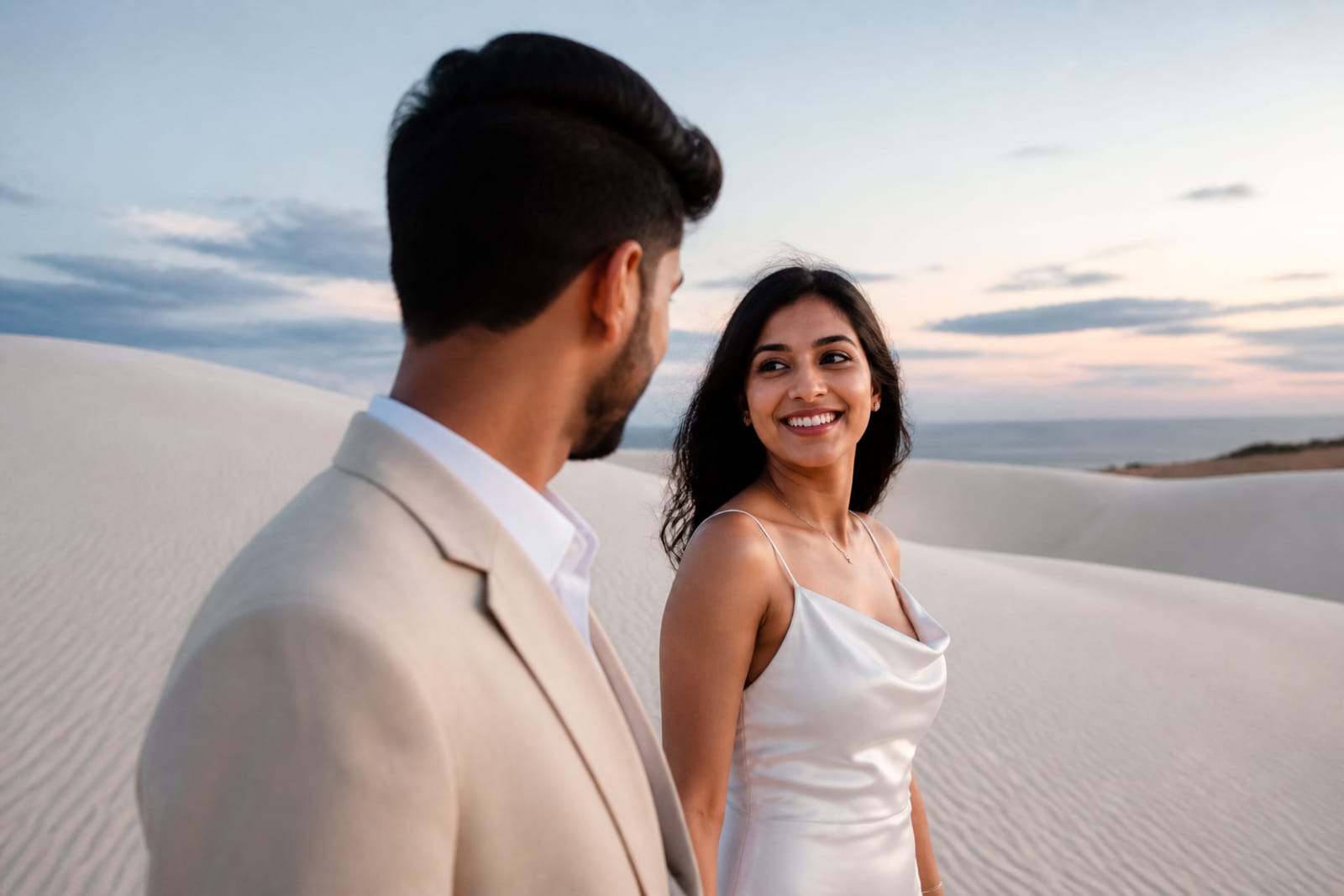
A typical 6-hour timeline reads like this: photographer and hair/makeup artist arrive at your hotel by 4:30–5:00 am; you're in the car and heading to the dunes by 5:15 am; first frames at 5:45–6:30 am on the dunes (outfit 1, wide shots, walking, detail of your hands or dress); outfit change in the car or a quiet spot by 6:45 am; second location (fishing village, rocks, quiet beach) by 7:30–8:30 am (outfit 2, more intimate frames); rest or loose frames at your hotel or a cafe by 9:00 am; if you want a third outfit, afternoon touch-ups and a golden-hour session at 4:30 pm at the coast or a local landmark; wrap by 6:30 pm. Edited previews or a 30–60 second vertical film arrives within 48 hours. The sequence works because light, not the clock, drives the shoot—you move when the light changes, not when the calendar says it's time.
How does wind and sand affect your outfit choices?
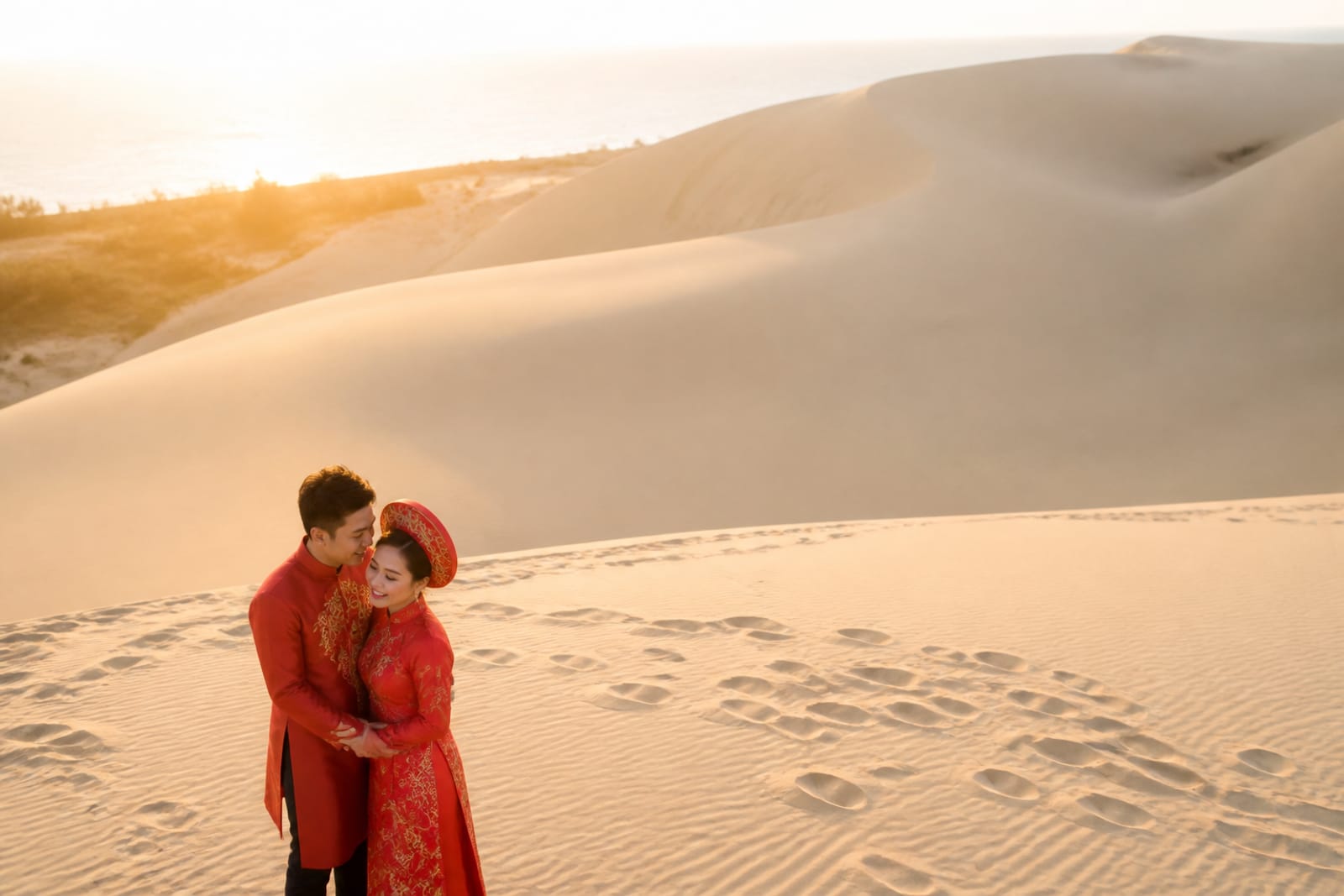
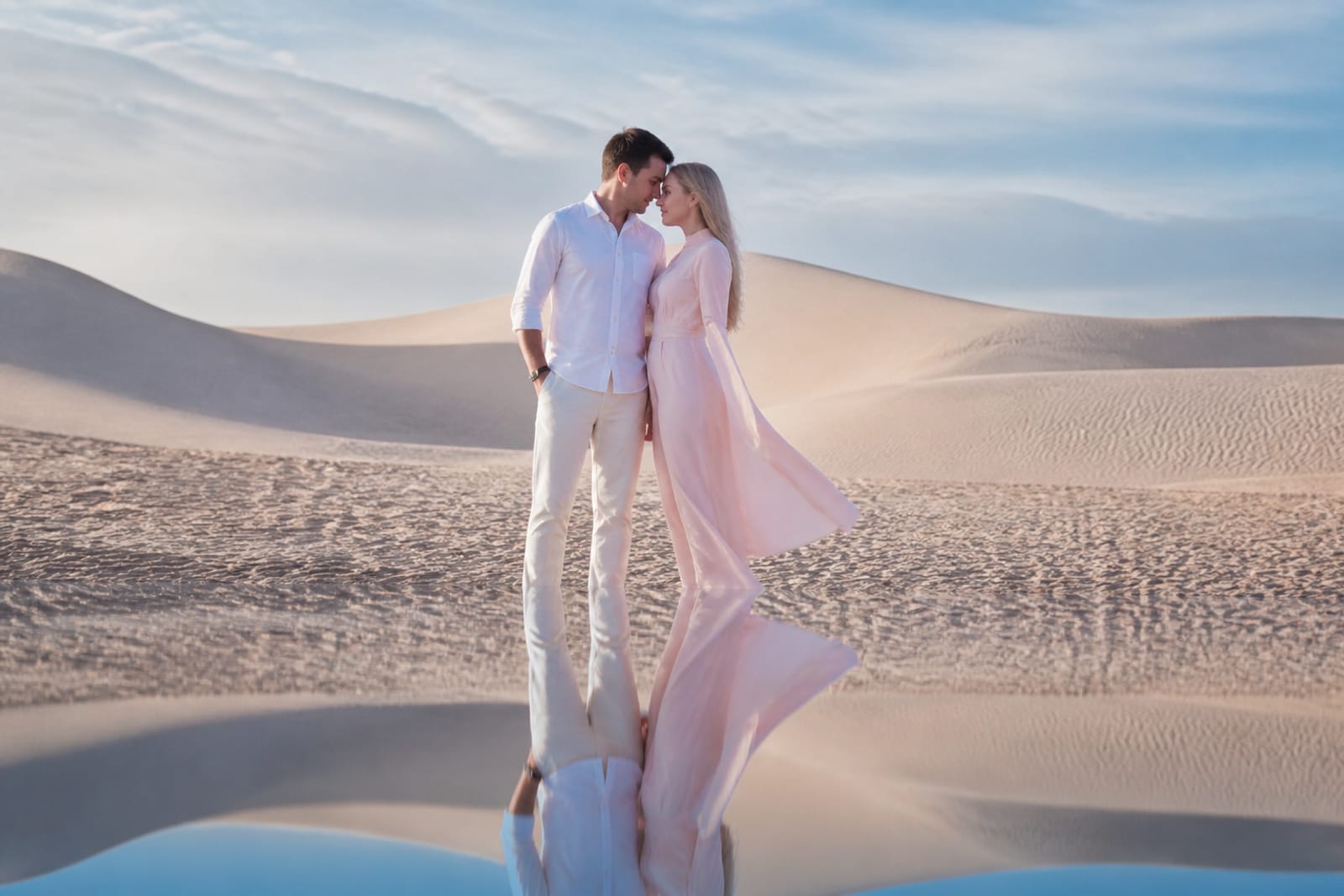
Mui Ne's dry season (Nov–Mar) brings strong winds that move sand across the dunes and beach—dramatic in frames, but it means loose fabrics (chiffon, silk, light tulle) billow and catch light beautifully, while heavy fabrics (dense satin, thick lace) sit flat. Neutral tones (ivory, blush, soft grey, dusty rose) photograph cleanly against sand; pure white can blow out and reads as flat in the dunes' early light. If you choose a colorful or patterned ao dai, the sand texture competes with the fabric—test it first or ask your photographer to shoot detail frames (hands, embroidery, your face) rather than full-length shots where sand dominates the frame. Avoid fully open-back dresses on windy days unless you're comfortable with your hair and body being the frame's focus. Bring a light robe or shawl to shield makeup and skin before the first shot. Ask your photographer or hair artist how they've worked with sand before; experienced teams know to keep makeup matte and hair oil minimal so wind doesn't create a matted look.
Which photographer should you hire: local, Hanoi-based travel, or someone else?
| Option | Best for | Light knowledge | Why it works or doesn't |
|---|---|---|---|
| Local Mui Ne photographer | Budget-conscious, 1–2 outfit couples | Knows tides, dune shadows, wind patterns | Fast, affordable; may lack cinematic direction or editing polish; check portfolio for frame depth and color work |
| Traveling photographer from Ho Chi Minh City or Hanoi | Couples wanting cinematic style and fast editing | Brings their own light setup and editing voice; may be less familiar with Mui Ne's exact light windows | Higher cost; needs airport pickup or early arrival; strong narrative direction; 48-hour turnaround typical |
| Cáo Studio (Hanoi or Saigon-based) | Couples who want one team for outfit, hair, makeup and photography | Full creative control over light, framing and message; travels for Mui Ne shoots by appointment | Ask on WhatsApp for Mui Ne coordination; our team is based in Hanoi and Ho Chi Minh City, so travel timing and cost vary by location |
Vetting matters: ask any photographer for a Mui Ne portfolio (not a generic beach reel), ask how they've shot in wind, and confirm they deliver edited files or film within your timeline. A Hanoi or Ho Chi Minh City team costs more but travels with a cohesive vision; a local photographer is cheaper but may deliver unedited JPEGs the same day. Some couples hire a local for the 6-hour session, then send the raw files to an editor in their home country—this adds two weeks to the timeline but spreads the cost. Cáo Studio's model is one team, one message: we handle outfit styling, hair, makeup and photography in a single booking, which means consistency and fewer coordination gaps. For a Mui Ne shoot, WhatsApp us to explore availability and logistics.
Should you book a pre-wedding day in Mui Ne or consider Hanoi or Ho Chi Minh City instead?
Mui Ne's strength is landscape drama—red sand dunes, clear water, fishing villages—and the dunes' unmatched golden-hour light. Its weakness is the wind (Nov–Mar), the distance from major airports (3+ hours from Ho Chi Minh City), and the small pool of experienced photographers who know how to direct cinematic frames in open desert. If you're already in Ho Chi Minh City or traveling through Vietnam for two weeks, a Mui Ne day works well alongside city sessions or a pre-wedding photoshoot in Hanoi or Ho Chi Minh City. If you're arriving just for the shoot, the time and cost of travel may not justify a single day; many couples choose Hoi An—lanterns, river, ancient streets, and less wind—or ask Cáo Studio to coordinate a multi-day journey (Hanoi → Ninh Binh → Ha Long, or Saigon → Mekong → Phu Quoc) where light and landscape vary across days. Discuss this with your photographer before booking; the best timeline is the one that fits your location and budget, not the place that looks best on Instagram.
What happens if the weather or light doesn't cooperate?
Overcast days on the dunes (Dec–Feb, when grey skies are common in northern Vietnam—though Mui Ne is drier) soften the light evenly, which actually suits intimate couple frames and ao dai detail shots; you lose the dune texture but gain a quiet, diffused quality. Rain in the dry season (Nov–Apr) is rare; in the wet season (May–Nov, worst Oct–Nov), afternoon downpours are short but heavy, and they can flood low roads. If weather is poor on your booked day, confirm with your photographer before dawn whether to reschedule or shoot in a sheltered location (fishing village, your resort, a cafe). Most contracts include a rain date; ask for this explicitly. If wind is extreme (above 20 km/h), loose fabrics become unmanageable, and sand blows onto every frame—light wind is part of Mui Ne's look, but dangerous wind is not. Your photographer should call the shoot or pivot to a sheltered beach cove if conditions are unsafe. Have a contingency: an indoor location (your hotel, a local gallery or villa), a second date, or a shorter 3-hour session focusing on one outfit and location instead of three.
What do you need to check before booking a pre-wedding photographer?
Photographer portfolio & experience:
- Do they have a dedicated Mui Ne or coastal portfolio (not a mix of every destination)?
- Do their frames show direction—couples walking, looking at each other, interacting with light—or are they stiff poses in front of landmarks?
- Are the colors and skin tones consistent across images, or does each photo look like a different edit?
Logistics & timeline:
- Do they arrive at your hotel, or do you meet them at the location?
- When do edited files arrive—same day, 48 hours, or two weeks?
- Is a hair and makeup artist included, or do you hire separately (and who coordinates timing)?
- Do they deliver edited JPEGs, RAW files, a film, or a printed album?
Cost factors (not amounts—ask on WhatsApp for quotes):
- Season (dry Nov–Apr is higher demand; wet May–Nov is cheaper);
- Number of outfits (each adds travel time and outfit-change logistics);
- Travel distance (Mui Ne to your hotel, or a fixed location);
- Turnaround speed (same-day delivery costs more than 2-week editing).
References & contracts:
- Ask for one or two past couples' WhatsApp or email so you can ask what actually happened;
- Confirm the reschedule policy if weather is poor;
- Clarify what "edited" means—do you get retouched skin tones, color grading, or basic JPEGs?
For pre-wedding photoshoots, Cáo Studio's model removes many variables: you have one team, one edit style, and a clear 48-hour turnaround. For a Mui Ne shoot outside our main cities, WhatsApp us to discuss coordination with a vetted local photographer or consider booking a session in Hanoi, Ho Chi Minh City, or Hoi An instead.
FAQ
What time should my pre-wedding photoshoot start in Mui Ne?
Sunrise (5:30–6:00 am) on the dunes, before heat and crowds. Aim to be in the car by 5:15 am and ready to shoot by 5:45 am. This captures the dunes' only flat, directional light window of the day.
Can we do a full pre-wedding shoot in Mui Ne in one afternoon?
No. Golden hour (4:30–6:30 pm) works for a secondary location—beach, fishing village, rocks—but a full session needs the dawn dunes shoot too. Plan 6–8 hours across both windows, or a 3-hour sunset-only session if budget is tight.
Do we need a hair and makeup artist in Mui Ne, or can we do our own?
Professional makeup holds better in the dunes' wind and sand than DIY; it's also faster for outfit changes. Most photographers recommend hiring one; ask if they have a trusted artist or if they can refer someone. Cáo Studio includes makeup and hair in package coordination for our main cities.
What should we wear under an ao dai for a pre-wedding shoot?
A fitted strapless or thin-strap white or nude slip dress, so straps don't show. In windy conditions, the slip prevents the ao dai from shifting; avoid heavy slips that add bulk. Ask your photographer if they've styled ao dai shoots before—some position the tunic differently depending on the location and light.
How do we avoid sand in our photos during a dunes shoot?
You don't avoid it—sand is the dunes' texture. Wear neutral tones (ivory, blush, soft grey) so sand doesn't wash out your outfit; ask your photographer to shoot close details (your hands, faces, embroidery) as well as wide shots so sand is context, not the focus. Overcast light (Dec–Feb) reduces sand glare on skin.
Should we book Cáo Studio for a Mui Ne pre-wedding photoshoot?
Cáo Studio operates in Hanoi, Ho Chi Minh City, and Hoi An. For Mui Ne, we can help you coordinate with a vetted local photographer via WhatsApp or suggest a pre-wedding session in one of our main cities instead, where our full team (photographer, makeup, hair, stylist) is based.
FAQ
What time should my pre-wedding photoshoot start in Mui Ne?
Sunrise (5:30–6:00 am) on the dunes, before heat and crowds. Aim to be in the car by 5:15 am and ready to shoot by 5:45 am. This captures the dunes' only flat, directional light window of the day.
Can we do a full pre-wedding shoot in Mui Ne in one afternoon?
No. Golden hour (4:30–6:30 pm) works for a secondary location—beach, fishing village, rocks—but a full session needs the dawn dunes shoot too. Plan 6–8 hours across both windows, or a 3-hour sunset-only session if budget is tight.
Do we need a hair and makeup artist in Mui Ne, or can we do our own?
Professional makeup holds better in the dunes' wind and sand than DIY; it's also faster for outfit changes. Most photographers recommend hiring one; ask if they have a trusted artist or if they can refer someone. Cáo Studio includes [makeup and hair](/makeup-and-hair) in package coordination for our main cities.
What should we wear under an ao dai for a pre-wedding shoot?
A fitted strapless or thin-strap white or nude slip dress, so straps don't show. In windy conditions, the slip prevents the ao dai from shifting; avoid heavy slips that add bulk. Ask your photographer if they've styled ao dai shoots before—some position the tunic differently depending on the location and light.
How do we avoid sand in our photos during a dunes shoot?
You don't avoid it—sand is the dunes' texture. Wear neutral tones (ivory, blush, soft grey) so sand doesn't wash out your outfit; ask your photographer to shoot close details (your hands, faces, embroidery) as well as wide shots so sand is context, not the focus. Overcast light (Dec–Feb) reduces sand glare on skin.
Should we book Cáo Studio for a Mui Ne pre-wedding photoshoot?
Cáo Studio operates in [Hanoi](/hanoi), [Ho Chi Minh City](/saigon), and [Hoi An](/hoi-an). For Mui Ne, we can help you coordinate with a vetted local photographer via WhatsApp or suggest a pre-wedding session in one of our main cities instead, where our full team (photographer, makeup, hair, stylist) is based.
Ao dai, makeup, hair and a local photographer in Hanoi or Saigon — one WhatsApp message.