/ao-dai-photoshoot
Traditional Vietnamese wedding elements for Mu Cang Chai photos
Traditional Vietnamese wedding elements — ao dai, betel and areca offerings, ritual gestures — photograph best in Mu Cang Chai during the golden hour before sunrise or after 4 pm, when side light flatters both fabric and landscape. The shoot works if you plan 2–3 days ahead (travel from Hanoi is 3–4 hours; a local photographer knows the terrain, but a team experienced in ao dai styling and ritual composition ensures each frame tells a story). Cáo Studio does not operate in Mu Cang Chai, but this guide covers season, light, outfits, finding a local photographer and honest logistics so your vision translates to frames you keep. --- 📸 Book on WhatsApp — ao dai photoshoot | 🌸 See the lookbook ---
Is Mu Cang Chai the right setting for traditional wedding photos?
Mu Cang Chai works for wedding sessions if you prioritize landscape over crowds and can accept a long drive. The terraced rice fields create a narrative backdrop — ritual moments frame naturally within geometry rather than against generic monuments. A couple wearing ao dai walking between rows, or sitting during a betel offering, reads as grounded in place and culture. The trade-off: Mu Cang Chai has no wedding day logistics (no nearby hair or makeup studios, no equipment storage, weather is unpredictable at altitude). It suits elopement-style or pre-wedding shoots where you control the timeline, not full wedding-day coverage. For full-day wedding photography with hair, makeup and multiple outfit changes, Hanoi or Hoi An (where Cáo Studio coordinates the full team) is more practical.
What season gives you the light and landscape you need?
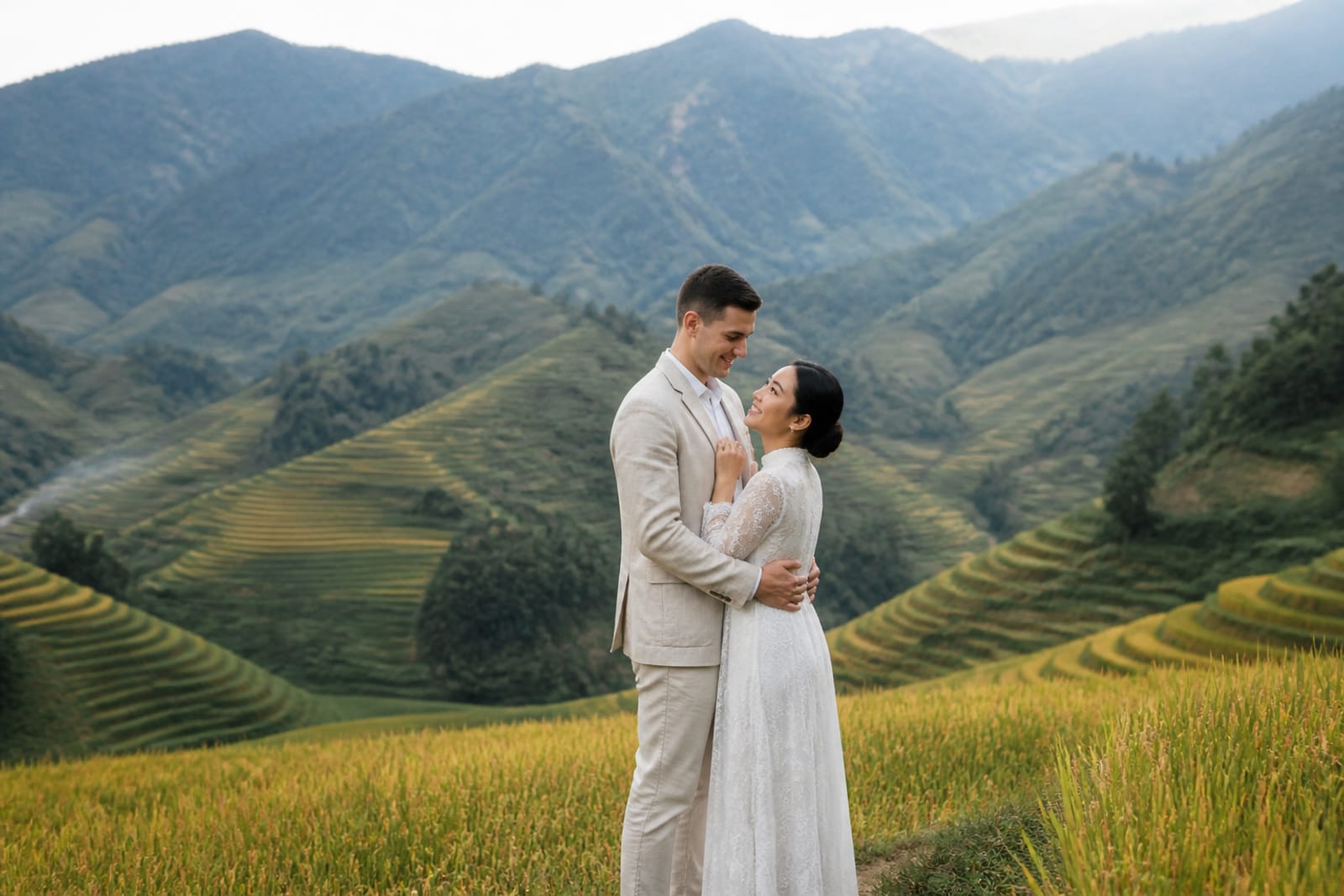
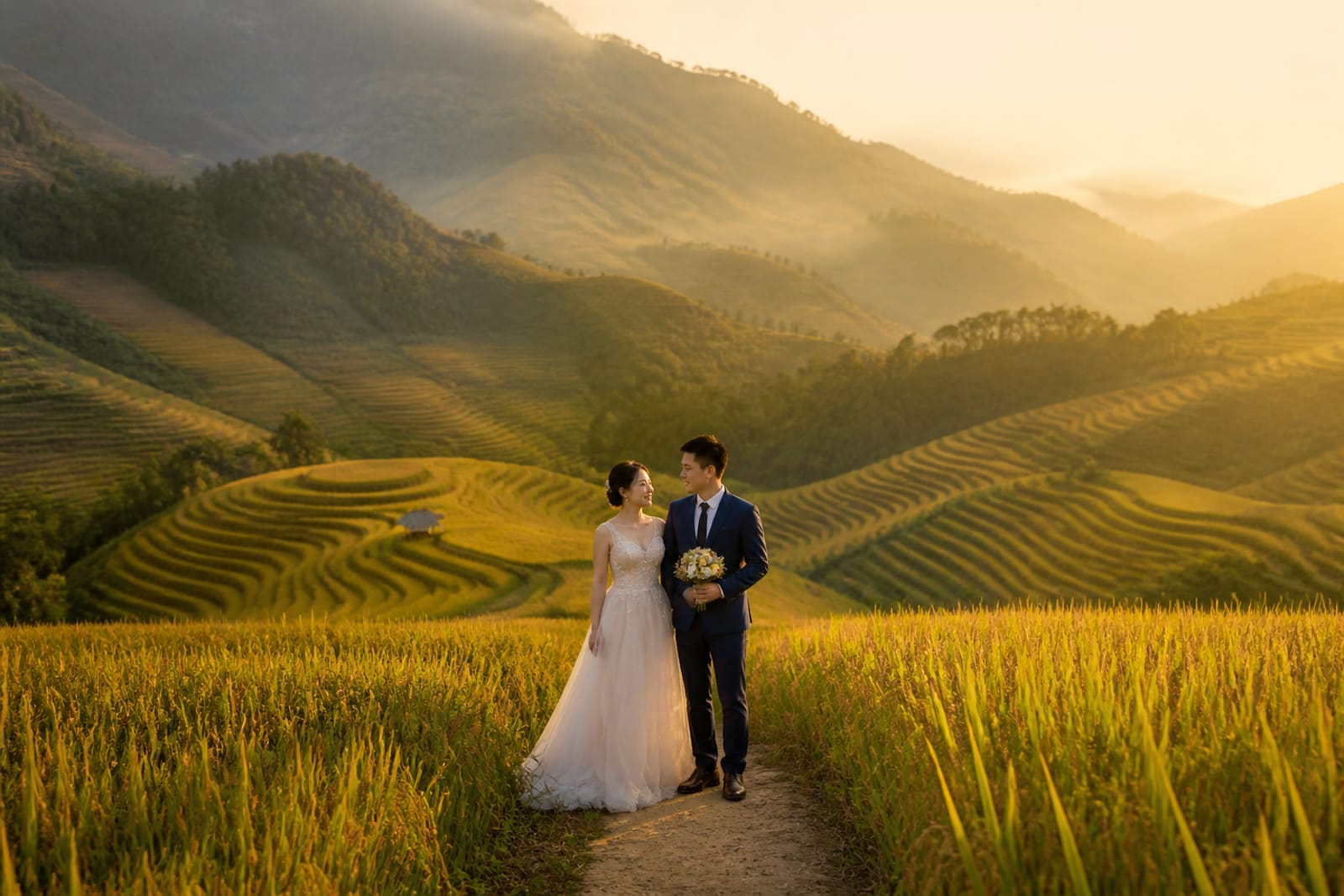
Mu Cang Chai terraces fill with water May–June, creating mirror reflections; golden terraces appear mid-September to early October. Light quality differs sharply: May–June has frequent morning mist (soft, diffused light; muted colours) and afternoon heat haze. September–October offers clear, angled light at dawn and dusk, sharper colours and deeper shadows — ideal for ao dai folds and ritual details. December–February is cool and clear but terraces are bare brown earth, reducing visual depth. Rain comes October–November, often at dawn. For traditional wedding elements (rituals, ao dai, emotion), September–October gives the cleanest canvas: light is directional, landscape is gold, and morning shoots stay cool.
Which traditional elements photograph strongest in the landscape?
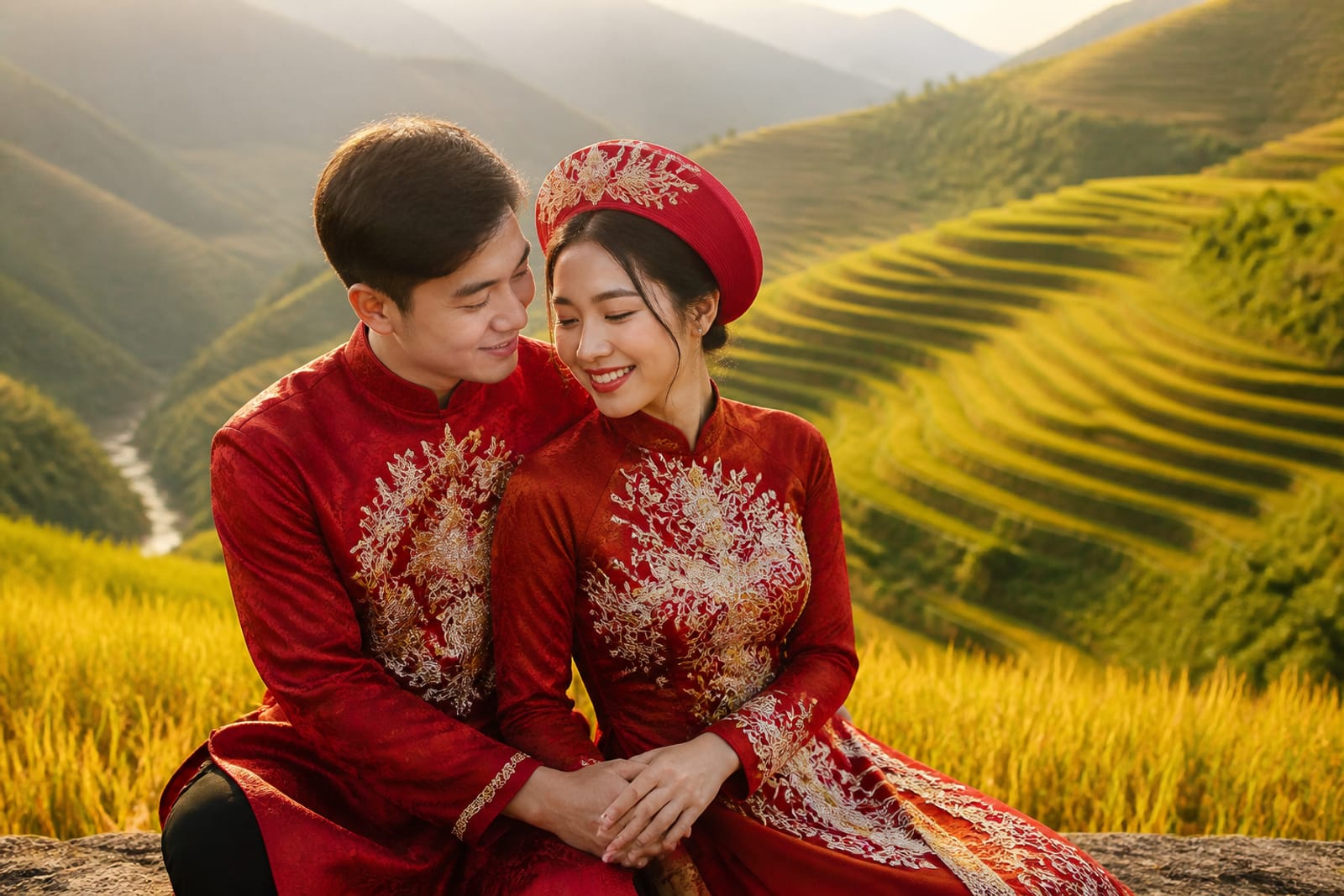
Betel and areca offerings, hand-holding during a tea ceremony, and ao dai folds photograph best when framed wide first (couple within the terrace geometry), then medium (hand gestures, fabric detail), then close (expression, ritual object). A bride and groom walking out of frame toward the horizon reads more powerfully than posed moments; a ritual moment captured mid-gesture (not pre- or post-) holds the eye. Formal bowing or kneeling reads awkward at ground level; photograph it from a slight elevation or from behind. Ao dai colour choice matters: deep jewel tones (emerald, burgundy, navy) separate from earth browns and golds; pastels (pale pink, cream) vanish into morning mist. For Mu Cang Chai's terrain, choose ao dai in colours that hold contrast against terraces and sky.
How do you find and vet a local Mu Cang Chai photographer?
Search Instagram hashtags (#mucangchai, #vietnamweddingphotographer) and look for portfolios that show ritual moments, not just posed couples in fields. Vet by asking: Do they shoot ao dai regularly? (Detail work on fabric, understanding how light moves through embroidery, is different from regular portraiture.) Have they worked at this location before? (Local knowledge of light paths, safe walking routes and permission requirements saves hours.) Do they provide edited images in 48–72 hours? (Mu Cang Chai is remote; workflow delays compound.) Ask for references from at least two previous couples; call them. Agree in writing: arrival time, number of outfits, locations, backup plan for rain, and delivery timeline. Cost factors are distance (Hanoi-based photographers charge travel fees), session length and outfit changes — never assume a quote includes hair or makeup coordination. Cáo Studio does not shoot in Mu Cang Chai, but if you prefer a team that handles ao dai, makeup and photography as one unit, book a pre-wedding session in Hanoi and travel with that vision to a local photographer as reference.
What logistics fail most often in Mu Cang Chai shoots?
Weather shifts fast at altitude: a clear dawn becomes overcast by 7 am, or afternoon wind scatters ao dai folds. Plan a 6 am start to secure light before cloud cover; bring a windbreak (a light frame or assistant to shield fabric). Ao dai moisture-wicks poorly in humidity; bring a cotton undershirt and ask the photographer to scout shade near fields for quick touch-ups. Terrain is muddy after rain; wear hiking-grade underfoot protection and accept that white or pale ao dai hems will mark. Permits: check locally whether you need permission to shoot near terraces or in villages; some areas restrict photography to certain times. Signal is patchy; confirm the photographer's WhatsApp status before the session. Hair and makeup: bring a mirror, blotting papers and a makeup artist if you did not book one locally (Cáo Studio's makeup and hair service operates in Hanoi and Saigon, not Mu Cang Chai). Plan for 30–45 minutes of fixing mid-session rather than a single pre-shoot touch-up.
Ao dai, suits and ritual objects: what actually works on camera?
| Choice | Best for | Light & Landscape | Why it works |
|---|---|---|---|
| Ao dai alone (no groom suit) | Solo or bride-focus sessions | Early light; terrace geometry holds attention | Silhouette reads against earth, fabric folds catch side light |
| Ao dai + suit | Couples, ritual moments | Golden hour (dusk); textured backlight | Contrast between fabrics; ritual gestures frame between figures |
| Áo dài + betel tray ritual | Full ceremony feel | Soft morning light, seated composition | Hand detail, fabric drape and offering object align in one frame |
| Áo dài + walking (no pose) | Narrative, moving through landscape | Directional side light, 6–8 am or after 4 pm | Figures within geometry; movement is the story |
| Áo dài + heritage site backdrop | Two locations in one session | Dawn light at terraces, then mid-morning at village shrine | Breaks up landscape monotony; ritual context shifts between frames |
Ao dai colour in Mu Cang Chai: jewel tones (emerald, burgundy) photograph richest against earth and sky; metallics (gold beading on red) add festive detail; pale tones (cream, pale pink) need overcast light or they bleach. Suits: lightweight linen or cotton breathes better than wool; dark navy or charcoal separate from terrain. Ritual objects (betel tray, tea set, flowers) photograph best at hand level; avoid overhead angles that flatten the composition.
---
💄 Makeup & hair at your hotel | 📸 Book on WhatsApp — ao dai photoshoot
---
What to check before you book
Ask the photographer upfront: (1) Do they have a backup plan if weather closes your primary location? (2) How many fully edited, high-resolution files do you receive and when? (3) Do they provide a shot list or mood guide, or do they prefer you to direct on the day? (4) If ao dai rental is needed, do they coordinate with a tailor or do you source it? (5) Is hair or makeup included, and if not, do they have local artist referrals? (6) What happens if you need to reschedule due to weather or personal reasons — refund, credit or rescheduling fee? (7) Ask to see a full previous session (not just highlights) so you see editing style, composition choices and how rituals were framed. This is not a consumer product you can return; the photographer's reliability and aesthetic match are the only guarantees you have.
For couples planning a full pre-wedding shoot with traditional elements, Cáo Studio's pre-wedding and elopement service in Hanoi or Hoi An includes ao dai styling, makeup, hair and a team that frames ritual moments as cinema, not snapshots. If you are set on Mu Cang Chai's landscape, use that service as a creative reference (mood, light, composition style) when briefing a local photographer.
---
---
FAQ
Can we do a full wedding day in Mu Cang Chai with ao dai, makeup and photography all coordinated?
Cáo Studio does not operate in Mu Cang Chai; logistics (no nearby makeup studios, remote location, unpredictable weather) make full-day coordination difficult. A pre-wedding or elopement shoot works better — plan 4–6 hours, one outfit, one light window. Hire a local photographer and bring your own makeup artist, or book a pre-wedding session in Hanoi first and travel with a clear mood guide.
What's the best time to shoot if we want waterlogged terraces reflected in our ao dai?
May–June, when terraces are flooded. Morning mist creates soft, diffused light ideal for reflections; plan an early start (5:30–6:30 am) before sun burns off the mist. Bring a windbreak and accept that humidity will affect ao dai folds and makeup.
Do we need a permit to photograph in Mu Cang Chai terraces?
Check locally with the Mu Cang Chai district office or your photographer — some village areas restrict photography or require notification. Most travel photographers handle this; confirm it in your contract before booking.
How does ao dai fabric move and photograph differently than regular wedding dress?
Ao dai has a high neckline and straight silhouette; it photographs best in side light (which shows fabric folds) and movement (walking, turning) rather than static poses. Wind catches the silk panels; use this as compositional depth. Regular dresses are fuller and read differently in frames — ao dai requires a photographer who understands how light interacts with the narrow column shape and embroidery detail.
Should we hire a makeup artist from Hanoi to travel to Mu Cang Chai, or book local?
If you want makeup that pairs with ao dai styling and holds through humidity and wind, bring a specialist or book Cáo Studio's makeup and hair service in Hanoi beforehand as a test (familiar with ao dai, humidity control, long-wear products). A local artist is cheaper but may not know ao dai-specific techniques (brows, cheek colour, lip choice for jewel-tone ao dai). Cost and reliability are trade-offs; decide based on your budget and risk tolerance.
What do we do if weather cancels the shoot?
Agree on a reschedule clause in your contract — most photographers offer a 48-hour window or a credit toward a second shoot. Mu Cang Chai rain is unpredictable September–November; build in two backup dates when booking, or schedule during May–June or September–October when weather is more stable.
FAQ
Can we do a full wedding day in Mu Cang Chai with ao dai, makeup and photography all coordinated?
Cáo Studio does not operate in Mu Cang Chai; logistics (no nearby makeup studios, remote location, unpredictable weather) make full-day coordination difficult. A pre-wedding or elopement shoot works better — plan 4–6 hours, one outfit, one light window. Hire a local photographer and bring your own makeup artist, or book a [pre-wedding session in Hanoi](/pre-wedding-photoshoot) first and travel with a clear mood guide.
What's the best time to shoot if we want waterlogged terraces reflected in our ao dai?
May–June, when terraces are flooded. Morning mist creates soft, diffused light ideal for reflections; plan an early start (5:30–6:30 am) before sun burns off the mist. Bring a windbreak and accept that humidity will affect ao dai folds and makeup.
Do we need a permit to photograph in Mu Cang Chai terraces?
Check locally with the Mu Cang Chai district office or your photographer — some village areas restrict photography or require notification. Most travel photographers handle this; confirm it in your contract before booking.
How does ao dai fabric move and photograph differently than regular wedding dress?
Ao dai has a high neckline and straight silhouette; it photographs best in side light (which shows fabric folds) and movement (walking, turning) rather than static poses. Wind catches the silk panels; use this as compositional depth. Regular dresses are fuller and read differently in frames — ao dai requires a photographer who understands how light interacts with the narrow column shape and embroidery detail.
Should we hire a makeup artist from Hanoi to travel to Mu Cang Chai, or book local?
If you want makeup that pairs with ao dai styling and holds through humidity and wind, bring a specialist or book Cáo Studio's [makeup and hair service](/makeup-and-hair) in Hanoi beforehand as a test (familiar with ao dai, humidity control, long-wear products). A local artist is cheaper but may not know ao dai-specific techniques (brows, cheek colour, lip choice for jewel-tone ao dai). Cost and reliability are trade-offs; decide based on your budget and risk tolerance.
What do we do if weather cancels the shoot?
Agree on a reschedule clause in your contract — most photographers offer a 48-hour window or a credit toward a second shoot. Mu Cang Chai rain is unpredictable September–November; build in two backup dates when booking, or schedule during May–June or September–October when weather is more stable.
Ao dai, makeup, hair and a local photographer in Hanoi or Saigon — one WhatsApp message.