/ao-dai-photoshoot
Traditional Vietnamese Wedding Elements for Mui Ne Photos
Traditional Vietnamese wedding elements carry deep meaning and photograph with striking contrast against Mui Ne's salt flats and coastline. But success depends on light, season, and a photographer trained to direct real movement—not pose guests in front of landmarks. Here's how to plan a session that honors the wedding story while capturing frames worth printing.
What makes ao dai and lanterns work in Mui Ne light?
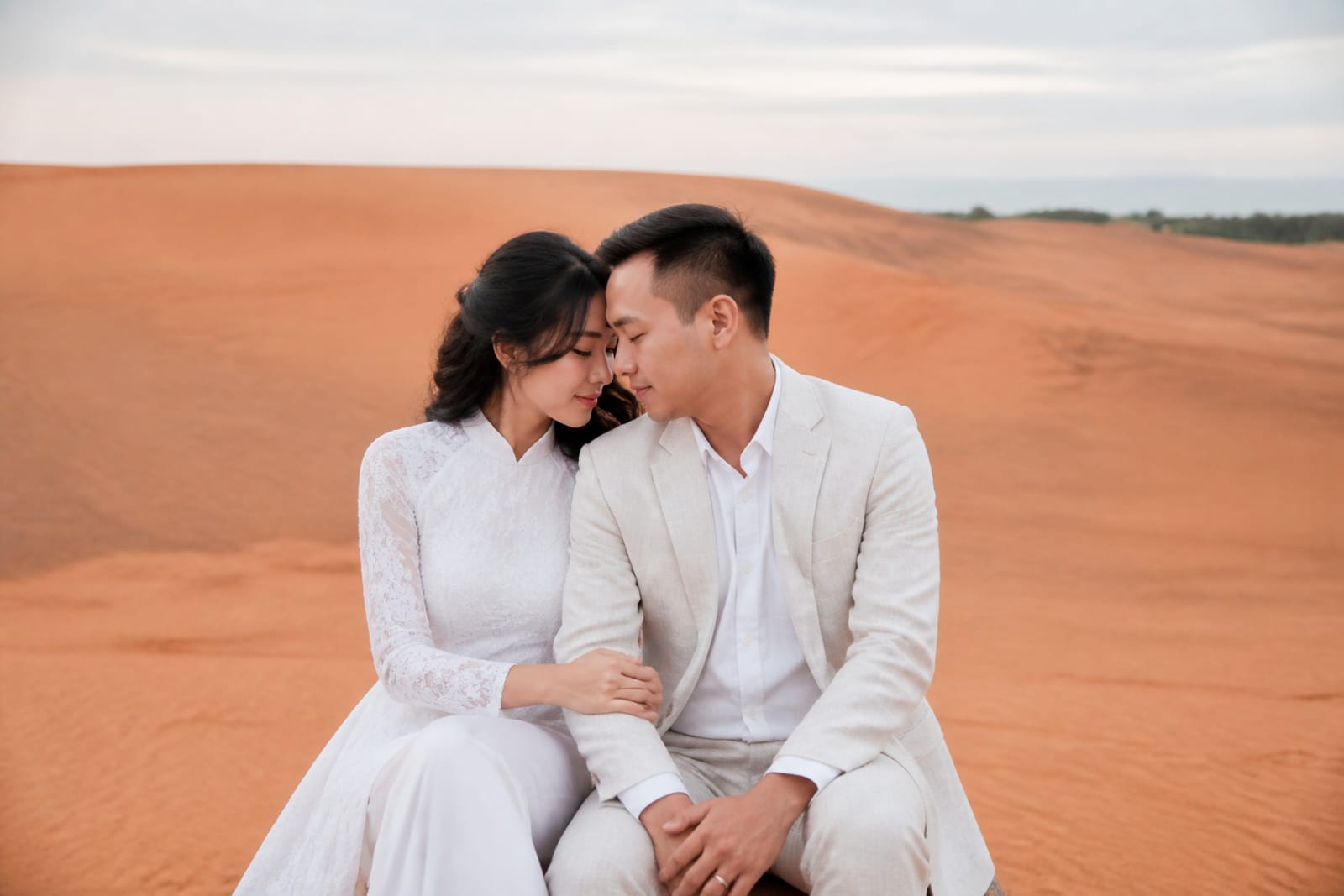
Ao dai is a silhouette—its power lies in how light falls across the fabric. Mui Ne's dry season (Nov–Apr) offers consistent morning haze and afternoon clarity; winds are strongest Nov–Mar, which moves loose ao dai and creates directional light. Lanterns photograph best during the golden hour (roughly 30 minutes before sunset) when their paper glows warm against the sky, and during blue hour (20–40 minutes after sunset) when the dunes show depth. A photographer who knows this timing won't ask you to stand still; instead, they'll direct you to walk toward or away from the light, which tells a story and keeps the ao dai moving. This is why Cáo Studio insists on directing, not posing—real light and real movement create frames that hold emotion, not just decoration.
Dry season vs. wet season: which months give you the best light?
| Timeframe | Light quality | Wind & heat | Wedding setup ease | Photography notes |
|---|---|---|---|---|
| Nov–Feb | Clear, soft, predictable | Strong winds (fabric moves), cool mornings | Lanterns stay lit, no afternoon rain | Peak season; sunrise warm side light, sunset gold; best for ao dai movement |
| Mar–Apr | Clear, warmer | Winds ease, midday heat rises | Comfortable for guests; afternoon setup safe | Late April storms begin; book early |
| May–Oct | Humid, frequent afternoon rain | Calm, oppressive heat | Lanterns flicker, makeup runs, setup delays | Risky; rain closes dunes some days; avoid |
Dry season (Nov–Apr) is non-negotiable for Mui Ne. Nov–Feb offers the strongest light contrast and wind—the ao dai will move, and lanterns will glow without competition from noon sun. Mar–Apr is still viable if you book early and shoot early morning or late afternoon; avoid midday. If you're committed to a wet-season date, expect rescheduling, tighter timings (sunset comes earlier, skies darken fast), and higher costs because the photographer must work around weather.
How do you integrate conical hats and lanterns without them looking staged?
Conical hats (nón lá) and lanterns are props until they're used—the difference is movement and context. Instead of posing with a lantern in hand, walk toward the photographer while holding it loosely; the rim will catch light and the fabric will glow. A conical hat works best worn, not held—have the photographer shoot you adjusting it or wearing it while looking at the view, not turning to face the camera. Lanterns hang from shepherd's crooks (placed in sand or held by an assistant off-camera) along the walking path; they light the foreground while you move through. The photographer should shoot first from wide (you walking, lanterns glowing, dunes behind), then medium (your faces, the glow), then detail (your hands, the lantern rim). This sequence—wide, medium, detail—is how Cáo Studio directs every session: it teaches the eye where to look and why the moment mattered.
📸 Book on WhatsApp — ao dai photoshoot
Should you bring family into the frame, and how does that change the shoot?
Family moments—parents pinning flowers, siblings adjusting your ao dai, a group walking together—are the strongest wedding frames because they're unconscious. If family joins, brief them the night before: "We'll walk naturally, the photographer will be quiet, and you'll look at each other, not the camera." Cáo Studio's couple and family photoshoots are built on this principle—one team (photographer, hair, makeup artist) directs everyone at once, so no one's waiting for three vendors to sync. In Mui Ne, this matters more: family setup takes time, the wind moves everyone's ao dai, and a solo photographer might miss the moment. A local Mui Ne photographer with a second person (assistant or hair artist) can manage direction and continuity better. Ask candidates: "Have you shot family ao dai sessions? Do you have an assistant to hold reflectors or manage timing?" If they hesitate, keep looking.
What do you actually check before booking a Mui Ne photographer?
Before you commit, ask for:
- Portfolio focus: 60%+ of recent work should be ao dai (not just standard couple shots). If most photos are posed against landmarks, they may not understand light and movement.
- Team: Who handles hair and makeup? Is it the same person as the photographer, or do they coordinate separate vendors? Separate vendors delay and fragment direction.
- Location knowledge: Have they shot the dunes, beaches, and salt flats in the dry season? Can they name specific times (e.g., "sunrise at the pink salt lake, 6:30 am") and explain why?
- Gear: What's their backup plan if the wind kicks sand into their sensor, or a lantern breaks? Professional photographers carry spares.
- Timing: How many hours is the session? Where will you shoot? How many outfits? Are they edited in 48 hours or do you wait weeks?
- Cost factors: Ask what affects the quote—season, travel from Ho Chi Minh City, number of locations, number of people, number of outfits—but never ask them to state a price upfront. Get a quote on WhatsApp after you've described your session.
If they can't answer three of these questions, they're not ready for your session.
How do you choose between a single ao dai and multiple outfits?
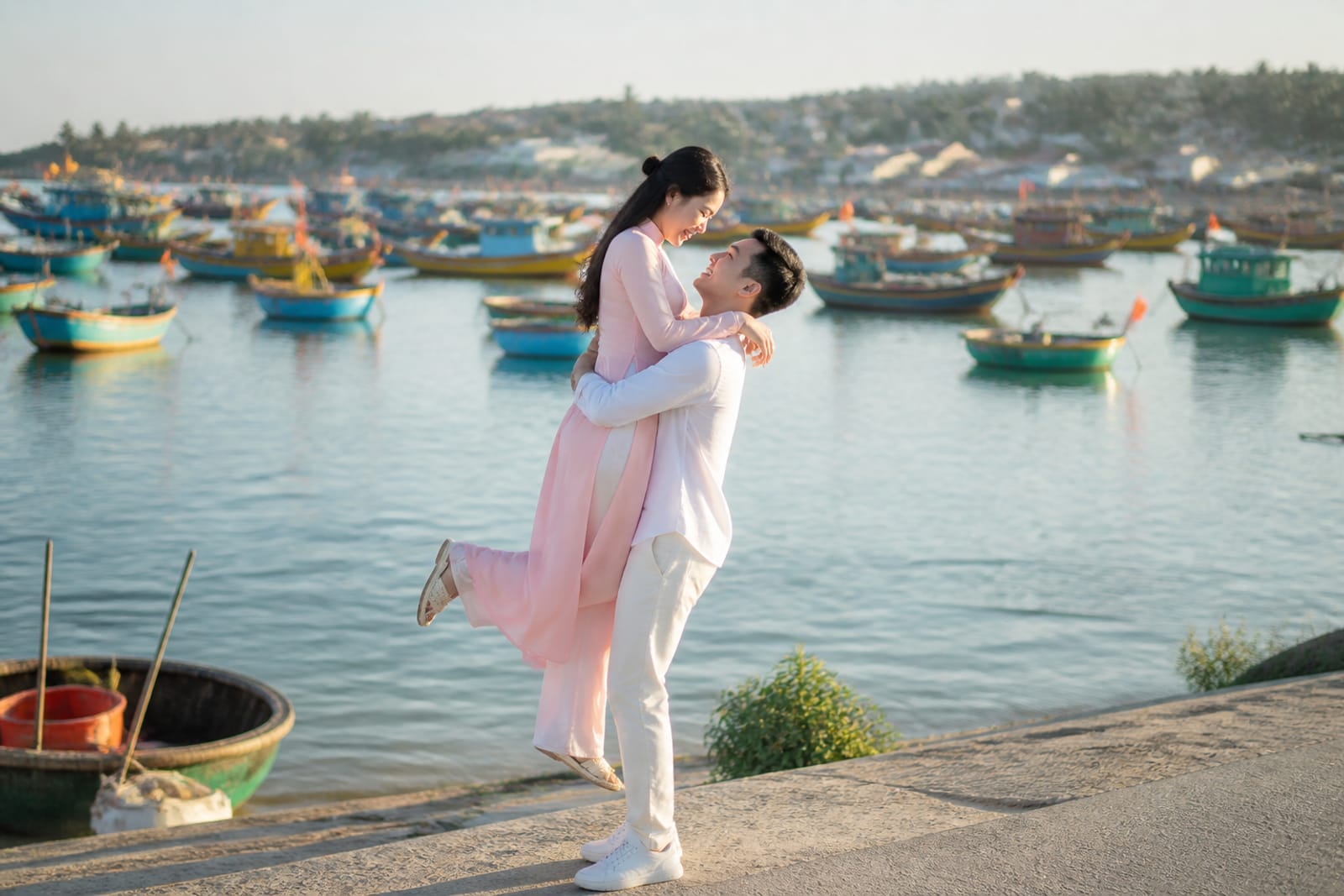
One ao dai, worn well and shot in multiple locations and light, often makes stronger frames than three outfits shot rushed. Cáo Studio's ao dai photoshoot philosophy is "one message"—the outfit, the light, the location, and your movement tell one story. In Mui Ne, you have two locations that justify outfit changes: the dunes (sunrise, movement, texture) and the coastline or beach (sunset, lanterns, water). If you do two outfits, each needs 45–60 minutes to shoot well; add hair and makeup changes, and you're looking at a 5–6 hour session. One outfit, shot at sunrise on the dunes and again at sunset near the lanterns, can feel like two completely different stories because the light transformed it. A skilled photographer will show you this in the lookbook before you book—ask to see frames of the same ao dai in different light. If they can't show you that, ask why.
What weather or wind scenarios should you plan for?
Mui Ne's winds (strongest Nov–Mar) are not a problem—they're a feature. Wind moves the ao dai, creates directional light, and makes frames feel alive. But extreme wind (>30 km/h) will blow your hair into your face, scatter sand into gear, and make standing still painful. A skilled photographer will work with moderate wind by directing you to walk into it (so fabric flows backward, creating shape) or across it (so the side light reaches you). If the wind is too strong on your shoot day, the photographer should propose rescheduling or moving to a sheltered beach. Sand is the other factor: after windy mornings, the dunes harden and light changes. Sunset shoots are safer because wind eases, but the window closes fast—make sure your photographer arrives early (by 3 pm for a 5:30 pm sunset start) to scout light and brief you.
Should you rent or buy your ao dai for Mui Ne?
If this is a one-time photoshoot, rent. If you plan to wear the ao dai again (family dinners, anniversaries, other shoots), buy. Rental is cheaper upfront and frees you from shipping or storage. When you rent, ask the vendor: "Does the ao dai fit under a conical hat? Is the hem weighted, or will wind blow it up?" Cáo Studio's ao dai rental page includes sizing tips and fit checks—even if you rent elsewhere, use that guide. For Mui Ne specifically, choose a fabric that photographs well in direct light: silk or silk-blend (not synthetic polyester, which looks flat). Darker or jewel-tone colors hold detail in bright sun; pale ao dai can blow out unless your photographer knows how to expose for the fabric. Ask the rental vendor for their top recommendation for photography, not just events.
---
What to check before you book
- Season: Is it Nov–Apr? If not, confirm the photographer has a Plan B for weather and timing.
- Light timing: Does the photographer propose specific times (sunrise, golden hour, blue hour) and explain why? Vague answers are a red flag.
- Vendor coordination: Is hair and makeup included, or separate? If separate, who ensures everyone's on time?
- Portfolio depth: Do they have 5+ ao dai sessions with similar setups (dunes, beach, lanterns)? Not just one couple.
- Movement direction: Ask, "How do you direct guests during the shoot?" Listen for "walk, look at each other, do something"—not "stand here and smile."
- Backup and safety: What happens if a lantern breaks, sand gets in the camera, or the sky clouds over?
---
For photoshoots in Hanoi or Ho Chi Minh City, Cáo Studio handles the full direction—photographer, makeup, hair, editing—so nothing fragments. For Mui Ne, use this guide to vet a local photographer and apply Cáo Studio's principles: one team, directed movement, light-first framing.
FAQ
Can I shoot Mui Ne photos during the wet season (May–Oct)?
Yes, but expect higher costs, rescheduling risk, and shorter light windows. Rain and humidity affect ao dai fit and makeup durability. Nov–Apr is strongly recommended for wedding elements outdoors.
Do I need a lantern and conical hat, or can I skip them?
Neither is mandatory. One strong element (the ao dai itself, in good light) is enough. Lanterns and hats add context to your story—choose them only if they're meaningful, not decorative.
How far in advance should I book a Mui Ne photographer?
6–8 weeks for dry season (Nov–Feb); 4–6 weeks for Mar–Apr. This gives you time to vet portfolios and ensures the photographer isn't overbooked during peak season.
Should my photographer be based in Mui Ne, or can they travel from Ho Chi Minh City?
Either works. Local photographers know the dunes and tides intimately. Photographers traveling from Ho Chi Minh City bring broader experience but need an earlier arrival for scouting—confirm this in your brief.
What's the difference between booking Cáo Studio and hiring a local Mui Ne photographer?
Cáo Studio shoots Hanoi, Ho Chi Minh City, and Hoi An with a single team (photographer, makeup, hair). For Mui Ne, we recommend a local photographer vetted by the checklist above. We're happy to advise on WhatsApp if you're unsure how to vet candidates.
Can I wear an ao dai bought overseas, or should I rent in Vietnam?
Both work. Overseas ao dai may need tailoring in Vietnam (allow 1–2 weeks). Rental ensures fit and avoids shipping stress. Either way, confirm the tailor or vendor knows about photography and wind—ask them to test the hem weight and fabric drape.
FAQ
Can I shoot Mui Ne photos during the wet season (May–Oct)?
Yes, but expect higher costs, rescheduling risk, and shorter light windows. Rain and humidity affect ao dai fit and makeup durability. Nov–Apr is strongly recommended for wedding elements outdoors.
Do I need a lantern and conical hat, or can I skip them?
Neither is mandatory. One strong element (the ao dai itself, in good light) is enough. Lanterns and hats add *context* to your story—choose them only if they're meaningful, not decorative.
How far in advance should I book a Mui Ne photographer?
6–8 weeks for dry season (Nov–Feb); 4–6 weeks for Mar–Apr. This gives you time to vet portfolios and ensures the photographer isn't overbooked during peak season.
Should my photographer be based in Mui Ne, or can they travel from Ho Chi Minh City?
Either works. Local photographers know the dunes and tides intimately. Photographers traveling from Ho Chi Minh City bring broader experience but need an earlier arrival for scouting—confirm this in your brief.
What's the difference between booking Cáo Studio and hiring a local Mui Ne photographer?
Cáo Studio shoots Hanoi, Ho Chi Minh City, and Hoi An with a single team (photographer, makeup, hair). For Mui Ne, we recommend a local photographer vetted by the checklist above. We're happy to advise on WhatsApp if you're unsure how to vet candidates.
Can I wear an ao dai bought overseas, or should I rent in Vietnam?
Both work. Overseas ao dai may need tailoring in Vietnam (allow 1–2 weeks). Rental ensures fit and avoids shipping stress. Either way, confirm the tailor or vendor knows about photography and wind—ask them to test the hem weight and fabric drape.
Ao dai, makeup, hair and a local photographer in Hanoi or Saigon — one WhatsApp message.