/pre-wedding-photoshoot
Two-day pre-wedding photo trip to Quy Nhon: itinerary and guide
A two-day pre-wedding photo trip to Quy Nhon centres on the central coast's rocky coves, lagoons and colonial architecture—best shot during the dry season (Feb–Aug) when afternoon light is clear and sea conditions calm. Day one typically covers Eo Gio (Fairy Stream mouth), Quy Nhon port or Ghenaon Beach for wide seascapes; day two moves inland to Tay Phuong Village or temple grounds for intimate framing and softer midday light. Start before 6 am or after 4 pm to catch side light; midday is harsh and flattens water. Cáo Studio does not operate in Quy Nhon—the team is based in Hanoi and Ho Chi Minh City, with Hoi An available by appointment—so you'll work with a local photographer or coordinate a travel shoot with our Hanoi or Saigon team if they're visiting the region. Budget 8–10 hours per day, include outfit changes (ao dai, casual beachwear, one formal piece), and scout locations the day before to confirm morning light angle and crowd timing.
Is Quy Nhon actually good for pre-wedding photos, and when?
Quy Nhon works best as a pre-wedding location during the dry season (Feb–Aug), when the sea is calm, skies are clearer and afternoon light holds warm tones. The central coast's rocky headlands and turquoise coves are genuinely dramatic—no crowded beach resorts, less touristy than Da Nang. However, Sep–Dec brings typhoon risk, heavy rains and grey skies; light is soft but unpredictable, and boat access to isolated coves becomes unsafe. Early Feb is ideal (post-Tet, light angles still low and warm); May–July is hotter but reliable. October and November are the worst months to shoot—floods and storms close roads and beaches. If you're set on Quy Nhon outside Feb–Aug, plan for indoor or sheltered shots (colonial villas, temple courtyards, street markets at dawn) and accept that coastal light will be diffused or absent.
📸 Book on WhatsApp — pre-wedding photoshoot | 🌸 See the lookbook
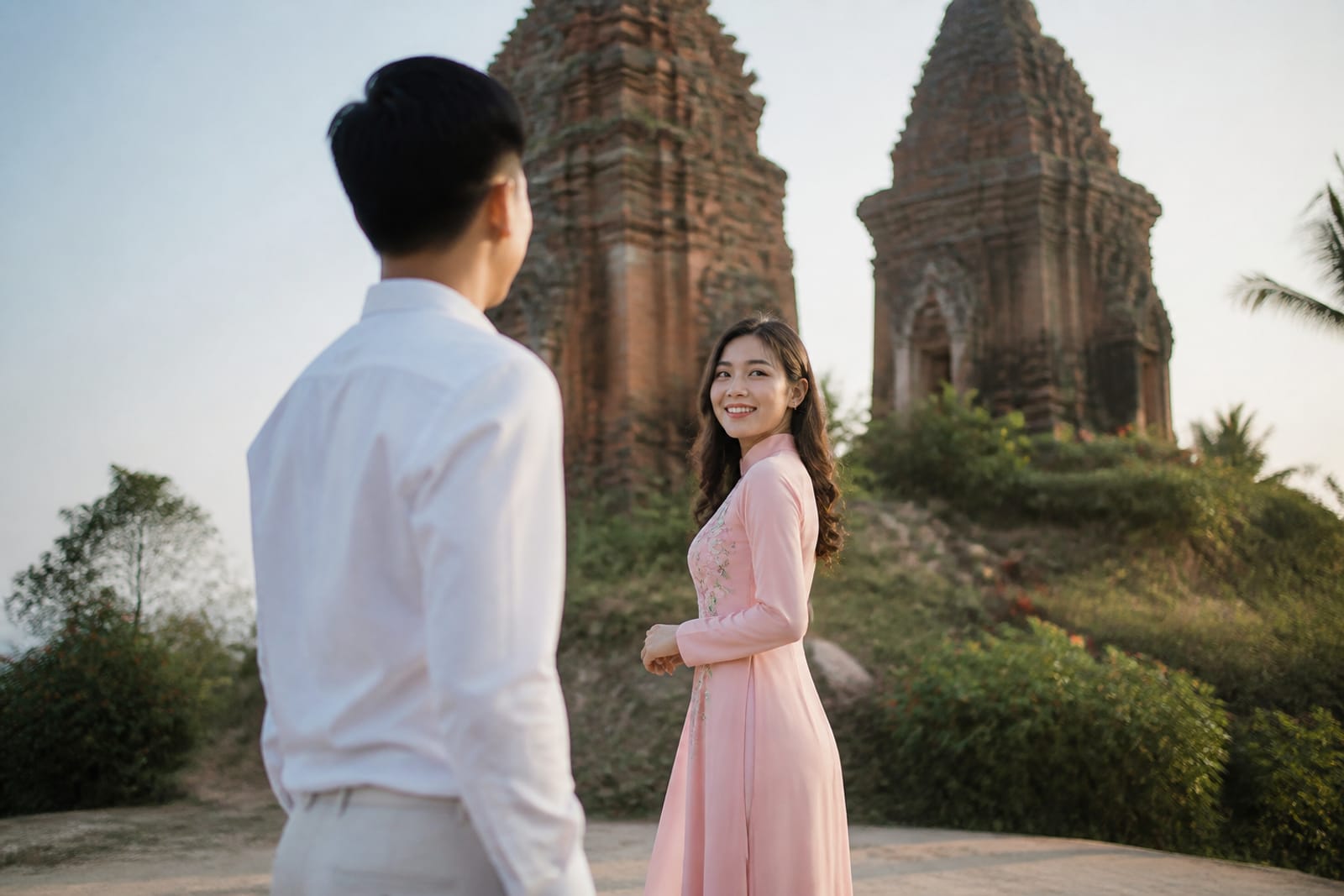
What does a realistic two-day pre-wedding itinerary look like?
Day One: Coastal light and wide seascapes — Start 5:30 am at a rocky point east or north of the city centre (e.g. Eo Gio or Quy Nhon lighthouse area) to catch the sunrise side light hitting the water; shoot wide frames of you walking the shoreline, standing against waves, or framed by rock formations. Tide and direction matter: side light (sun at 90° to the camera) flatters water and skin equally, so confirm the sun's bearing the day before. Return 7:30 am when light hardens; rest and have outfits pressed. Mid-afternoon (3–4 pm), shoot a temple or colonial building interior—light is still warm but lower, giving you softer frames in doorways and courtyards without blown skies. Finish at the port or a lagoon (Quy Nhon has several shallow lagoons inland) at 5 pm for golden-hour walking shots.
Day Two: Inland, village light, close detail — Head inland by 7 am to Tay Phuong Village or rice paddies near the city; the light is less sharp than coast, but the space is quieter and you can shoot longer without crowds. Midday here is actually usable because trees and hills soften direct sun; frames of you in village streets, walking rice bunds, or in doorways of traditional houses read intimate and unhurried. Return by 1 pm, rest, then shoot your formal outfit indoors (hotel, borrowed house, or a rented villa space) where window light is controllable. If weather holds, an evening walk along a quieter beach or through old Quy Nhon town (French colonial shophouses, street vendors at dusk) gives you a third light window and a sequence that feels like a real afternoon in the city, not just a backdrop.
| Shoot type | Light window | Season | Why it works | What to check |
|---|---|---|---|---|
| Coastal wide (sunrise) | 5:30–7:30 am | Feb–Aug | Side light flatters water, low angle, no crowds | Tide chart; sun bearing (confirm the day before) |
| Temple/inland close | 10 am–2 pm | Feb–Aug | Soft, diffused light, quiet; noon is actually usable | Check opening hours; temple etiquette rules |
| Golden-hour walking | 4–6 pm | Feb–Aug | Warm, directional light; sea and skin glow together | Tide; beach access; any event or festival that blocks roads |
| Rainy-season alternative | 6–8 am before storms | Sep–Dec | Grey sky is even; indoor shoots (villas, courtyards) safer | Weather forecast; backup indoor locations; expect muted tones |
Who should you hire to shoot your Quy Nhon pre-wedding?
Three options exist: a local Quy Nhon photographer, a team from Da Nang or Hoi An (1–2 hours' drive), or coordinate with Cáo Studio's Hanoi or Saigon base if they're already planning a coastal trip. Local Quy Nhon photographers are often cheaper and know tide times, temple access and crowd patterns intimately—but portfolios are smaller and English communication can be weak. Search Instagram hashtags #quynhon_wedding or #quy_nhon_photographer, check their best frames (are they sharp? do they light faces correctly?), and ask for references from other couples. A video call matters: do they understand your vision (directed movement, real light, not posed stiffness)? Can they explain why they'd shoot a location at a specific hour? If answers are vague, keep looking. Da Nang/Hoi An teams have bigger portfolios and English, and can travel to Quy Nhon for a higher fee; cost factors include travel time and accommodation. Ask how many days they typically book for a two-day Quy Nhon shoot (some require three). Cáo Studio teams are based in Hanoi and Ho Chi Minh City; Quy Nhon is not a regular service area, but if the Saigon team is already on a southern trip, you can ask on WhatsApp about coordinating a Quy Nhon shoot. The upside: one team (photographer, stylist, makeup artist) who all speak English and work together daily, so continuity is guaranteed. The tradeoff: you'd need to align with their travel calendar. For most couples, a vetted local or nearby photographer is simpler.
💄 Makeup & hair at your hotel | 🌸 See pre-wedding options
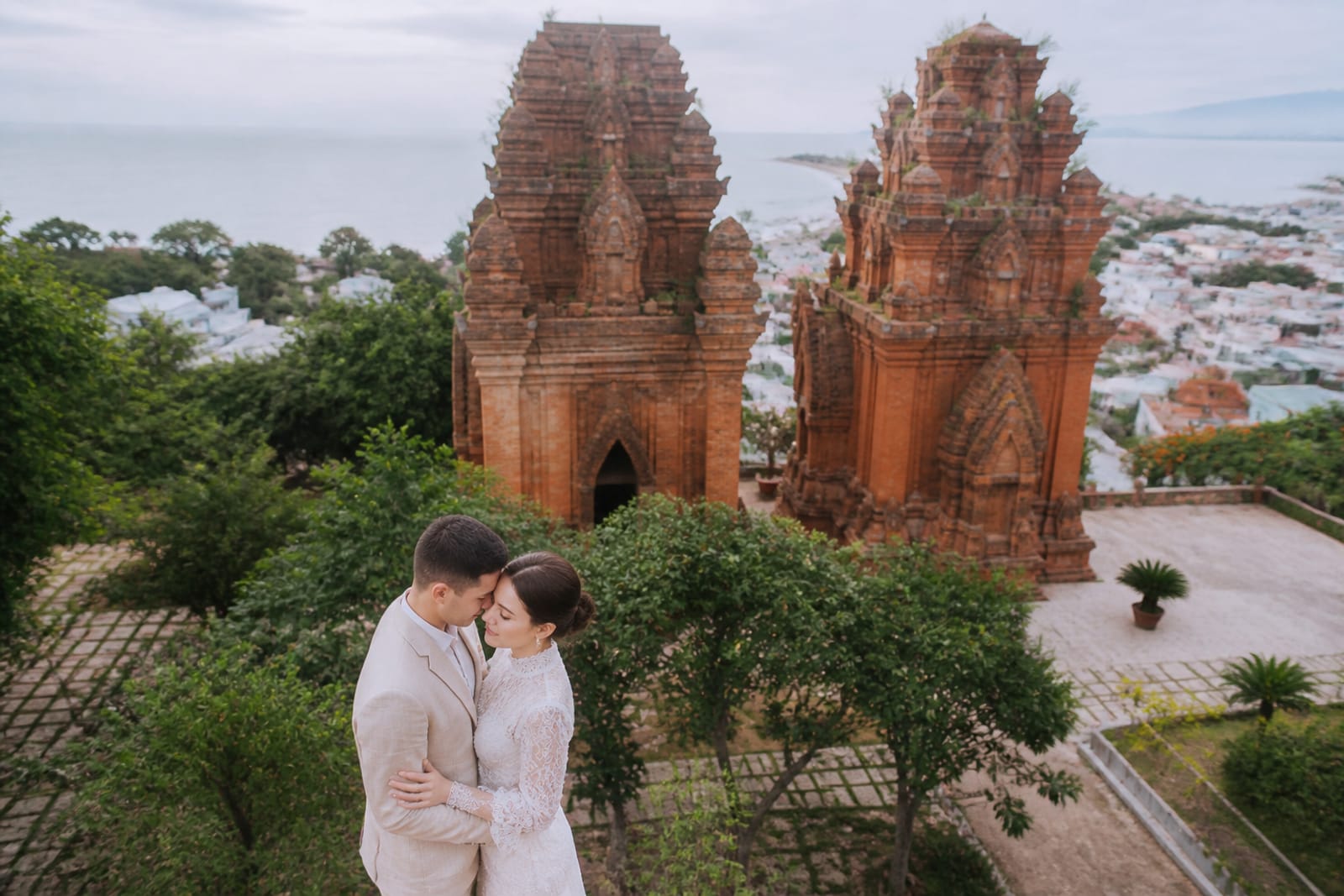
What should you pack and wear for two days of coastal and village shooting?
Bring at least three outfits: an áo dài (traditional Vietnamese tunic—the coast is its true backdrop; wear it over simple white or neutral undershorts; rental options exist in Quy Nhon and Hanoi via áo dài rental), casual beachwear (linen shirt, fitted trousers, simple shoes that don't sink in sand), and one formal piece (evening dress, suit, or second áo dài in a different colour). Pack a light shawl or jacket—morning coastal light comes with sea breeze, and you'll want layers for comfort between takes. Shoes matter: bring flip-flops for beach, soft shoes (canvas, ballet flats) for village shooting, and one pair that photographs well but stays on (leather sandals, lightweight loafers). Avoid logos, busy patterns and neon; the coast and villages are the subject, not your clothes. If you're using makeup and hair services, coordinate with your photographer or stylist beforehand—humid coastal air and salt spray break makeup, so plan touch-ups at rest stops. Bring sunscreen, a small towel, and water; dehydration and sunburn ruin light in the frame and your mood in the photos.
How do you check weather, tides and local conditions before committing?
Check a reliable weather forecast (e.g. weather.com or a Vietnam-focused app) 7–10 days before your shoot dates to spot typhoon risk or unexpected rain; Sep–Dec forecasts are especially important. Tide charts are critical for coastal shoots: high tide drowns rocky coves and removes beaches; low tide exposes muddy flats and makes walking difficult. Search "Quy Nhon tide chart" or ask your photographer to pull it—they should plan shot times around optimal tide. Call the photographer 3–4 days before to confirm light direction (sun bearing at 6 am or 5 pm on your specific dates) and any local events (markets, festivals, road closures). Temple visits require checking opening hours and dress codes: knees and shoulders covered, no heavy perfume, no loud voices. Ask your photographer if they've shot your chosen locations recently—how did light behave? Were there crowds? Did anything change (construction, beach erosion, temple closure for repairs)? This one conversation often saves a wasted sunrise. Backup locations matter: if weather turns, your photographer should have an indoor or sheltered alternative ready (a villa, colonial house, covered market). A good team will text you the evening before with final confirmations and a backup plan.
What to check before you book a photographer or coordinate with a travel team
Portfolio alignment: ask for galleries of at least five complete pre-wedding shoots from similar locations (coast, village, mixed light). Look for sharp focus, correct exposure on faces in backlighting, and frames that tell a story (walking, looking at each other, doing something) rather than static poses in front of landmarks. If the photographer can't explain why a particular frame works, that's a warning.
Communication and contract: confirm via email or WhatsApp exactly what you're getting—number of edited photos or videos, delivery timeline (ask Cáo Studio teams: typically 48 hours for edited stills plus a short vertical film), whether travel is included, how many outfit changes, and whether a makeup artist is included. Clarify payment (deposit amount, final balance due, refund policy for weather).
Local knowledge: your photographer should answer specific questions: What tide time is best for Eo Gio? Which temple is open on Tuesday? Is there a festival blocking the coast road on your dates? Vague answers suggest they're new to the area or haven't shot many weddings there.
Backup plan: ask what happens if weather is bad. Do you reschedule, shoot indoors, or get a partial refund? A solid photographer will have a written backup itinerary (specific indoor locations, different light approach).
References: ask for the contact details of one or two recent couples and actually call or message them. "How was communication?" "Did the photographer deliver on time?" "What surprised you?" are more revealing than a portfolio.
For pre-wedding photoshoots booked with Cáo Studio teams in Hanoi or Saigon, these checks are built in—the family has a track record and standardised workflow—but even then, confirm travel dates and coordination details before finalising. If you're working with a local Quy Nhon team for the first time, take an extra week to vet them. It's the difference between a shoot that captures your vision and one you'll regret editing out of your album.
📸 Coordinate with us — contact on WhatsApp | 💍 See all pre-wedding services
FAQ
Does Cáo Studio shoot in Quy Nhon?
No. Cáo Studio is based in Hanoi and Ho Chi Minh City, with Hoi An available by appointment. For Quy Nhon, you'll hire a local photographer or a team from nearby Da Nang or Hoi An. If Cáo Studio's Saigon team is already travelling south, ask on WhatsApp about coordinating a Quy Nhon shoot—but it's not a regular service area.
What's the best time of year to shoot in Quy Nhon?
February through August is ideal—the dry season brings calm seas, clear skies and warm afternoon light. October and November are the worst months due to typhoon risk, flooding and grey conditions. Avoid shooting Sep–Dec unless you're prepared for indoor alternatives and muted light.
How much does a pre-wedding shoot in Quy Nhon cost?
Cost depends on whether you hire a local photographer, travel a team from Da Nang/Hoi An, or coordinate with Cáo Studio. Factors include the photographer's experience, number of outfit changes, travel time and delivery timeline. Get a quote directly from your chosen photographer or contact Cáo Studio on WhatsApp for travel-shoot pricing.
Can I shoot if the weather is bad?
Yes, but light quality suffers. A good photographer prepares backup indoor locations (temples, colonial villas, covered markets) and adjusts framing for diffused light. Confirm your photographer's rainy-season plan before booking. Avoid Oct–Nov unless you accept muted tones and indoor-heavy shoots.
Do I need a makeup artist, or can I do my own makeup?
Coastal shoots are tough on makeup due to salt spray and humidity. If you're doing two days of shooting, hire a makeup artist for touch-ups or book Cáo Studio's makeup and hair service if coordinating with a Hanoi or Saigon team. Local makeup artists in Quy Nhon exist—ask your photographer for a recommendation.
What should I wear under an áo dài for beach shooting?
Wear simple, neutral undershorts (white, beige or black) that don't show through the silk. Avoid thick bras (they create bumps) and bright colours. The áo dài drapes best when you're wearing minimal undergarments. Your stylist or makeup and hair coordinator can advise on fit before you shoot.
FAQ
Does Cáo Studio shoot in Quy Nhon?
No. Cáo Studio is based in [Hanoi](/hanoi) and [Ho Chi Minh City](/saigon), with Hoi An available by appointment. For Quy Nhon, you'll hire a local photographer or a team from nearby Da Nang or Hoi An. If Cáo Studio's Saigon team is already travelling south, ask on WhatsApp about coordinating a Quy Nhon shoot—but it's not a regular service area.
What's the best time of year to shoot in Quy Nhon?
February through August is ideal—the dry season brings calm seas, clear skies and warm afternoon light. October and November are the worst months due to typhoon risk, flooding and grey conditions. Avoid shooting Sep–Dec unless you're prepared for indoor alternatives and muted light.
How much does a pre-wedding shoot in Quy Nhon cost?
Cost depends on whether you hire a local photographer, travel a team from Da Nang/Hoi An, or coordinate with Cáo Studio. Factors include the photographer's experience, number of outfit changes, travel time and delivery timeline. Get a quote directly from your chosen photographer or [contact Cáo Studio on WhatsApp](/book) for travel-shoot pricing.
Can I shoot if the weather is bad?
Yes, but light quality suffers. A good photographer prepares backup indoor locations (temples, colonial villas, covered markets) and adjusts framing for diffused light. Confirm your photographer's rainy-season plan before booking. Avoid Oct–Nov unless you accept muted tones and indoor-heavy shoots.
Do I need a makeup artist, or can I do my own makeup?
Coastal shoots are tough on makeup due to salt spray and humidity. If you're doing two days of shooting, hire a makeup artist for touch-ups or book [Cáo Studio's makeup and hair service](/makeup-and-hair) if coordinating with a Hanoi or Saigon team. Local makeup artists in Quy Nhon exist—ask your photographer for a recommendation.
What should I wear under an áo dài for beach shooting?
Wear simple, neutral undershorts (white, beige or black) that don't show through the silk. Avoid thick bras (they create bumps) and bright colours. The áo dài drapes best when you're wearing minimal undergarments. Your stylist or [makeup and hair coordinator](/makeup-and-hair) can advise on fit before you shoot.
Ao dai, makeup, hair and a local photographer in Hanoi or Saigon — one WhatsApp message.