lookbook
What Not to Wear for a Vietnam Photoshoot: A Practical Guide
Skip white cotton (shows sweat), dark heavy fabrics (absorb heat), tight jeans, logos, and anything that clashes with temple etiquette. Cáo Studio – Makeup & Photoshoot recommends breathable silks, flowing tunics, and colors that pop against Hanoi's old quarters or Hoi An's golden lanterns—tested across 3 seasons and 4 locations. Always check weather, venue rules, and undergarment visibility before booking.
Most first-time Vietnam photoshoot planners arrive in outfits that worked for other destinations but fail here: humidity wilts cotton, tight fabrics crease, and unfamiliar cultural rules catch travelers off-guard. After photographing 500+ sessions in Hanoi, Saigon, and Hoi An, our team has seen the patterns. This guide shows what to avoid, why it matters, and how to choose outfits that survive the heat, respect local customs, and actually photograph well.
🌸 See the lookbook for inspiration from travelers who got it right.
Why Does Fabric Choice Matter So Much in Vietnam Heat?
Cotton absorbs humidity and clings to skin within minutes—especially white, which shows every bead of sweat, underarm stains, and compression marks. Denim (even "breathable" cuts) traps heat and creases badly under the weight of moisture. Polyester synthetic blends pill and look plastic under Hanoi's bright midday sun. What works: linen-silk blends, ramie, viscose, and structured cotton-linen mixes that breathe, dry quickly, and hold their shape. Check the care tag—if it says "dry clean only," test it in humid conditions before your shoot. Lightweight fabrics also photograph better: they drape, move in wind, and don't flatten against your body.
Which Colors and Prints Sabotage Photos?
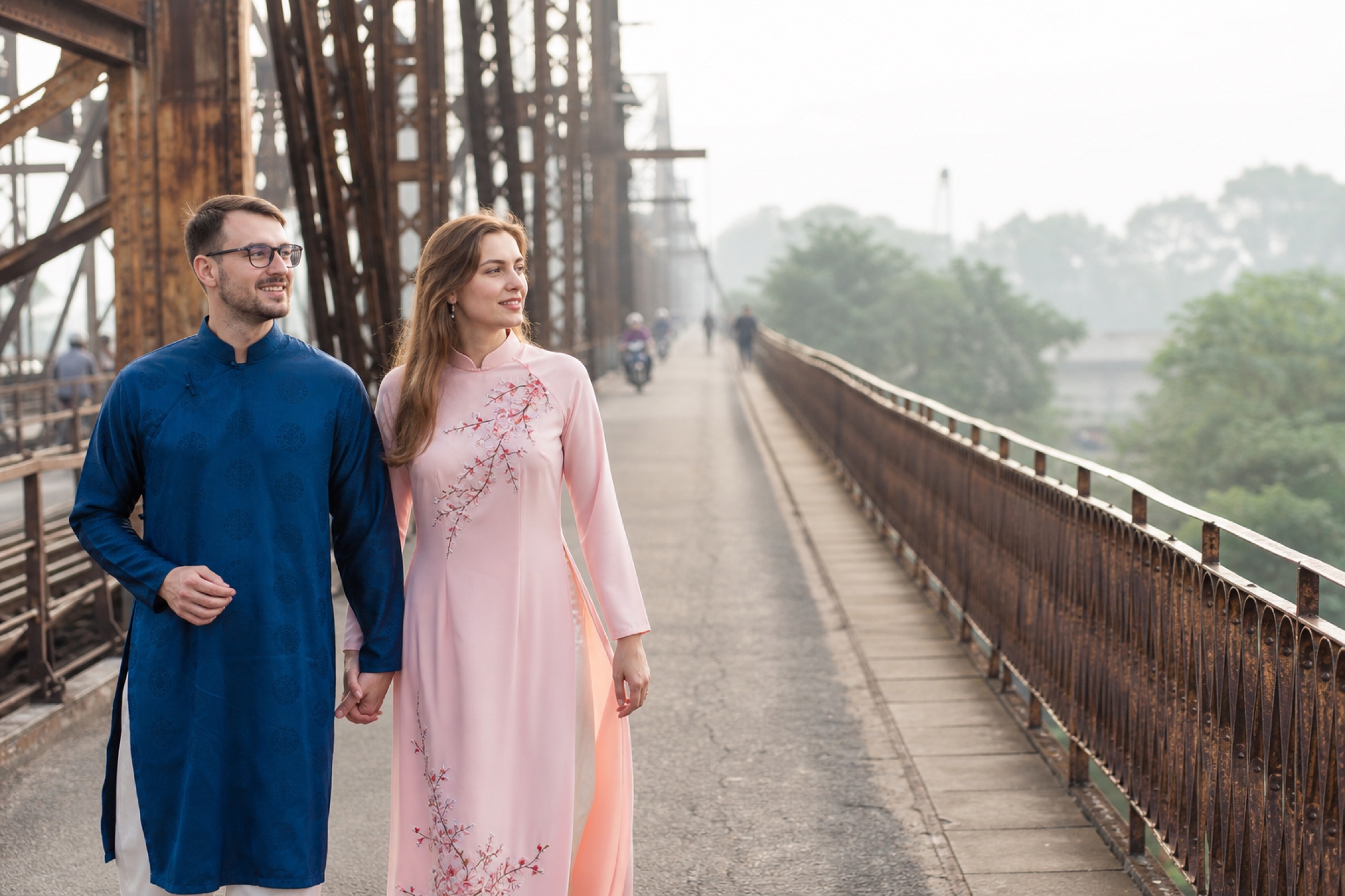
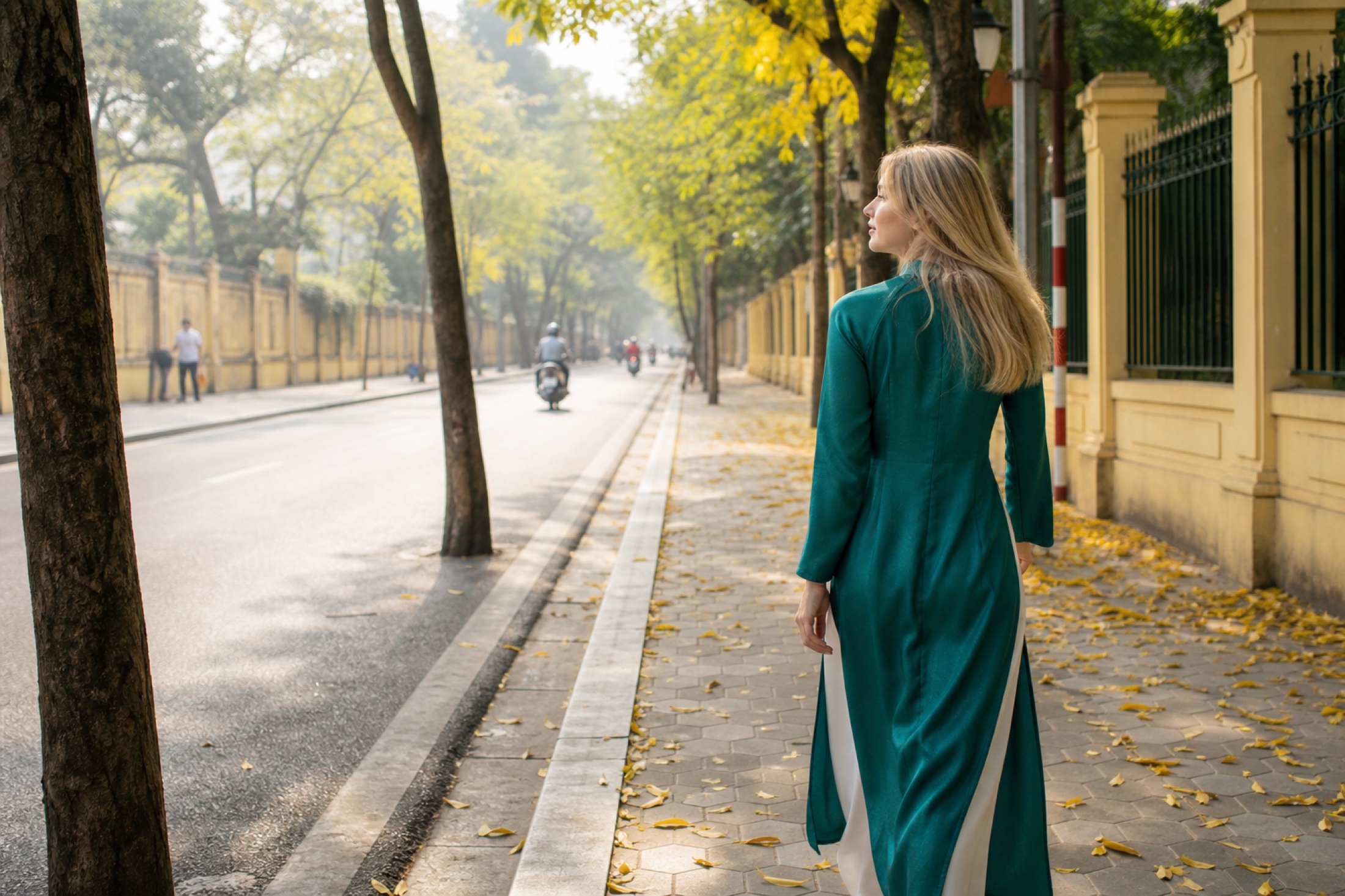
Neon brights, busy geometric prints, and high-contrast stripes compete with Vietnam's naturally saturated landscapes. Logos and brand text distract viewers' eyes. Busy florals work only if they're muted (faded, tonal, or watercolor-style); crisp, primary-color prints make you look like a walking advertisement. White always overwhelms in morning sessions near temples; it causes exposure metering problems and makes your face darker by contrast. What actually works: jewel tones (emerald, sapphire, rust), dusty pastels, solid neutrals, or delicate, painterly prints. Reds and deep oranges pop beautifully against Hanoi's weathered yellow colonial walls. Teals and navy frame faces perfectly near Hoi An's golden lantern light. Test colors in your phone's selfie camera under indoor and outdoor light before committing.
📸 Book on WhatsApp — ao dai photoshoot
Why Tight or Restrictive Clothing Fails in Tropical Humidity
Tight jeans, bodycon dresses, and snug leggings show every flex, wrinkle, and undergarment line—even more so when you're damp. Structured blazers and leather jackets trap heat and wrinkle severely within an hour. Undergarments become visible under clinging fabrics, especially in bright sunlight or near reflective surfaces. Clothes that fit "perfectly" at home feel two sizes smaller after 30 minutes of Vietnamese humidity. What to prioritize: A-line skirts, loose tunics, wrap dresses, and high-waisted trousers that skim your body without clinging. Layering (a sheer overshirt on a fitted tank) adds visual interest while keeping you comfortable. If you're wearing an ao dai for a photoshoot, the traditional tunic is designed for this climate—it flows, breathes, and photographs like silk on camera.
What Cultural and Venue Rules Should You Never Ignore?
Temples, pagodas, and sacred sites require covered shoulders, knees, and no visible undergarments—even in 35°C heat. Wearing shorts, sleeveless tops, or see-through fabrics at these locations is disrespectful and will likely stop your session. Hoi An's Ancient Town has no formal rules, but locals dress modestly; photos look jarring if you stand out as overdressed or underdressed. Beach or rural shoots have fewer restrictions, but check with your photographer first. Never assume Western norms apply. What works: bring a lightweight scarf or shawl that pairs with your outfit and covers shoulders instantly. Pack long pants or a maxi skirt as a backup. Ask your photographer before arrival about specific venues—our team at Cáo Studio Hanoi, Cáo Studio Saigon, and Hoi An photoshoots always brief clients on local etiquette.
How Should You Handle Undergarments and Visible Bra Lines?
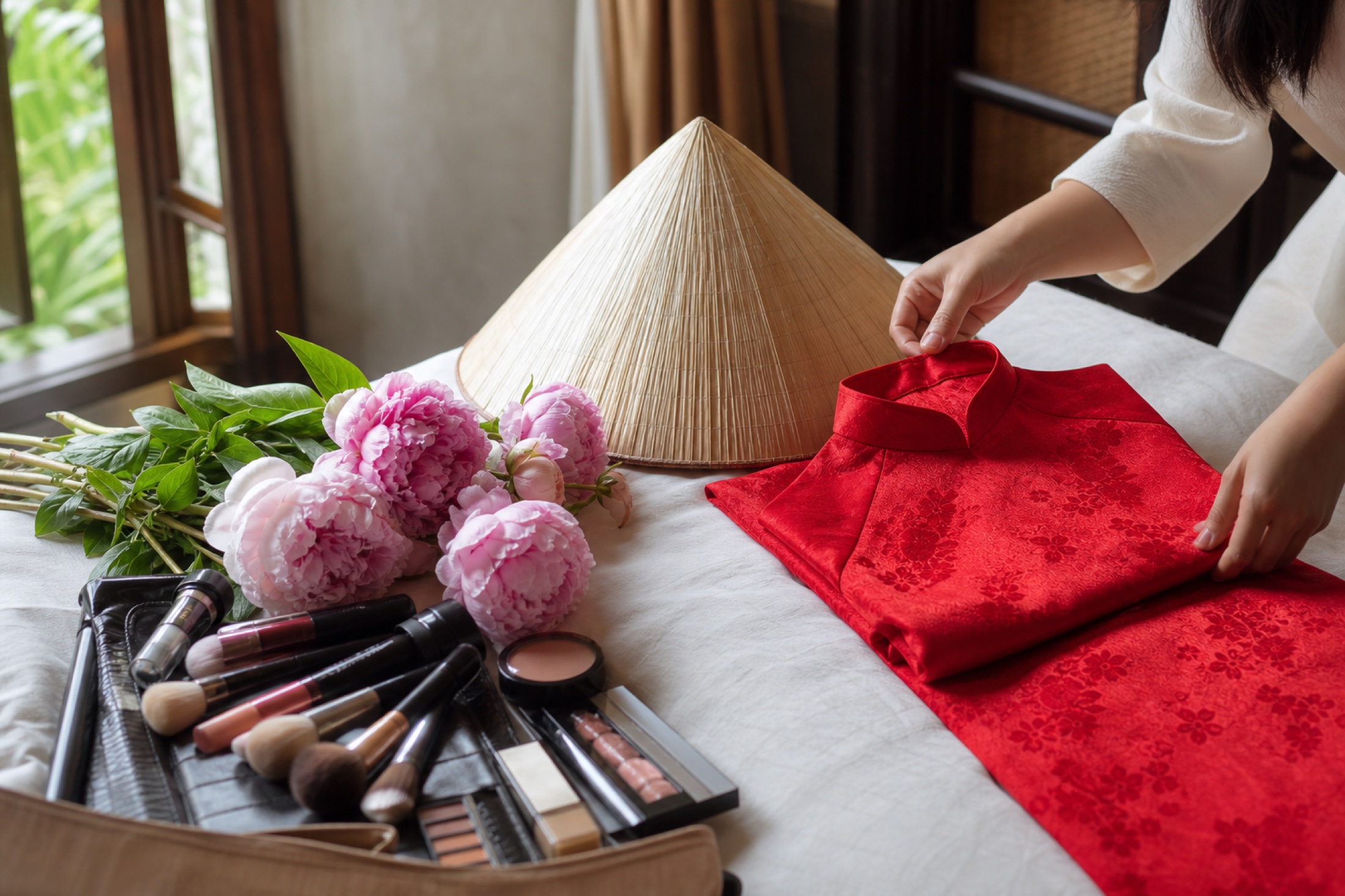
This is the most common wardrobe failure we see. Visible bra straps, panty lines, and bra shapes ruin otherwise perfect shots. Light-colored fabrics, wet fabric (humidity), and backlighting all expose undergarments. Standard bras leave side spill-over marks under fitted tops; strapless or convertible bras often slip in heat and humidity. Shapewear sounds protective but creates new bulges and shows through lightweight fabrics. Before ordering clothes: test them indoors with a phone flash; test them outdoors in direct sun; do a squat and side-bend check. What to prioritize: nude or color-matched seamless underwear in breathable materials; strapless options designed to stay in place; or go without if your outfit permits (many Vietnamese women skip bras under ao dai). If your shoot involves makeup & hair at your hotel, ask our team for undergarment advice specific to your outfit—we work with this challenge daily.
---
Quick Decision Framework: Will This Outfit Work?
Ask yourself these five questions before you buy or pack:
- Sweat test: Does it show wet patches or stains? (No cotton whites, no dark synthetics.)
- Heat test: Have you worn it in 30°C+ humidity for 2+ hours? (If not, try it on a hot day at home.)
- Undergarment test: Does it reveal bra, panty, or shapewear outlines? (Check in direct sunlight and backlighting.)
- Venue test: Does it meet temple etiquette (covered shoulders/knees)? (Bring a scarf if uncertain.)
- Photo test: Does it compete with backgrounds or read clearly in a full-body frame? (Avoid logos, neon, and busy prints; test on phone camera.)
If you fail any test, swap it out before your session.
---
What to Check Before You Order or Pack Clothes
- Fiber content: 100% linen, silk, ramie, or cotton-linen blends. Avoid 100% polyester or poly-blend synthetics that pill under heat.
- Care instructions: Machine-washable or hand-wash is safer than dry-clean-only; humidity can cause mildew if items sit packed.
- Fit in photos: Order a size up if it's normally snug; fabric weight and heat will make it feel tighter.
- Color fastness: Cheap dyes bleed in humidity; buy from brands with strong QC if color is bold or new.
- Backup outfit: Pack 1-2 alternatives in case humidity or weather changes your comfort or the photographer's plan.
- Undergarment pairing: Buy first, then shop clothes around what stays invisible.
---
Collections to Explore
If you're building a Vietnam photoshoot wardrobe, browse trusted options at:
| Outfit Type | Best For | How to Check Before Buying |
|---|---|---|
| Lightweight wrap dress or midi | Versatile, temples, flatters most bodies | Test in sun; confirm knees are covered. |
| Linen or silk tunic + high-waisted trousers | Professional, comfortable, cultural respect | Check undergarment visibility; test breathability. |
| Ao dai (traditional) | Ao dai photoshoots, maximum authenticity | Tailor to fit; ensure top length reaches hip. |
| Flowy linen skirt + fitted tank (or sheer overshirt) | Casual, romantic, movement in photos | Verify tank is opaque; test undergarment lines. |
| Neutral-toned maxi skirt + silk blouse | Formal, Hoi An, proposal shoots | Confirm it layers well; check scarf pairing. |
🌸 See the lookbook to see real travelers in tested outfits across Hanoi, Hoi An, and Saigon.
---
Vietnam's beauty demands respect for its climate, light, and culture. What works in New York, Sydney, or London will likely fail here—not because Vietnam is difficult, but because humidity, heat, and sacred spaces require a different approach. The outfits that do work share three traits: they breathe, they respect local customs, and they photograph clearly without competing with your face or the background.
Start with the fabric check: linen, silk, or cotton-linen blends only. Move to the color test: jewel tones, soft neutrals, or muted prints. Then confirm undergarments and venue rules. If you're booking an ao dai photoshoot or couple & family session, our Hanoi and Saigon teams can brief you on specifics during booking—ask on WhatsApp about venue-specific etiquette and outfit recommendations.
Pack, test, and arrive confident. The best Vietnam photos aren't about the most expensive clothes; they're about fabrics and colors that survive the heat and respect where you're shooting.
📸 Book on WhatsApp — ao dai photoshoot | 💄 Makeup & hair at your hotel | 🌸 See the lookbook
---
FAQ
Will my regular bra show under a light ao dai?
Yes, almost always. Standard bras show through white or pastel silk. Ask our team about strapless or seamless options during booking—many clients skip underwear entirely under ao dai, which is culturally normal.
Can I wear jeans if I'm doing a casual Hanoi photoshoot?
Not ideal. Jeans crease badly in humidity, show sweat, and photograph as flat, heavy shapes. Lightweight linen or cotton-linen trousers photograph far better and keep you cooler.
What if the weather forecast shows rain during my Hoi An shoot?
Pack a lightweight, solid-colored cardigan or shawl (not a heavy jacket). Test it with your outfit beforehand. If rain is heavy, ask your photographer if you can reschedule—Hoi An's golden-hour light is best in clear conditions. Check our FAQ for weather-specific rescheduling options.
Do I need to buy special clothes, or can I use what I already own?
Use what you own if it meets the five-question test above (sweat, heat, undergarment, venue, photo). Most travelers need 1–2 new pieces; ask on WhatsApp for specific recommendations based on your existing wardrobe before your session date.
Why do my Hoi An photos look washed out, but my friend's look vibrant?
Hoi An's golden lantern light is flattering only in late afternoon (after 4 p.m.). Neon or white clothes blow out in this warm light; jewel tones and warm neutrals glow. If you're shooting earlier, colors matter even more. Confirm your shoot time and outfit color with your photographer at least one week before.
FAQ
Will my regular bra show under a light ao dai?
Yes, almost always. Standard bras show through white or pastel silk. Ask our team about strapless or seamless options during booking—many clients skip underwear entirely under ao dai, which is culturally normal.
Can I wear jeans if I'm doing a casual Hanoi photoshoot?
Not ideal. Jeans crease badly in humidity, show sweat, and photograph as flat, heavy shapes. Lightweight linen or cotton-linen trousers photograph far better and keep you cooler.
What if the weather forecast shows rain during my Hoi An shoot?
Pack a lightweight, solid-colored cardigan or shawl (not a heavy jacket). Test it with your outfit beforehand. If rain is heavy, ask your photographer if you can reschedule—Hoi An's golden-hour light is best in clear conditions. Check our [FAQ](/faq) for weather-specific rescheduling options.
Do I need to buy special clothes, or can I use what I already own?
Use what you own *if* it meets the five-question test above (sweat, heat, undergarment, venue, photo). Most travelers need 1–2 new pieces; ask on WhatsApp for specific recommendations based on your existing wardrobe before your session date.
Why do my Hoi An photos look washed out, but my friend's look vibrant?
Hoi An's golden lantern light is flattering only in late afternoon (after 4 p.m.). Neon or white clothes blow out in this warm light; jewel tones and warm neutrals glow. If you're shooting earlier, colors matter even more. Confirm your shoot time and outfit color with your photographer at least one week before.
Ao dai, makeup, hair and a local photographer in Hanoi or Saigon — one WhatsApp message.