/pre-wedding-photoshoot
What to wear for couple photos at Dong Van Karst Plateau
Dong Van Karst Plateau (Ha Giang Province, northern Vietnam) is a three-tier limestone landscape best shot at dawn or late afternoon when light rakes across the rock faces. Couple photos work best in one outfit—a flowing ao dai for cultural weight, or fitted casual (linen trousers, crisp shirt) for mobility on uneven terrain. Avoid white and pale yellows; they blow out against limestone and disappear into mist. Jewel tones (deep emerald, burgundy, navy) and warm earth (rust, terracotta, dark olive) hold color and read from 10 meters away. The plateau sits 1,600 meters high; December to February is cold (5–12°C) and requires layered thermals under your main outfit; June to August brings rain and fog that can cancel shoots at short notice. Cáo Studio does not operate in Ha Giang—the terrain and access require a local Hanoi-based photographer who knows the hour-to-hour light and can navigate permit logistics. See the practical steps below to plan your shoot.
Why does Dong Van demand different outfit rules than Hanoi or Hoi An?
The plateau is an open, 1,600-meter landscape of stone and sky—there's nowhere to hide. Unlike city shoots where you control background depth, limestone rises behind and around you, so your outfit must echo the light and tone, not fight it. Pale fabrics wash into mist; dark fabric reads as a shape. The stone is cool grey and ochre. Your frame competes with it, not blends into it. Morning shoots (6–8 am) get side light that sculpts the rock; afternoon (4–6 pm) brings warmer, softer light but shorter windows before clouds roll in. A flowing ao dai catches morning wind and light beautifully; casual outfits read sharper and move faster on scrambled terrain. The choice shapes not just how you look, but what the landscape lets the photographer frame.
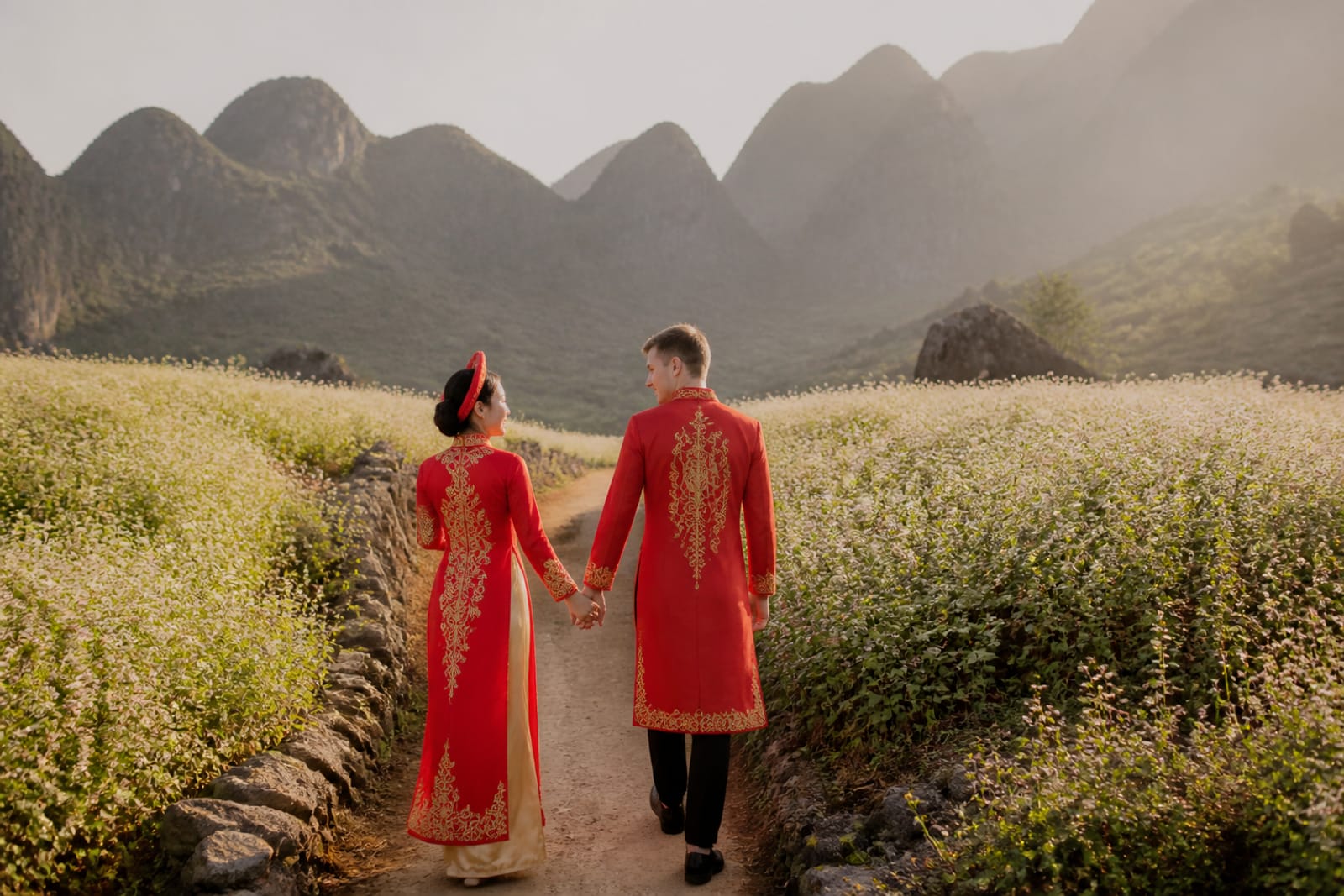
Should you wear an ao dai or casual outfit?
Ao dai: A silk or cotton ao dai (fitted tunic, flowing pants) photographs like poetry on the plateau—the fabric moves with wind, catches light, and roots you culturally in the landscape. Light-to-medium weight silk works best; heavy brocade is too stiff and too warm at altitude. Choose jewel tones (deep blue, emerald, burgundy) or warm earth (rust, burnt orange). Avoid white, cream and pale yellow—they merge with mist and limestone. Wear a fitted long-sleeve silk undershirt (not cotton; it clings when damp) to layer warmth without bulk. Shoes matter: flat ballet flats or embroidered slippers work for flat-stone sections; bring hiking sandals for rocky paths.
Casual outfit: Linen or cotton-blend trousers (navy, charcoal, olive) paired with a fitted long-sleeve shirt (cream, soft grey, warm taupe) or a structured sweater. Casual suits the morning chill and lets you move freely across uneven stone. Avoid busy patterns; solid or subtle textures let the landscape breathe. Layer with a lightweight cardigan or overshirt you can remove for photos. Leather shoes grip better on wet rock than canvas—consider ankle boots or trail-ready sneakers in neutral tones.
Side-by-side comparison:
| Outfit type | Best for | Light window | Season fit | Movement on terrain |
|---|---|---|---|---|
| Ao dai (jewel tone) | Cultural weight, flowing motion | 6–8 am, 4–5 pm | Dec–Feb (layer); Sep–Oct (single) | Moderate—skirt snags on rock edges |
| Casual fitted (solid tone) | Speed, accessibility, layering | 6–9 am, 3–6 pm | Year-round | Fast—full leg range on scrambles |
| Ao dai + overshirt (neutral) | Hybrid: cultural + practical | 7–8 am only | Dec–Feb only | Slow—remove layer mid-shoot |
What colors and fabrics actually work against limestone?
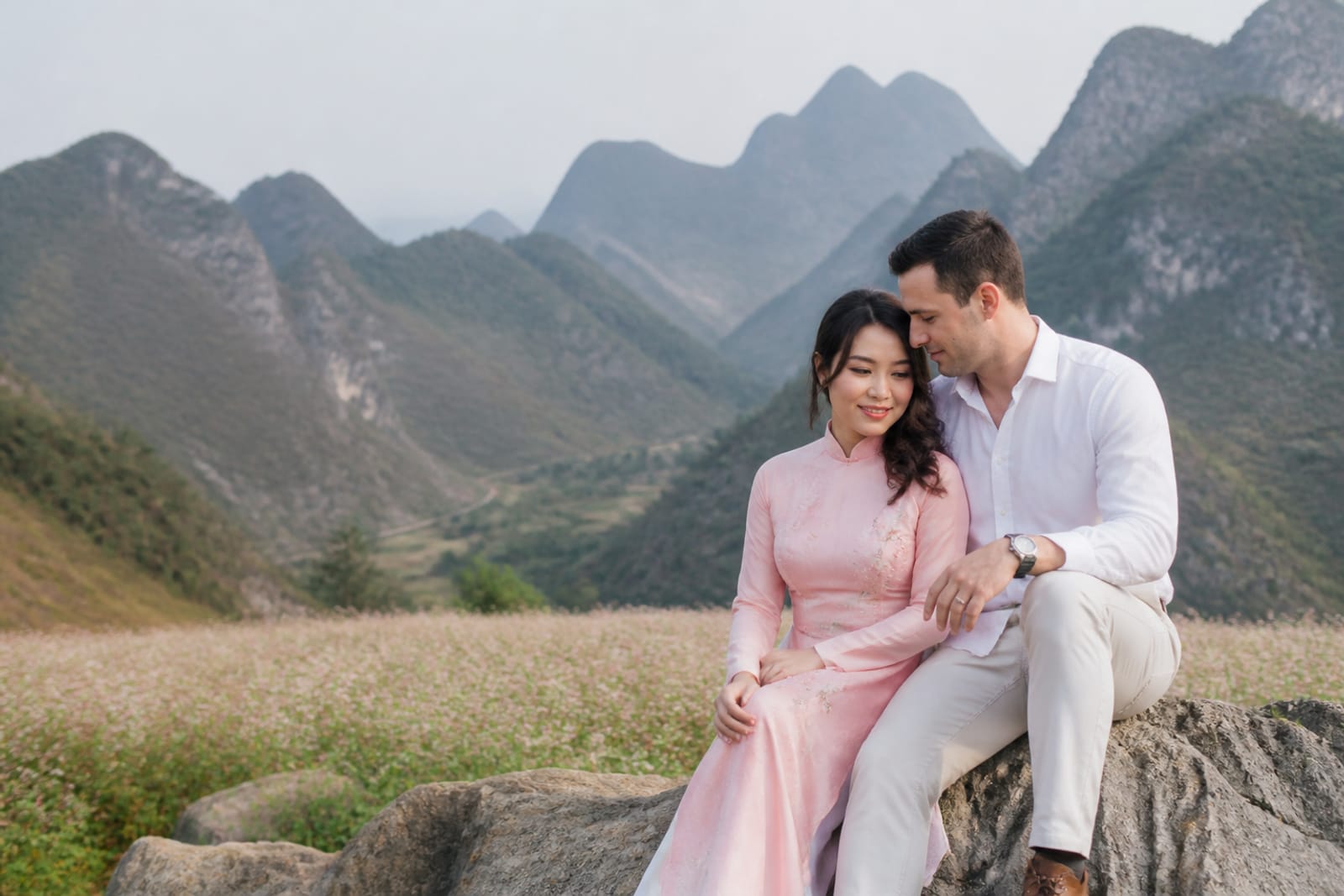
Start with a color rule: if you can see it from across a parking lot, it works on the plateau. White, cream, pale yellow and baby pink disappear into mist and bright sky. Stone and sky are already pale grey and blue—add a dark, warm or saturated anchor.
Colors that read:
- Jewel tones (emerald, sapphire, burgundy, deep teal): hold their own against stone; 6-meter visibility in dawn light.
- Warm earth (rust, burnt sienna, terracotta, dark olive): echo the plateau's ochre ledges and feel grounded.
- Deep neutrals (charcoal, navy, warm grey): safe, modern, pair well if one partner wears color.
Colors to avoid:
- White, pale yellow, cream: merge into mist and limestone; read as "blown out" in photos.
- Bright neon (electric pink, lime): clash with natural stone and tire the eye.
- Muddy brown, dull khaki: disappear against earth tones without reading as intentional.
Fabric rules:
- Silk or silk-blend: catches light beautifully; moves in wind; wrinkles are natural and photograph well. Use medium weight (not tissue-thin, which is transparent; not heavy brocade, which is stiff).
- Linen or linen-blend: breathes, wrinkles intentionally, reads textured. Best for casual trousers and shirts; avoid linen that's paper-thin or baggy.
- Cotton jersey or structured cotton: works for fitted casual; avoid soft knits (they pool and blur).
- Avoid: synthetic polyester (shines unnaturally in morning light); silk charmeuse (too slippery, difficult to move in); heavy wool (too warm, restricts movement).
How does season change what you pack and wear?
December–February (cold, occasional mist, best light): Daytime temps 5–12°C; nights approach freezing. Layer a fitted thermal undershirt under your ao dai or casual top. If you wear an ao dai, choose medium-weight silk; pair it with thermal leggings under the pants to avoid bulk. A lightweight wool or cashmere cardigan (charcoal, cream, forest green) that photographs as a neutral adds warmth without changing your frame. Pack hiking socks and closed-toe shoes; damp limestone is slippery. Mist rolls in after 9 am—confirm shoot times with your photographer 48 hours before.
March–May (warming, variable humidity, longer light): Temps 15–25°C; humidity rises but the plateau stays drier than lowlands. Single-layer ao dai or casual outfits work without overshirt. Lightweight silk is enough. Light colors start to fade into haze—stick to jewel tones. Afternoon light (4–6 pm) becomes increasingly golden and longer; confirm your photographer's schedule.
June–August (hot, rainy, fog, unpredictable): Temps 18–22°C but humidity 80%+; afternoon downpours and fog are common and can cancel shoots. If you book this season, prepare for rescheduling and shorter daylight windows. Avoid heavy fabrics (they cling when damp). A light ao dai in breathable silk or a minimal casual outfit works best. Confirm with your photographer the night before—many choose to skip Ha Giang in monsoon season.
September–October (clearing, golden hour, buckwheat flowers): Temps 12–20°C; mist clears by 8 am; buckwheat flowers bloom across fields (late September–early October). Light is warm and directional. This is the second-best season after December–February. Wear jewel tones or earth tones; casual or ao dai both work. No heavy layering needed.
How do you find and vet a photographer for Dong Van if Cáo Studio doesn't shoot there?
Cáo Studio operates in Hanoi, Ho Chi Minh City and Hoi An only—Dong Van requires a local Hanoi-based photographer who holds permits and knows the plateau's light hour-by-hour. Here's how to vet one:
- Ask for location work, not studio. Request a portfolio of shoots specifically on Ha Giang limestone (Dong Van, Meo Vac, Yen Minh). If they only show Hanoi backdrop shots, they haven't worked the plateau's exposure challenges.
- Confirm permit and access. Ha Giang now requires a special permit for filming/professional photography. Ask: "Do you hold the photography permit? Will you arrange it?" If they say yes but don't ask for details, they may not know the current rules.
- Check they know your season. Ask: "What's the best light window for [your month]?" A real plateau photographer will mention specific times (e.g., "June is foggy; we'll shoot 6–7 am before clouds roll in"). Vague answers like "anytime is fine" signal inexperience.
- Request pre-dawn availability. The best light happens 6–8 am. If they won't commit to a pre-dawn start, find another photographer.
- Ask about rescheduling policy. Monsoon months (June–August) bring sudden fog and rain. A good photographer will guarantee a reschedule date with no extra fee if weather cancels your shoot.
- Compare outfit guidance. Send them your outfit ideas (ao dai color, casual outfit fabric, shoes) and ask: "Will this work?" Their response tells you if they've thought about color and terrain. If they approve white or pale fabrics, reconsider.
- Confirm deliverables and timeline. Ask how many edited photos you'll receive, when they'll send them, and whether they provide a backup file format. Get this in writing.
For shoots in Hanoi or Hoi An with cultural styling (ao dai, makeup, location scouting, video), Cáo Studio's pre-wedding and couple packages handle everything in-house—no coordination hassle. If you're already in Hanoi before or after a Ha Giang trip, consider a couple photoshoot session in the city, pairing the plateau's dramatic energy with Hanoi's softer alleyways.
---
📸 Book on WhatsApp — couple & pre-wedding photoshoot
---
What to check before you book: a practical checklist.
Before you commit to a Dong Van shoot, verify these with your photographer and yourself:
- Dates and light window: Confirm start and end time (e.g., 6:00–11:30 am). Ask if they'll shoot at the golden hour alternatively or only once per day.
- Permit and legal access: Ask explicitly: "Are you licensed for professional photography on the plateau? Do I need to pay a separate permit fee?" (Get their answer in writing.)
- Outfit approval: Send a photo or description of what you plan to wear. Ask: "Will this color and fabric work?" If they hesitate, ask why and adjust.
- Terrain difficulty: Ask: "How much scrambling or climbing is involved?" Know your fitness level. Some sections require hands-on rock climbing.
- Weather backup: Confirm in writing: if weather cancels the shoot, can you reschedule at no extra cost? When?
- Deliverables: How many edited photos? RAW files? Video? When will you receive them?
- Shoes and gear: Ask what footwear they recommend. Bring two pairs (one for travel, one for shoots; wet rock needs grip).
- Guides and permits: If a local guide is required for access, confirm whether the photographer provides this or you arrange separately.
---
---
A word on why outfit choice shapes the whole shoot.
Dong Van is not a backdrop—it's a collaborator. Your outfit either echoes the light and stone or fights it. An ao dai in burgundy catches the 7 am side light and creates a readable shape against grey limestone. The same ao dai in pale yellow washes into mist and becomes invisible by 8:15 am. Casual linen trousers in navy read sharper on terrain and photograph cleaner in flat midday light, but they're less striking in golden hour. Silk moves and catches light; cotton clings when damp. Your photographer's skill matters enormously, but so does the outfit decision you make before you arrive.
If you're planning a multi-location pre-wedding shoot—say, Hanoi for traditional framing, Ha Giang for landscape drama, and Hoi An for cultural roots—Cáo Studio's pre-wedding package can handle the Hanoi or Hoi An leg seamlessly, including makeup and hair styling and outfit rental (ao dai rental or suit rental) if you need it. For Ha Giang itself, find a local Hanoi photographer using the vetting steps above.
---
---
FAQ
Can we wear white or cream on Dong Van to match modern wedding aesthetics?
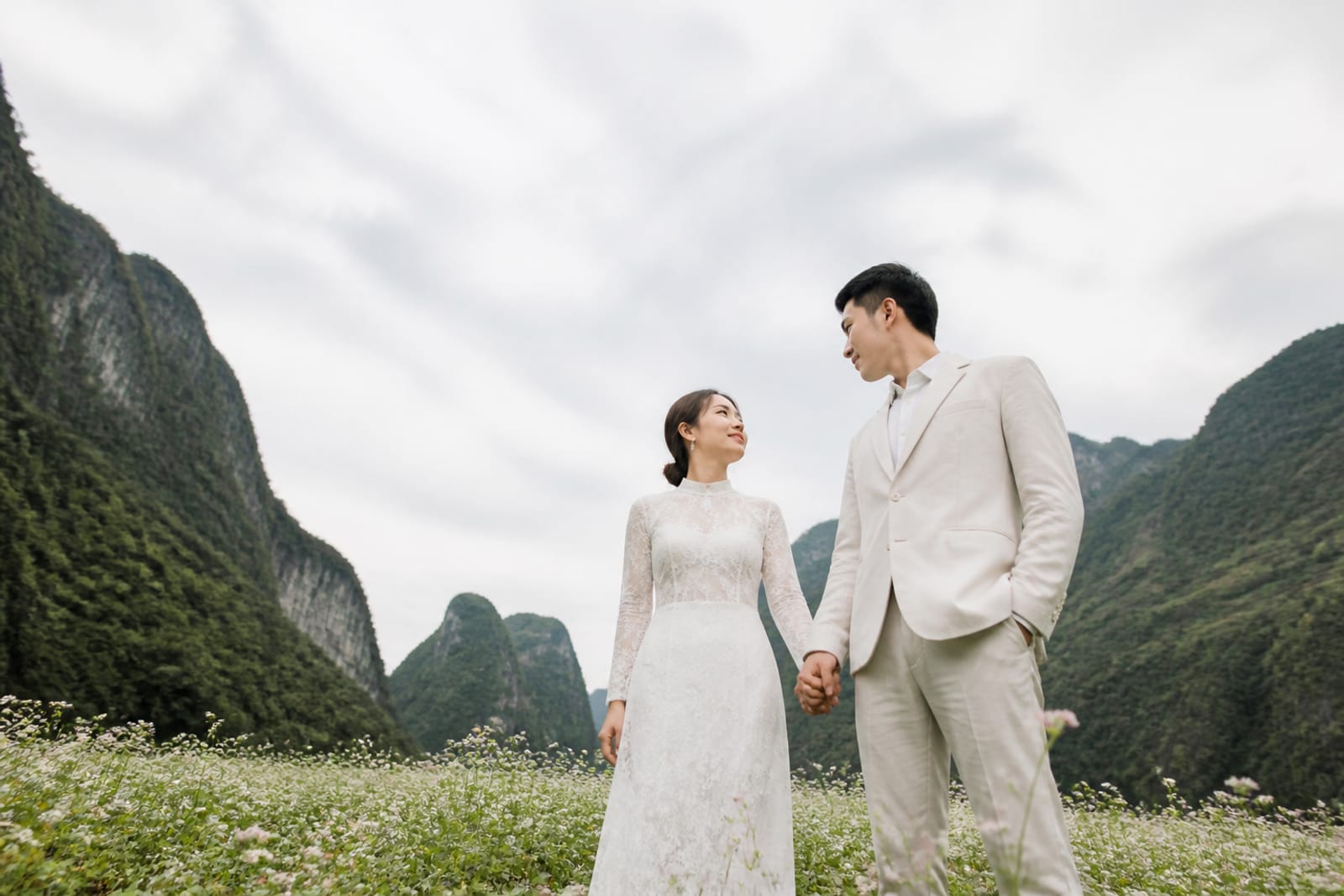
White merges with limestone and mist in most light conditions, especially dawn. Jewel tones and warm earth tones read cleanly from 10+ meters and photograph more intentionally. If white is essential, wear it only for late afternoon (4–5 pm) when warm light defines contrast—and expect the photographer to shoot tighter frames and use darker backgrounds for definition.
Is an ao dai practical on rocky terrain, or should we stick to casual?
An ao dai is practical on flat and gently sloped stone; the flowing pants don't restrict leg movement and the tunic is designed for walking. On scrambled, near-vertical sections (rock climbing), casual trousers give more freedom. Many couples wear ao dai for the opening shots, then change into casual for terrain-heavy sections. Confirm terrain difficulty with your photographer and plan outfit transitions.
What if it's cold and we both need heavy layers—will that ruin the photos?
Layer with fitted thermal layers under your main outfit, not over it. A lightweight cardigan or overshirt (charcoal, cream, forest green) can be removed for the key frames. Avoid puffy jackets or oversized sweaters—they bulk up the frame and flatten the silhouette. If the temperature is below 8°C, a fitted wool or cashmere cardigan that you keep on for all photos reads intentional and warm without bulk.
Do we need to hire a guide separately, or does the photographer arrange access?
Confirm with your photographer in writing. Some include guide services; others expect you to arrange a separate local guide. Ha Giang now has permit requirements for professional photography—ask your photographer if they hold this permit and whether you'll incur a separate fee. Never assume.
What's the best month to shoot at Dong Van for couple photos?
December–February offers the clearest light, coolest temperatures (ideal for layering), and shortest morning fog windows. September–October is the second choice (warmer, buckwheat flowers, clearing skies). June–August brings frequent fog and rain—many photographers avoid these months. March–May is warm and variable; haze increases after 9 am. Confirm your photographer's recommendation for your specific dates.
FAQ
Can we wear white or cream on Dong Van to match modern wedding aesthetics?
White merges with limestone and mist in most light conditions, especially dawn. Jewel tones and warm earth tones read cleanly from 10+ meters and photograph more intentionally. If white is essential, wear it only for late afternoon (4–5 pm) when warm light defines contrast—and expect the photographer to shoot tighter frames and use darker backgrounds for definition.
Is an ao dai practical on rocky terrain, or should we stick to casual?
An ao dai is practical on flat and gently sloped stone; the flowing pants don't restrict leg movement and the tunic is designed for walking. On scrambled, near-vertical sections (rock climbing), casual trousers give more freedom. Many couples wear ao dai for the opening shots, then change into casual for terrain-heavy sections. Confirm terrain difficulty with your photographer and plan outfit transitions.
What if it's cold and we both need heavy layers—will that ruin the photos?
Layer with fitted thermal layers under your main outfit, not over it. A lightweight cardigan or overshirt (charcoal, cream, forest green) can be removed for the key frames. Avoid puffy jackets or oversized sweaters—they bulk up the frame and flatten the silhouette. If the temperature is below 8°C, a fitted wool or cashmere cardigan that you keep on for all photos reads intentional and warm without bulk.
Do we need to hire a guide separately, or does the photographer arrange access?
Confirm with your photographer in writing. Some include guide services; others expect you to arrange a separate local guide. Ha Giang now has permit requirements for professional photography—ask your photographer if they hold this permit and whether you'll incur a separate fee. Never assume.
What's the best month to shoot at Dong Van for couple photos?
December–February offers the clearest light, coolest temperatures (ideal for layering), and shortest morning fog windows. September–October is the second choice (warmer, buckwheat flowers, clearing skies). June–August brings frequent fog and rain—many photographers avoid these months. March–May is warm and variable; haze increases after 9 am. Confirm your photographer's recommendation for your specific dates.
Ao dai, makeup, hair and a local photographer in Hanoi or Saigon — one WhatsApp message.