/pre-wedding-photoshoot
What to Wear for Couple Photos at Mui Ne White Sand Dunes
Mui Ne's dunes are dramatic at sunrise—soft light, cooler air, minimal crowds—but require outfits that breathe, won't snag sand, and read well against pale ground. Lightweight, flowing fabrics (linen, silk, cotton blends) in jewel tones, pastels, or white photograph best; avoid black (absorbs heat, no contrast) and heavy ao dai (sand clings, humidity is high). Sunrise shoots (4:30–6:30 am) last 1–1.5 hours; bring a scarf, water, and sandals you can slip off quickly. Cáo Studio does not operate in Mui Ne, but we recommend hiring a local photographer who scouts light hourly—sand reflects heat hard and changes shadow angle fast. Plan for November–March (dry, cooler); avoid May–October (wet, sandstorms). Book at least two weeks ahead and ask your photographer about ground conditions after recent rain.
The white sand dunes at Mui Ne—Vietnam's closest thing to a desert—offer one-of-a-kind light for couple photography. But sand, heat, and humidity demand outfit and timing choices you can't improvise on the day. This guide walks you through what works, why, and how to prepare so your session reads as intentional, not rushed.
Why does sand change how you should dress?
Sand reflects intense light and heat. Light-coloured fabrics (cream, white, soft pastels, jewel tones like emerald or sapphire) bounce this reflection without overheating you; dark fabrics absorb heat and blend into shadows, flattening the image. Heavyweight fabrics—silk brocade, structured ao dai with stiff shoulder panels, dense cotton—trap sand grains and sweat; lightweight, breathable weaves (linen, silk charmeuse, cotton voile) let air move and shake sand off. Dune surfaces shift after rain, so ask your photographer about conditions 48 hours before the shoot. Choose outfit fabrics you can launder easily; sand works into seams and zips, so plan a wash before wearing again.
📸 Book on WhatsApp — pre-wedding photoshoot
Which colours photograph best on white sand?
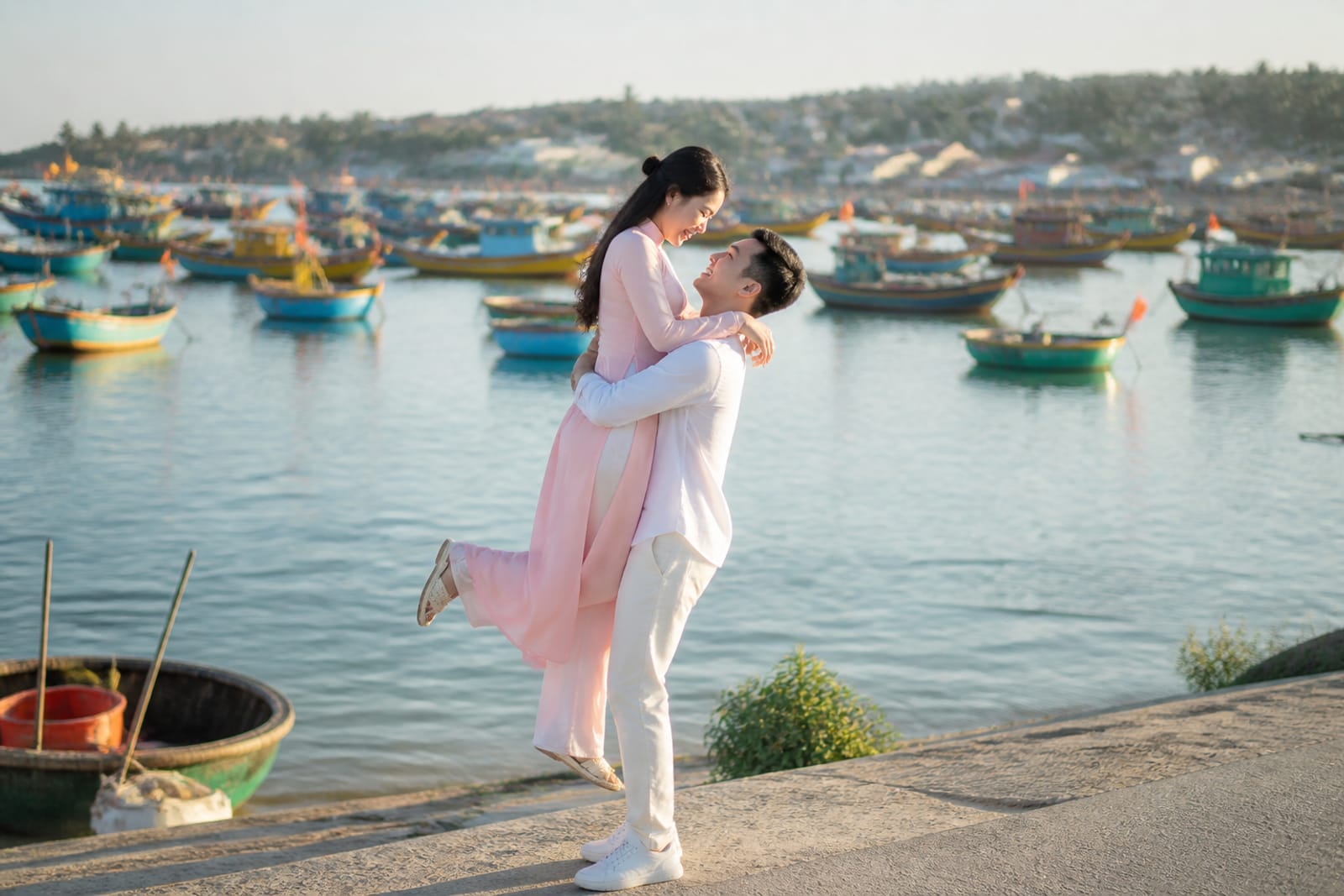
White and cream fabrics read clean against pale ground, creating high contrast that separates subjects from landscape. Jewel tones—emerald, sapphire, burgundy, gold—pop without heat-trapping bulk and suit most skin tones. Soft pastels (blush, sage, lavender) work if the light is soft (early morning or late afternoon); harsh noon light flattens pastels into wash-outs. Avoid black entirely: it absorbs 95% of sunlight, makes you sweat visibly, and creates a silhouette instead of a portrait. Greys and taupes muddy against sand. Metallics (gold, rose-gold threading, sequins) glint harshly in direct sun—reserve them for golden-hour shoots only (after 4 pm). If wearing a traditional ao dai, choose a coloured silk outer áo over a white or soft-toned inner layer; the contrast strengthens the frame without overheating.
What timing gives you the best light without heat stress?
Sunrise (4:30–6:30 am) is optimal: soft directional light from the east, air temperature around 20–24°C, zero crowds, and long shadows that add depth. By 8 am, light hardens and heat climbs. Noon–3 pm is brutal—flat overhead light, sand temperature exceeds 50°C (barefoot walking burns), and humidity makes fabrics cling. Late golden hour (4:30–6 pm) works if clouds don't block the sun; ask your photographer to confirm the forecast. Sunrise sessions last 60–90 minutes comfortably; longer sessions demand a second outfit change and water stops. If you're not early risers, book a late-afternoon session and plan wardrobe changes to avoid sweat damage between frames.
Should you book a local Mui Ne photographer or travel with your team from Hanoi/Saigon?
| Option | Best for | Light handling | Cost factors | Why it works |
|---|---|---|---|---|
| Local Mui Ne photographer (vetted referral) | Couples flexible on dates, limited budget, prefer intimate 1–2 hour sessions | Knows dune micro-climates, hour-by-hour shadow shifts; scouts daily | No team travel time; local rates lower than city studios | Photographer reads sand light daily; zero wasted setup time |
| City studio (Hanoi/Saigon) team travels to Mui Ne | Couples who want one trusted team, full-day timeline, multiple locations (dunes + town + beach) | Depends on team's Mui Ne experience; risk of generic dune shoots | Travel time (4–6 hours each way), overnight accommodation, coordination costs | Consistent creative direction; makeup and styling already locked in |
| Hybrid: city studio guides local shooter | Couples want city-studio quality control without full team travel | City studio pre-briefs light/framing; local shooter executes in real time | Lower than full travel; higher than local-only | Blends expertise with efficiency |
Cáo Studio (Hanoi and Saigon base) does not operate in Mui Ne. If you're already booked with a local photographer, ask them: How many Mui Ne dune shoots have you led? Do you scout light at the exact time we'll shoot? What's your backup plan if sand is wet after rain? Vague answers signal a generalist, not a dune specialist.
How do you prepare your body and outfit logistics for sand?
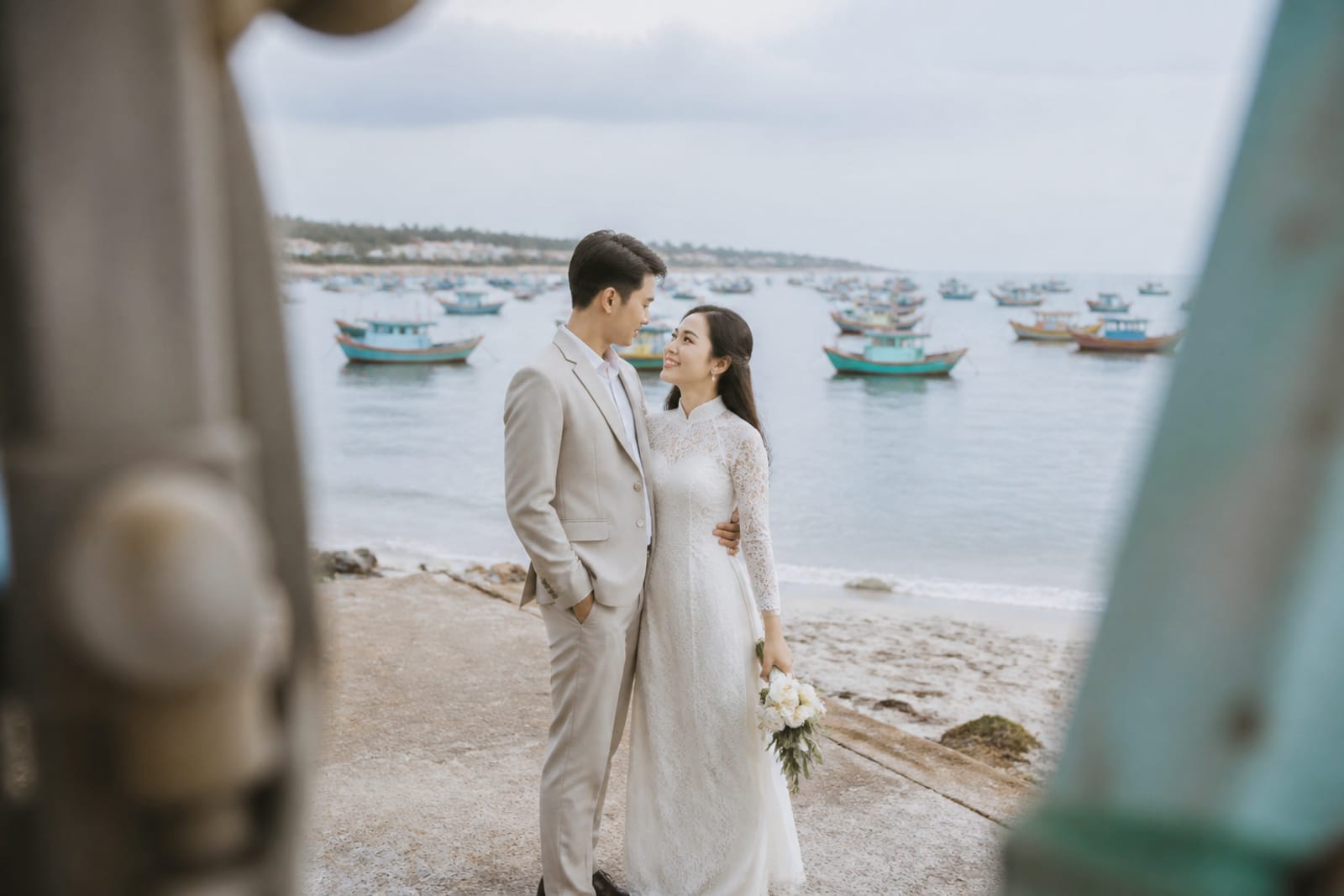
Wear a slip, fitted shorts, or seamless leggings under any skirt or dress to prevent sand from reaching skin—friction causes chafing within 30 minutes. Bring: a microfiber towel (sand doesn't stick to microfiber as it does cotton), a change of socks, sandals you can slip on and off, a wide-brimmed hat or headwrap (sun exposure at dawn is still intense after 30 minutes), and at least 1 litre of water per person. Apply a light, sweat-resistant sunscreen 15 minutes before the shoot. Avoid silicone-heavy hair products—sand clings to them; use lightweight leave-in conditioner instead. If wearing jewellery, keep it minimal and secured (sand and metal create friction that dulls gemstones). Pack a small bag with safety pins, a comb, and blotting sheets for touch-ups between outfit changes.
What season should you aim for?
Mui Ne is one of Vietnam's driest areas year-round. November–March (dry season, cooler) is ideal: consistent sunrise light, air temperature 18–25°C, rare rain. Winds are strong (November–March), so expect sand drift—ask your photographer if wind-blown sand adds texture to the frames or muddies them. April–October is wet season with afternoon downpours; dunes can be damp and heavy until mid-morning. August–October brings occasional sandstorms that reduce visibility and scratch camera lenses. Book your session in November–March and confirm the forecast two weeks and again three days before. Tet (late January–mid February) brings crowds to Mui Ne, so aim for early November, December, or February–March for clearer dunes.
What to check before you book a Mui Ne photoshoot
- Photographer experience: Ask for portfolios of 5+ Mui Ne dune sessions, not generic beach or landscape shots. Dune light is specific; generic photographers often underexpose or overexpose sand.
- Equipment: Does the photographer have a polarizing filter (cuts sand glare), backup batteries (heat drains them fast), and lens protection (sand scratches are permanent)?
- Backup plan: If wind creates sandstorms or rain falls, can the session move to Mui Ne town or beach? A solid local photographer has two backup locations.
- Timing flexibility: If sunrise light is flat one day, can you reschedule at no cost? Ask this outright.
- Outfit fit: Will the photographer advise you on fabric and colour choices before the session, or will they be surprised on the day? A director scouts outfit choices; a reactive shooter does not.
- Delivery timeline: How fast do edited photos arrive? Sand sessions often have exposure issues that take time to correct; ask for realistic timelines (usually 5–10 days for a small dune set).
- Accessibility: Does the photographer cover parking and guide you to the dunes, or do you navigate alone? Mui Ne dunes lack signage; a photographer who handles logistics reduces stress.
If you're based in Hanoi or Ho Chi Minh City and want a full pre-wedding photoshoot with your own makeup and hair team, Cáo Studio can brief you on Mui Ne preparation and recommend a vetted local photographer. Book a consultation on WhatsApp to discuss timing, outfits, and light strategy.
---
FAQ
Can I wear a traditional ao dai for dune photos?
Yes—choose a lightweight silk ao dai in a jewel tone or white, with a fitted slip underneath to prevent sand chafing. Avoid heavily embellished or structured áo (they trap sand and heat). Ask your photographer if they'll help you walk and pose to avoid sand settling on the hem; sitting is difficult and requires a clean cloth underneath.
What if I'm not an early riser—can we shoot at sunset instead?
Sunset at Mui Ne (after 4:30 pm) works if the sky is clear and not overcast. Light is softer than noon but warmer than sunrise; you'll need jewel tones or pastels to avoid looking washed out. Wind often increases at sunset, kicking up sand—ask your photographer if this adds texture or causes problems for your frames.
Should I hire a local photographer or bring my team from the city?
Local photographers cost less and know dune micro-climates in real time. City-studio teams (Hanoi, Saigon) offer consistent creative direction and makeup/hair continuity but need travel time and accommodation, which raises costs. If budget allows, a hybrid approach works: city studio briefs a local shooter you've vetted together.
How much sand will actually get into my clothes and hair?
Microfiber fabrics and tightly woven weaves shed sand within an hour of leaving the dunes. Loosely woven or hairy fabrics (fleece, velvet, knits) trap sand for days. Avoid wearing braids or heavy styling products; a sleek bun or loose waves are easier to manage. Bring a microfiber towel and shake everything out before getting into a vehicle.
What do I do if it rains or wind creates a sandstorm?
Rain at Mui Ne (May–October) usually hits as a brief afternoon downpour; early-morning shoots avoid this. Sandstorms (August–October, strong winds November–March) reduce visibility within minutes. A prepared photographer has two backup locations: Mui Ne town streets or the beach. Ask your photographer to name these backups before you book; vague answers signal poor contingency planning.
Can we do multiple outfit changes in one session?
Yes, but plan for 15–20 minutes per change (including touch-ups). A 2-hour sunrise session fits two outfits comfortably; three outfits require hydration stops and risk overheating. Organize outfits in order of difficulty (simplest first) so you're not fussing with zips and buttons when energy drops. Ask your photographer to estimate how long each location will take so you're not rushed.
FAQ
Can I wear a traditional ao dai for dune photos?
Yes—choose a lightweight silk ao dai in a jewel tone or white, with a fitted slip underneath to prevent sand chafing. Avoid heavily embellished or structured áo (they trap sand and heat). Ask your photographer if they'll help you walk and pose to avoid sand settling on the hem; sitting is difficult and requires a clean cloth underneath.
What if I'm not an early riser—can we shoot at sunset instead?
Sunset at Mui Ne (after 4:30 pm) works if the sky is clear and not overcast. Light is softer than noon but warmer than sunrise; you'll need jewel tones or pastels to avoid looking washed out. Wind often increases at sunset, kicking up sand—ask your photographer if this adds texture or causes problems for your frames.
Should I hire a local photographer or bring my team from the city?
Local photographers cost less and know dune micro-climates in real time. City-studio teams (Hanoi, Saigon) offer consistent creative direction and makeup/hair continuity but need travel time and accommodation, which raises costs. If budget allows, a hybrid approach works: city studio briefs a local shooter you've vetted together.
How much sand will actually get into my clothes and hair?
Microfiber fabrics and tightly woven weaves shed sand within an hour of leaving the dunes. Loosely woven or hairy fabrics (fleece, velvet, knits) trap sand for days. Avoid wearing braids or heavy styling products; a sleek bun or loose waves are easier to manage. Bring a microfiber towel and shake everything out before getting into a vehicle.
What do I do if it rains or wind creates a sandstorm?
Rain at Mui Ne (May–October) usually hits as a brief afternoon downpour; early-morning shoots avoid this. Sandstorms (August–October, strong winds November–March) reduce visibility within minutes. A prepared photographer has two backup locations: Mui Ne town streets or the beach. Ask your photographer to name these backups before you book; vague answers signal poor contingency planning.
Can we do multiple outfit changes in one session?
Yes, but plan for 15–20 minutes per change (including touch-ups). A 2-hour sunrise session fits two outfits comfortably; three outfits require hydration stops and risk overheating. Organize outfits in order of difficulty (simplest first) so you're not fussing with zips and buttons when energy drops. Ask your photographer to estimate how long each location will take so you're not rushed.
Ao dai, makeup, hair and a local photographer in Hanoi or Saigon — one WhatsApp message.