/pre-wedding-photoshoot
What to Wear for Couple Photos at Ta Phin Village
Ta Phin village sits in Sapa's northwest mountains; couples shoot there for the green terraces, morning mist, and narrow stone paths that frame movement naturally. The light peaks at sunrise (roughly 5:30–7:00 am) and again before sunset (5:00–6:30 pm depending on season). Wear layers—temperatures drop 5–10°C above Hanoi, and mist means damp ground—and choose footwear with grip (hiking boots or trail sneakers, not heels or flip-flops). Most couples book a local guide and photographer together; Cáo Studio does not shoot Ta Phin directly, but our Hanoi team can advise on outfit, light and logistics via WhatsApp and recommend vetted local photographers who understand couple directing.
Why does Ta Phin village work for couple photos?
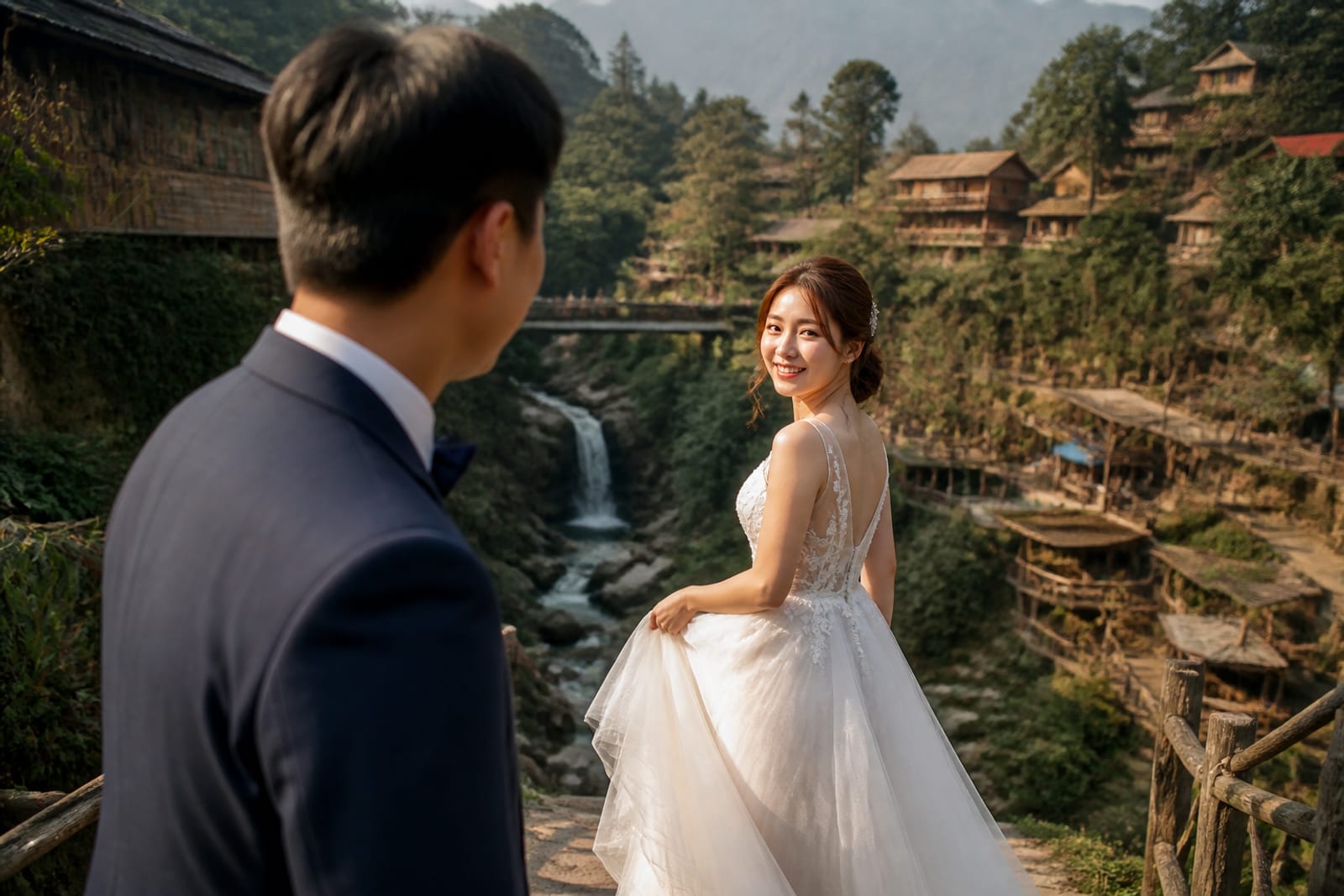
Ta Phin sits at roughly 1,000 m elevation in Sapa district, Lao Cai province—a forty-minute drive from Sapa town. Stone footpaths wind between Hmong homes and water-filled rice paddies; the morning light comes soft and low, casting long shadows that give depth to walking shots. The village is quieter than Sapa's main town, and the terraces stay green year-round (brightest Jun–Aug). Most couples walk toward the light rather than posing stiffly in front of it—the path naturally frames the two of you moving, talking, or looking at each other as you go. Mist often lingers until 8:00 am, which softens the background and hides crowds. That natural direction and weather make Ta Phin a strong choice for couples who want frames that tell a story, not arranged smiles.
What seasons and light hours suit Ta Phin best?
Seasonal guide and light timing
| Season | Light quality | Rice color | Weather | Best hours |
|---|---|---|---|---|
| Mar–May (spring) | Soft, diffused by mild haze | Pale green, terraces filling | Mild, 15–20°C; some cloud | 6:00–7:30 am, 5:00–6:00 pm |
| Jun–Aug (summer) | Bright, humid; mist burns off by 9 am | Lush, water-filled | Wet 3–4 pm; morning clear | 5:30–7:00 am only |
| Sep–Nov (autumn) | Sharp, low-angle gold light; clear air | Golden (mid-Sep to mid-Oct); then brown | Cool, 10–18°C; low rain | 6:00–7:30 am, 5:00–6:00 pm |
| Dec–Feb (winter) | Grey, cold; mist thick all day | Dry, brown; occasional frost | Cold 2–10°C; fog common | Avoid; light too flat |
March through May and September through November are the strongest windows. Sunrise light (5:30–7:00 am) gives the softest, most directional glow; evening light (5:00–6:30 pm, depending on month) is sharper and warmer but comes with thicker crowds walking home from fields. Mist is heaviest Jun–Aug (atmospheric but unpredictable) and Dec–Feb (flat, grey light). Winter closes many local services. Book a shoot in autumn if you want golden light and clear air; spring if you prefer mild temperature and renewal greenery.
What should you wear—outfit, footwear, and layers?
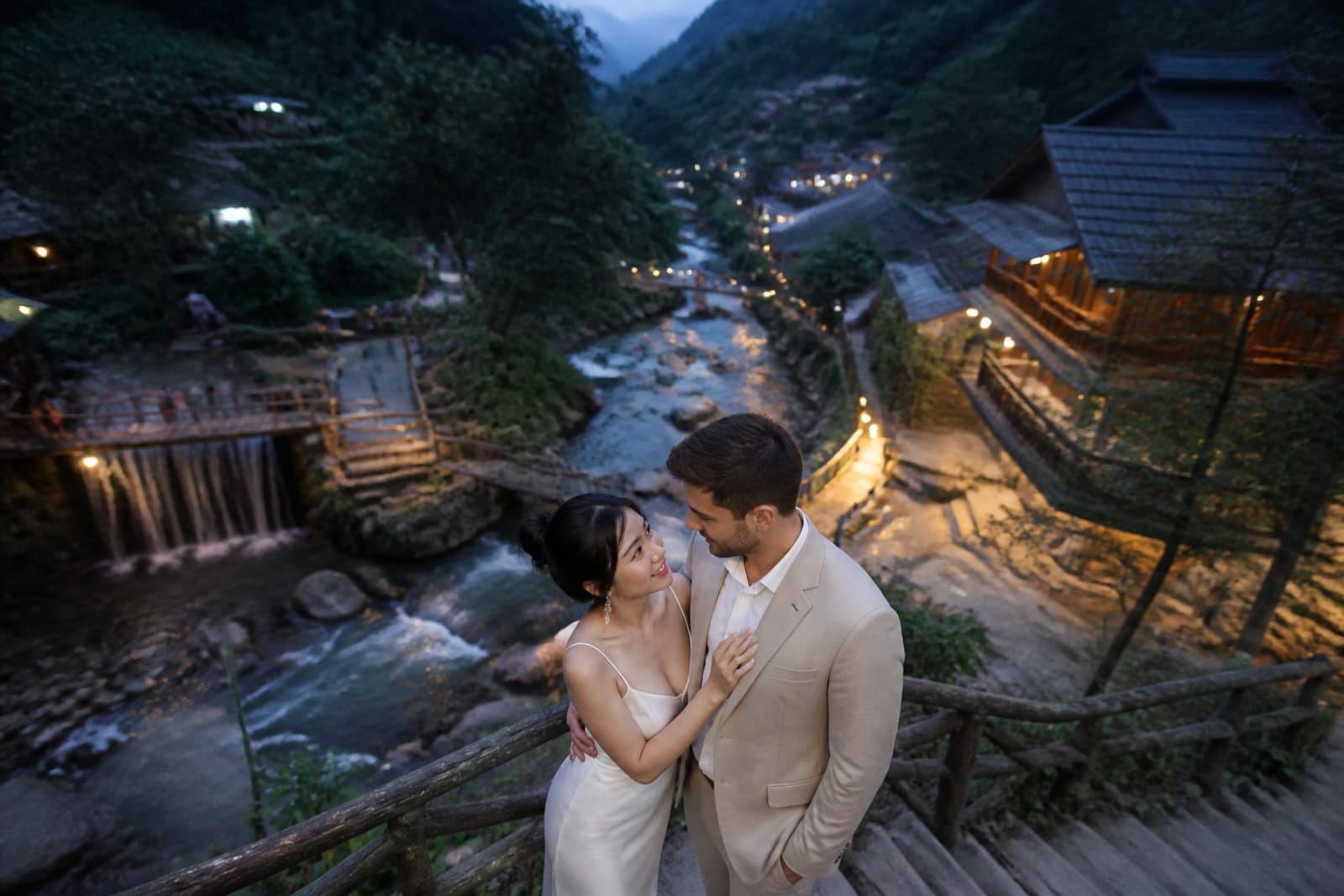
Dress in layers because temperature swings fast at altitude. Start with a fitted thermal or merino base, add a sweater or fleece, and bring a windbreaker or lightweight rain shell—you'll shed layers as the sun rises and the walk warms you. Avoid heavy coats (they bulk up in photos and restrict movement) and never wear heels, flip-flops, or smooth soles; the stone paths are steep, wet, and slippery. Hiking boots or trail running shoes with aggressive tread are essential—you'll climb 200+ m and slip on morning dew otherwise.
For outfit choice, consider the vibe you want. A traditional ao dai rental works if you want colour contrast and cultural resonance, but the garment's length tangles on steep steps—you'll spend half the shoot managing fabric instead of moving naturally. A fitted sweater or long-sleeve shirt (neutral or jewel tone) paired with dark jeans or trousers lets you walk, sit on rocks, and move with ease; the simplicity lets the landscape and your connection show. Avoid busy patterns, logos, and white (it overexposes in bright light and shows dirt fast on a muddy path). Soft neutrals (grey, navy, olive, rust, cream) and jewel tones (emerald, burgundy, teal) photograph well against green terraces and grey stone.
Hair: tie it back or pin it partially—loose hair blows across faces constantly in mountain wind. A low bun or half-up style keeps the look romantic without distraction. Makeup should be weatherproof (long-wear primer, powder rather than cream) because mist, humidity, and sweat work fast; if you're having professional makeup applied, book makeup & hair at your hotel in Sapa town the morning before, then travel to Ta Phin with the look already set.
What to pack in your day bag:
- Spare socks (moisture wicks fast; wet feet ruin a shoot)
- Sunscreen and lip balm with SPF (mountain sun is deceptive)
- A small towel or bandana (wipe damp skin before photos)
- Phone power bank (guides and photographers use GPS, cameras, and messaging constantly)
- Water (at least 1 L per person; altitude dehydrates quickly)
How do you find and vet a local Ta Phin photographer?
Cáo Studio does not operate in Sapa or Ta Phin; you'll need a local photographer with on-the-ground knowledge. Here's how to vet one:
Ask these questions when contacting a local photographer:
- Do you shoot in Ta Phin regularly? Ask for 5–10 sample frames from different couples, different seasons. (If the portfolio looks identical, the photographer uses the same three spots and one pose—flag it.)
- Can you guide us into the village and negotiate with local families? (Respectful shooting requires introducing yourselves; a photographer with village ties avoids tension and captures authentic moments.)
- What happens if weather turns? Do you have a backup location or a refund clause? (Mist and rain are normal; a solid plan matters more than a guarantee.)
- How many hours will we be walking, and at what pace? (Ta Phin is steep; if you're not fit for 4–5 km over uneven ground, a shorter route or a guide with a motorbike backup is wise.)
- Will you direct us to walk, look at each other, or move naturally—or do you ask us to pose? (Avoid photographers who set up couples like statues in front of monuments; the best frames come from movement and real light.)
- How will you deliver photos and when? (Expect 2–4 weeks for local photographers; faster turnaround usually means less editing.)
Red flags: No portfolio online, only one outfit shown across multiple "couple" shoots, reluctance to answer questions, or pressure to book without samples.
Check Google Maps or local Sapa tourism forums (e.g., Vietnam travel subreddits, Facebook Sapa expat groups) for names and reviews. Ask your hotel concierge for a referral—they know which photographers treat guests well and deliver on time. Request a formal quote in writing (include shoot duration, number of outfits, delivery timeline, file format, and refund terms) before paying any deposit.
📸 See how Cáo Studio directs couple shoots
Should you hire a guide, and does it change the photo outcome?
Most visitors hire a guide for Ta Phin—not just for navigating terrain, but for cultural context and logistics. A guide walks with you, carries water, introduces you to local families (whose homes and fields become your backdrop), and knows exactly where light will hit at each hour. This shapes the shoot: you move freely instead of asking "where do we go next," and the photographer focuses on framing rather than navigation.
The downside is cost (guides charge a daily rate; check with your hotel or a Sapa tour operator for current pricing) and a third person in the frame sometimes. Couples without a guide often end up retracing steps, missing optimal light windows, or (rarely) getting lost on confusing paths. A guide prevents that waste.
If you're booking a local photographer, ask if they've already partnered with guides—many have a standing relationship and can arrange pickup from Sapa town, which simplifies logistics. If you're coordinating solo, your hotel can usually connect you with a vetted guide within a day.
Bottom line: A guide is not mandatory but nearly always worth it for a couple shoot lasting 3+ hours.
💄 Makeup & hair at your hotel — book before your shoot
What to check before you book a Ta Phin couple photoshoot
Pre-booking checklist:
- Fitness level: Can you walk 4–5 km over steep, wet stone paths for 3–4 hours? If not, ask the photographer or guide about a shorter route or a rest spot where you pause for posed shots.
- Season and backup plan: If booking Dec–Feb, confirm the photographer has an alternative location (e.g., nearby villages or Sapa town) in case fog makes Ta Phin unusable; get this in writing.
- Outfit approval: Share your planned clothes with the photographer 1–2 weeks ahead (a photo of the items is enough). They'll confirm colours work against the terraces and suggest changes if footwear or fit poses problems.
- Weather in the week before: Check forecasts 3–5 days prior. Typhoons or heavy rain (Sep–Nov) can flood paths; ask the photographer whether to reschedule or pivot to an indoor/covered location.
- Delivery and editing: Agree on the timeline (2–4 weeks is standard for local photographers), file format (JPEGs, RAW files, or a shared album), and number of final edited photos. Get this in writing.
- Refund and reschedule terms: If weather forces a cancellation, can you reschedule at no extra cost? What happens if you cancel 48 hours before? Avoid photographers with "no refund" blanket policies.
- Permits or permissions: Confirm the photographer or guide handles any informal "village fee" or permissions to shoot on private land. You shouldn't negotiate these on the day.
🌸 Browse couple & pre-wedding styles in our lookbook
If you're considering a photoshoot in Hanoi, Ho Chi Minh City, or Hoi An instead—or want to add a formal pre-wedding shoot to your Vietnam trip—Cáo Studio's one-team approach means your outfit, makeup, hair, and direction are all aligned from the start. Reach out on WhatsApp to explore options, ask about outfit recommendations, or book a session with Cáo Studio in a location we operate.
FAQ
Can we shoot Ta Phin in winter (December–February)?
Possible but challenging. Fog often blankets the village all day, flattening light and reducing visibility. Most photographers and couples reschedule to spring or autumn. If you must shoot in winter, ask the photographer for an indoor or sheltered backup location in Sapa town.
Do we need special permits to photograph in Ta Phin village?
No formal permits exist for tourist couple photoshoots. A local guide or photographer handles casual greetings with families and any unwritten "village courtesy" fees; avoid trying to negotiate these yourself on the day. Respect homes and private land—always ask before stepping into someone's yard or terraces.
How much time should we allow for a Ta Phin couple shoot?
3–4 hours minimum for meaningful frames. This includes travel from Sapa town (40 min each way), a 1.5–2 hour walk through the village, and breaks for light changes and outfit changes. A half-day shoot (2–3 hours) works only for a single outfit and lighter walking.
What if it rains the morning of our shoot?
Light rain is manageable—mist and drizzle often create moody, intimate frames. Heavy rain floods paths and makes slipping dangerous; most photographers will propose rescheduling or moving to a sheltered village area or Sapa town. Confirm the photographer's rain policy before you book.
Can we wear an ao dai to Ta Phin without damaging it?
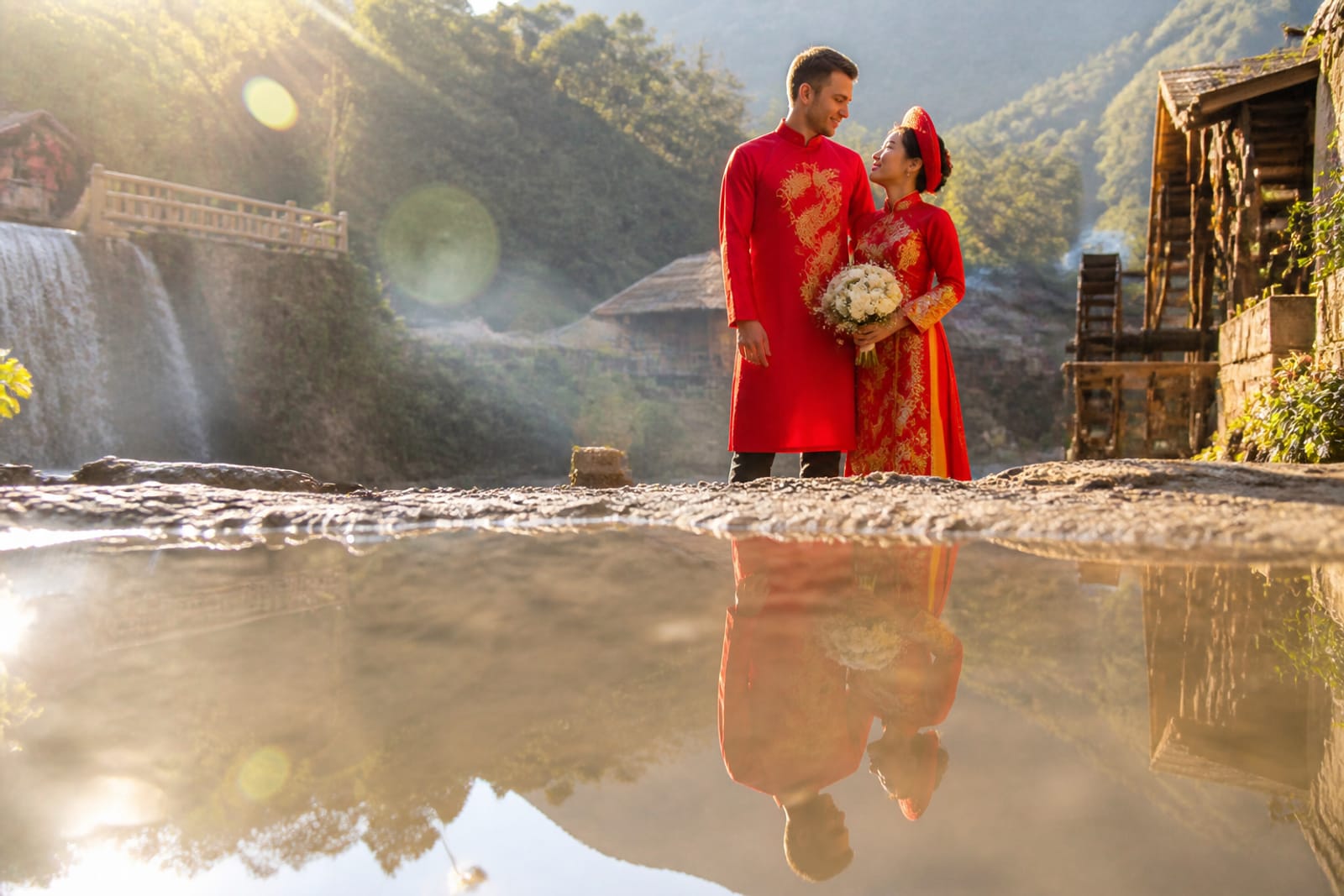
An ao dai works for 30–60 minutes of light walking and posing in one spot, but the hem tangles on stairs, mud sticks to the fabric, and sitting on rocks risks tearing the back panel. Rent an ao dai if you want it for a separate Hanoi or Hoi An shoot; for Ta Phin's terrain, fitted modern clothes (sweater + jeans + hiking boots) photograph just as beautifully and move more freely. See ao dai rental for options in Hanoi or Saigon.
FAQ
Can we shoot Ta Phin in winter (December–February)?
Possible but challenging. Fog often blankets the village all day, flattening light and reducing visibility. Most photographers and couples reschedule to spring or autumn. If you must shoot in winter, ask the photographer for an indoor or sheltered backup location in Sapa town.
Do we need special permits to photograph in Ta Phin village?
No formal permits exist for tourist couple photoshoots. A local guide or photographer handles casual greetings with families and any unwritten "village courtesy" fees; avoid trying to negotiate these yourself on the day. Respect homes and private land—always ask before stepping into someone's yard or terraces.
How much time should we allow for a Ta Phin couple shoot?
3–4 hours minimum for meaningful frames. This includes travel from Sapa town (40 min each way), a 1.5–2 hour walk through the village, and breaks for light changes and outfit changes. A half-day shoot (2–3 hours) works only for a single outfit and lighter walking.
What if it rains the morning of our shoot?
Light rain is manageable—mist and drizzle often create moody, intimate frames. Heavy rain floods paths and makes slipping dangerous; most photographers will propose rescheduling or moving to a sheltered village area or Sapa town. Confirm the photographer's rain policy before you book.
Can we wear an ao dai to Ta Phin without damaging it?
An ao dai works for 30–60 minutes of light walking and posing in one spot, but the hem tangles on stairs, mud sticks to the fabric, and sitting on rocks risks tearing the back panel. Rent an ao dai if you want it for a separate Hanoi or Hoi An shoot; for Ta Phin's terrain, fitted modern clothes (sweater + jeans + hiking boots) photograph just as beautifully and move more freely. See [ao dai rental](/ao-dai-rental) for options in Hanoi or Saigon.
Ao dai, makeup, hair and a local photographer in Hanoi or Saigon — one WhatsApp message.