Cáo Studio · Mga gabay sa photoshoot sa Vietnam · Ao Dai Photoshoot Vietnam: Mga Opsyon at Gabay sa Pagbili 2026
Ao dai wedding photos in Phu Quoc — best spots, timing & how to book
Cáo Studio team · Hanoi · 2026-10-03
An ao dai wedding photoshoot in Phu Quoc pairs a traditional Vietnamese dress with one of Southeast Asia's most dramatic light conditions—turquoise water, white sand, and limestone cliffs that catch side light at dawn. Unlike a generic tourist photo, a directed session with Cáo Studio means the photographer works with your hair and makeup artist in real time, adjusting framing as light moves, so every frame tells a story instead of looking posed.
Phu Quoc's light and season: when to shoot
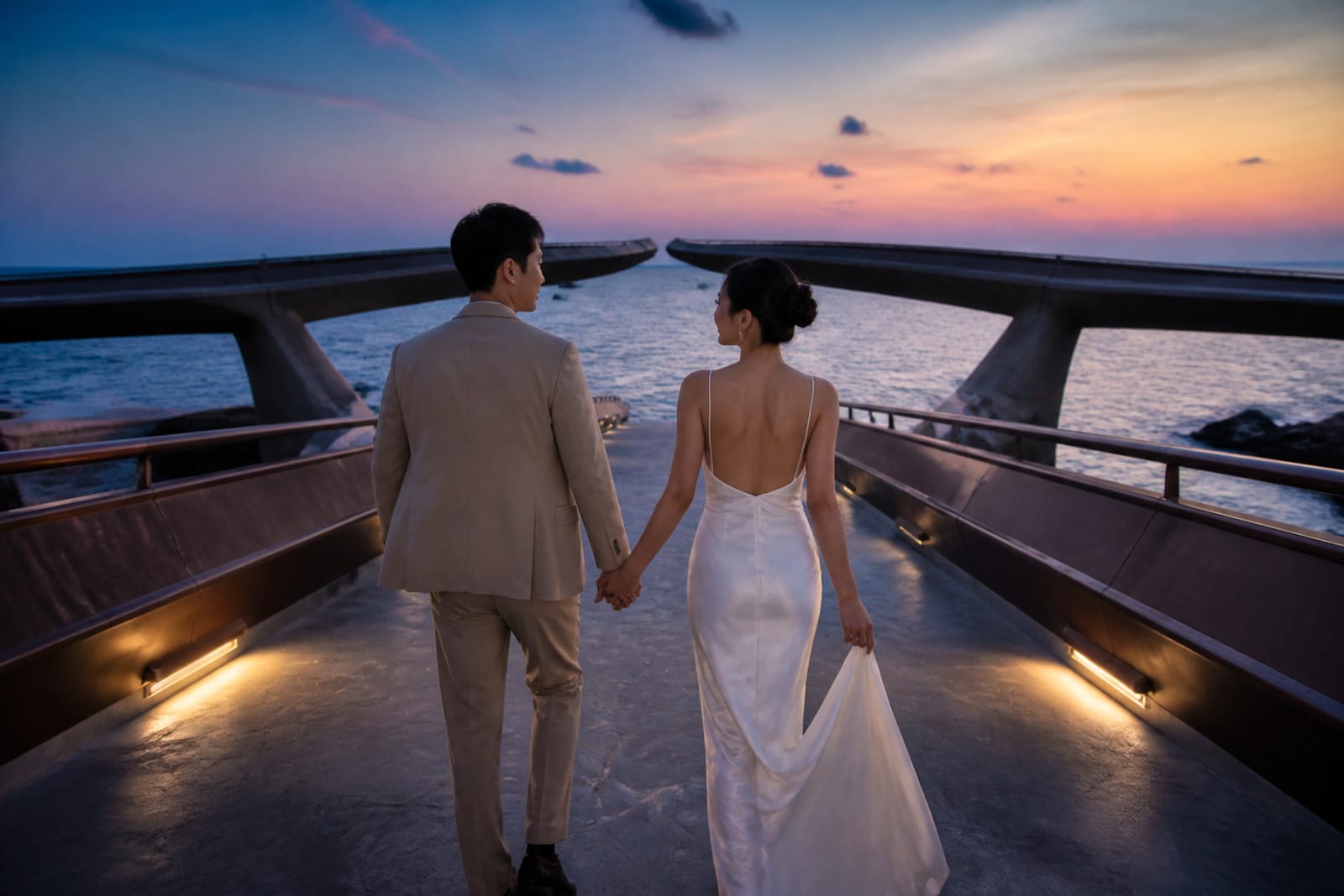
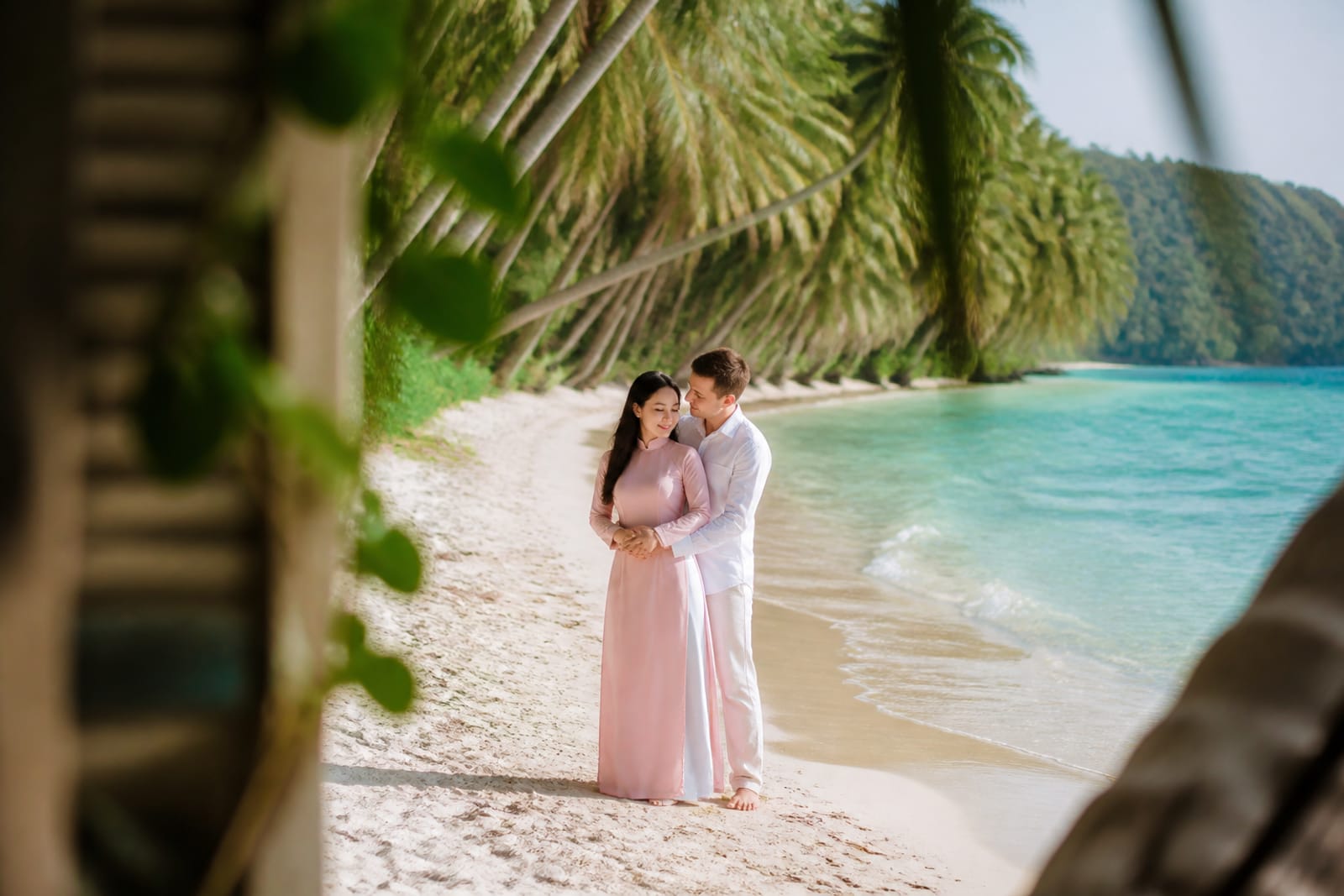
Phu Quoc's best light depends entirely on season. The dry season (Nov–Apr) is reliable: mornings are cool, skies clear, and the sea stays calm. Early morning (6–7 am) on the west coast beaches—where Sunset Town and the Kiss Bridge sit—gives you soft side light that flatters an ao dai's drape and embroidery without blown-out skies. Afternoon light (4:30–6 pm) turns golden and rakes across the water, perfect for walking shots along the shoreline.
The rainy season (May–Oct) brings afternoon downpours, often between 2–5 pm, which interrupts shoots and forces rescheduling. Humidity is high, makeup sets harder, and the west coast sees rougher seas. If you must shoot May–Oct, book early morning (6–8 am) before storms build, or move indoors to temples and colonial buildings where overhead light is diffused.
Key takeaway: Nov–Apr guarantees clear light and calm water; shoot early morning or late afternoon to avoid harsh midday glare.
Ao dai fit and fabric in heat and humidity
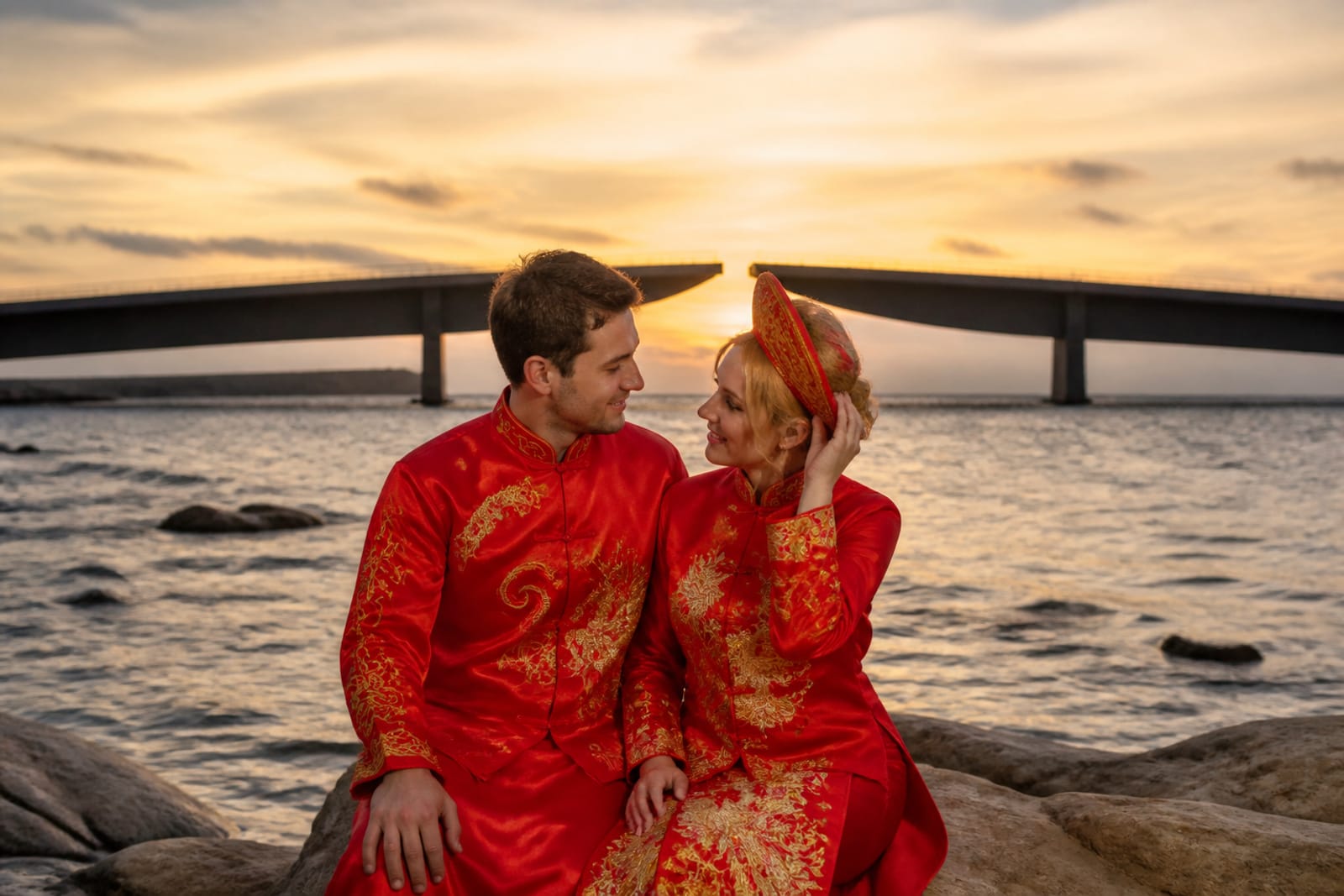
An ao dai's silk or cotton panels can cling to your body in Phu Quoc's heat, making movement look stiff. Work with your team—hair and makeup at your hotel is available—to choose a lighter silk blend or linen ao dai rather than heavy brocade. A custom-fitted ao dai moves better than a rental that's too loose or too tight; if renting, try it on at least two days before the shoot and have a backup.
Humidity swells fabric slightly, so a ao dai that fit perfectly in your air-conditioned hotel may feel snug by 8 am outdoors. Plan a 15-minute break halfway through the session to let the fabric breathe and reset your posture. Your team should carry safety pins, a steamer, and a lint roller to keep pleats sharp and embroidery crisp between locations.
Tip: Silk ao dai (not polyester replicas) breathes better, moves more elegantly in footage, and photographs with richer color depth.
Best locations and light hours on the island
| Location | Best for | Light hour | Why it works |
|---|---|---|---|
| Sunset Town (west coast) | bride & groom frames, silhouettes | 6–7 am (soft), 4:30–6 pm (golden) | turquoise water behind, minimal crowds early morning, golden hour reflects off water |
| Kiss Bridge | romantic walking shots, reflections | 6–8 am (side light) | low angle catches bridge detail, calm water reflects, tourists arrive after 9 am |
| Ganh Dau (north cape, rocky) | editorial wide frames, wind movement | 8–10 am (cool, diffused) | dramatic rock formations, natural wind moves ao dai, few people, light wraps around cliffs |
| Phu Quoc Prison (colonial ruins) | couple in architecture, texture | 7–9 am (side light through walls) | weathered walls frame faces, soft morning light through bars, historically grounded |
| An Thoi temple (south, high ground) | traditional frames, framing | 6:30–8 am or 4–5 pm | elevated vantage for wide ocean shots, steep steps suit walking direction |
| Duong Dong beach (east coast) | casual, sunrise option | 5:30–7 am (sunrise, rare) | less common angle for Phu Quoc, softer than west coast sunset, fewer tourists |
Shoot wide first (establishing the location), then medium (walking, looking at each other), then detail (hands, fabric, faces). This sequence ensures you have frames that work on their own or stitched into a story. Avoid midday (11 am–3 pm) when light is harsh and shadows are black; the sea glare overpowers skin tone and ao dai color.
One team, one message: why it matters on location
A directed wedding photoshoot with Cáo Studio means your photographer, hair artist, and makeup artist are in sync from start to finish. If light shifts at Kiss Bridge at 6:45 am, the makeup artist resets your skin tone in real time while the photographer adjusts framing. A separate hair person, makeup person, and photographer working independently often argue about pacing (hair takes 20 minutes, light changes in 10), leaving you standing around while decisions slow down.
One team also means one message: the outfit, hair color, makeup tone, and framing are chosen to tell one story, not three. On a Phu Quoc beach, this means your ao dai color is picked to contrast with the water at that specific hour, your hair is styled to move in the island breeze, and your makeup is set to resist humidity and photograph true in golden light. Generic team-ups often send a bride in heavy bridal makeup (wrong for beach light) with a updo that looks stiff when the photographer wants you moving, creating frames that feel disconnected.
Why it works: coordinated timing + shared vision = frames that belong together.
Permits, temple etiquette, and scheduling on Phu Quoc
Some Phu Quoc temples require advance permission for photography, especially early morning shoots before opening hours. An Thoi temple and other active worship sites may restrict ao dai shoots during prayer times (usually 6–7 am); your team should confirm dates and times 3–5 days ahead. Never shoot at a temple in shoes; remove them before entering, and dress respectfully (ao dai covers the body fully, so this is rarely an issue).
Sunset Town is private property with beach-club rules; request permission a week ahead if your team wants to shoot on the sand. Kiss Bridge is public but crowded after 8 am on weekends; book a weekday early-morning slot to keep the bridge empty. Ganh Dau (the north cape) is a public park with no fees, but roads are rough; your team should scout the route the day before if traveling by motorbike or van.
Tet (Lunar New Year, late Jan–mid Feb) closes many temples and fills beaches; if you're shooting during Tet week, book locations two weeks early. Ferry schedules to nearby islands (Phu Quoc Cablecar, boat trips) may run fewer trips in rainy season, so confirm transport before the shoot date.
What to confirm before booking: temple permissions, private property access, ferry or transport schedules, and whether your shoot date falls near Tet.
What to check before you book an ao dai wedding photoshoot
- Season and light guarantee – Ask your team to map out exact locations and light hours for your date. If you're shooting in May (borderline rainy season), ask for a contingency plan: indoor temple, studio, or rain date rebook.
- Ao dai source and fit – Confirm whether Cáo Studio provides a custom ao dai, a rental from a local vendor, or if you bring your own. If renting, ask for fitting timeline (minimum 2 days before the shoot) and a backup dress in case of damage.
- Team composition – Verify that one photographer, one hair artist, and one makeup artist are on the shoot date. Ask for their first names and WhatsApp numbers so you can confirm the morning of.
- Delivery timeline – Exact inclusions (number of edited photos, film format, album) are confirmed on WhatsApp. Ask whether edits include color correction for Phu Quoc's bright light (some photographers under-expose beach shoots; your team should test this).
- Transport and permits – Does your team handle temple permits, cablecar bookings, or is that on you? Clarify who confirms access 3–5 days before.
- Backup shooting day – If monsoon rain hits, can you reschedule to the next clear day within two weeks? What's the rebook fee (discuss it, never assume)?
- Communication language – Cáo Studio works in English and Filipino; if you speak another language, ask if an interpreter is needed or if your partner can translate on set.
Ask these seven questions before booking. Most delays or disappointments on Phu Quoc shoots stem from unclear logistics (no permit, tide too high, team arrives late), not creative work.
📸 Book on WhatsApp — ao dai photoshoot
Phu Quoc vs. other Vietnam photo destinations: which suits your shoot
| Destination | Best for | Season | Logistical load | Real-time light changes |
|---|---|---|---|---|
| Phu Quoc | beach, golden hour, tropical | Nov–Apr dry | high (permits, ferry, permits at temples) | medium (turquoise water stable, light angle changes fast) |
| Hoi An | ancient architecture, lanterns, heritage | Nov–Feb dry, Feb–Aug clear | low (town is compact, easy permits) | low (town's narrow streets filter light evenly) |
| Hanoi | urban, temples, lakes, bridge | Oct–Nov, Mar–Apr (cool) | low (metro nearby, team local) | high (early morning light through Lake Hoan Kiem fog, then harsh by 10 am) |
| Ha Long Bay | dramatic limestone, water frames | Oct–Apr (calm seas) | very high (must travel by cruise, light at sea level unpredictable) | high (limestone cliffs create spotty light, water glare intense midday) |
Phu Quoc suits couples who want beach light, golden hour, and drama, and can accept permit complexity and monsoon risk. Hoi An suits heritage-focused couples who want minimal logistics. Hanoi suits urban couples with flexible timing (you must shoot very early or very late). Choose based on your ao dai story, not just scenery.
Editing and delivery: what to expect in 48 hours
A 48-hour turnaround on Phu Quoc means your team shoots, returns to their base (Hanoi or Ho Chi Minh City, since there is no Cáo Studio Phu Quoc branch), and begins editing the same evening. Phu Quoc's bright light requires careful exposure correction—the ocean is blown-out in many beach photos, so color grading must recover blue and teal without looking artificial. Skin tone on a beach is tricky: direct sun yellows the face, golden hour turns it orange, and the editor must match faces across locations shot hours apart.
Ask your team whether they color-grade all frames or only a select few. A full edit means every frame is color-matched and sharpened; a select edit means 10–20 frames are fully graded, the rest are lightly adjusted. Neither is wrong—full edit takes longer, select edit is faster and often enough for a couple's album.
Delivery format matters: ask for JPEGs (easy to share, compress well), a password-protected online gallery (no download cap), and a short vertical film (15–30 seconds) suitable for Instagram Reels. The film should cut to music and show walking, looking, and movement—not just static portraits.
Takeaway: confirm edit scope (full or select), file format, gallery deadline, and whether a film is included before signing on.
Cáo Studio's approach to wedding ao dai shoots in Phu Quoc
Cáo Studio brings one photographer, one hair artist, and one makeup artist to Phu Quoc for a 2–3 hour directed session. The team scouts locations the day before, confirms temple permits, and maps light hours for your date. On the morning of the shoot, you meet at your hotel for hair and makeup (done on-site so fabric isn't messed before leaving); the team then drives or ferries to the first location (usually a beach or temple at dawn).
The photographer directs you to walk, pause, look at each other, and move naturally; hair and makeup touch up between locations. Unlike a pose-heavy session, real movement photographs better and feels less stiff in the final frames and film. The team shoots wide (landscape), medium (you in the frame), and detail (hands, fabric, faces) in sequence so frames tell a story.
By evening, back in Hanoi or Ho Chi Minh City, the team begins color grading and selecting frames. By 48 hours after the shoot, you receive edited JPEGs and a short film via a private online gallery, password-protected.
Cáo Studio is based in Hanoi and Ho Chi Minh City (see Cáo Studio Hanoi and Cáo Studio Saigon for details). For Phu Quoc shoots, the team travels. Ask on WhatsApp about exact pricing, package inclusions, and available dates.
FAQ
What month is best for an ao dai wedding shoot in Phu Quoc?
Nov–Apr is the dry season with calm seas, clear skies, and reliable early morning and late afternoon light. Avoid May–Oct when afternoon monsoon rains interrupt shoots and the west coast sees rough water.
Do we need permits to shoot at temples and beaches in Phu Quoc?
Some temples require advance permission; your team should confirm 3–5 days ahead. Sunset Town is private; request beach access a week prior. Ganh Dau and public beaches have no fees but are crowded after 9 am.
Can we shoot an ao dai wedding photoshoot during Tet (Lunar New Year)?
Tet (late Jan–mid Feb) closes many temples and fills beaches. If you're shooting Tet week, book locations two weeks early and expect higher humidity. A rescheduled date after Tet (mid-Feb onward) is easier.
How long does an ao dai wedding photoshoot take in Phu Quoc?
Typically 2–3 hours on location (dawn or golden hour), plus 30 min–1 hour for hair and makeup at your hotel. The team shoots wide, medium, and detail in sequence, then you're done.
What's the difference between Phu Quoc and Hoi An for an ao dai wedding shoot?
Phu Quoc offers beaches, tropical light, and golden hour reflections but requires permits and has monsoon risk. Hoi An offers heritage buildings, lanterns, and lower logistics but no beach light—pick based on your story.
When will we receive edited photos and film after the Phu Quoc shoot?
Cáo Studio delivers edited JPEGs and a short vertical film within 48 hours. Exact inclusions (number of photos, film length, album option) are confirmed on WhatsApp before booking.
Do we provide our own ao dai or does Cáo Studio rent one?
Ask on WhatsApp. If renting, fitting is 2 days before the shoot; if you bring your own, confirm fit and any alterations in advance so the dress moves well in heat and light.
Can Cáo Studio shoot indoors at a temple or hotel if rain cancels the beach shoot?
Yes. Confirm a contingency plan (backup date, indoor location, or rebook policy) before booking so you're not left without a plan if monsoon rain hits.
Mga karaniwang tanong
What month is best for an ao dai wedding shoot in Phu Quoc?
Nov–Apr is the dry season with calm seas, clear skies, and reliable early morning and late afternoon light. Avoid May–Oct when afternoon monsoon rains interrupt shoots and the west coast sees rough water.
Do we need permits to shoot at temples and beaches in Phu Quoc?
Some temples require advance permission; your team should confirm 3–5 days ahead. Sunset Town is private; request beach access a week prior. Ganh Dau and public beaches have no fees but are crowded after 9 am.
Can we shoot an ao dai wedding photoshoot during Tet (Lunar New Year)?
Tet (late Jan–mid Feb) closes many temples and fills beaches. If you're shooting Tet week, book locations two weeks early and expect higher humidity. A rescheduled date after Tet (mid-Feb onward) is easier.
How long does an ao dai wedding photoshoot take in Phu Quoc?
Typically 2–3 hours on location (dawn or golden hour), plus 30 min–1 hour for hair and makeup at your hotel. The team shoots wide, medium, and detail in sequence, then you're done.
What's the difference between Phu Quoc and Hoi An for an ao dai wedding shoot?
Phu Quoc offers beaches, tropical light, and golden hour reflections but requires permits and has monsoon risk. Hoi An offers heritage buildings, lanterns, and lower logistics but no beach light—pick based on your story.
When will we receive edited photos and film after the Phu Quoc shoot?
Cáo Studio delivers edited JPEGs and a short vertical film within 48 hours. Exact inclusions (number of photos, film length, album option) are confirmed on WhatsApp before booking.
Do we provide our own ao dai or does Cáo Studio rent one?
Ask on WhatsApp. If renting, fitting is 2 days before the shoot; if you bring your own, confirm fit and any alterations in advance so the dress moves well in heat and light.
Can Cáo Studio shoot indoors at a temple or hotel if rain cancels the beach shoot?
Yes. Confirm a contingency plan (backup date, indoor location, or rebook policy) before booking so you're not left without a plan if monsoon rain hits.