Cáo Studio · Mga gabay sa photoshoot sa Vietnam · Pre-Wedding Photoshoot Vietnam: Hanoi, Saigon & Hoi An Guide
Rainy season pre-wedding photoshoot in Hanoi: plan now
Cáo Studio team · Hanoi · 2026-10-03
Planning a pre-wedding photoshoot in Hanoi during rainy season (May–September) requires three moves: book a studio (like Cáo Studio Hanoi) that scouts by weather forecast, not calendar date; choose outfits and locations that work in overcast conditions and on wet pavement; and lock shoots in the 48 hours after rain clears, when humidity drops and streets are still wet but skies are clearing. Rainy season doesn't cancel the shoot—it reframes it. Soft, directional light off wet surfaces and through cloud cover rivals autumn's clarity. The trade: unpredictability. A team experienced in May–September Hanoi light (and willing to reschedule around typhoon warnings or flash floods) knows which streets drain fast, which temple grounds stay dry, and how to meter skin tone when every surface bounces grey-reflected light. Budget three to four location options per half-day and confirm the weather call 24 hours before.
Hanoi's rainy season from May to September transforms wedding photography. Not cancels it—transforms it. Grey skies, wet pavement, and reflected light off rain-soaked stone create a tonal palette that studio lighting can't replicate. But the shoot only works if you treat rain as a partner, not an obstacle.
The Hanoi climate divides clearly. December to February is cool and dry but overcast—soft light without drama. March to April is mild but hazier and damp. October to November is the postcard season: dry, mild, trees gold-orange. May to September is your rainy window. The rain itself isn't continuous—it arrives in heavy spells, often in late afternoon. Between spells, the city breathes: humidity drops, streets glisten, light softens without losing direction.
For a couple booking a pre-wedding & elopement session, rainy season means choosing between two paths: reschedule to October–November (the safest light) or lean into May–September and demand a team that reads weather like a text.
Kilalanin ang iyong Hanoi rain windows—kailan talaga ang pinakamahusay na liwanag?
Rainy season doesn't mean it rains for five months straight. Rain in Hanoi typically falls in intense afternoon downpours (2–5 pm), leaving early mornings dry and evenings clearing by dusk. A shoot booked for 6 am–10 am in late May has good odds of dry light with soft overcast cover. Book the same slot in August, and you're gambling—typhoon remnants can cancel entire days.
The golden window: late May through June, and September after the worst typhoons pass. July and August see the most intense heat and humidity; schools close, many services shut partially, and the light becomes murky and yellowish. Early September (first two weeks) often reopens clearer skies before the autumn northeast wind fully sets in.
Check the weather forecast 10 days before, then 3 days before, then 24 hours before. If rain is forecasted on your shoot date, a pro Hanoi team reschedules immediately—not to disappoint you, but because noon downpours will wreck the session. A team that says "we'll shoot in the rain" is either inexperienced or selling you a compromise; real rainy-season shoots avoid the rain itself and hunt the light that comes after.
Anong damit ang gumagana sa madilim na kalangitan at basa na lupa?
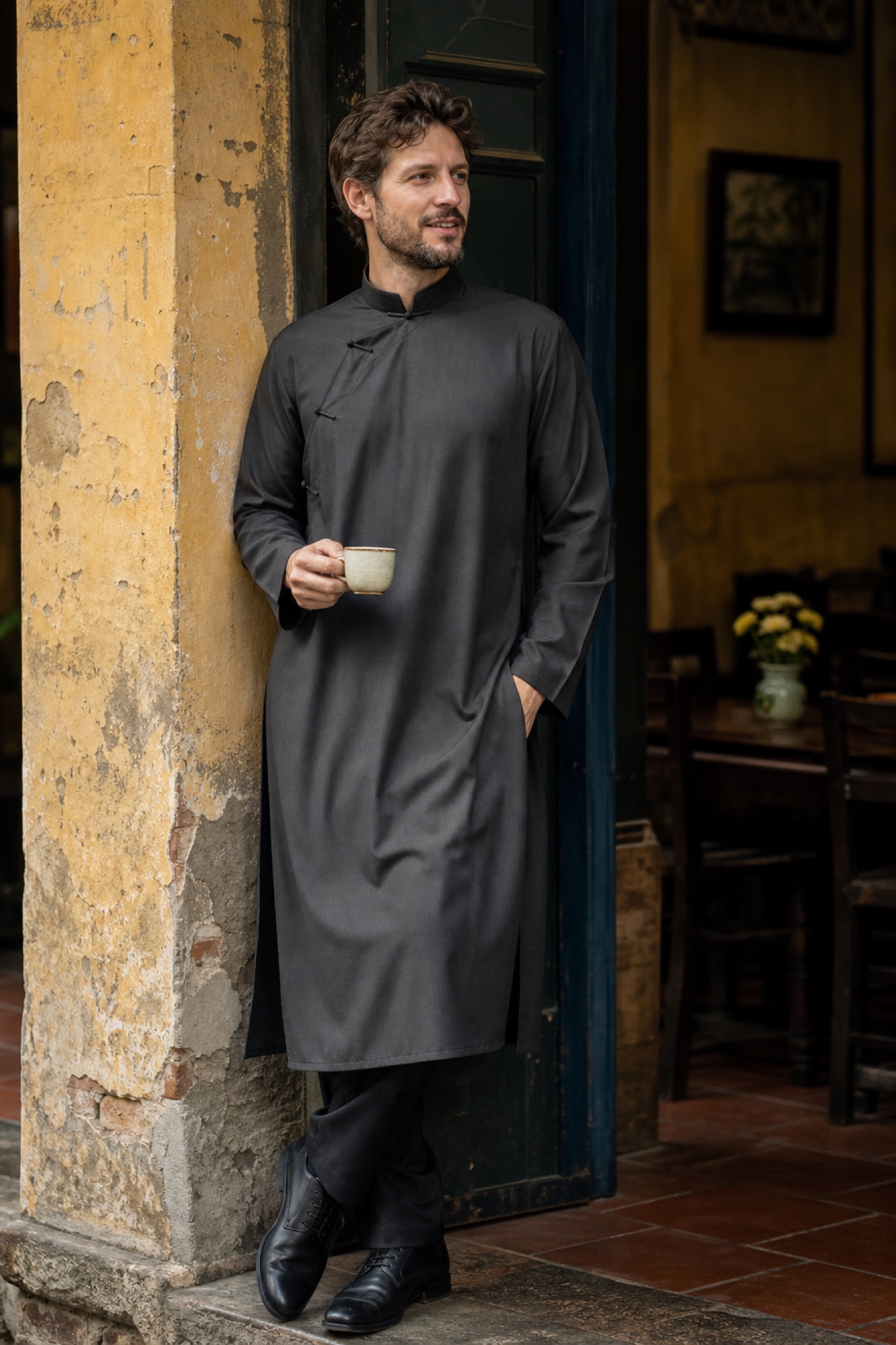
Wedding dresses and groom suits designed for bright daylight backlight look flat and washed in overcast conditions. Rainy-season outfits need saturation, texture, and deep tones to hold shape under grey skies. Light fabrics (sheer, white linen, pale silk) disappear into the fog. Rich colors—deep burgundy, forest green, charcoal, gold-embroidered ao dai—anchor the frame.
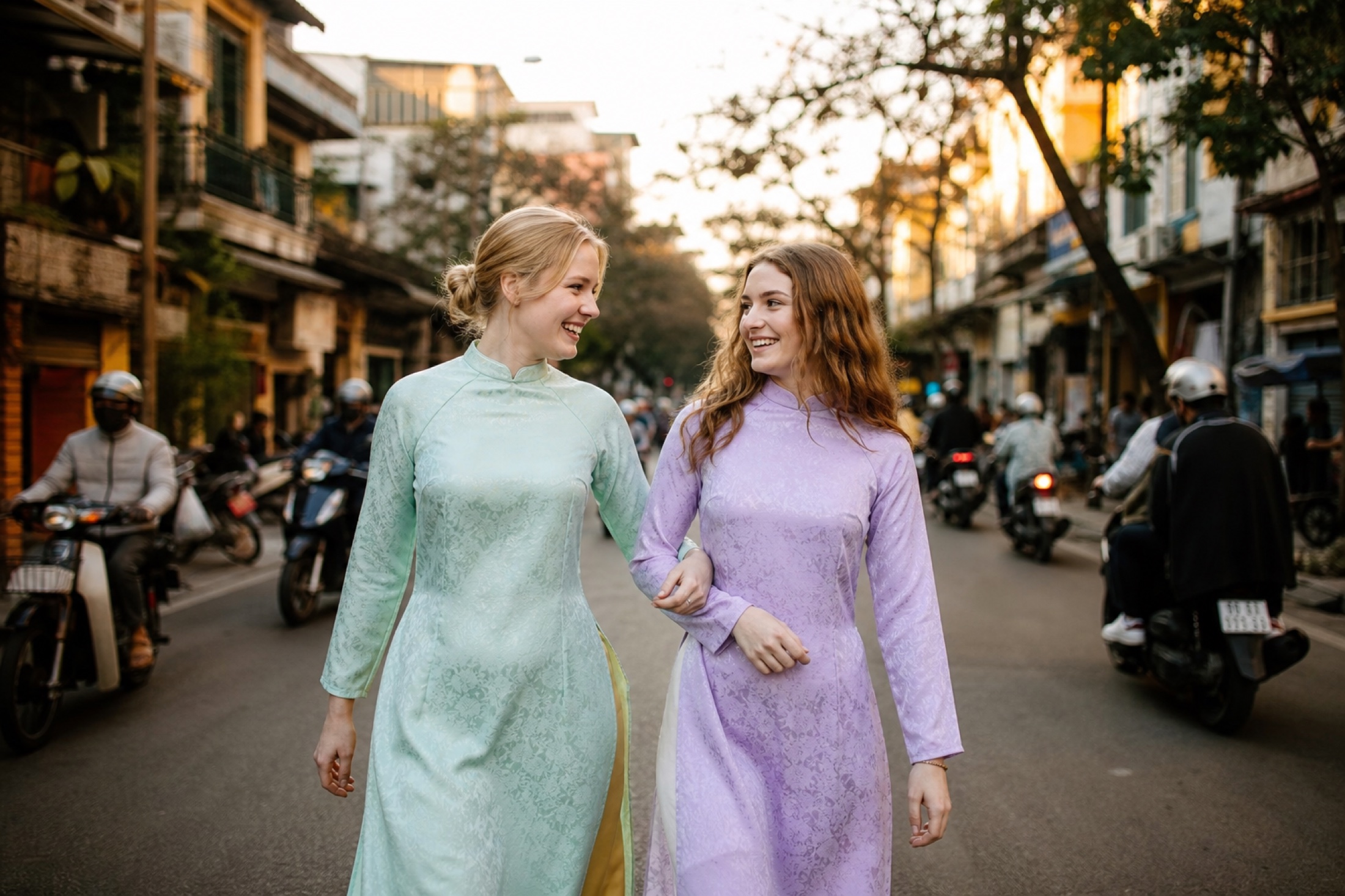
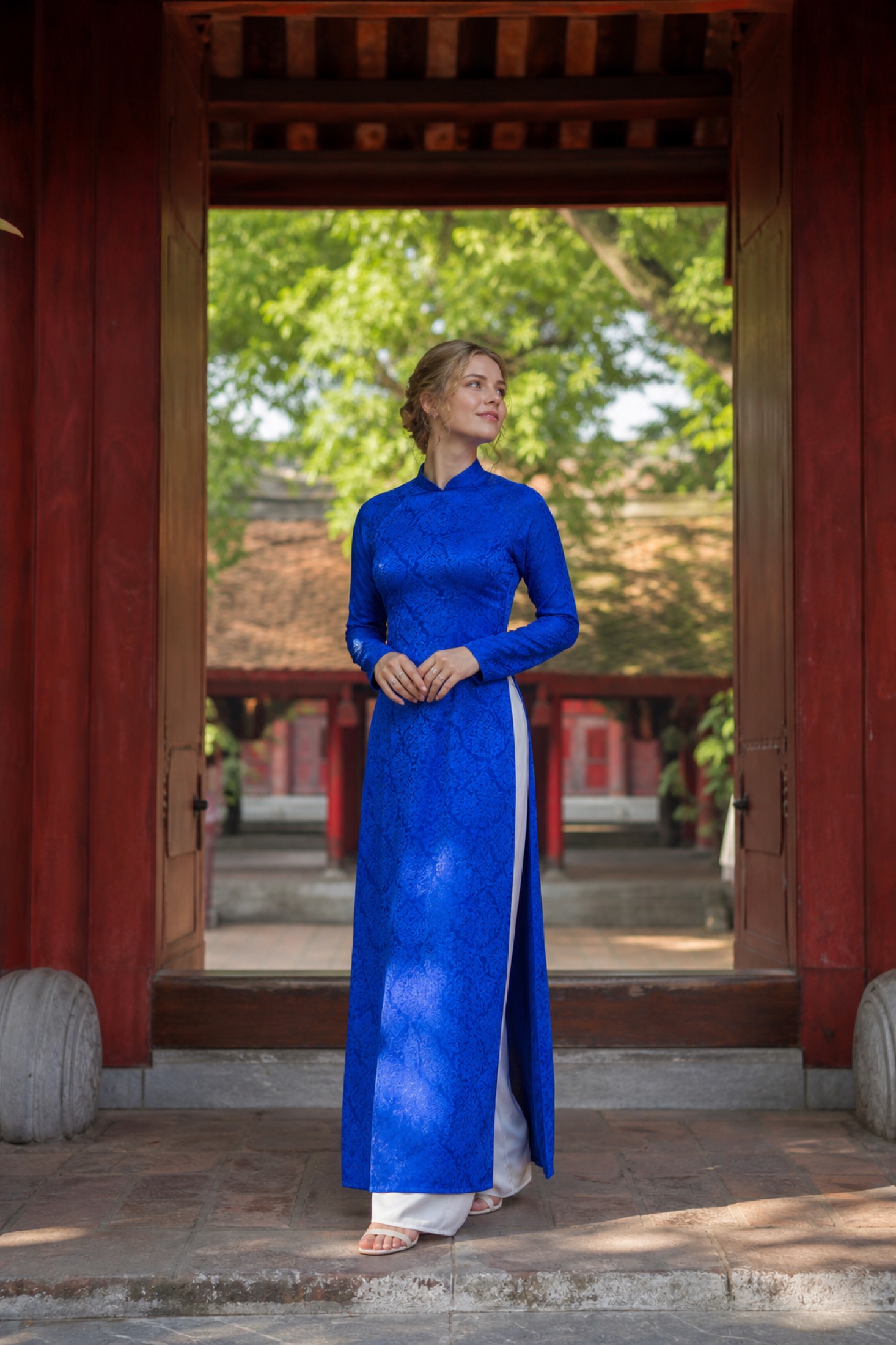
If you're booking an ao dai photoshoot, rainy season is ideal: silks in jewel tones photograph warmer and more detailed under diffuse light than bleached daylight can render. The ao dai's embroidery, pleating, and drape become visible, not blown out. A traditional red or gold ao dai in grey-lit morning becomes a study in texture. Pair it with a deep burgundy or slate-blue groom suit, and the couple pops without looking overexposed.
For Western wedding dress, ask yourself: does this dress photograph well in overcast light? Ballgowns with fine lace work brilliantly under soft light. Sleek minimalist silhouettes can look severe. Test a phone photo outdoors on an overcast morning—that's your rainy-season baseline.
Footwear matters on wet streets. Stone and brick in the Old Quarter and around temples drain unevenly; puddles lurk. Flat shoes, loafers, or sandals (not heels) keep the shoot moving without a stop for twisted ankles. Wet concrete is slippery—the photographer knows this, but you should too.
Cáo Studio includes outfit consultation in planning; mention rainy-season shooting so the team can advise fabric and color before you commit to a dress.
Saan sa Hanoi ang nag-uusap ng madilim na liwanag nang hindi kailangan ng mamimili?
Rainy-season light reshapes where you shoot. Sunlit landmarks (Hoan Kiem Lake's open shoreline, Trang Tien Bridge in midday) lose drama under overcast skies. Narrow streets, temple grounds, and covered lanes sing.
The Old Quarter's packed stone passages and shuttered shopfronts are designed for diffuse light—rainy season is their season. Soft overhead light (no harsh shadows) reveals the texture of colonial shutters, wet brick, and narrow geometry. A couple walking through Hang Dao Street or Ta Hien Street at 7 am, when tourists haven't arrived and the street is still damp, reads as intimate and detailed.
Temples like Tran Quoc Pagoda (on tiny Tran Quoc Island in Red River) photograph beautifully under grey skies; the red-tile roofs hold warmth, reflected sky water softens faces. Ninh Binh's Trang An waterway—about two hours south of Hanoi—is limestone reflections and mist, which rainy season amplifies. Wet stone, wet pavement, reflected overcast sky: these are your tools, not obstacles.
Here's a comparison of rainy-season Hanoi locations by light behavior and walking difficulty:
| Lokasyon | Pinakamaganda sa | Liwanag na gantimpala | Bakit ito gumagana | Hirap |
|---|---|---|---|---|
| Old Quarter alley (Hang Dao, Ta Hien) | Early morning (6–8 am) after light rain | Diffuse overhead, wet stone gleam, no shadow harsh | Narrow street = natural softbox; wet pavement = mirror for light | Mga turista dumadami ng 10 am |
| Tran Quoc Pagoda + island path | 6–7 am before humidity peaks | Red tile + grey sky + river reflection; warm + cool tones | Enclosed by water; mist + overcast = cinematic layers | Bituin kailangan; 20 min mula ng lungsod center |
| Ancient Town Gate (Hang Chieu) | 7–9 am, wet stone still glisten | Direct diffuse (no backlight washout); texture sharp | Grey sky bounce + stone geometry = detail | Madilim ang shade sa loob |
| Ninh Binh Trang An (boat + limestone trails) | 8–9 am early (mist still present) | Reflected limestone + water + sky; soft glow | Mist + overcast = atmospheric, no contrast crush | 2-hour drive; kailangan ng boat rental |
Avoid Hoan Kiem Lake's open waterfront between 11 am and 4 pm in any season, but especially rainy season—the light is flat, crowds pile in, and if rain is forecast, you're exposed. Train Street is now restricted by local authorities at unpredictable times; verify access before planning a shoot there.
Paano ang Cáo Studio Hanoi ay nag-set up para sa maraming pagpipilian sa panahon ng ulan?
A team that shoots rainy-season Hanoi keeps three to four location options ready. The night before or morning of, they check the forecast one more time and confirm with you which two locations will be the primary and backup.
This isn't indecision—it's logistics. If your 7 am slot at Tran Quoc Pagoda is clear but the Hang Chieu Old Quarter path has a drainage issue, the team pivots to the pagoda and captures the quiet golden hour there, then moves to a covered arcade or temple interior for a second outfit if light allows. Or if morning skies are unusually dark (tropical low-pressure system moving in), the team may push the second half to late afternoon when the front passes and skies clear slightly.
The workflow is: shoot location 1 (wide establishing shots, then couple walking or positioned), then medium shots and detail (hands, ao dai folds, groom's expression), then location 2 (if light and time allow). Between locations, the photographer assesses light and exposure and communicates to you whether the next spot will yield better frames or if staying and reshaping the current scene makes more sense.
A rushed rainy-season shoot tries to cram five locations into four hours. A directed shoot (which is Cáo Studio's method) prioritizes light and one message per location—often one location, one outfit, and one clear story of you two together.
Makeup & hair is also planned to survive humidity and wet conditions. Matte foundations and water-resistant products work better than dewy finishes. The makeup artist applies products knowing the final two hours will be in 70–80% humidity and possibly mist.
Kapag dapat mag-book—at kapag dapat maghintay para sa October–November?
Rainy-season booking makes sense if: you're already in Hanoi and flexible, you love the idea of moody atmospheric frames, you trust the team to reschedule if weather turns dangerous (typhoon warning, flash flood risk), and you're willing to accept that humidity may flatten your hair and skin may feel clammy by hour three.
Rainy-season booking does NOT make sense if: you have one fixed date and can't reschedule, you've hired a makeup artist or videographer separately (coordinating three vendors in monsoon conditions is fragile—Cáo Studio is one team for a reason), you're traveling on a tight schedule with no buffer days, or your dress is pale silk that disappears in flat light.
October to November is objectively easier: dry, mild, no reschedule stress, and the light is direct without being harsh. The trade-off is cost factors (more couples book October–November, so your session may be priced at a different tier than May–June; check with the studio on WhatsApp) and timing (you book further ahead to secure a slot).
A practical path: if your wedding is in November or December, book the pre-wedding shoot for October (peak Hanoi light). If your wedding is in January or early February, and you want to shoot in Hanoi, book for late October or early November. If you're set on a May or June pre-wedding, accept that it will be humid, book a team that knows rainy-season light, and prepare for a 48-hour reschedule grace period.
For couples already in Hanoi during rainy season (perhaps visiting family or on a work contract), a vacation & solo photoshoot or couple's session in May–August is a chance to turn grey skies into an asset rather than waiting for a "perfect" season that may never align with your schedule.
Ano ang dapat i-check bago mag-book ng rainy-season pre-wedding photoshoot
- Weather-reschedule policy: Does the studio confirm or reschedule if a typhoon warning or red weather alert is issued? (Cáo Studio will, but confirm this explicitly on WhatsApp before payment.)
- Backup locations: How many location options are included? Are they scouted or improvised on the day?
- One-team credential: Makeup, hair, and photographer—are they one studio or three separate vendors stitched together? Rainy season amplifies this: a unified team adapts faster.
- Humidity gear: Will the makeup artist bring water-resistant products and matte bases? Will the photographer bring lens cloths and weather seals for gear?
- Outfit guidance: Does the studio consult on colors and fabrics before you buy or rent? (Cáo Studio does via WhatsApp planning.)
- Delivery timeline: How long until you see edited photos? If the shoot is rescheduled, is the turnaround still 48 hours?
- Outfit-change time: How much time between outfits for touch-ups and outfit swap? In humidity, 5 minutes becomes 15 minutes.
Before committing to May–September, ask the studio: "Which years and weeks have been your best pre-wedding shoots?" The answer will tell you whether they're experienced in this season or just available.
📸 Book on WhatsApp — pre-wedding & elopement | 💄 Makeup & hair at your hotel | 🌸 Ideas & lookbook
---
Kailan ang Ninh Binh daytrip ay mas mahusay kaysa sa Hanoi proper?
Ninh Binh (Trang An limestone and Mua Mountain area), about two hours south of Hanoi, is a rainy-season secret. The geography—towering karst, water, mist—is made for overcast conditions. Mist in Ninh Binh under grey skies reads as intentional, not accidental. A couple on a Trang An boat or walking a limestone trail in misty light looks cinematic without effort.
The catch: it's a daytrip, which means a 4–5 hour round-drive and limited shooting time. Hanoi couples often add Ninh Binh as an extended pre-wedding & elopement shoot—one morning in Hanoi's Old Quarter, then afternoon/early evening in Ninh Binh. It's ambitious but possible if you start before dawn.
Ask Cáo Studio on WhatsApp whether Ninh Binh is feasible for your dates and whether a Ninh Binh + Hanoi combo is included in your package or priced separately.
💬 Ask about Ninh Binh daytrip options
---
Hanoi ulan versus Da Nang ulan—saan mas maganda ang shoot?
If you're comparing rainy seasons across Vietnam: Hanoi (May–Sep) has tropical downpours and occasional typhoon effects but recovers quickly. The central coast—Hoi An, Da Nang (Sep–Dec worst; Feb–Aug driest)—has a different monsoon cycle. Da Nang and Hoi An photoshoots book best in February–August when rain is minimal. Hanoi pre-wedding shoots book best Oct–Nov and again late May–June.
If you're traveling to Vietnam in July and can choose between Hanoi and Hoi An, Hoi An is typically drier in July than Hanoi is. But Hoi An's driest+clearest window is late March–April and again late August–early October.
For rainy-season pre-wedding shoots, Hanoi is the choice—not because it's drier (it's not), but because the Old Quarter and temple light is specifically calibrated to diffuse, overcast conditions. The humidity and occasional rain are part of the aesthetic, not a compromise.
FAQ
Kung umuulan ng mabigat sa araw ng shoot, kailan tayo mag-reschedule?
Cáo Studio checks the forecast 24 hours before and again 3 hours before shooting. If thunderstorms, typhoon warnings, or flash flood risks are forecast, the team reschedules immediately—no penalty to you. Brief afternoon showers are often planned around; hard rain means a new date.
Bakit mas maganda ang dating ng ao dai sa madilim na langit kaysa sa maliwanag na araw?
Overcast light reveals texture—silk sheen, embroidery detail, pleating—without bleaching or flattening color. Direct sun backlight can blow out light-colored fabric; grey-sky bounce illuminates the ao dai evenly and richly, especially in jewel tones.
Gaano kalayo ang Ninh Binh mula Hanoi, at kailan ko dapat doon mag-book?
Ninh Binh is about 120 km (2–2.5 hours drive) south of Hanoi. It's worth adding to a pre-wedding shoot if you have a full day (8+ hours); rainy season makes Ninh Binh's mist and limestone glow under overcast skies. Ask Cáo Studio on WhatsApp about combined Hanoi + Ninh Binh packages.
Dapat ba akong mag-book ng isang videographer para sa ulan, o ang isa lang na team ay enough?
Cáo Studio is one team (photographer + makeup + hair + direction). If you want video, wedding & pre-wedding video is coordinated within the same session, not sourced separately. One team = faster adaptation to weather and real-time decisions. Three separate vendors slow everything down.
Gaano katagal bago makita ko ang mga larawan pagkatapos ng shoot?
Cáo Studio delivers edited photos and a short vertical film within 48 hours of the shoot. If your shoot is rescheduled due to weather, the 48-hour clock starts from the new shoot date, not the original.
Dapat ba akong mag-cancel ng ao dai rental dahil ulan, o pwede pa rin itong gamitin?
Ao dai rental is safe in rainy season. The fabric (silk or silk-blend) is durable; water-resistant treatments are standard. Wet ao dai can be worn, photographed, and dried afterward. The challenge is mud on the hem—wear it on a clean stone path or pavement, not muddy temple grounds.
Mga karaniwang tanong
Kung umuulan ng mabigat sa araw ng shoot, kailan tayo mag-reschedule?
Cáo Studio checks the forecast 24 hours before and again 3 hours before shooting. If thunderstorms, typhoon warnings, or flash flood risks are forecast, the team reschedules immediately—no penalty to you. Brief afternoon showers are often planned around; hard rain means a new date.
Bakit mas maganda ang dating ng ao dai sa madilim na langit kaysa sa maliwanag na araw?
Overcast light reveals texture—silk sheen, embroidery detail, pleating—without bleaching or flattening color. Direct sun backlight can blow out light-colored fabric; grey-sky bounce illuminates the ao dai evenly and richly, especially in jewel tones.
Gaano kalayo ang Ninh Binh mula Hanoi, at kailan ko dapat doon mag-book?
Ninh Binh is about 120 km (2–2.5 hours drive) south of Hanoi. It's worth adding to a pre-wedding shoot if you have a full day (8+ hours); rainy season makes Ninh Binh's mist and limestone glow under overcast skies. Ask Cáo Studio on WhatsApp about combined Hanoi + Ninh Binh packages.
Dapat ba akong mag-book ng isang videographer para sa ulan, o ang isa lang na team ay enough?
Cáo Studio is one team (photographer + makeup + hair + direction). If you want video, [wedding & pre-wedding video](/fil/wedding-video) is coordinated within the same session, not sourced separately. One team = faster adaptation to weather and real-time decisions. Three separate vendors slow everything down.
Gaano katagal bago makita ko ang mga larawan pagkatapos ng shoot?
Cáo Studio delivers edited photos and a short vertical film within 48 hours of the shoot. If your shoot is rescheduled due to weather, the 48-hour clock starts from the new shoot date, not the original.
Dapat ba akong mag-cancel ng ao dai rental dahil ulan, o pwede pa rin itong gamitin?
Ao dai rental is safe in rainy season. The fabric (silk or silk-blend) is durable; water-resistant treatments are standard. Wet ao dai can be worn, photographed, and dried afterward. The challenge is mud on the hem—wear it on a clean stone path or pavement, not muddy temple grounds.