Cáo Studio · Guides de séances photo au Vietnam · Séance photo áo dài au Vietnam : guide complet 2026
Couple ao dai photos: Son Tra Peninsula vs. Linh Ung Pagoda
Équipe Cáo Studio · Hanoï · 2026-10-03
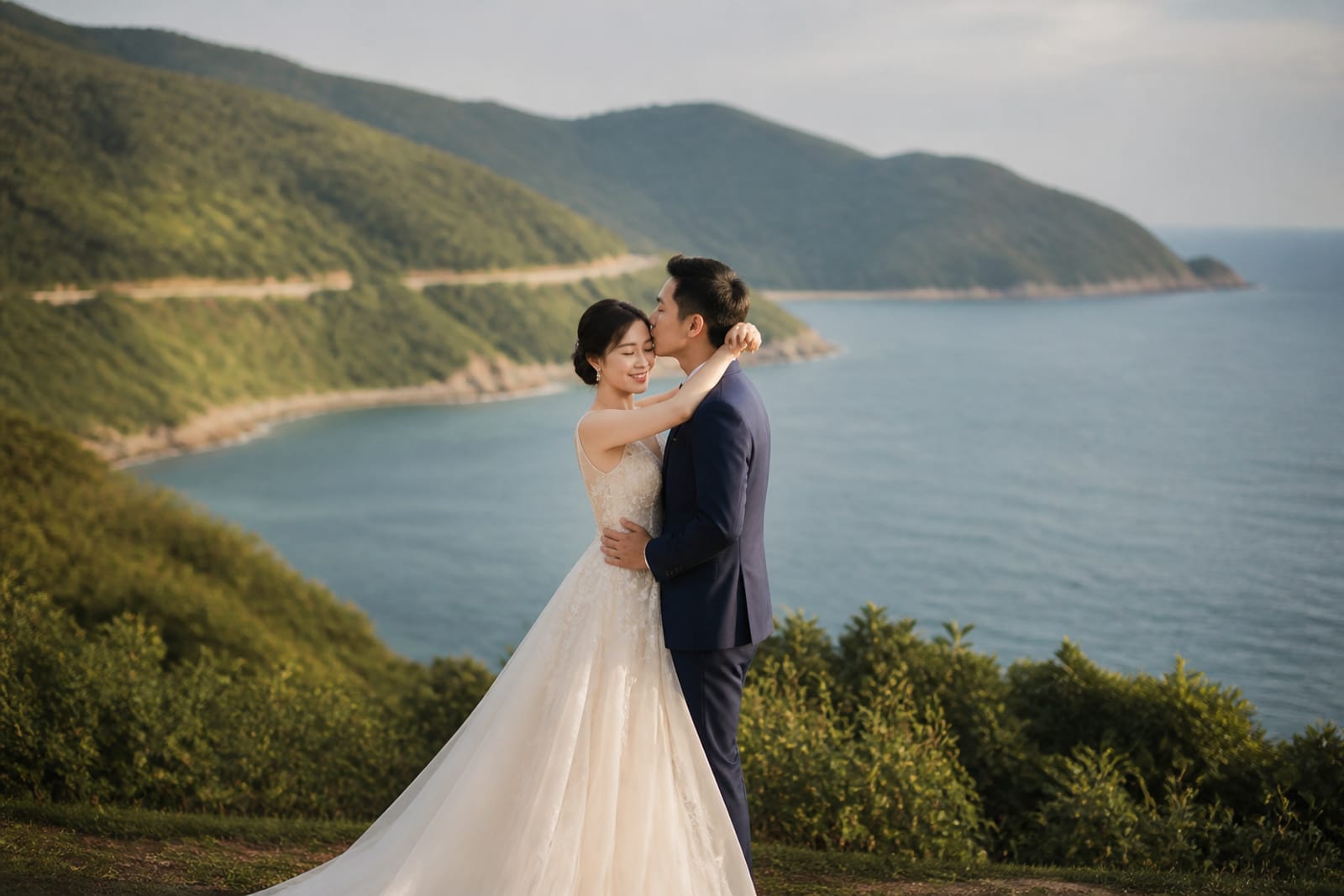
Son Tra Peninsula and Linh Ung Pagoda are Da Nang's premier ao dai couple backdrops, each with distinct light windows and season constraints. Son Tra (a protected promontory north of Da Nang city) offers wild cliff light and ocean depth best Feb–Aug, with sunrise and late-afternoon side light ideal before 7 a.m. or after 4 p.m.; the site requires a 45-minute drive from the city, physical stamina for rocky terrain, and a sturdy ao dai (saltwater spray risks delicate silk). Linh Ung Pagoda (an active temple complex on a hilltop overlooking Da Nang) gives spiritual framing, soft misty light in cooler months (Dec–Feb), and easier foot access but demands cultural respect — loud shutter sounds and posed stiffness disrupt the sacred space. Both sites suit different couple stories: Son Tra for adventure-focused pairs who walk and move naturally; Linh Ung for couples valuing ceremony and calm. Cáo Studio does not operate in Da Nang — this guide helps you find and vet a local photographer who understands ao dai fabric, light timing and etiquette at each site. ---
Où chaque lieu brille : saisons et lumière
Why does timing matter so much for these two locations?
Da Nang sits on Vietnam's central coast, where the driest, clearest light runs Feb–Aug and the rainy, typhoon season spans Sep–Dec (worst Oct–Nov). Son Tra Peninsula benefits from Feb–Aug clarity: ocean swells catch side light, limestone cliffs glow warm, and the sky stays mostly blue from sunrise until mid-morning, then haze often builds by noon. Linh Ung Pagoda, by contrast, photographs best in Dec–Feb cooler months when mist clings to the hills at dawn, softening hard shadows and framing the sacred steps in diffused light — a distinct mood that Sep–Nov humidity and afternoon rain clouds undermine. If you're torn between the two, your season choice narrows the fit: Feb–Aug favours Son Tra's ocean drama; Dec–Feb favours Linh Ung's spiritual calm. Outside these windows, both sites carry risk — Sep–Dec can mean cancelled shoots due to flash downpours or dangerous cliff winds.
📸 Book on WhatsApp — ao dai photoshoot
---
Comparaison : qui convient à quel couple ?
| Aspect | Son Tra Peninsula | Linh Ung Pagoda |
|---|---|---|
| Meilleure saison | Feb–Aug (soleil clair, mer calme) | Dec–Feb (brume, lumière douce) |
| Meilleure heure | Avant 7 h ou après 16 h | Avant 8 h 30 (brume+matin) |
| Type de couple | Aventureux, en mouvement, histoire nature | Calme, cérémonial, histoire spirituelle |
| Accès | Route 45 min, terrain rocheux, physique | 10 min à pied, escaliers, pas d'équipement lourd |
| Risques ao dai | Eau salée, rochers, vent, tissu délicat | Poussière, escaliers abrupts, escalade |
| Foule | Faible avant 9 h (sentiers sauvages) | Forte après 9 h (pèlerins, touristes) |
| Ambiance photo | Épique, sauvage, mouvement naturel | Sacrée, statique, respect du lieu |
---
Son Tra: cadrer la falaise et l'océan
What's the actual process of shooting at Son Tra, and what can go wrong?
A Son Tra shoot unfolds in phases. Your photographer drives north from Da Nang city, parks at the peninsula's entry (about 45 minutes depending on traffic), and walks you to chosen viewpoints — typically the rocky overlook facing east toward the coast, or smaller sheltered bays if waves are rough. The walk itself is uneven: loose gravel, low scrub, exposed rock; many couples in rented ao dai stumble or catch fabric on thorns, so a local photographer comfortable with terrain and quick repairs is essential. Light windows are tight: sunrise (5:30–6:30 a.m.) and the hour before sunset (around 4:30–5:30 p.m. depending on the month) give warm side light and long shadows that frame the couple against the ocean. Mid-morning and afternoon light is harsh, flattening the landscape. A common pitfall is arriving late — by 8 a.m. the site fills with tour groups and the light turns neutral. Another: saltwater spray damages delicate ao dai fabric and camera gear; shooting with a towel and protective case is non-negotiable. Photographers familiar with ao dai know to guide you to walk toward the light, look at each other while moving, and pause at ledges — never stiff poses in front of monuments. A session here runs 90–120 minutes to account for walk time, outfit changes and light shifts.
---
Linh Ung: clarté spirituelle et étiquette sacrée
How do you shoot respectfully at an active temple, and what's actually possible?
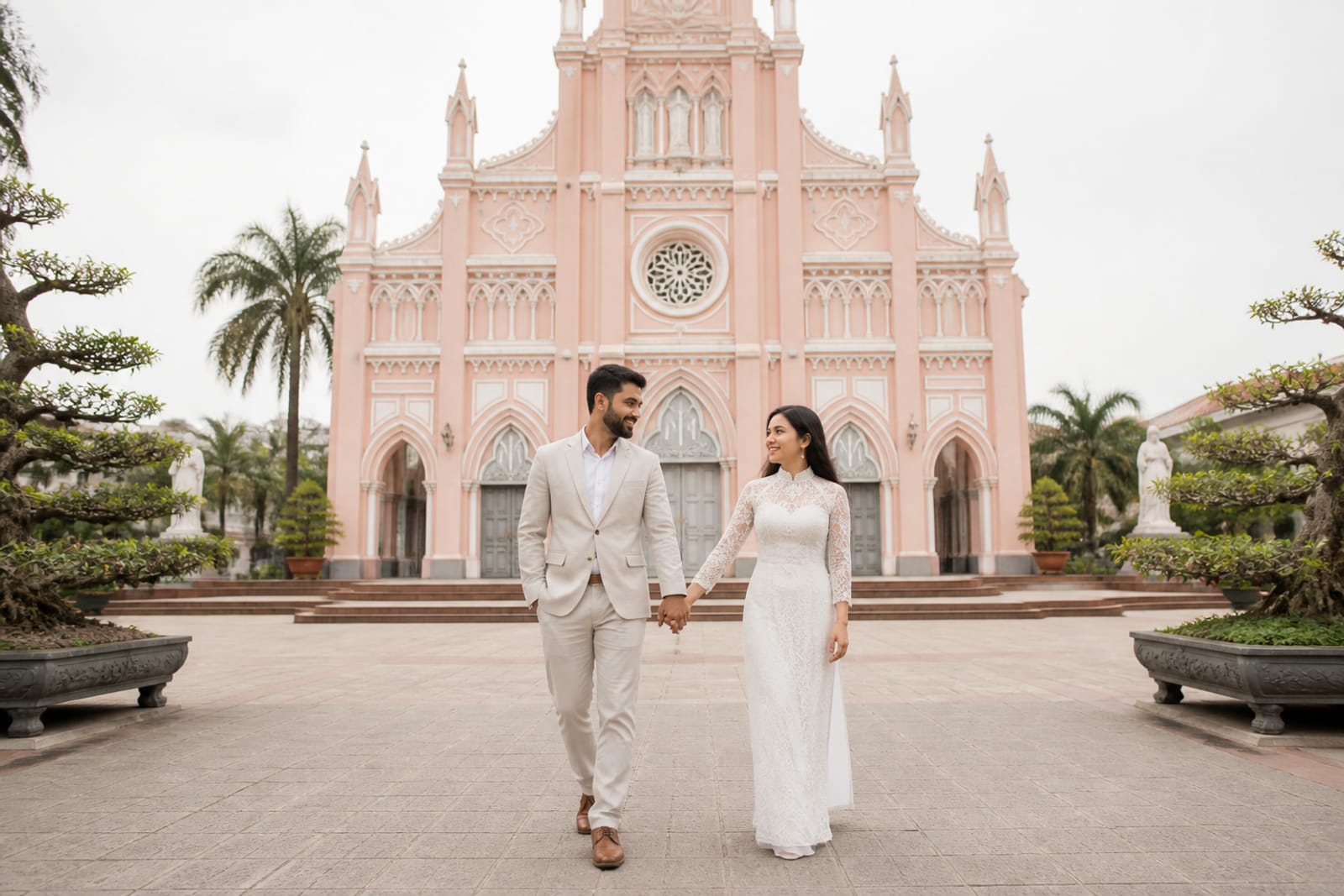
Linh Ung Pagoda (officially Linh Ung Bai But, overlooking Da Nang from the south) is an active Buddhist temple where monks worship daily. Respectful photography means arriving before 8 a.m., shooting on the terrace steps and viewing platforms (not inside the main hall), dressing modestly under your ao dai, and turning off shutter sound if the camera permits. Photographers who ignore this — loud bursts during prayers, posing couples in front of altars, directing stiff tableaux — are politely asked to leave or return. The reward for respect is light: dawn mist and the soft glow of temple lanterns create a contemplative mood that no other Da Nang site matches. The walk from the car park to the main terrace is steep (about 200 stone steps) but manageable in sturdy ao dai; the pagoda's white walls and golden roof frame couples warmly at sunrise. After 9 a.m., busloads of domestic tourists arrive, and the site loses intimacy. The best ao dai stories here are slow: one couple walking the steps together, turning to look back at the temple, or standing in silence facing the view. A session runs 60–90 minutes because foot traffic, temple rhythms and respectful framing demand patience over speed. Photographers who shoot fast and directive (posing, repositioning) create stiff frames that betray the site's sacredness.
---
Sélectionner un photographe Da Nang : critères d'évaluation
What should you ask a local photographer before booking either site?
Vet a Da Nang ao dai photographer on five concrete points. First, ask to see a portfolio of at least three prior ao dai couple shoots at each location — not generic couple shots, but images showing ao dai fabric in motion, light timing specific to the site, and natural framing (walking, looking, pausing) rather than posed tableaux. Second, confirm they understand fabric: ask how they'd protect delicate silk at Son Tra's spray and what tools they carry (microfibre cloth, protective case, quick-dry solutions). Third, verify they've shot at the site during the season you've booked — Feb–Aug for Son Tra, Dec–Feb for Linh Ung — and can explain why timing matters. Fourth, ask what happens if weather cancels the shoot: do they reschedule for free, or charge a rebooking fee? A professional will commit to one free reschedule within a defined window. Fifth, discuss the actual sequence: do they guide you to walk and move, or direct static poses? A director-style photographer (preferred) will explain their approach before the session; a pose-heavy photographer will say "I'll show you positions to try." Always check their response time on WhatsApp — if they take hours to reply before booking, expect delays on the day itself. Request a contract or written summary of timing, outfit changes, number of edited photos and delivery date. Many local photographers are excellent but informal; written confirmation prevents misunderstandings.
---
Ao dai logistics: tissu, location, préparation
What specific ao dai choices work best for each site, and how do you prepare?
At Son Tra, your ao dai must be sturdy: medium-weight silk or silk blend (not gossamer), in deep jewel tones (emerald, sapphire, burgundy) that show ocean light contrast, and a fitted áo (tunic) without heavy bead work that catches wind. Lightweight áo with flowing fabric photograph beautifully in wind, so embrace movement — don't fight it. Avoid white or pale cream ao dai; saltwater spray and dust will stain them. Rent or bring a durable outfit; ask the photographer to carry absorbent cloth and suggest quick rinses at the car park before the drive back (saltwater hardens fabric). At Linh Ung, choose refined, calm colours: soft jade, rose, ash grey — colours that honour the temple without clashing with its golden roof and white walls. Bead work is acceptable here because the pace is slower and wind less severe. Wear dark trousers under the áo (visible when climbing steps); white or light trousers read as modern and undermine the ceremonial mood. Bring slip-on shoes (not heels — the steps are steep and uneven); many couples remove shoes for certain frames, so clean socks are wise. For hair and makeup at both sites, opt for styles that withstand wind and humidity: pinned updos or braided styles at Son Tra, soft waves or loose styles at Linh Ung. At Linh Ung, minimal makeup reads more respectful; at Son Tra, bold makeup (deep lips, defined eyes) stands out against ocean and rock. If you're arriving in Da Nang without pre-arranged makeup, ask the photographer for a trusted local makeup artist, or book a session with a Hanoi or Saigon team if you're willing to travel — Cáo Studio offers makeup & hair at your hotel in Hanoi and Ho Chi Minh City; for Da Nang, a local artist is more practical.
---
Cáo Studio: vos options de photoshoot ailleurs
Can Cáo Studio shoot in Da Nang?
Cáo Studio operates in Hanoi, Ho Chi Minh City, and Hoi An (by appointment — ask on WhatsApp for Hoi An dates). Da Nang is not on the current service area. If you're drawn to ao dai couple shoots and prefer a full-team approach (photographer, makeup artist and stylist coordinated as one), consider booking a couple photoshoot in Hoi An (30 minutes from Da Nang by road) — Hoi An's Ancient Town, riverside walks and lantern light suit ao dai beautifully, and the Cáo team travels for appointments. For Hanoi or Ho Chi Minh City, browse the ao dai photoshoot service and lookbook to see the team's light and framing style. A local Da Nang photographer is your best fit for Son Tra and Linh Ung; use the vetting criteria above to find one who understands light, fabric and site respect.
---
Avant de réserver : checklist final
Before booking a photographer for either site, confirm:
- Season & light. Confirm the date you're proposing falls in Feb–Aug for Son Tra or Dec–Feb for Linh Ung. Check the Da Nang weather forecast 5–7 days before — if rain or storm warnings appear, ask the photographer about their reschedule policy.
- Portfolio & site familiarity. See at least two prior shoots from the same location and season; ask the photographer to name the specific time of day and explain the light.
- Ao dai & fabric prep. Confirm the photographer knows ao dai care (no harsh spray exposure without protection, quick rinses post-shoot). Ask if they have protective gear.
- Timing & delivery. Ask: how many edited photos are included, when will you receive them, and what happens if you want revisions? A written summary prevents disputes.
- Reschedule & cancellation. Confirm one free reschedule is included if weather cancels; clarify the rescheduling window (7 days, 14 days, same season).
- Communication. Test the photographer's WhatsApp response time before booking — ideally within 2–4 hours.
---
Conclusion : choisir votre moment
Son Tra and Linh Ung tell different stories, and the season, light and couple style you carry will pull you toward one. Son Tra rewards the adventurous pair willing to walk, embrace ocean wind, and be guided naturally through motion and discovery — book Feb–Aug, arrive before dawn. Linh Ung rewards the couple who value stillness, ceremony and spiritual space — book Dec–Feb, arrive early, respect the temple's rhythm. Either way, your photographer's ability to read light, protect your ao dai and guide rather than pose will make the difference between frames you keep and frames you delete. Start with a local photographer who has shot your chosen site before, verify their portfolio against the light and season you've picked, and confirm the logistics in writing. If you later book a pre-wedding photoshoot or couple shoot elsewhere in Vietnam, Cáo Studio is available in Hanoi, Ho Chi Minh City and Hoi An — reach out on WhatsApp for availability.
📸 Book on WhatsApp — ao dai photoshoot
---
FAQ
Quelle est la meilleure saison pour les photos ao dai à Son Tra et Linh Ung ?
Son Tra brille Feb–Aug (ciel clair, lumière chaude, océan calme). Linh Ung excelle Dec–Feb (brume douce, lumière délicate). Sep–Dec risque pluies et tempêtes. Choisissez la saison selon le site et l'ambiance souhaitée.
Combien de temps faut-il pour une séance à l'un de ces deux lieux ?
Son Tra demande 90–120 minutes (45 min de route, marche, changements de tenue, fenêtres de lumière). Linh Ung prend 60–90 minutes (accès à pied, rythme respectueux du lieu sacré).
Comment protéger mon ao dai à Son Tra avec les embruns d'eau salée ?
Apportez un tissu absorbant, demandez au photographe de vous rincer rapidement au car park après la séance, et choisissez une soie robuste plutôt que la mousseline. Évitez le blanc ou les couleurs claires.
Puis-je photographier à l'intérieur du temple Linh Ung ?
Non. Respectez les espaces extérieurs (terrasse, escaliers, plate-forme de vue). Désactivez le bruit du déclencheur, arrivez avant 8 h, et évitez les salles de prière où les moines adorent.
Cáo Studio peut-il photographier mon couple à Da Nang ?
Non, Cáo Studio opère à Hanoi, Ho Chi Minh City et Hoi An. Pour Da Nang, trouvez un photographe local expérimenté en ao dai, seasoned sur Son Tra ou Linh Ung, et vérifiez son portefeuille avant de réserver.
Comment vérifier que mon photographe comprend l'ao dai et la lumière ?
Demandez un portefeuille de trois shoots ao dai antérieurs au même site et en même saison. Posez des questions sur la protection du tissu, l'heure exacte de prise, et la tactique de direction (mouvement naturel vs. poses statiques).
Questions fréquentes
Quelle est la meilleure saison pour les photos ao dai à Son Tra et Linh Ung ?
Son Tra brille Feb–Aug (ciel clair, lumière chaude, océan calme). Linh Ung excelle Dec–Feb (brume douce, lumière délicate). Sep–Dec risque pluies et tempêtes. Choisissez la saison selon le site et l'ambiance souhaitée.
Combien de temps faut-il pour une séance à l'un de ces deux lieux ?
Son Tra demande 90–120 minutes (45 min de route, marche, changements de tenue, fenêtres de lumière). Linh Ung prend 60–90 minutes (accès à pied, rythme respectueux du lieu sacré).
Comment protéger mon ao dai à Son Tra avec les embruns d'eau salée ?
Apportez un tissu absorbant, demandez au photographe de vous rincer rapidement au car park après la séance, et choisissez une soie robuste plutôt que la mousseline. Évitez le blanc ou les couleurs claires.
Puis-je photographier à l'intérieur du temple Linh Ung ?
Non. Respectez les espaces extérieurs (terrasse, escaliers, plate-forme de vue). Désactivez le bruit du déclencheur, arrivez avant 8 h, et évitez les salles de prière où les moines adorent.
Cáo Studio peut-il photographier mon couple à Da Nang ?
Non, Cáo Studio opère à Hanoi, Ho Chi Minh City et Hoi An. Pour Da Nang, trouvez un photographe local expérimenté en ao dai, seasoned sur Son Tra ou Linh Ung, et vérifiez son portefeuille avant de réserver.
Comment vérifier que mon photographe comprend l'ao dai et la lumière ?
Demandez un portefeuille de trois shoots ao dai antérieurs au même site et en même saison. Posez des questions sur la protection du tissu, l'heure exacte de prise, et la tactique de direction (mouvement naturel vs. poses statiques).