Cáo Studio · ベトナム撮影ガイド · ベトナムのアオザイ撮影ガイド|ハノイ・ホーチミンでの選び方
Khan Đông Headpiece Photoshoot in Vietnam: Style, Light & How to Book
Cáo Studio チーム · ハノイ · 2026-10-03
Khan đông (khăn đông) is a folded silk headpiece worn traditionally with the ao dai; in modern photoshoots, it signals elegance and cultural depth. A khan đông photoshoot works best in soft, directional light — dawn at the Red River's edge or late afternoon near temples — where the fabric's sheen and folds read clearly in frames. Sessions typically run 2–3 hours: outfit change, hair wrap, then shooting wide (walking through old streets), medium (seated by water), and detail (the fold, your face, hands). Cáo Studio directs these from light and location — no stiff poses — and delivers edited frames plus a vertical film in 48 hours. Cost depends on season, travel time between sites, and number of outfits; get a quote on WhatsApp.
Khan đông (khăn đông) — the traditional Vietnamese silk headpiece folded and pinned above the forehead — has become a signature element in ao dai photoshoots for travelers wanting to go beyond standard portraits. It's not a hat; it's a deliberate frame for the face and a cultural anchor that transforms a session into storytelling. Cáo Studio has directed hundreds of khan đông shoots in Hanoi and Saigon, and every one teaches the same lesson: the piece only reads in the right light, at the right hour, with a director guiding movement rather than posing.
Khan Đông vs. No Headpiece — Which Suits Your Session?
Question: Do I need a khan đông for an ao dai photoshoot, or is it optional?
Khan đông is optional; many travelers skip it for freedom of movement or speed. But it changes the framing: with khan đông, the session becomes portrait-focused (face, shoulders, symmetry), while without it, poses can roam wider and looser. Khan đông also reads best in specific light — soft, directional (dawn or late afternoon) — because backlit folds vanish and harsh midday sun flattens the fabric. If you're shooting in Hoi An's ancient streets or by a temple, khan đông feels contextual; if you're jumping between five locations in one afternoon, skipping it saves 20–30 minutes and lets you move faster.
| Option | Best For | Light Requirement | Why It Works |
|---|---|---|---|
| Khan đông + ao dai | Portrait-forward, temple or heritage backdrop | Dawn or 4 pm onward (soft side/back light) | Folds and sheen read clearly; face framing feels intentional |
| Ao dai alone (unbound hair) | Movement, multiple locations, freedom | Any time (light matters less) | Faster changes, looser poses, doesn't require pinning or styling time |
| Khan đông + ao dai + jewelry | Cultural depth, family or couple story | Golden hour only (6–7 pm, low angle) | Silk, metal, and skin glow together; reads like an heirloom moment |
📸 Book on WhatsApp — ao dai photoshoot
What Light Makes Khan Đông Shine in Photos?
Question: What time of day shoots khan đông best, and why?
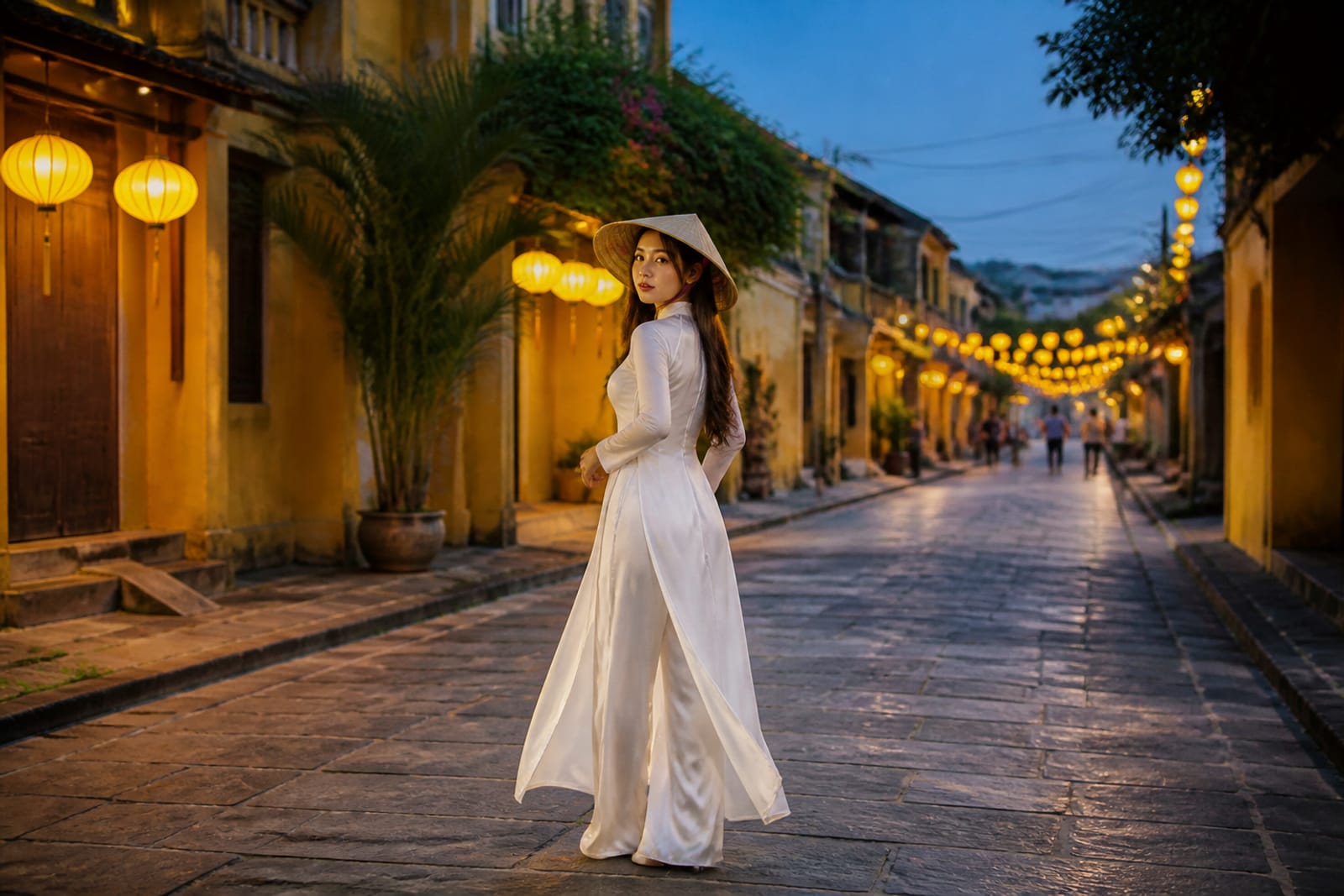
Khan đông is a reflective, folded fabric — it needs directional light to show texture and dimension. Shooting in harsh midday sun flattens the piece into a single color; shooting into the light blows out the face. The window is narrow: dawn (5:30–6:30 am) when light rakes across the face from the side, or late afternoon (4–5 pm) when the sun is low and golden, hitting the wrap from behind or the shoulder. In Hanoi, Huc Bridge (Cầu Huc) at 6:10 am catches the river's reflected light and softens the wrap. In Saigon, Nguyen Hue Walking Street (Đường Nguyễn Huệ) at 5 pm bounces urban warmth off buildings. Overcast mornings work too — no shadows, even exposure — but the fabric reads duller. Always scout the light path before the session; a director with a meter and a clear eye saves the shoot.
How to Wear Khan Đông Without Discomfort During a Session
Question: What do I wear under the khan đông, and how long can I keep it on?
The khan đông sits directly on your hair, pinned with two or three clips. Wear the hair smoothed (no loose waves underneath) so the fold doesn't slip. Underneath the ao dai, wear a silk or cotton slip — never a heavy bra with thick straps, as it will show under the shoulder seams. The headpiece itself is light (a meter of silk, folded) and breathable; most guests wear it comfortably for 45 minutes to an hour before needing a micro-adjustment. After an hour, the fold may loosen or the pins may shift slightly — this is normal. A makeup and hair artist travels with the shoot to refresh the wrap and tighten pins between location changes. If you wear glasses or have a sensitive scalp, mention it at booking; the team can adjust the pin placement or offer a gentler fold variant. Visit the makeup & hair service to confirm what's included in your session.
Shooting Khan Đông Across Vietnam's Best Locations
Question: Where in Vietnam looks best with khan đông, and what's the shooting rhythm?
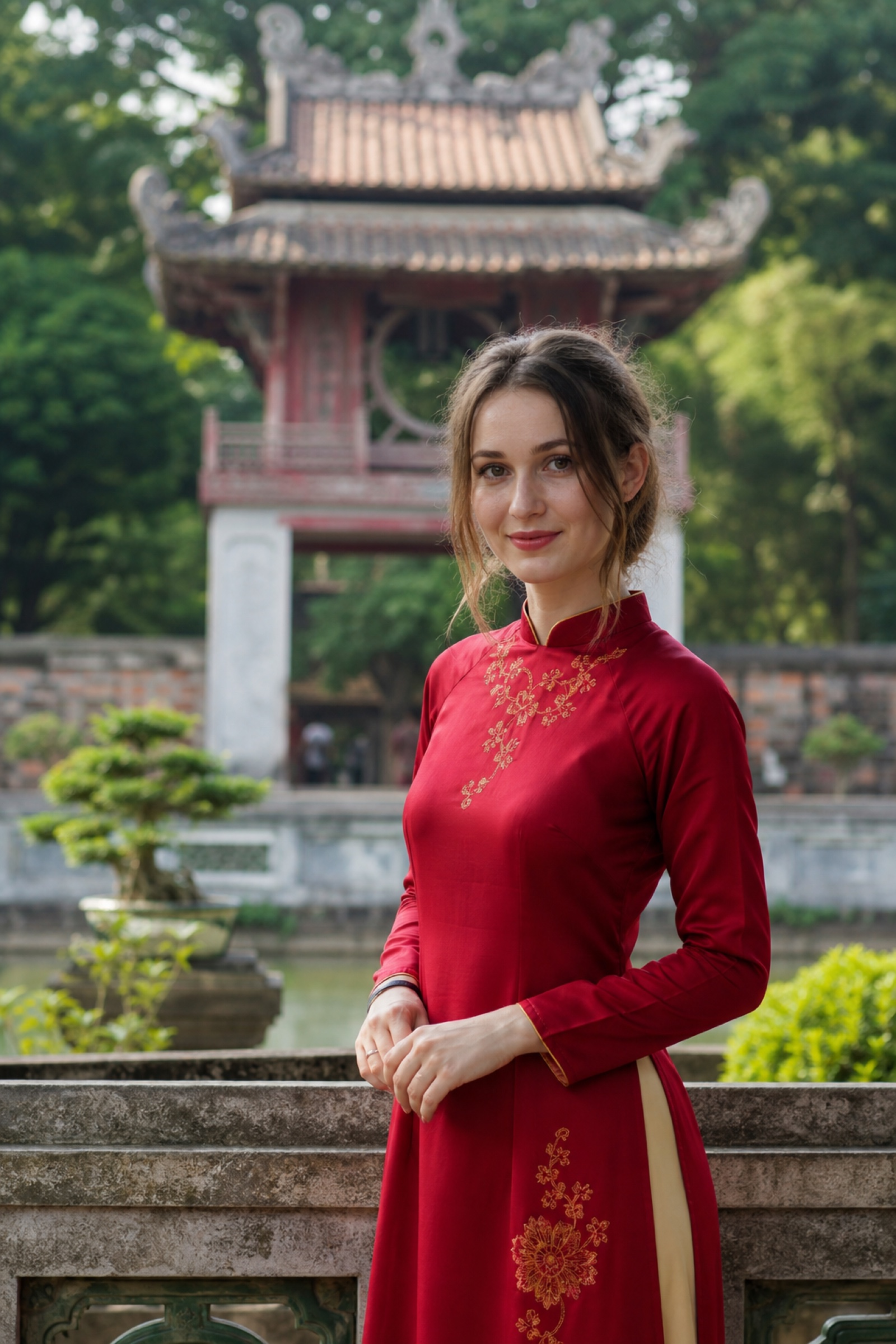
Khan đông reads best against heritage and water: old temples, riverbanks, narrow alleys with weathered walls. In Hanoi (the studio's home base), the Red River at sunrise, the Old Quarter's tube streets, and the grounds of the Temple of Literature (Văn Miếu) all frame the piece well. In Ho Chi Minh City, the Saigon River Promenade at dusk, colonial villas in District 1, and the Bitexco Financial Tower's reflection pool work. Hoi An — reachable by the team on appointment — is the strongest backdrop; its entire ancient town (Phố Cổ Hội An) was built for this. The shooting rhythm is always the same: arrive 30 minutes before prime light, wrap the khan đông with the hair artist, shoot wide first (you walking toward the camera or away), then medium (seated or standing interaction with architecture), then detail (the fold, your hands, light on silk). Between locations, the team handles transport; you change outfits or refresh makeup in the van or a pre-scouted café. Most shoots move 2–3 times in a 3-hour session. See our Hoi An photography guide for full details.
💄 Makeup & hair at your hotel — included with most sessions
What Sets a Khan Đông Shoot Apart From a Costume or Party Photo
Question: Is khan đông a "costume" for fun, or a serious photoshoot subject?
This is the difference between posing in front of a monument and being directed as a subject. A khan đông photoshoot is serious — it assumes the piece has cultural weight, that your wearing it means something (heritage, respect, storytelling), and that the frames should honor that. This is why Cáo Studio never poses guests "chin down, smile at the camera" with khan đông. Instead, the director might say: "Walk toward the temple steps. Don't look back yet. When you reach the shadow, turn — just your head — toward the light." The session becomes a film; the khan đông becomes a costume in a story, not for a joke. Cost and time are higher because a director is calling every move and a hair artist is steadying the piece. If you want a quick, cheerful costume snap, that's fast and fun — but it's different. Cáo Studio's model suits travelers who want frames they'll show for years, not just reshare once on Instagram.
Cost Factors for Khan Đông Sessions: Season, Sites & Timing
Question: What makes one khan đông shoot cost more than another?
Three variables: season (Dec–Feb and late Jul–Aug are peak travel and book faster, raising studio availability cost); distance (one Hanoi location costs less than shuttling between Hanoi, Ha Long, and Ninh Binh; Hoi An requires the team to travel, adding logistics); and outfits (one khan đông + ao dai = shorter session; two or three outfit changes = longer day, more artist time). No fixed price is listed here — that comes in a WhatsApp quote — but you should ask the studio: Does the kit include khan đông rental, or do I bring my own? (some guests buy or rent a traditional wrap beforehand), How many outfits are in the base package?, and Are all locations within one district, or will we travel far? Before booking, also clarify the weather window: if your session falls in the typhoon season (Sep–Oct, especially central Vietnam), rain is possible — confirm the rain-date policy. Reach out on WhatsApp for a tailored quote.
🌸 Ideas & lookbook — see how others styled khan đông
What to Check Before You Book a Khan Đông Photoshoot
Before sending a booking inquiry, prepare these details:
- Date & city: Are you in Hanoi, Saigon, or Hoi An? (If Hoi An, ask about travel dates.)
- Your vision: Portrait (close-up face, khan đông folds) or narrative (you walking through old streets)?
- Outfit count: One khan đông + ao dai, or multiple outfits?
- Timeline: Do you have a specific date, or are you flexible within a week or month?
- Hair & makeup: Do you need a hair wrap (khan đông requires it), or do you have someone in Vietnam already?
- Location preference: River, temple, old town, or modern backdrop?
- Mobility: Are you able to walk 2+ km between sites in heels or dress shoes? (Some guests hire a private car; the studio can advise.)
Confirm with the studio on WhatsApp: Are the khan đông wrap, makeup, and hair artist included, or charged separately? and What is the exact turnaround for edited frames and video? Never assume — the studio's exact inclusions are confirmed only in the WhatsApp quote. Message to book.
---
Related Services & Ideas
If khan đông feels too traditional or you want a looser vibe, explore the ao dai photoshoot page for unbound styles, or consider a couple or family session where one person wears khan đông and the other wears modern ao dai — the contrast reads beautifully. For a first-time traveler unsure about the piece, the vacation photoshoot option lets you change outfits freely without committing to one look. And if this is part of a larger trip, pair it with the pre-wedding or elopement package if you're marrying in Vietnam, or the wedding day photographer if you're planning something bigger.
---
FAQ
Khan đông is folded silk — does it damage easily during a shoot?
No. The piece is sturdy and designed to be pinned and worn for hours. The hair artist adjusts it gently between locations. Never yank it off yourself — let the artist unpin it. If you're renting from the studio, they handle the care.
Can I wear my own family's khan đông, or should I rent?
Yes, bring your own if it's meaningful. The hair artist will work with it. Rental is also available; ask on WhatsApp. Wearing your own adds a personal, heirloom element to the frames.
What if I have short hair or a shaved head — can I still wear khan đông?
Khan đông is pinned into hair for grip. Very short or no hair makes pinning risky (the piece may slip). A skilled artist can use wig tape or adjust the fold to sit as a wrap rather than a pinned cap. Mention this at booking so the team can prepare.
How many photos will I get from a khan đông shoot?
That depends on the package — the exact count is confirmed on WhatsApp when you receive your quote. Cáo Studio delivers edited frames plus a short vertical film in 48 hours.
Is there a best month for khan đông photoshoots in Vietnam?
Feb–Apr and Sep are ideal — mild temps, low rain, soft light. Dec–Jan is cool (northern Vietnam) and crowded. May–Aug is hot and humid; Sep–Oct risks rain, especially central Vietnam. No month is bad, but winter and shoulder seasons require less heat management during the wrap.
Do I need a makeup artist if I'm already wearing makeup?
Makeup for photo sessions is different — it's heavier, bolder, and built to hold in soft light for 3+ hours. Wearing street makeup under khan đông often reads as flat or washed out in frames. The makeup artist is usually part of the session; confirm on WhatsApp.
Can I do a khan đông shoot on the same day I land in Vietnam?
Not recommended. Jet lag, travel swelling, and unfamiliar streets make rushing risky. Wait one full day, stay hydrated, and arrive at the shoot rested. A tired face reads in close-up frames, and khan đông tightness can amplify discomfort. Plan the shoot for day two or three of your trip.
よくある質問
Khan đông is folded silk — does it damage easily during a shoot?
No. The piece is sturdy and designed to be pinned and worn for hours. The hair artist adjusts it gently between locations. Never yank it off yourself — let the artist unpin it. If you're renting from the studio, they handle the care.
Can I wear my own family's khan đông, or should I rent?
Yes, bring your own if it's meaningful. The hair artist will work with it. Rental is also available; ask on WhatsApp. Wearing your own adds a personal, heirloom element to the frames.
What if I have short hair or a shaved head — can I still wear khan đông?
Khan đông is pinned into hair for grip. Very short or no hair makes pinning risky (the piece may slip). A skilled artist can use wig tape or adjust the fold to sit as a wrap rather than a pinned cap. Mention this at booking so the team can prepare.
How many photos will I get from a khan đông shoot?
That depends on the package — the exact count is confirmed on WhatsApp when you receive your quote. Cáo Studio delivers edited frames plus a short vertical film in 48 hours.
Is there a best month for khan đông photoshoots in Vietnam?
Feb–Apr and Sep are ideal — mild temps, low rain, soft light. Dec–Jan is cool (northern Vietnam) and crowded. May–Aug is hot and humid; Sep–Oct risks rain, especially central Vietnam. No month is bad, but winter and shoulder seasons require less heat management during the wrap.
Do I need a makeup artist if I'm already wearing makeup?
Makeup for photo sessions is different — it's heavier, bolder, and built to hold in soft light for 3+ hours. Wearing street makeup under khan đông often reads as flat or washed out in frames. The makeup artist is usually part of the session; confirm on WhatsApp.
Can I do a khan đông shoot on the same day I land in Vietnam?
Not recommended. Jet lag, travel swelling, and unfamiliar streets make rushing risky. Wait one full day, stay hydrated, and arrive at the shoot rested. A tired face reads in close-up frames, and khan đông tightness can amplify discomfort. Plan the shoot for day two or three of your trip.