Cáo Studio · Panduan sesi foto di Vietnam · Konsep Potret Vietnam: Panduan Pilih Sesi untuk Perjalanan Anda
Cinematic Film Look Photoshoot Vietnam: How Directed Light Beats Posed
Pasukan Cáo Studio · Hanoi · 2026-10-03
A cinematic film look photoshoot is a session where you walk, look at each other, or move through a location while the photographer captures real light and emotion—not a posed smile at a monument. In Vietnam, this style works best at dawn (Huc Bridge, Hanoi; Trang An, Ninh Binh) or golden hour (Hoi An lantern streets, Ho Chi Minh City's Nguyen Hue pedestrian zone) when light is soft and directional. Cáo Studio operates as one team: the photographer frames the movement, the makeup artist ensures light reads on your skin, and the stylist picks outfits that move well in the shot. A typical session runs across one location or two linked spots (to follow the light), and delivered edited frames plus a short vertical film within 48 hours. The main mistake is booking three separate vendors (photographer, makeup, hair) and losing continuity; one team shoots faster, talks less, and reads the light together. Cinematic work costs more than a quick snapshot but less than a full production crew—ask on WhatsApp for a quote tailored to your locations and outfit count. ---
Cinematic vs Posed: Why Movement and Light Matter More Than Landmarks
Posed photoshoots line you up in front of an iconic temple or lantern street and say "smile at the camera." Cinematic shoots ask you to walk out of frame, reach for your partner's hand, or look at the light—while the photographer captures the story, not the smile. The difference is direction, not location. You can shoot at the same Hoi An lantern street and get stiff portraits or flowing frames, depending on whether the photographer is posing you or directing movement through real light.
In Vietnam's climate, light is a character. Winter mornings (Dec–Feb) in Hanoi bring soft, grey side light that flatters without harsh shadows. Summer dawn (May–Aug) offers cooler air and lower humidity before 7 a.m.—critical for makeup that stays put and skin that doesn't blow out. Midday light anywhere is flat and unflattering; cinematic shoots avoid it. Instead, we time sessions for the hour before sunset (golden hour) or the hour after sunrise, when the sun is low and directional—the light that movies are built on.
Posing freezes a moment. Directing allows a moment to unfold. A cinematic approach means the photographer shoots wide (you entering a frame), medium (you walking, turning, or connecting), and detail (hands, expressions, fabric) in sequence—the way a film editor cuts. This means more coverage, fewer staged moments, and frames that tell a story when you flip through them later.
📸 Book on WhatsApp — ao dai photoshoot
---
Best Light Hours for Cinematic Work in Vietnam: When to Shoot
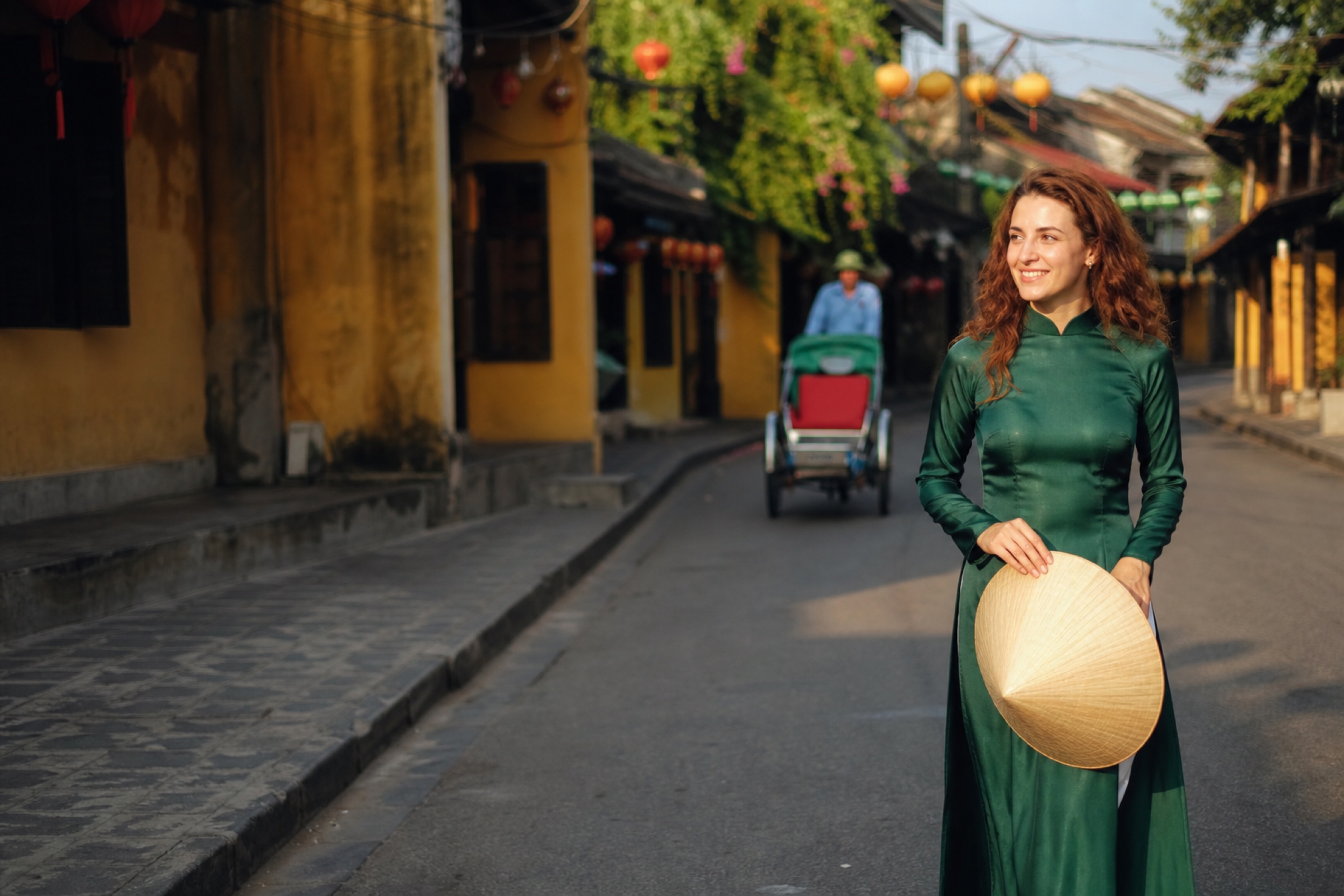
Cinematic light has a window. In Hanoi and Ho Chi Minh City, book sessions 6–7 a.m. (before crowds and heat) or 5–6 p.m. (golden hour) for side light that sculpts faces and fabric. In Hoi An, the lantern-lit streets work 6:30–7:30 p.m., when ambient light mixes with hanging lamps—a natural color grade. In Ninh Binh (Trang An, Mua Cave), book a boat or sunrise hike for 6–7 a.m., when mist clears and limestone reflects soft light.
| Location | Best Hour | Why It Works | Season | What to Watch |
|---|---|---|---|---|
| Huc Bridge, Hanoi | 6–6:30 a.m. | Soft side light, few walkers, mist lifting | Oct–Mar (cooler) | Humidity May–Sep; dress absorbs sweat |
| Hoi An Ancient Town | 6:30–7:30 p.m. | Lanterns + golden hour mix, fewer tourists | Feb–Aug (dry) | Oct–Nov = rain risk; Sept = heat spikes |
| Trang An boats, Ninh Binh | 6–7 a.m. | Mist + low sun = cinema | Nov–Mar (coolest) | Summer boats rock more; hair/makeup harder to hold |
| Ho Chi Minh City, Nguyen Hue | 5–6 p.m. | Pedestrian zone, street light, crowds thin | Dec–Feb (coolest) | May–Sep = heavy humidity; makeup sets fast then melts |
| Hoi An riverside walk | 7 p.m. | Lanterns on water, soft amber glow | Feb–Aug | Sept–Dec = typhoon/rain; light is grey, flat |
The northern winter (Dec–Feb) is ideal for cinematic work: cool air keeps makeup in place, humidity is low, and the grey sky acts like a giant diffuser—no blown-out skin, no harsh shadows. Summer (May–Sep) is humid and hot, requiring earlier starts (5:30 a.m.) and faster makeup application. The central coast (Hoi An, Hue, Da Nang) is driest Feb–Aug; avoid Oct–Nov (typhoon season = grey light and rain). The south (Ho Chi Minh City, Mekong) is dry Dec–Apr and wet May–Nov, with afternoon downpours—so cinematic work means morning sessions or early evening before rain.
---
One Team vs Three Vendors: Why Continuity Matters for Cinematic Work
A cinematic shoot requires conversation mid-session: the photographer sees glare on the skin and asks the makeup artist to powder; the stylist notices the dress folds awkwardly as you walk and adjusts the fit; the photographer finds a new frame and calls everyone to reposition in 30 seconds. Three separate vendors—a photographer booked via one app, a makeup artist via another, a stylist on a third—cannot talk fast enough. They compete for your time, second-guess each other's choices, and lose momentum.
Cáo Studio runs as one team. The photographer, makeup artist, and stylist know each other's pace and priorities. When light shifts, makeup is already prepped for the next location. When you move, the stylist is already adjusting the ao dai hem or dress train so it photographs cleanly. This saves 30–45 minutes per session—time that becomes more coverage, more locations, or calmer takes.
A second reason: makeup for cinema. Typical vacation makeup works for daytime snapshots and Instagram stories. Cinematic makeup must read across the frame—slightly more definition around the eyes, blush placed to flatter cheekbones under side light, lip color that doesn't fade between takes. The makeup artist needs to see what the photographer is seeing (the frame, the light, the skin tone in that light) and adjust in real time. A separate makeup artist working from a standard bridal checklist won't know the frame; a team knows it together.
Cost consequence: one team is more expensive per hour than booking a photographer alone, but cheaper than three vendors, and delivers more usable frames. Ask us on WhatsApp for a quote that compares single-photographer vs. one-team options for your locations.
---
Cinematic Outfit Choice: Fabric, Movement, and What Reads on Camera
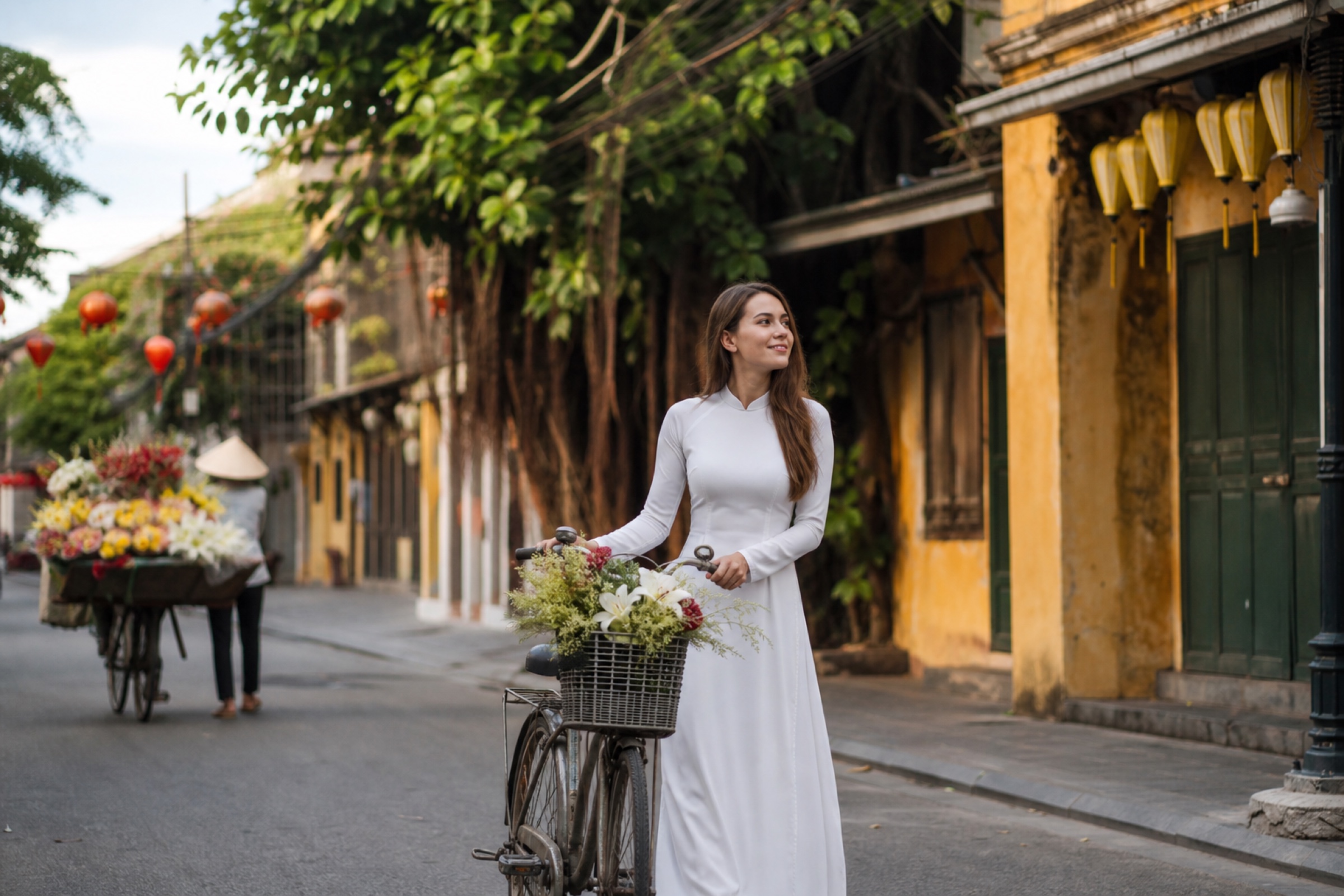
Cinematic work demands outfits that move. An ao dai in lightweight silk floats when you walk; one in heavy brocade clings to your legs and photographs stiffly. A wedding dress with a long, light train catches wind and creates a frame within the frame; a dress without flow reads as a static block.
Fabric rules for cinema:
- Silk, linen, cotton gauze: move, catch light, photograph soft. Best for morning and golden hour.
- Satin, heavy brocade: elegant but static. Suit evening events (proposal photoshoots, anniversary dinners) where movement is minimal.
- Layered or tiered skirts: create depth in the frame; medium shots look richer.
- Solid colors over prints: read cleaner in low or mixed light. Hoi An's lantern light favors deep jewel tones (emerald, navy, burgundy) or cream.
For ao dai photoshoots, we recommend lightweight silk in colors that flatter your skin under golden or grey light: pastels (soft pink, lavender, peach) for warm, sunny seasons; deeper hues (deep blue, teal, burgundy) for winter or evening shoots. Sleeveless or flutter-sleeve cuts move better in video than fitted long sleeves.
For couple and family photoshoots, coordinate silhouettes, not exact colors. Both partners in flowing fabrics (linen shirts, light trousers) move together in frame; one stiff and one flowing creates imbalance. Neutral bases (cream, grey, navy) + one accent color (a rust scarf, a burgundy dress) photograph cinematic without clashing.
What to avoid: logos, graphic tees, bright neon, patterns smaller than your hand (they vibrate on camera), and anything that binds your shoulders or hips (you can't walk naturally).
---
How Cáo Studio Delivers Cinematic Frames in 48 Hours
We shoot in real locations (no studio backdrop) and edit within 48 hours: photos colored and cropped for movement, plus a short vertical film (30–90 seconds) that strings together the best 4–6 moments from your session. This turnaround means we prioritize continuity of story, not volume. You get 30–50 edited stills and one film, not 300 raw files.
Workflow:
- Scouting & timing (before the session): We confirm the exact location, check sunrise/sunset times via real weather data, and plan two backup spots in case crowds arrive early or light shifts.
- Preparation (morning of): Makeup artist and stylist prep outfits and makeup at your hotel or at our base; photographer tests camera and light meters. This takes 45–60 minutes.
- On-location directing (1–2 hours): You walk, we shoot. The photographer calls movement ("walk toward me," "turn and look at the river"); makeup artist watches skin and adjusts between takes; stylist smooths fabric every few frames. No poses, no "smile at the camera."
- Editing (24–48 hours): Photos are color-graded for the light and time of day (dawn has a cool, blue tone; golden hour has amber); film is cut to music. We send a preview link; revisions are incorporated before final delivery.
This pace requires we shoot once per day per client. We do not run multiple sessions in a single afternoon. One shoot, one team, one story—that's the cinematic principle.
---
Before You Book a Cinematic Photoshoot in Vietnam: Key Questions
1. Is the photographer trained in directing, not posing? Ask to see their lookbook. Do their frames show movement (people walking, turning, looking away from the camera) or mostly static poses facing the lens? Cinematic work shows movement.
2. Is makeup included, and will the makeup artist be on-location? If makeup is listed as "optional" or "arranged separately," the photographer is not set up for cinematic work. On-location makeup adjusts in real time; hotel-only makeup cannot.
3. What is the editing style? Cinematic edits preserve natural skin tone and light consistency; they do not over-saturate colors or add artificial glow. Ask if edits are minimal ("you see what we saw") or stylized ("colors shifted for mood"). Both are valid; know which you prefer.
4. How many locations, and how does the team move between them? Cinematic shoots often involve a walk from one spot to another (Huc Bridge to a quiet lane in Hanoi, or Hoi An riverside to the covered bridge). Confirm transport, timing, and whether the full team (photographer, makeup, stylist) moves with you.
5. What is included, and what costs extra? Outfits, hair, makeup, number of locations, number of edited photos, and delivery time vary. Confirm details on WhatsApp—there is no one-size-all package.
6. When is the session best booked? In Vietnam, book 2–4 weeks in advance. This allows us to scout locations, coordinate outfits, and confirm weather windows. Tet (late January–mid February) closes many services; avoid booking then.
---
Which Cáo Studio Service Fits Your Cinematic Vision?
Cinematic style suits several session types. Here's how to match your vision to a package:
- Ao dai photoshoots: Traditional dress, cultural immersion, movement through heritage sites (temples, lantern streets, village lanes). Best for travelers wanting to "become Vietnamese for an afternoon."
- Couple and family photoshoots: Partners or multi-generational groups moving together, narrative of connection. Light is everything; timing and coordination matter most.
- Proposal and anniversary packages: High emotion, specific moment (dawn at a landmark, sunset on a boat). Cinematic approach turns a nervous, scripted moment into something that feels natural and flows.
- Pre-wedding and elopement shoots: Day-long or multi-day, multiple locations, outfits, and emotional arcs. Cinematic work shines here; narrative spans the full day.
- Vacation photoshoots: Solo or with a travel partner, capturing your days without staging. Movement through markets, streets, food moments—cinema verité style.
Each begins with the same question: What story are you telling, and where is the light best? Choose Cáo Studio if you want one team that sees the story, reads the light, and directs you into it—not three vendors and a stiff pose.
📸 Book on WhatsApp — ao dai photoshoot
---
Cinematic Shoots by Location: Hanoi, Saigon, Hoi An
Hanoi: Winter Light and Urban Geometry
Huc Bridge at 6 a.m. offers the north's cleanest light—soft, directional, grey-toned. Walk from the bridge into Hoàn Kiếm old quarter and you have narrow lanes, shuttered shop-houses, and dappled shade. Winter (Dec–Feb) is ideal; summer means heat and humidity compromise makeup by 7:15 a.m. Expect crowds by 7:30 a.m., so early start is essential.
Ho Chi Minh City: Pedestrian Zones and Golden Hour
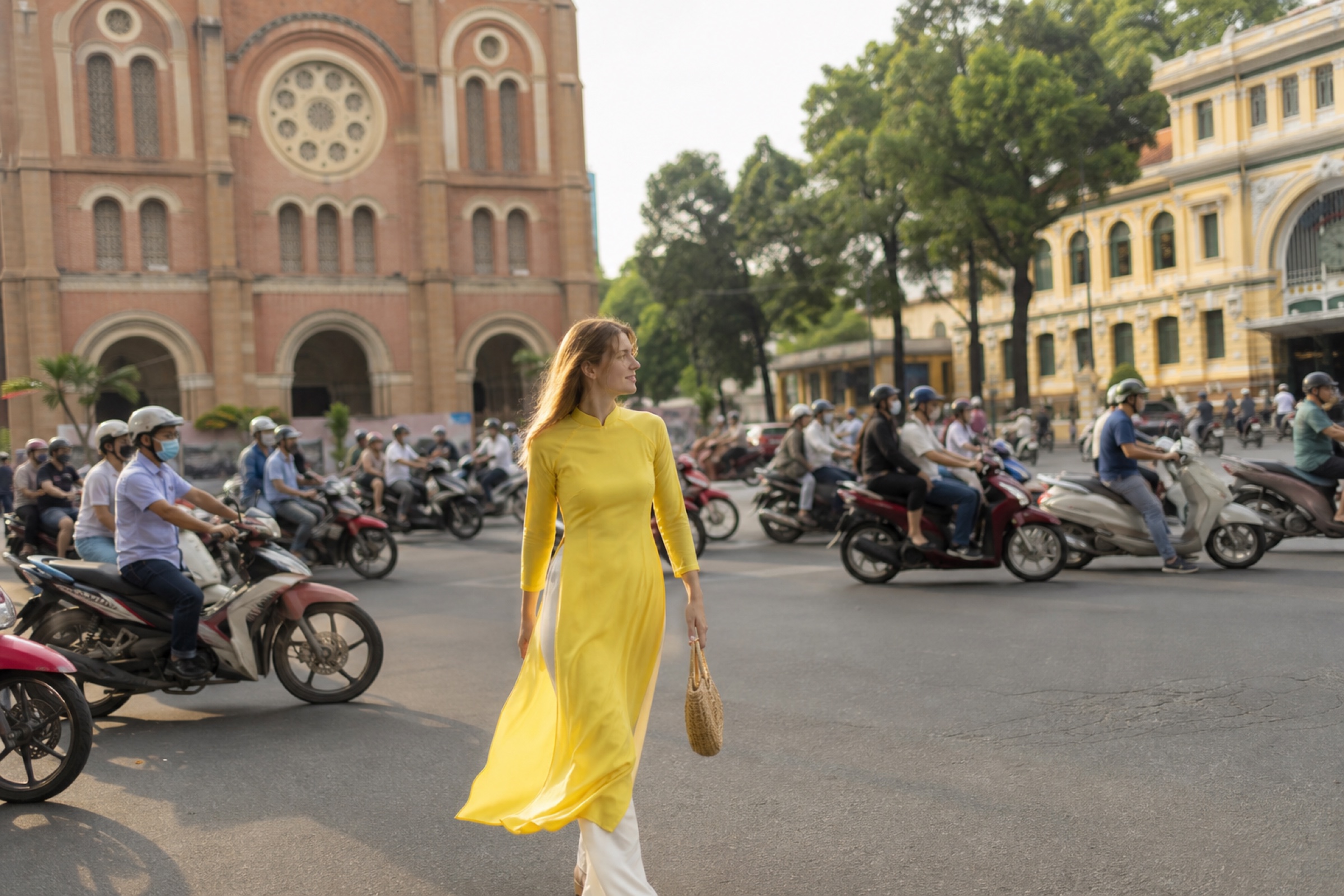
Nguyen Hue Walking Street and Ben Thanh market perimeter work best 5–6 p.m. (golden hour). The street is wide and open; light is amber and directional. December–February is coolest; May–September means fast makeup melt and afternoon thunderstorms. Backup indoor locations (War Remnants Museum, Saigon Opera House grounds) suit midday if weather fails.
Hoi An: Lantern Light and Ancient Lanes
Hoi An's cinematic window is 6:30–7:30 p.m., when natural golden light mixes with hanging lanterns. The ancient town's narrow lanes and yellow-washed walls read richly on camera. Dry season (Feb–Aug) is safest; Oct–Nov brings typhoon risk. We travel to Hoi An by appointment—ask on WhatsApp for available dates and logistics.
---
FAQ
Does cinematic light require expensive camera equipment?
No. The photographer's camera matters less than their skill reading natural light and directing movement. Cáo Studio uses professional-grade cameras, but the cinematic look comes from timing, direction, and the team's coordination—not gear. A skilled director with a basic camera beats an equipped photographer who only poses.
Can we do a cinematic shoot indoors or at night?
Indoors, cinematic work is harder—it requires bounce light or careful positioning in window light. Nighttime (streets lit by streetlamps and neon) can work, but skin tone reads flat or color-shifted. Best practice: book dawn or golden hour outdoors. If night is your only option, let us know on WhatsApp and we'll discuss feasibility and cost factors.
What if the weather is grey or rainy on the shoot day?
Grey skies are cinematic—soft, diffused light, no shadows. Rain is not; it halts outdoor work. We book a 48-hour rain window; if weather fails, the session reschedules to the next available slot. Tet holidays and peak season (Dec–Feb in the north, Feb–Aug in central Vietnam) fill up fast, so flexibility helps.
How many outfits can we include in one cinematic session?
Typically one primary outfit (ao dai, dress, formal wear) per 90–120 minute session. Changing outfits mid-session loses momentum and light quality. For multi-outfit cinematic work, book a longer session (3–4 hours) or split across two days. Ask on WhatsApp for cost factors—outfit swaps add complexity and coordination time.
Do we need to prepare poses, or does the photographer tell us what to do?
The photographer directs movement, not poses. We'll say "walk toward me," "turn and look at the river," "reach for her hand"—not "put your hand on your hip" or "smile at the camera." Come relaxed and ready to move naturally. The more you overthink, the stiffer the frame. Trust the team and the light.
Can we book Cáo Studio for a destination outside Hanoi, Saigon, and Hoi An?
We shoot in Hanoi, Ho Chi Minh City, and Hoi An (by appointment). For other Vietnam destinations (Ninh Binh, Da Nang, Sapa, Ha Long, Mekong), we can provide a planning guide (best spots, light times, outfit choices, local photographer recommendations) free of charge. Reach out on WhatsApp. --- 📸 Book on WhatsApp — ao dai photoshoot | 🌸 Ideas & lookbook | 💄 Makeup & hair at your hotel For more on how a single team works: see special concept shoots. For pre-wedding and elopement cinema, read our pre-wedding and elopement guide.
Soalan lazim
Does cinematic light require expensive camera equipment?
No. The photographer's camera matters less than their skill reading natural light and directing movement. Cáo Studio uses professional-grade cameras, but the cinematic look comes from timing, direction, and the team's coordination—not gear. A skilled director with a basic camera beats an equipped photographer who only poses.
Can we do a cinematic shoot indoors or at night?
Indoors, cinematic work is harder—it requires bounce light or careful positioning in window light. Nighttime (streets lit by streetlamps and neon) can work, but skin tone reads flat or color-shifted. Best practice: book dawn or golden hour outdoors. If night is your only option, let us know on WhatsApp and we'll discuss feasibility and cost factors.
What if the weather is grey or rainy on the shoot day?
Grey skies are cinematic—soft, diffused light, no shadows. Rain is not; it halts outdoor work. We book a 48-hour rain window; if weather fails, the session reschedules to the next available slot. Tet holidays and peak season (Dec–Feb in the north, Feb–Aug in central Vietnam) fill up fast, so flexibility helps.
How many outfits can we include in one cinematic session?
Typically one primary outfit (ao dai, dress, formal wear) per 90–120 minute session. Changing outfits mid-session loses momentum and light quality. For multi-outfit cinematic work, book a longer session (3–4 hours) or split across two days. Ask on WhatsApp for cost factors—outfit swaps add complexity and coordination time.
Do we need to prepare poses, or does the photographer tell us what to do?
The photographer directs movement, not poses. We'll say "walk toward me," "turn and look at the river," "reach for her hand"—not "put your hand on your hip" or "smile at the camera." Come relaxed and ready to move naturally. The more you overthink, the stiffer the frame. Trust the team and the light.
Can we book Cáo Studio for a destination outside Hanoi, Saigon, and Hoi An?
We shoot in Hanoi, Ho Chi Minh City, and Hoi An (by appointment). For other Vietnam destinations (Ninh Binh, Da Nang, Sapa, Ha Long, Mekong), we can provide a planning guide (best spots, light times, outfit choices, local photographer recommendations) free of charge. Reach out on WhatsApp. --- [📸 Book on WhatsApp — ao dai photoshoot](https://wa.me/84338762340) | [🌸 Ideas & lookbook](/ms/lookbook) | [💄 Makeup & hair at your hotel](/ms/makeup-and-hair) For more on how a single team works: see [special concept shoots](/ms/special-concept). For pre-wedding and elopement cinema, read our [pre-wedding and elopement guide](/ms/pre-wedding-photoshoot).