Cáo Studio · Panduan sesi foto di Vietnam · Sesi Fotografi Pra-Perkahwinan Vietnam: Panduan Lengkap 2026
O Quy Ho Pass, Sapa wedding photos: planning guide
Pasukan Cáo Studio · Hanoi · 2026-10-03
O Quy Ho Pass (O Quy Ho hairpin curve, Sapa, northern Vietnam) sits at roughly 1,600 m elevation, famous for steep switchbacks and low-lying cloud cover at sunrise. Pre-wedding shoots here require a local photographer—Cáo Studio does not operate in Sapa, but we work in Hanoi and can advise on gear, outfit, and timing. Typical shoots run 3–4 hours (sunrise or late afternoon, when mist rolls in), starting 2–3 am for dawn light. Mountain weather changes fast: expect cold (5–10°C in winter), sudden mist, and no shelter. You'll need sturdy footwear, layers, and a secondary outfit for lower elevations where light is softer. Avoid December to February (fog dominates) and May to September (afternoon heat and rain); March to April and October to November offer the best balance of clear air and manageable cold. Book a guide (mandatory for safety) and a photographer comfortable at altitude weeks ahead. Cost factors include vehicle hire, guide fees, and permit requirements—check with local tourism offices. ---
Bakit ang O Quy Ho ay challenging para sa pre-wedding shoots?
O Quy Ho's drama comes at a price: extreme altitude gain over 20 km of hairpins tests both couple and crew. Mist can arrive in minutes, erasing views; cold air stiffens fabric and hands; no defined photo zones mean scrambling for safe, legal spots between traffic and cliffs. The pass crosses multiple switchbacks—each offers a different angle but requires repositioning the team and vehicle. Couples often underestimate the physical toll: you're walking uphill in cold, possibly in heels or traditional áo dài (which catches wind and requires pinning). A local photographer who knows the pass avoids illegal road stops, reads weather patterns, and scouts backup light at lower elevations where mist clears.
📸 Book on WhatsApp — pre-wedding photoshoot | 💄 Makeup & hair at your hotel | 🌸 Ideas & lookbook
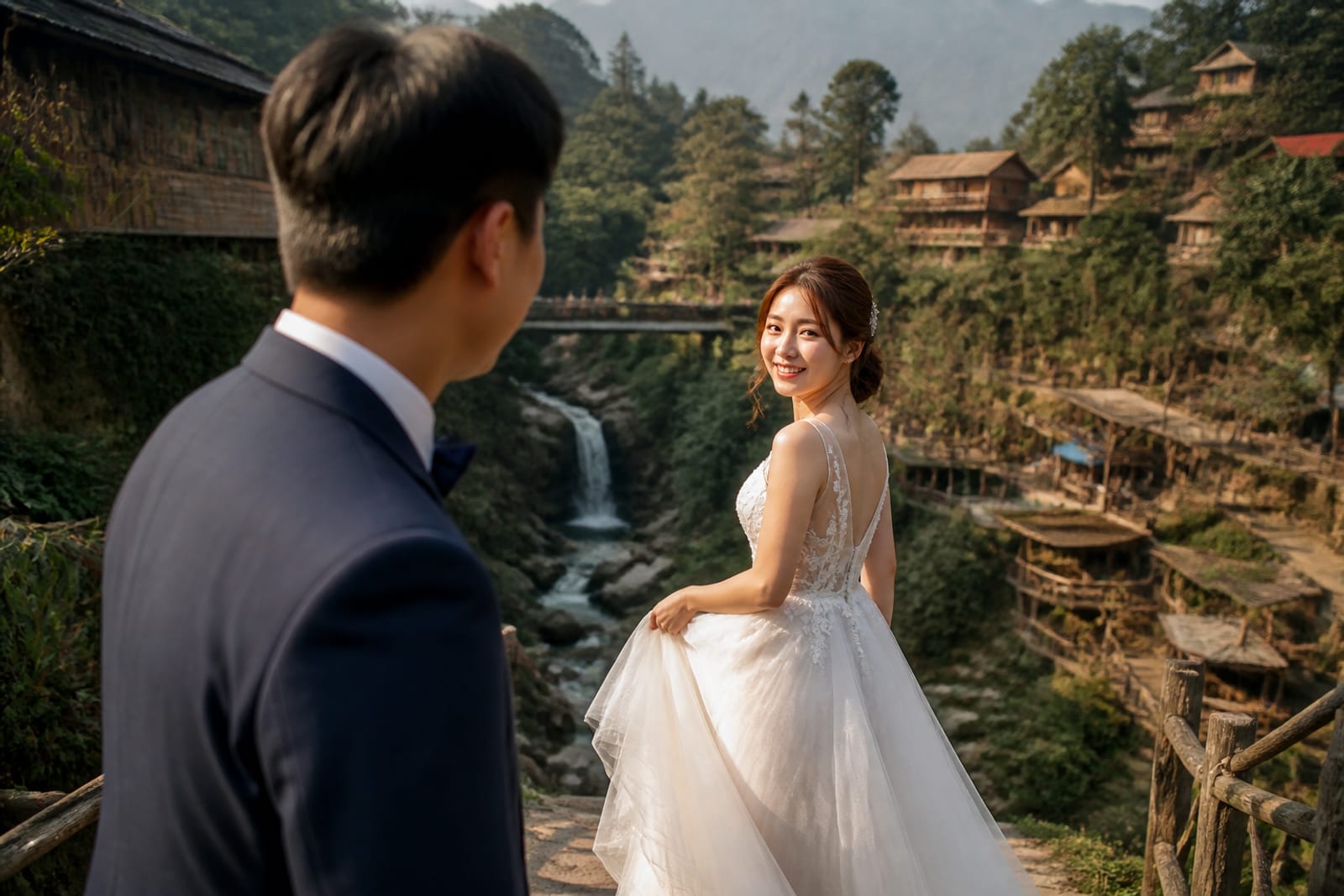
Anong season ang best para sa O Quy Ho pre-wedding photos?
March to April: cool air (8–15°C), low rainfall, mist still present at dawn but clears by mid-morning. October to November: similar conditions, often clearer skies, harvest-season golden light on lower rice terraces visible from the pass. December to February: frequent fog and grey overcast; sunrise and sunset merge into one grey band. May to September: afternoon thunderstorms, humidity, midday heat kills soft light, mist lifts too early. For reliably sharp, mist-wrapped frames with visibility, target March–April or October–November. Book your local photographer 4–6 weeks before to secure early-morning permits and a driver comfortable with the terrain.
Dapat na costume at styling tips para sa O Quy Ho?
Plan two outfits: one for the high pass (sturdy, layered, wind-resistant) and one for lower elevations (lighter, more flowing, better for soft late-afternoon light). Áo dài looks romantic at altitude but requires a fitted slip underneath to prevent wind-flattening and a small team to manage folds while walking. Modern dress or suit works if tailored close to the body; loose fabrics billow and distract. Hair: expect wind and mist to undo loose waves—consider half-up styles, braids, or clips. Makeup must be waterproof (mist will sit on your skin) and warm-toned to offset the cool light at dawn. Footwear: insulated, gripping shoes (not heels or open sandals—the asphalt is slick, slopes are real). Jewelry: keep it minimal and secure (one ring, earrings pinned, no dangling necklaces). If you shoot at dawn at O Quy Ho and then descend to Sapa town or nearby rice paddies for a second outfit, coordinate with your photographer and driver to minimize cold-related stress on the couple.
| Outfit choice | Best for | Light & season | Why it works |
|---|---|---|---|
| Áo dài (tailored, slip underneath) + heels | Traditional, romantic mood at sunrise | Oct–Nov, clear dawn | Silhouette reads well in mist; requires careful pinning on narrow passes |
| Modern dress + fitted blazer | Couples wanting less fuss, faster movement | Mar–Apr, early light or late afternoon | Wind-resistant, allows longer shooting windows lower on the pass |
| Lightweight dress (secondary) | Afternoon shoots lower elevation (Sapa town, terraces) | Any season, soft late-light | Fabric moves naturally; pairs well with local backdrop (flowers, wooden architecture) |
| Suit + simple shirt (groom/partner) | Any style; focus stays on light and composition | Any season | Close fit avoids billowing; darker tones absorb cool overhead mist beautifully |
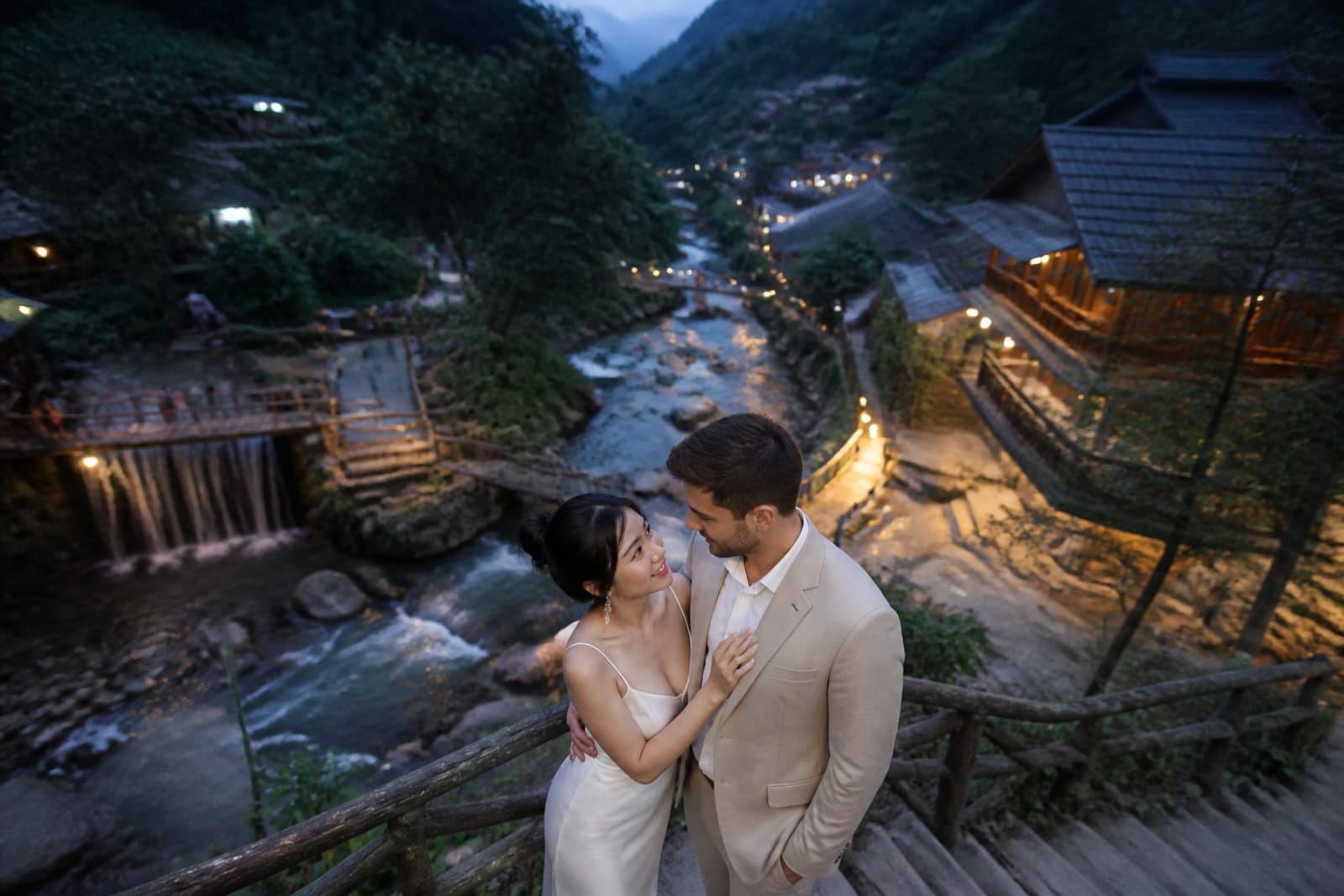
How to find at vet a local Sapa photographer for this shoot?
Cáo Studio operates in Hanoi and Saigon, not Sapa. For O Quy Ho shoots, search for Sapa-based photographers on Instagram (#SapaPhotography, #SapaWedding) or ask your hotel concierge. Key vetting steps: (1) Ask to see a full gallery of dawn shoots at O Quy Ho or similar high-pass locations—watch for sharp frames, mist handling, and safe framing (no reckless roadside poses). (2) Confirm they work with a guide and driver and won't push for illegal photo zones. (3) Request a detailed timeline: departure time, light forecast, backup plan if weather turns. (4) Ask about their altitude experience—do they know how to direct movement safely and quickly at 1,600 m? (5) Check if they deliver edited photos in 48 hours (reasonable for single-location mountain shoots) or weeks later. (6) Confirm they've shot in cold, misty conditions before—technical skills differ at dawn and at altitude. A photographer comfortable leading you confidently but calmly, who stops movement if traffic approaches, and who knows three good light spots on the pass is worth the vetting time.
What logistics & permits do you need before booking O Quy Ho?
O Quy Ho Pass itself does not require a formal photo permit, but your photographer and driver must follow traffic law: no stopping on the curve, no blocking lanes, no trespassing private land for sightseeing. A registered guide or local driver is essential—they know current rules, safe pull-off zones (rest stops, viewpoints), and weather changes. You'll need a private vehicle (sedan or SUV, not motorbike) for the couple, photographer, and crew. Early-morning departure (2–3 am from Sapa town) means arranging pickup from your hotel the night before and confirming your driver's phone number. If your photographer is based elsewhere (e.g., Hanoi), factor in their travel time and overnight accommodation—this adds to the overall cost. Check road conditions the day before (ask your hotel or driver) and have a backup date in mind. For pre-wedding shoots in Hanoi that you plan to combine with a Sapa trip, Cáo Studio can advise on timing and outfit; we don't shoot on the pass but can help you coordinate gear and styling before you travel north.
📸 Book on WhatsApp — pre-wedding photoshoot | 💄 Makeup & hair at your hotel
What to check before booking a pre-wedding shoot at O Quy Ho
- Photographer's mountain experience: ask for 3 past O Quy Ho dawn shoots, not just Sapa scenery photos.
- Weather backup: confirm they have a plan if mist doesn't clear or rain moves in (lower-elevation shots, rescheduling policy).
- Gear suited to cold: do they have weather-sealed camera, fast lenses for low-dawn light, and a tripod for mist-wrapped long exposures?
- Safe directing: watch a sample video or ask how they guide you to move on a narrow, trafficked pass without putting you at risk.
- Timeline and delivery: confirm shoot start, expected finish, and when you'll receive edited photos (48 hours is standard; longer waits for a single location are reasonable).
- Cost transparency: ask what's included (vehicle, guide, number of outfits, edited image count, album or prints) and what's extra (rush editing, additional outfits, travel for photographer from outside Sapa).
- Contract or confirmation: agree in writing (WhatsApp is fine) on date, time, location, deliverables, and cancellation terms in case of bad weather.
- Outfit trials: if shooting in áo dài, do a fit test with your photographer at your hotel before the 2 am wake-up; cold and wind expose loose seams.
📸 Book on WhatsApp — ao dai photoshoot | 🌸 Ideas & lookbook
If you're planning a broader pre-wedding photoshoot across Vietnam, consider pairing an O Quy Ho mountain shoot with a Hanoi session (Huc Bridge at sunrise, temple detail shots, cyclo ride on the Red River)—this gives you variety and safer logistics. Cáo Studio handles makeup, styling, and direction in Hanoi; we can brief you on what works for mountain light and chaperone your outfit choices before your Sapa trip.
---
FAQ
Kailangan ba ng permit para mag-shoot sa O Quy Ho Pass?
No formal photo permit is required for O Quy Ho itself, but you must follow traffic law and work with a registered guide. Your photographer and driver should know safe zones and current restrictions. Check locally the day before your shoot.
Ano ang best time ng umaga para sa sunrise shoot dito?
Arrive at the highest point (main hairpin curve) by 5:30–6:00 am. Mist often rises and light clarifies 6:30–7:30 am. Departure from Sapa town is typically 2:30–3:00 am. Confirm with your photographer—timing depends on weather and season.
Malamig ba talaga at kailangan ng special clothing?
Yes. Winter (Dec–Feb) can drop to 2–5°C; March–April and October–November average 8–15°C. Layers are essential: thermal underwear, a fitted sweater or fleece, and a windproof jacket. Áo dài requires a warm slip underneath. Insulated, non-slip shoes are mandatory.
Paano ko alam na ang photographer ay experienced sa O Quy Ho altitude shoots?
Ask to see a full gallery of past dawn shoots at the pass or similar high-elevation locations. Request a sample video of how they direct movement safely on narrow, trafficked curves. Confirm they've edited and delivered mountain-light photos before (mist and overcast require different post-processing).
Ano ang typical na duration ng shoot, at gaano kalayo ang walking?
Most shoots are 3–4 hours (5:00 am to 8:30 am). You'll walk 1–2 km total, repositioning between 3–5 safe spots on the pass. Movement is uphill with altitude—pace is slower and rests are frequent. Plan for physical effort comparable to a casual hike, not a stroll.
Pwede ko bang i-combine ang O Quy Ho shoot with a second location on the same day?
Yes. Many couples shoot at O Quy Ho (dawn, 5–8 am), descend to Sapa town or lower rice terraces (9 am–12 pm) for a second outfit and softer light, then rest. Coordinate closely with your photographer and driver. This extends the day significantly and adds fatigue.
Bakit hindi nag-shoot ang Cáo Studio sa O Quy Ho?
Cáo Studio operates in Hanoi, Ho Chi Minh City, and Hoi An. Mountain passes like O Quy Ho require specialized local knowledge, guides, and logistics that are best handled by photographers based in Sapa. We advise couples on styling, gear, and planning; we direct you to vetted local professionals for the shoot itself.
Soalan lazim
Kailangan ba ng permit para mag-shoot sa O Quy Ho Pass?
No formal photo permit is required for O Quy Ho itself, but you must follow traffic law and work with a registered guide. Your photographer and driver should know safe zones and current restrictions. Check locally the day before your shoot.
Ano ang best time ng umaga para sa sunrise shoot dito?
Arrive at the highest point (main hairpin curve) by 5:30–6:00 am. Mist often rises and light clarifies 6:30–7:30 am. Departure from Sapa town is typically 2:30–3:00 am. Confirm with your photographer—timing depends on weather and season.
Malamig ba talaga at kailangan ng special clothing?
Yes. Winter (Dec–Feb) can drop to 2–5°C; March–April and October–November average 8–15°C. Layers are essential: thermal underwear, a fitted sweater or fleece, and a windproof jacket. Áo dài requires a warm slip underneath. Insulated, non-slip shoes are mandatory.
Paano ko alam na ang photographer ay experienced sa O Quy Ho altitude shoots?
Ask to see a full gallery of past dawn shoots at the pass or similar high-elevation locations. Request a sample video of how they direct movement safely on narrow, trafficked curves. Confirm they've edited and delivered mountain-light photos before (mist and overcast require different post-processing).
Ano ang typical na duration ng shoot, at gaano kalayo ang walking?
Most shoots are 3–4 hours (5:00 am to 8:30 am). You'll walk 1–2 km total, repositioning between 3–5 safe spots on the pass. Movement is uphill with altitude—pace is slower and rests are frequent. Plan for physical effort comparable to a casual hike, not a stroll.
Pwede ko bang i-combine ang O Quy Ho shoot with a second location on the same day?
Yes. Many couples shoot at O Quy Ho (dawn, 5–8 am), descend to Sapa town or lower rice terraces (9 am–12 pm) for a second outfit and softer light, then rest. Coordinate closely with your photographer and driver. This extends the day significantly and adds fatigue.
Bakit hindi nag-shoot ang Cáo Studio sa O Quy Ho?
Cáo Studio operates in Hanoi, Ho Chi Minh City, and Hoi An. Mountain passes like O Quy Ho require specialized local knowledge, guides, and logistics that are best handled by photographers based in Sapa. We advise couples on styling, gear, and planning; we direct you to vetted local professionals for the shoot itself.