Cáo Studio · Przewodniki po sesjach zdjęciowych w Wietnamie · Sesja zdjeciowa w ao dai w Wietnamie – poradnik i rezerwacja
Ao dai couple photos at Long Bien Bridge — Hanoi's best light and how
Zespół Cáo Studio · Hanoi · 2026-10-03
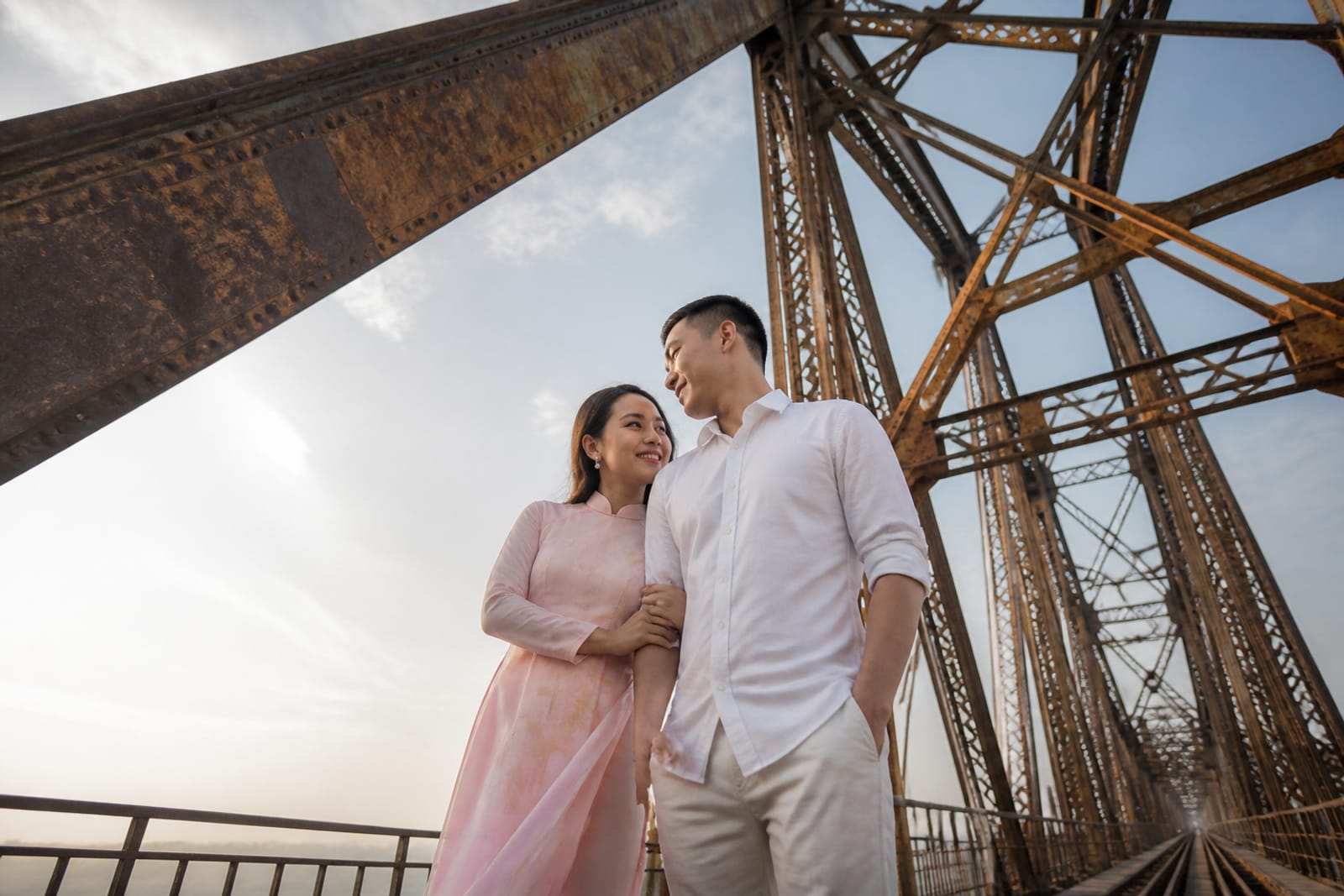
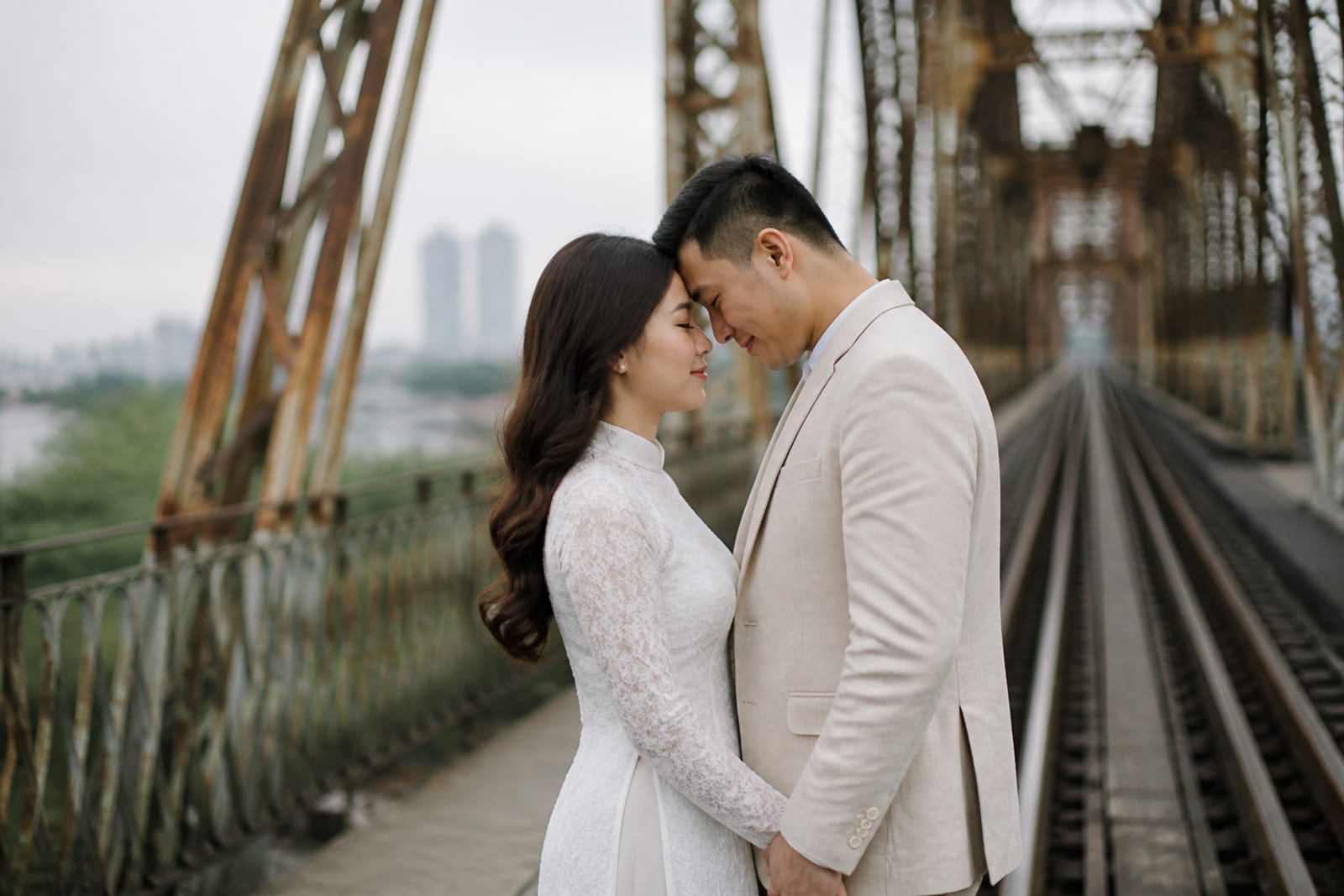
Long Bien Bridge is a 100-year-old steel span that photographs best in the 30 minutes after dawn (around 6–6:30 am in autumn, 5:30–6 am in late spring). The red ao dai and the bridge's iron grid create depth; the river below adds scale. Cáo Studio runs couple ao dai shoots here by booking the session at least two weeks ahead—the team arrives with styling, hair and makeup, and a director who frames the walk, not poses. Plan October to early November for consistent light and manageable crowds; avoid May–September (heat, haze, afternoon storms). The session takes 90–120 minutes, ending before 8 am when tour buses arrive. Budget time for: outfit change on location (10 min), makeup touch-ups (5 min), three shot series (wide, medium, detail), and a walk-out-of-frame sequence.
Long Bien Bridge opens at dawn for couple ao dai photography because the light is soft, the crowds are absent, and the geometry—arches, cables, the river—turns a moment into a frame. Here's the director's perspective on shooting it, season by season, and how to avoid the mistakes most couples make.
Why does Long Bien Bridge work for couple ao dai photos?
The bridge is a working steel structure, not a ruin or temple—it frames modern Vietnam. An ao dai's silk and the bridge's industrial rust create contrast; the iron grid lets light through, sculpting shadow on skin and fabric. From the pedestrian walkway, you shoot toward the city or downriver, with the river as a base layer. The scale makes two people look intimate, not small. Morning side-light (from the east, 6–6:30 am in autumn) skims the dress and defines the iron, avoiding the flat noon glare that flattens texture. Most couples photograph best when they walk, not stand—the team cues a slow walk toward the far span, framing the dress trailing, the couple's shoulders almost touching. A posed stance reads as tense; a walk reads as real.
📸 Book on WhatsApp — ao dai photoshoot
When is the light best at Long Bien Bridge by season?
| Season | Light start time | Why it works | Why it's tricky | Best ao dai color |
|---|---|---|---|---|
| Oct–Nov | 6:00–6:30 am | Soft, consistent side-light; cool air; low humidity | Occasional drizzle; book 2+ weeks ahead | Red, burgundy, jewel tones |
| Dec–Feb | 6:15–7:00 am | Golden angle; dry; rare clouds | Overcast 3 days in 5; pale light; cold hands | Pale pink, cream, gold |
| Mar–Apr | 5:45–6:15 am | Quick rise; long golden hour | Haze, humidity; drizzle risk; outfit clings | Pastels, blush, white |
| May–Sep | 5:15–5:45 am | Early light, brief quality | Heat, pre-storm clouds, high humidity; light fades into haze by 6:30 am | Bright jewel, emerald (shows in haze) |
Autumn (Oct–Nov) is the industry standard—Cáo Studio prioritizes couple ao dai bookings here because overcast skies are rare, the air is clear, and the 6 am light hits the eastern span at a 30-degree angle that reveals texture. December to February is colder (about 10–15°C by 6 am); bring an outer layer for the couple to wear between shots. Spring (Mar–Apr) is humid and unpredictable; drizzle can occur. Summer (May–Sep) requires an earlier start (5:15 am) because haze rises and flattens light by 7 am. If you're visiting in March or July, ask Cáo Studio on WhatsApp to confirm current weather patterns—light timing shifts by 15–20 minutes depending on cloud cover.
What ao dai style and color shows best on Long Bien Bridge?
The bridge's palette is rust, grey steel, and water—a muted, industrial stage. A bright or jewel-tone ao dai (red, burgundy, emerald, sapphire) reads as a focal point; pale ao dai (cream, pale pink, gold) merges with morning sky if it's overcast. Most couples choose a single ao dai for Long Bien (the walk is only 5–10 minutes), then change into a second color or style at a nearby hotel or the studio's Hanoi base afterward. The dress should fit snug through the chest and shoulders so it moves with the body—a loose or overly stiff ao dai reads as costume, not worn. Ask the tailor or rental studio to fit the áo body (the tunic) with 2–3 cm of ease; the pants (quần) should sit at the natural waist and taper slightly at the ankle so they don't catch on the bridge's worn edges. Cáo Studio's ao dai rental service can ensure fit before the shoot.
The couple's coordinating outfit matters too. If the bride wears red, the groom's groom's áo (shirt/tunic) can be cream, pale gold, or soft grey—high contrast reads better in dawn light than matching colors. Avoid prints on the groom's áo; a solid, fine weave (silk, linen) photographs cleaner. If the couple is non-binary or both in áo, choose complementary shades (one warm, one cool, or same tone in different saturation). Avoid white or cream ao dai for the groom unless the bride's dress is notably darker—the bridge's metal reflects light and can cause exposure confusion in post.
How does a Cáo Studio session run at Long Bien Bridge?
The team (photographer, makeup artist, and stylist) meets the couple at a nearby hotel at 5:30 am in autumn, earlier in summer. Hair and makeup take 25–30 minutes; the couple changes into the ao dai (10 minutes). At 5:55 am, the team walks to the pedestrian entrance and frames the first wide shot—the couple walking toward the far span, the bridge's geometry framing them. Typically, three shot types occur: (1) wide, showing the couple's full body and the arch behind them; (2) medium, focusing on the waist up as they walk; (3) detail, close-ups of the dress's silk, the groom's hands, the river reflected in their eyes. By 7 am, the team steps off the bridge before the first tour buses arrive. The couple then has a choice: change into a second ao dai and repeat the shoot at another Hanoi location (Huc Bridge, the Temple of Literature, or Phong Nha cave—if traveling), or return to the hotel for breakfast and a costume change into Western wedding attire for a hotel-based photo session. Cáo Studio's couple & family photoshoot page outlines how back-to-back locations work; confirm the plan when you book.
The session includes one direction cue: "Walk slowly, look at each other, don't slow down." The couple does not pose; they do. This distinction is key. A posed couple on a bridge reads as formal; a couple walking and the photographer catching them mid-stride, mid-glance reads as documentary. By 8 am, the team has 150–200 frames; editing begins within 24 hours.
What are the biggest mistakes couples make when booking Long Bien?
First: booking without confirming the bridge's access status. Local authorities periodically restrict pedestrian access for maintenance or safety; Cáo Studio checks the current status before confirming a date. Do not assume access is guaranteed—ask on WhatsApp at least 10 days before your shoot.
Second: arriving in the rainy season (May–Sep in Hanoi) without flexibility. A 6 am downpour voids the shoot; rescheduling requires two weeks' notice. If you're visiting in June or July, confirm with Cáo Studio whether a rain date or location swap (indoors, hotel, or a sheltered temple) is possible before you commit.
Third: underestimating the cold in winter (Dec–Feb). By 6 am, the bridge's metal is cold, hands numb, and goosebumps show on skin. Ask the team to bring a lightweight robe or shawl the couple can wear between shots.
Fourth: choosing an ill-fitting ao dai. A dress that's too loose reads as borrowed; too tight restricts movement and walking. Have the dress fitted 5–7 days before the shoot, not the day before—last-minute alterations often misalign seams. Cáo Studio's ao dai rental fits on-site, so book the rental when you confirm the photoshoot date.
Fifth: not budgeting travel time. The bridge is in the Old Quarter; taxis or grab drivers are slow in rush hour (7–9 am). If your session is at 6 am, the team meets you by 5:30 am. Plan your hotel location within 5 km of Long Bien to avoid last-minute delays.
How much does a couple ao dai shoot at Long Bien cost, and what's included?
Pricing varies by season (autumn bookings cost more due to demand), number of locations, and outfit changes. Cáo Studio sends a custom quote on WhatsApp after you confirm your travel dates and vision. The quote includes all styling, hair, makeup, photography, and editing—one team, one message, no separate vendors. Ask on WhatsApp whether the quote covers one location (Long Bien only) or two (Long Bien + another Hanoi spot), and how many outfit changes are bundled. Some couples add a proposal or anniversary session the same morning; ask if a package discount applies.
---
What to check before you book
- Confirm Long Bien Bridge access — Ask Cáo Studio on WhatsApp whether the pedestrian walkway is open on your dates. Access is sometimes restricted without notice.
- Fit your ao dai 5–7 days before — If renting, confirm fit with Cáo Studio's rental service at least one week ahead. Last-minute alterations can delay the shoot.
- Plan your hotel location — Choose a hotel within 5 km of the bridge so the team can collect you by 5:30 am without delays. Traffic in Hanoi's Old Quarter is unpredictable before 6:30 am.
- Book at least two weeks in advance — Autumn (Oct–Nov) fills quickly. Spring and winter have more availability but less predictable light.
- Ask about location swaps — If the forecast shows rain or the bridge is unexpectedly closed, confirm with Cáo Studio that Huc Bridge, the Temple of Literature, or another Hanoi location is available as a backup.
- Confirm what's in the package — Ask on WhatsApp: How many edited photos? One outfit or two? Hotel pickup included? One location or flexibility to add a second? Delivery time for edited images? Exact inclusions are confirmed when you book.
---
Related services
If you're a couple planning a longer photoshoot, Cáo Studio's pre-wedding & elopement sessions often combine Long Bien with a second location and a costume change (ao dai in the morning, Western attire later). For families visiting Hanoi, family photoshoots can include a couple portrait segment at the bridge. If you're staying at a hotel in the central district, makeup & hair can be done in your room before departure.
---
📸 Book on WhatsApp — ao dai photoshoot
FAQ
Can we book Long Bien Bridge for a sunset shoot instead of dawn?
Sunset at Long Bien (around 5–5:30 pm in autumn) is backlit and golden, but tour buses and evening commuters crowd the walkway. The light is softer than noon but flatter than dawn. Cáo Studio does not recommend sunset here; Huc Bridge (Hoan Kiem Lake area) is better for golden hour because it's pedestrian-only on weekend evenings. Ask on WhatsApp about sunset options.
What if it rains on our booked shoot date?
Cáo Studio does not shoot in heavy rain. If the forecast shows rain, the team can reschedule within the same week or month if dates align, or offer a location swap (hotel, sheltered temple, or an indoor studio space). Confirm the studio's rain policy when you book on WhatsApp—rescheduling terms depend on how far ahead you booked and the season.
Do we need a permit to photograph at Long Bien Bridge?
Long Bien is open to the public for personal photography. Commercial or very large wedding crews sometimes need to check with local authorities; Cáo Studio (shooting editorial-style couple portraits) does not require a permit. If you're unsure, the team can confirm the current status on WhatsApp.
How many edited photos do we receive from a Long Bien shoot?
The exact number and delivery timeline are confirmed on WhatsApp when you book. Cáo Studio delivers edited images within 48 hours of the session, plus a short vertical film. Ask whether the quote includes one location or flexibility to add a second spot (e.g., Huc Bridge or Temple of Literature) on the same morning.
Can we add a Western suit or dress change at Long Bien, or do we need a second location?
Changing outfits on the bridge takes 10–15 minutes and requires a private space (usually a nearby hotel room or the studio's base). Most couples keep the ao dai for Long Bien and change locations for a second shoot. Ask Cáo Studio on WhatsApp whether a two-location morning (ao dai at Long Bien, Western attire elsewhere) is possible—pricing and timing depend on the distance between sites.
What should we wear under an ao dai for a photoshoot?
Wear a thin, breathable undershirt (or nothing if you're comfortable and the ao dai is opaque). The áo body (tunic) should sit snug; loose undergarments show as wrinkles under the silk. For the quần (pants), wear smooth, neutral underwear—no visible lines. In winter, a thermal long-sleeve layer keeps you warm without adding bulk. Ask Cáo Studio's makeup & hair service or rental team for specifics when you book.
Najczęstsze pytania
Can we book Long Bien Bridge for a sunset shoot instead of dawn?
Sunset at Long Bien (around 5–5:30 pm in autumn) is backlit and golden, but tour buses and evening commuters crowd the walkway. The light is softer than noon but flatter than dawn. Cáo Studio does not recommend sunset here; Huc Bridge (Hoan Kiem Lake area) is better for golden hour because it's pedestrian-only on weekend evenings. Ask on WhatsApp about sunset options.
What if it rains on our booked shoot date?
Cáo Studio does not shoot in heavy rain. If the forecast shows rain, the team can reschedule within the same week or month if dates align, or offer a location swap (hotel, sheltered temple, or an indoor studio space). Confirm the studio's rain policy when you book on WhatsApp—rescheduling terms depend on how far ahead you booked and the season.
Do we need a permit to photograph at Long Bien Bridge?
Long Bien is open to the public for personal photography. Commercial or very large wedding crews sometimes need to check with local authorities; Cáo Studio (shooting editorial-style couple portraits) does not require a permit. If you're unsure, the team can confirm the current status on WhatsApp.
How many edited photos do we receive from a Long Bien shoot?
The exact number and delivery timeline are confirmed on WhatsApp when you book. Cáo Studio delivers edited images within 48 hours of the session, plus a short vertical film. Ask whether the quote includes one location or flexibility to add a second spot (e.g., Huc Bridge or Temple of Literature) on the same morning.
Can we add a Western suit or dress change at Long Bien, or do we need a second location?
Changing outfits on the bridge takes 10–15 minutes and requires a private space (usually a nearby hotel room or the studio's base). Most couples keep the ao dai for Long Bien and change locations for a second shoot. Ask Cáo Studio on WhatsApp whether a two-location morning (ao dai at Long Bien, Western attire elsewhere) is possible—pricing and timing depend on the distance between sites.
What should we wear under an ao dai for a photoshoot?
Wear a thin, breathable undershirt (or nothing if you're comfortable and the ao dai is opaque). The áo body (tunic) should sit snug; loose undergarments show as wrinkles under the silk. For the quần (pants), wear smooth, neutral underwear—no visible lines. In winter, a thermal long-sleeve layer keeps you warm without adding bulk. Ask [Cáo Studio's makeup & hair service](/pl/makeup-and-hair) or rental team for specifics when you book.