Cáo Studio · คู่มือถ่ายรูปที่เวียดนาม · Ao Dai Photoshoot Vietnam: How to Choose & Book
Áo Dài Couple Photos at Da Lat Railway Station: Light, Season & Local
ทีม Cáo Studio · ฮานอย · 2026-10-03
Da Lat Railway Station suits áo dài couple shoots because its yellow-ochre colonnades frame traditional dress against highland mist—best shot at sunrise (6:30–7:30 am) when side light lifts the fabric and fog still clings to the pine hills behind. The station lies at roughly 1,500 m elevation in the central highlands; December to April brings cool, dry mornings with clean light; May–November brings afternoon showers but often clears by dawn. Crowds arrive around 8 am, so an early shoot means soft light, empty frames, and no tourist jostling. Cáo Studio does not operate in Da Lat—you'll need to hire a local photographer or travel to Hanoi for a directed áo dài photoshoot where the team handles outfit, hair, makeup and camera together. Permit the station visit in advance (check with your hotel or guide) and scout the light angle the day before to confirm which archway suits your áo dài color.
Why Da Lat Railway Station Works for Áo Dài Couple Shots
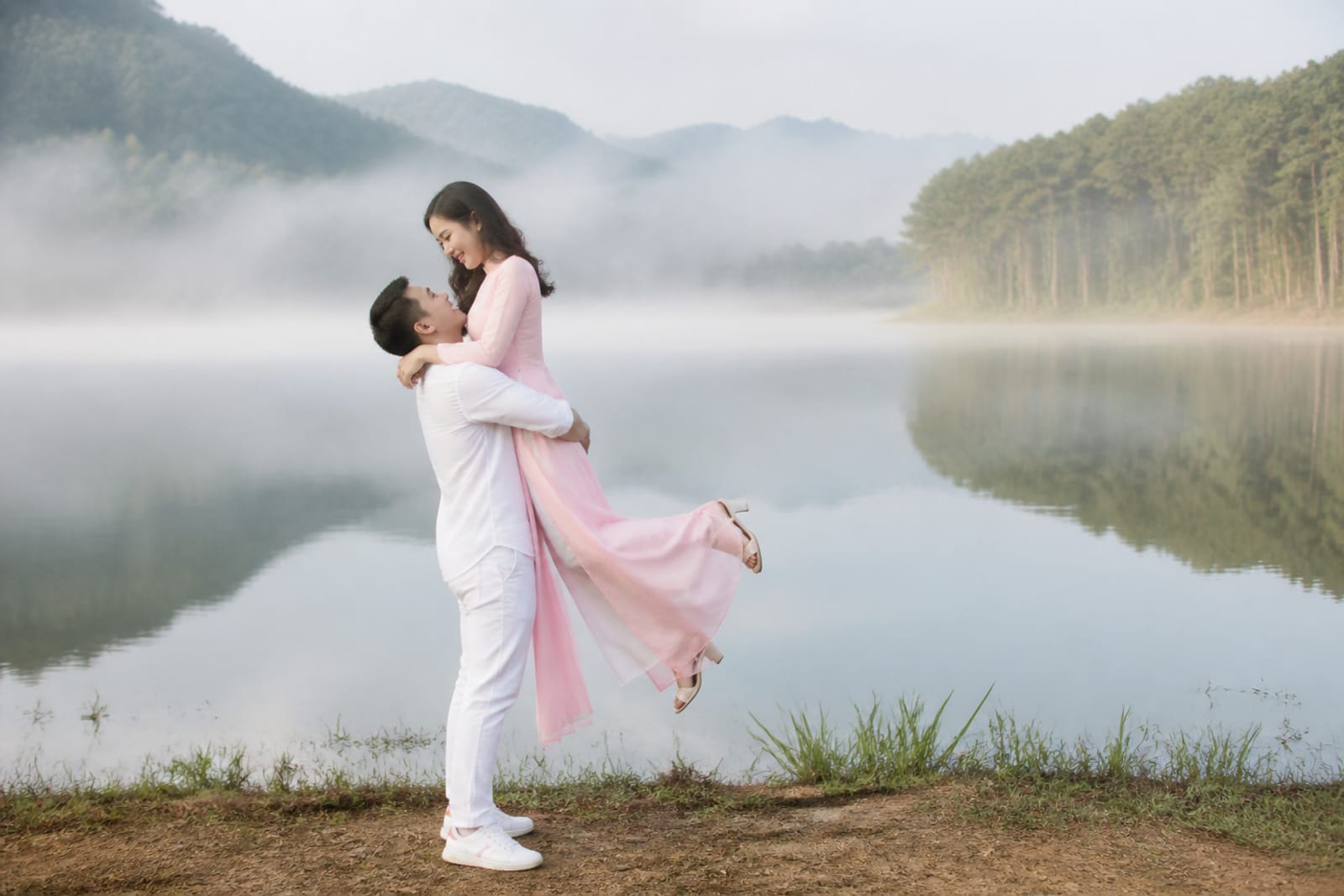
Da Lat's Colonial-era railway station—abandoned since 1964 but restored as a heritage site—has become the highland couple-shoot hotspot for one reason: the light is architectural. The long row of ochre-painted stone pillars and arches creates a natural corridor that catches early sunlight at a low, forgiving angle, and the misty pine forest visible beyond the platform gives depth without clutter. Unlike Hoi An's crowded Ancient Town or Hanoi's urban backdrops, the station feels intimate—the structure frames just you two. The cool highland air (typically 15–20°C in winter, 18–25°C year-round) keeps áo dài fabric crisp; there's no sticky humidity to wilt the embroidery or flatten your hair. For couples, this matters: the outfit photographs sharper, colors hold true, and sweat isn't a worry during a 30-minute walk-through shoot. The drawback is access—the station requires a permit (held by your hotel, guide, or the shoot coordinator) and sits 15 km from Da Lat town, so a photoshoot there means coordinating transport, timing the sunrise, and hiring someone with both da Lat expertise and couple-shoot skill.
📸 Book on WhatsApp — ao dai photoshoot | 🌸 Ideas & lookbook
How to Choose Between Shooting Here vs. a Hanoi or Saigon Team
Shooting at Da Lat Railway Station requires hiring a local photographer because Cáo Studio operates only in Hanoi, Ho Chi Minh City, and Hoi An by appointment. Here's the practical difference:
| Option | Best For | Light & Season | Why It Works |
|---|---|---|---|
| Local Da Lat photographer | Couples already in Da Lat; want to maximize one location; prefer to avoid travel to shoot | Dec–Apr mornings (6:30–7:30 am); mist + side light. Rainy season mornings often clear. | No team travel cost; instant local scout knowledge; can build relationship before shoot. Risk: quality varies; no outfit/makeup coordination. |
| Hanoi team (Cáo Studio) | Couples adding a dedicated couple photoshoot to a Hanoi stay; want one coordinated team; prioritize post-production speed | Hanoi: Dec–Feb cool + grey, best for soft light; Mar–Apr warm + clear; May–Sep hot + humid. | One team (photographer + hair + makeup) ensures cohesion; 48-hour turnaround on edits; familiar with directing couples into movement, not poses. |
| Saigon base option | Couples in South Vietnam; want Cáo Studio's direction; then add Da Lat as side shoot with local photographer | Saigon team can advise; Cáo Studio Saigon base offers pre-shoot consultation. Then hire local in Da Lat. | Hybrid: get one directed session in Saigon, then shoot Da Lat with local photographer armed with direction from Cáo team. |
The real decision: if you're already in Da Lat for a 2–3 day stay and áo dài is one part of your trip, hire locally and give yourself 2–3 hours at the station (dawn scout, breakfast in town, midday return to shoot arches in side light, 3 pm mist chase if clouds allow). If you're building a dedicated couple photoshoot as a travel highlight—with outfit choice, hair styling, makeup, and a full day of locations—travel to Hanoi or work with the Saigon team to get Cáo Studio's one-team workflow.
What to Check Before You Book a Local Da Lat Photographer
When vetting a local photographer for the station, these details separate real skill from tourist-trap booking:
- Have they shot the station before sunrise? Ask to see 5–10 dawn shots of couples or individuals at the arches. Look for soft, directional light from the side (not flat midday sun). If their portfolio shows bright overhead shots, they're not experienced with golden-hour work.
- Do they have a permit or guide relationship? The station requires advance access. A good local photographer has this built into their process—not something you arrange yourself the night before.
- How do they direct movement? Ask what they tell couples to do. "Stand in front of the arch and smile" is a red flag. Good answers sound like: "Walk toward the light together, then look at each other as you pass the middle pillar" or "Stand with the mist behind you, she adjusts his áo groom collar while he looks out toward the forest." Movement + a small gesture beats posed stillness every time.
- Can they deliver a short film or just stills? Cáo Studio includes a vertical film with every shoot (you can see examples on the lookbook). Ask if your local photographer does a 15–30 second edit—trending now and shareable. If not, that's fine; just know what you're getting.
- How many shots do you receive, and when? Agree on a number and edit timeline upfront. A common da Lat benchmark is 40–60 edited shots within 5–7 days, but confirm. (Cáo Studio delivers edits within 48 hours; a local photographer may take longer—this is a cost factor, not a quality one.)
Check their Instagram feed for at least 10 recent couple shoots. If every photo looks the same (same poses, same light, same framing), move on. If you see variety in light, genuine interaction, and attention to fabric and fabric movement, you've found someone who understands áo dài work.
💄 Makeup & hair at your hotel | 📸 Book on WhatsApp — ao dai photoshoot
Best Light Times and Season for Da Lat Couple Áo Dài Photos
Da Lat's highland climate is its own weather system. The station sits in the pine forests above the main town; mist rolls in overnight and usually clears by mid-morning. This shapes every shoot window:
December–February (cool, dry): Ideal season. Mornings are crisp (12–18°C), fog hugs the hillside until 7:30–8 am, and side light comes in clear and low. Plan to arrive at 6:30 am; shoot from 6:45–8 am while the mist is still visible behind the arches but the pillars catch gold-hour light. No rain. Wind is gentle.
March–April (warming, still dry): Light is excellent but arrives earlier (6 am side light comes in strong). Temperature climbs to 20–25°C by 8 am. Mist thins faster. Shoot 6:15–7:45 am to catch both mist and clean light. Ideal for áo dài fabric—no humidity to flatten embroidery.
May–September (rainy, afternoon showers): Mornings are usually clear but can be hazy. Afternoon downpours are common (2–5 pm). Shoot at dawn (6:30–7:30 am) before clouds build. Humidity rises, so fabric can feel limp, but mist at sunrise is often thicker and moodier. Fewer tourists. Risk: a sudden early shower can force cancel; coordinate backup date with photographer.
October–November (typhoon tail, floods possible): Risky. The central highlands can see heavy rain from coastal typhoons. October especially brings downpours. If you must shoot, dawn is often clear, but arrange a fully flexible booking with a local photographer who understands the region's microclimate.
Light direction specifics: The station's arches run roughly north–south. Sunrise comes from the southeast (around bearing 120°), so the station's east-facing side gets the warm side-light on your faces and the áo dài fabric. Shoot on the platform on the east side of the pillars, not the west (which gets backlit and silhouetted). By 8 am, the sun climbs, and that magic corridor light flattens; midday (11 am–3 pm) is unusable for couple shots (hard shadows, blown highlights on white áo dài, red fabric turns flat). Late afternoon (4–5:30 pm) can work if the sun is lower and you position on the west platform, but you'll need to move quickly—the light window is 20 minutes.
The golden rule: if you're hiring a local photographer, agree on a 6:30–8 am window and make that non-negotiable. If the photographer suggests 10 am or midday "because it's easier," they don't shoot áo dài professionally.
What to Wear Under Your Áo Dài and How to Prepare
Áo dài couple shoots require more gear prep than you'd expect, especially in a cool highland morning:
- Undergarments: Wear a fitted, seamless white or nude slip or leggings under the áo dài. The fabric is thin silk or silk-blend; any bra line, panty line, or bunching shows in daylight and close-ups. A slip also keeps you warm at 15°C—crucial for standing still during photos.
- Groom's áo: Make sure the tunic fits through the shoulders; a tight fit restricts movement and shows stress wrinkles in photos. The áo groom is usually tailored tighter than the áo bride, but it should still allow a full arm swing when he walks. Test a walk-through the day before.
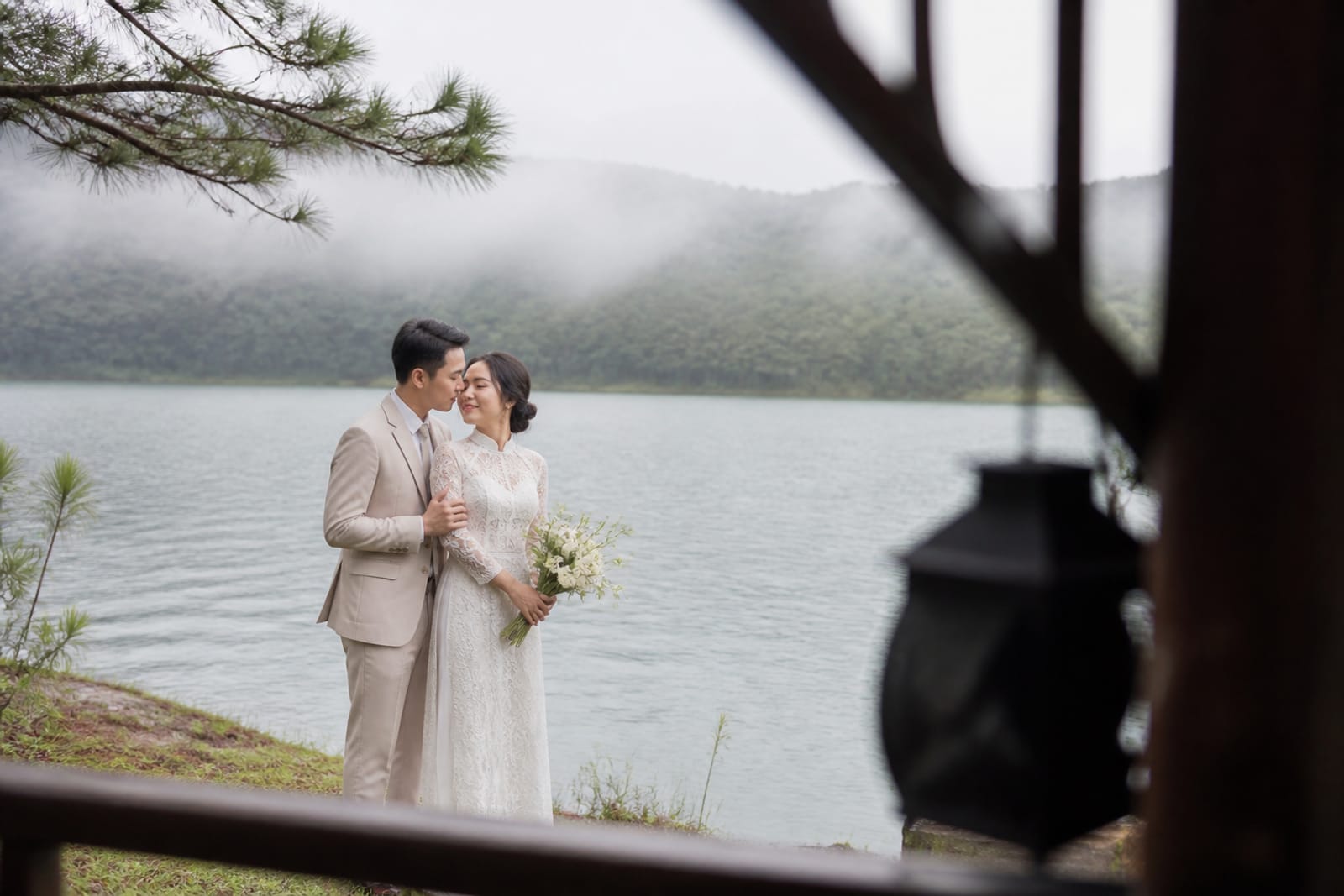
- Bride's áo: A well-fitted áo drapes from shoulder to toe with a slit up the sides. Sit, stand, and walk in it before the shoot to ensure the slit opens gracefully (not twisted) and the fabric doesn't bunch at the hip. The back seam should run dead-center, not twisted. If the tailor made it too snug at the waist, ask them to add gussets—a photographer will see a pinched waist in every shot.
- Footwear: Wear flat sandals or soft ballet flats (not sneakers—they show in wide shots). The station platform has some uneven stone; test your shoes on stairs the day before to avoid a twisted ankle mid-shoot.
- Hair and makeup: Cool highland air is actually an advantage—makeup won't run with sweat, and hair stays set. But arrive with hair already styled (not damp). If you're hiring a local photographer only, book a makeup artist separately or arrange with your hotel. If you're in Hanoi, Cáo Studio includes makeup and hair as part of the package.
- Underarm and neckline check: Áo dài are sleeveless; make sure your arms are comfortable with a sleeveless fit (especially in cool weather). The neckline is modest but high; no bra straps should show. Do a final mirror check before leaving your hotel.
For couples, this takes time. Arrive at your accommodation with the áo dài the day before, do a full fit-and-walk test, and have the photographer see a photo of you both in the outfit via WhatsApp or email. This way, if something needs tailoring, there's time to fix it.
🌸 Ideas & lookbook | 📸 Book on WhatsApp — ao dai photoshoot
Logistics: Getting to the Station, Permits, and Timing Your Shoot
Da Lat Railway Station sits on Trai Mat Road, roughly 5 km south of Da Lat's central market and about 15 minutes by car or scooter (depending on traffic and road condition). Here's the step-by-step:
- Day before: Contact your hotel or a local guide to arrange a visit permit. The station is a heritage site, and entry requires advance notice (not a cost barrier, just a courtesy). Ask the permit holder about current opening times—these can shift seasonally.
- Transport: Book a private driver or hire a scooter the morning of the shoot. If you're shooting at 6:30 am, leave your hotel by 6 am. Factor in 15 minutes of driving, 5 minutes of finding parking, and 5 minutes of walking to the platform. Arrive by 6:20 am.
- Scout and timing: On the day before the shoot, visit the station at the same time of day (e.g., if shooting at 6:45 am, scout at 6:45 am) to see where the light falls and which arch frames best. Take a phone photo or two. This 10-minute visit saves 30 minutes of wasted angle-hunting on shoot day.
- Photographer arrival: Confirm with your photographer the night before: exact meeting spot (gate? platform? which pillar?), what they'll bring (how many lenses, reflector or not, backup battery), and their backup plan if weather turns. A good photographer has already been there at that hour and knows the light.
- Shoot window: Plan for 45–60 minutes of actual shooting. The first 20 minutes is scouting frames and taking test shots. The next 30 minutes is directing you through movement (walking, looking at each other, detail shots of fabric and hands). The last 10 minutes is a location move (maybe to the platform's far end if light shifts) or a final outfit check and reset.
- Exit by 8 am: After 8 am, tourists start arriving, and the mist burns off. The light quality drops, and you'll spend more time asking people to move out of frame than actually posing. A professional photographer will naturally wrap by 7:45–8 am.
- After the shoot: If you're working with a local photographer, ask when you can expect the first edited photos (often 3–7 days). If you're adding this to a Hanoi or Saigon shoot, coordinate with Cáo Studio on how to integrate the Da Lat images into the full album.
One common mistake: arriving late because "the light will be better in an hour." It won't. The station's best light window is 6:45–7:30 am, full stop. After that, the sun is too high, the mist is gone, and you're fighting harsh shadows.
Hiring a Local Da Lat Photographer: Vetting, Price Factors, and Red Flags
Since Cáo Studio does not operate in Da Lat, your best path is to hire a local photographer experienced in áo dài and highland light. Here's how to avoid common pitfalls:
Where to find them:
- Ask your hotel or guesthouse—they often have trusted referrals and may have a relationship with a photographer (which can speed permit access).
- Search Instagram for "Da Lat photographer couple" or "áo dài Da Lat" and look at the most recent posts. Follow anyone with 5+ couple áo dài shoots in the past 6 months.
- Check Google Maps reviews for "Da Lat photography" or "Da Lat couple shoot"—real reviews mention light, timing, and delivery.
What to ask upfront:
- "Can you shoot at Da Lat Railway Station at 6:30 am, and do you already have access/a permit relationship?" (Not "Do you know the station?"—yes/no isn't enough.)
- "Show me 10 shots of couples in áo dài. What was the light direction and time of day for each?" (A professional knows and can explain.)
- "How many edited shots will I receive, and by when?" (Typical: 40–80 shots within 5–7 days; agree on a number and stick to it.)
- "Do you do any video or just stills?" (Video is nice-to-have, not essential, but good to know.)
- "What's your process if it rains?" (Flexibility matters; a photographer who cancels outright isn't local-smart.)
Cost factors (not amounts—ask on WhatsApp for exact quotes):
- Season: December–April is peak (cool, dry, high demand). May–November is off-season (rain risk, but fewer tourists and sometimes lower rates). Local photographers may adjust rates by season.
- Shoot length: 1-hour shoots are standard for station-only sessions. Longer shoots (2–3 hours with multiple locations) will cost more than a single-location 45-minute window.
- Outfit count: One áo dài couple outfit is standard. If you want to change outfits, timing expands, and the photographer may charge extra (or build it into a half-day rate).
- Delivery timeline: Faster edits (48 hours) typically cost more than 5–7 day turnaround. Decide what matters to you.
- Retouching level: Ask if their quote includes basic edits (color, crop, exposure) or extensive retouching (blemish removal, background cleanup). Standard áo dài photographer edits include color correction and exposure adjustment; heavy retouching is sometimes an add-on.
Red flags:
- "I can shoot any time—midday is fine, the light doesn't matter." (It does. Walk away.)
- "No sample photos of áo dài—only general couple or wedding shots." (Áo dài is a specific craft. A photographer experienced with it will have examples.)
- "I'll give you 200 unedited photos in RAW files." (Unedited RAW files are not a finished product. Expect edited JPEGs, not raw data.)
- "The price includes unlimited revisions and reshoots." (Vague. Agree on a number of edits and what constitutes a reshoot.)
- No WhatsApp or fast communication. (A good local photographer responds within a few hours, especially the day before the shoot.)
How to confirm before paying:
- Ask for the photographer's WhatsApp number and confirm they respond within 2–4 hours.
- Send them the exact date, time (6:30 am), and location (Da Lat Railway Station, Trai Mat Road).
- Ask them to confirm they've shot at that location at that hour before.
- Request a written agreement (even a WhatsApp message) on: shoot date/time, location, outfit count, number of edited photos, delivery date, and cost. Screenshots count.
- Pay a deposit (usually 30–50% of the total) upfront; balance due on delivery of edited photos.
If the photographer hesitates at any of these steps, they're not professional enough. Move to the next referral.
---
What to Check Before You Book: A Couple's Checklist
Use this before you confirm a booking with a local photographer or decide whether to travel for a dedicated couple photoshoot with a studio team:
- [ ] Season fit: Is your travel date Dec–Apr (ideal) or May–Nov (workable, but rain-risk)? Confirm the photographer has a weather backup plan.
- [ ] Light timing non-negotiable: Photographer confirms 6:30–8 am is the shoot window and won't push for midday or afternoon "for convenience."
- [ ] Outfit fit test: Both áo dài fit through the shoulders and waist without bunching or pulling. Groom can swing his arms freely. Bride's slit opens symmetrically when she walks. Done ✓
- [ ] Permit arranged: Hotel or guide has secured station access. Not "we'll figure it out the morning of."
- [ ] Transport locked: Private driver or scooter booked for 6 am departure. Backup plan if car breaks down.
- [ ] Photographer vetting: You've seen 10 prior áo dài couple shoots, confirmed their Da Lat sunrise experience, and received a written agreement (WhatsApp is fine) on date, time, location, shot count, and delivery date.
- [ ] Makeup and hair: If not hiring a makeup artist, you've done a trial run the week before. Áo dài couple photos show faces close-up; makeup matters.
- [ ] Undergarments ready: Slip or seamless leggings under the áo dài. No bra lines or panty lines visible.
- [ ] Footwear tested: Walked in your shoot shoes on stairs; they're comfortable and not noisy on stone.
- [ ] Backup outfit: If your primary áo dài is damaged or doesn't fit the day of, have a second áo (even a rental) as a fallback.
- [ ] Communication plan: You have the photographer's WhatsApp number and have exchanged a message confirming the final details the night before.
If you're considering whether to book a local photographer or travel to Hanoi or Saigon for a directed couple photoshoot with Cáo Studio, ask yourself: Do I want outfit consultation, professional makeup, and one coordinated team? Or do I want to maximize a single iconic location in Da Lat? Both are valid. A local photographer + Da Lat Railway Station is cheaper and location-specific. A studio team in Hanoi or Saigon gives you more creative direction, faster turnaround, and a full day of locations. Choose based on your priorities, not your timeline.
FAQ
Is Da Lat Railway Station open for photoshoots, and do I need a permit?
The station is a heritage site and requires advance notice to visit. Ask your hotel or guide to arrange access—it's a simple courtesy call, not a paid permit. Always confirm current opening hours, as they can shift seasonally. Arrive early (before 8 am) to avoid tourist crowds.
Can I hire Cáo Studio to shoot at Da Lat Railway Station?
Cáo Studio operates only in Hanoi, Ho Chi Minh City, and Hoi An. Da Lat is outside our service area. You'll need to hire a local photographer experienced in áo dài and highland sunrise light. We can advise you on vetting local photographers via WhatsApp if you'd like.
What time of day is best for couple áo dài photos at the station?
Sunrise (6:30–7:30 am) is the only ideal window. The side light is warm and directional, the mist is visible behind the arches, and tourists haven't arrived yet. After 8 am, the sun is too high, shadows are harsh, and the platform is crowded. Avoid midday and afternoon entirely.
What's the difference between hiring a local photographer in Da Lat and booking a shoot with Cáo Studio in Hanoi?
A local Da Lat photographer is cost-efficient and location-expert for one site (the station). Cáo Studio in Hanoi or Saigon offers one coordinated team (photographer + hair + makeup + stylist), multiple locations in a full day, and 48-hour edited delivery. Choose local if the station is your only priority; choose a studio team if you want outfit consultation, professional glam, and a wider range of frames.
What should I wear under my áo dài for the shoot?
Wear a fitted, seamless white or nude slip or leggings underneath. The áo dài fabric is thin and shows any bumps or lines. A slip also keeps you warm at the cool 15–18°C highland temperature. Test the undergarment and áo together the day before to ensure nothing shows or bunches.
How many edited photos will I receive from a local photographer, and how long does editing take?
This varies by photographer—confirm upfront. A typical range is 40–80 edited shots delivered within 5–7 days. Cáo Studio delivers 48 hours, but a local photographer may take longer. Agree on a number and timeline before booking, and get it in writing (WhatsApp message is fine).
What if it rains on the day of my shoot?
May–November is rainy season in Da Lat; morning showers are possible but often clear by dawn. Coordinate a flexible booking date with your photographer so you can reschedule without penalty if heavy rain hits. December–April is dry and predictable; if you have date flexibility, book then instead.
Can I add a second location, like Da Lat's Crazy House or flower gardens, to my station shoot?
Yes, but you'll need extra time (2–3 hours instead of 1 hour) and your photographer to know both locations well. Costs will rise. Confirm with your photographer if they're comfortable moving locations and how it affects the shoot plan and pricing.
Should I rent or bring my own áo dài?
If you're local to Vietnam, renting from a da Lat tailor is cheaper and simpler—they can fit it perfectly the day before and adjust the hem or seams if needed. If you're traveling, bringing your own áo dài ensures perfect fit and meaning (family heirloom, custom tailored). Either way, do a full fit-and-walk test 24 hours before the shoot.
คำถามที่พบบ่อย
Is Da Lat Railway Station open for photoshoots, and do I need a permit?
The station is a heritage site and requires advance notice to visit. Ask your hotel or guide to arrange access—it's a simple courtesy call, not a paid permit. Always confirm current opening hours, as they can shift seasonally. Arrive early (before 8 am) to avoid tourist crowds.
Can I hire Cáo Studio to shoot at Da Lat Railway Station?
Cáo Studio operates only in Hanoi, Ho Chi Minh City, and Hoi An. Da Lat is outside our service area. You'll need to hire a local photographer experienced in áo dài and highland sunrise light. We can advise you on vetting local photographers via WhatsApp if you'd like.
What time of day is best for couple áo dài photos at the station?
Sunrise (6:30–7:30 am) is the only ideal window. The side light is warm and directional, the mist is visible behind the arches, and tourists haven't arrived yet. After 8 am, the sun is too high, shadows are harsh, and the platform is crowded. Avoid midday and afternoon entirely.
What's the difference between hiring a local photographer in Da Lat and booking a shoot with Cáo Studio in Hanoi?
A local Da Lat photographer is cost-efficient and location-expert for one site (the station). Cáo Studio in Hanoi or Saigon offers one coordinated team (photographer + hair + makeup + stylist), multiple locations in a full day, and 48-hour edited delivery. Choose local if the station is your only priority; choose a studio team if you want outfit consultation, professional glam, and a wider range of frames.
What should I wear under my áo dài for the shoot?
Wear a fitted, seamless white or nude slip or leggings underneath. The áo dài fabric is thin and shows any bumps or lines. A slip also keeps you warm at the cool 15–18°C highland temperature. Test the undergarment and áo together the day before to ensure nothing shows or bunches.
How many edited photos will I receive from a local photographer, and how long does editing take?
This varies by photographer—confirm upfront. A typical range is 40–80 edited shots delivered within 5–7 days. Cáo Studio delivers 48 hours, but a local photographer may take longer. Agree on a number and timeline before booking, and get it in writing (WhatsApp message is fine).
What if it rains on the day of my shoot?
May–November is rainy season in Da Lat; morning showers are possible but often clear by dawn. Coordinate a flexible booking date with your photographer so you can reschedule without penalty if heavy rain hits. December–April is dry and predictable; if you have date flexibility, book then instead.
Can I add a second location, like Da Lat's Crazy House or flower gardens, to my station shoot?
Yes, but you'll need extra time (2–3 hours instead of 1 hour) and your photographer to know both locations well. Costs will rise. Confirm with your photographer if they're comfortable moving locations and how it affects the shoot plan and pricing.
Should I rent or bring my own áo dài?
If you're local to Vietnam, renting from a da Lat tailor is cheaper and simpler—they can fit it perfectly the day before and adjust the hem or seams if needed. If you're traveling, bringing your own áo dài ensures perfect fit and meaning (family heirloom, custom tailored). Either way, do a full fit-and-walk test 24 hours before the shoot.